 NihontoWatchNihontoWatch
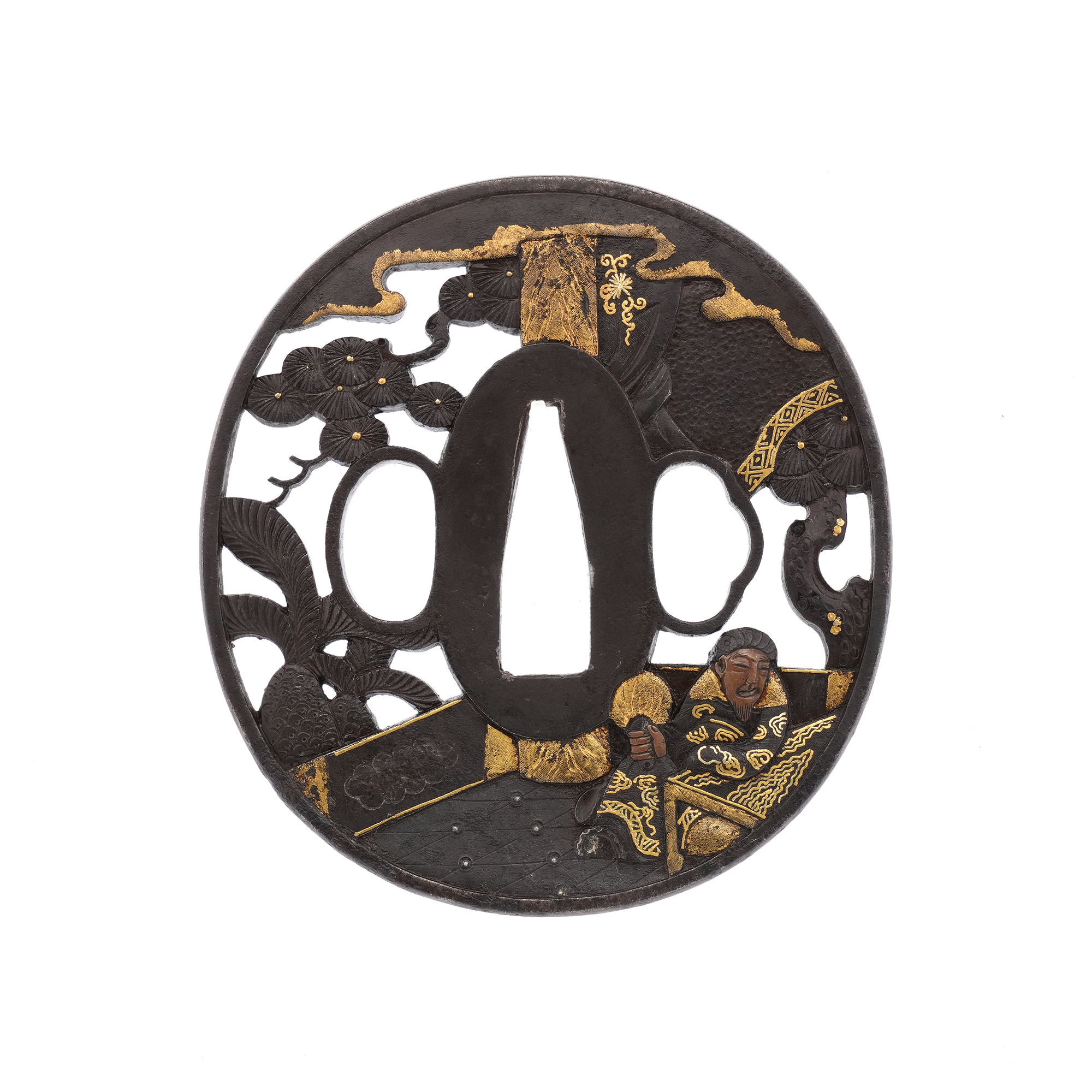
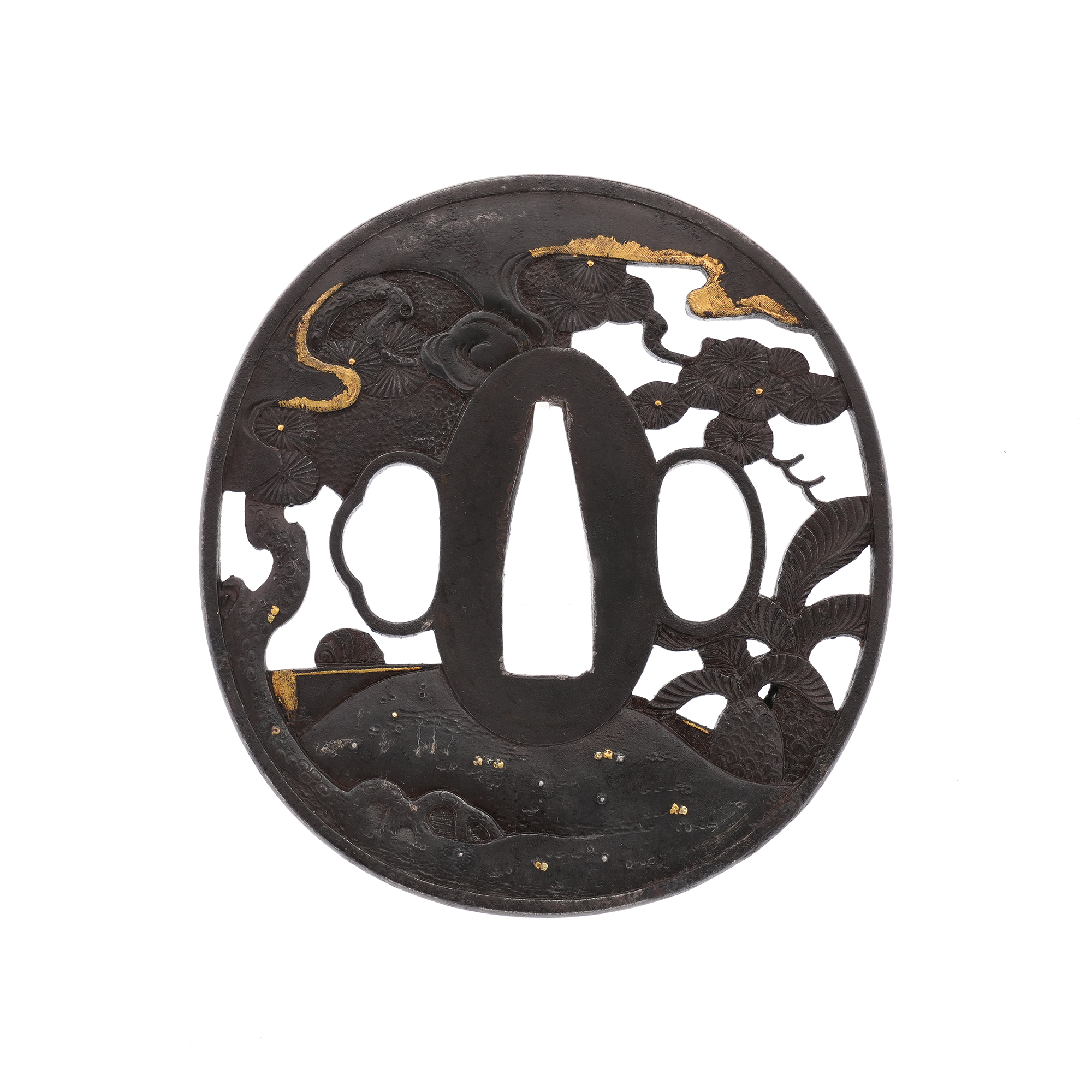
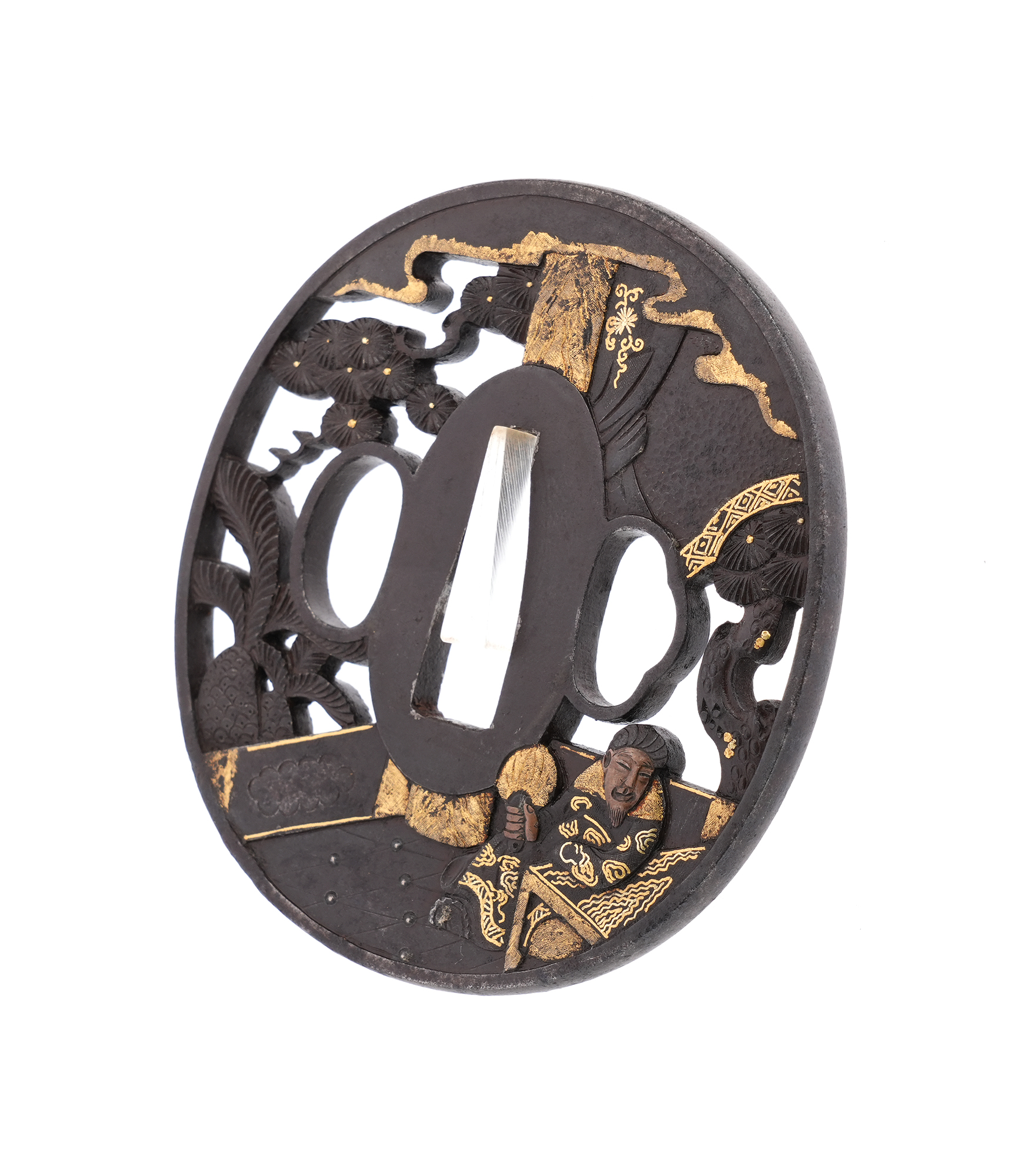
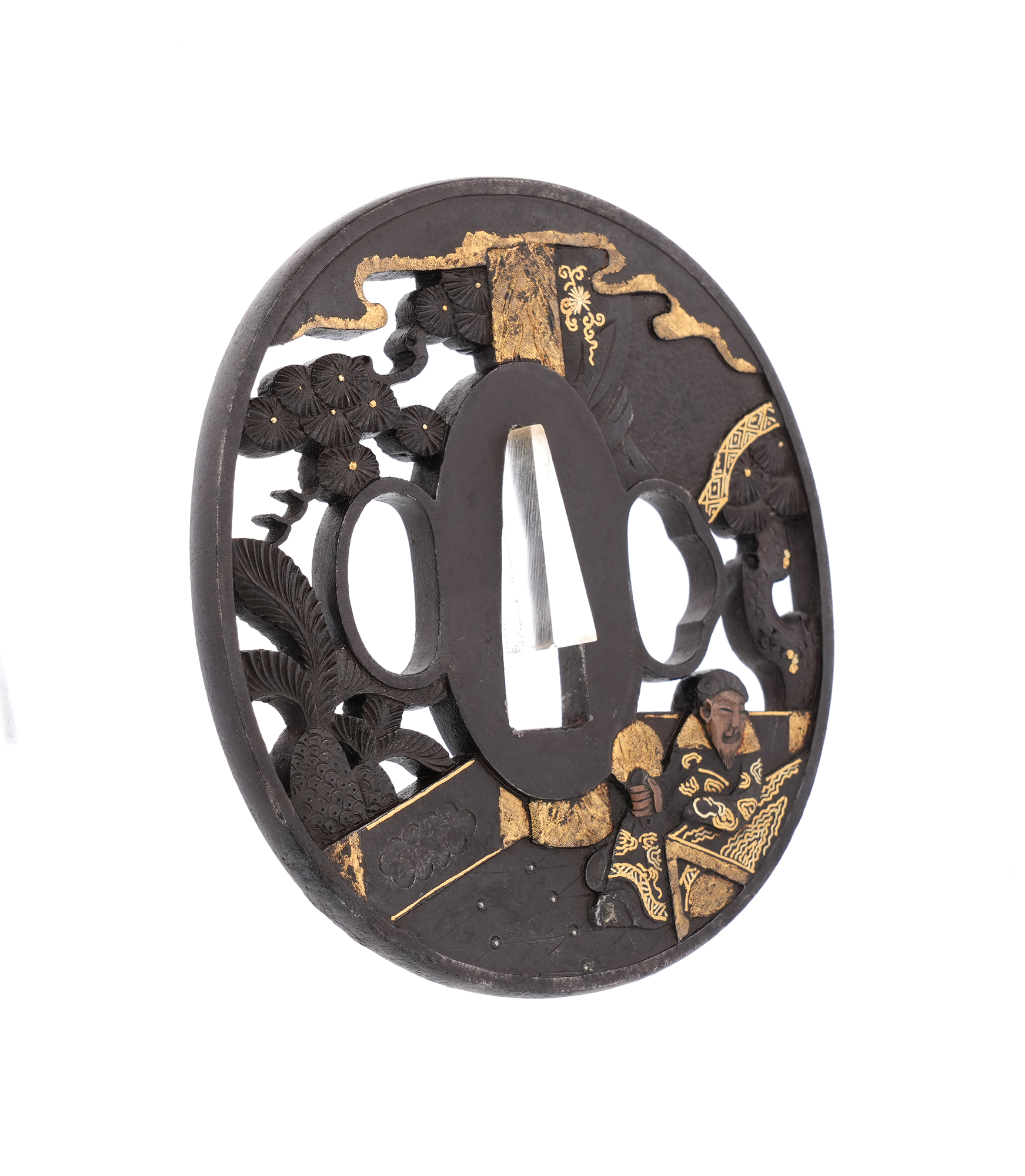
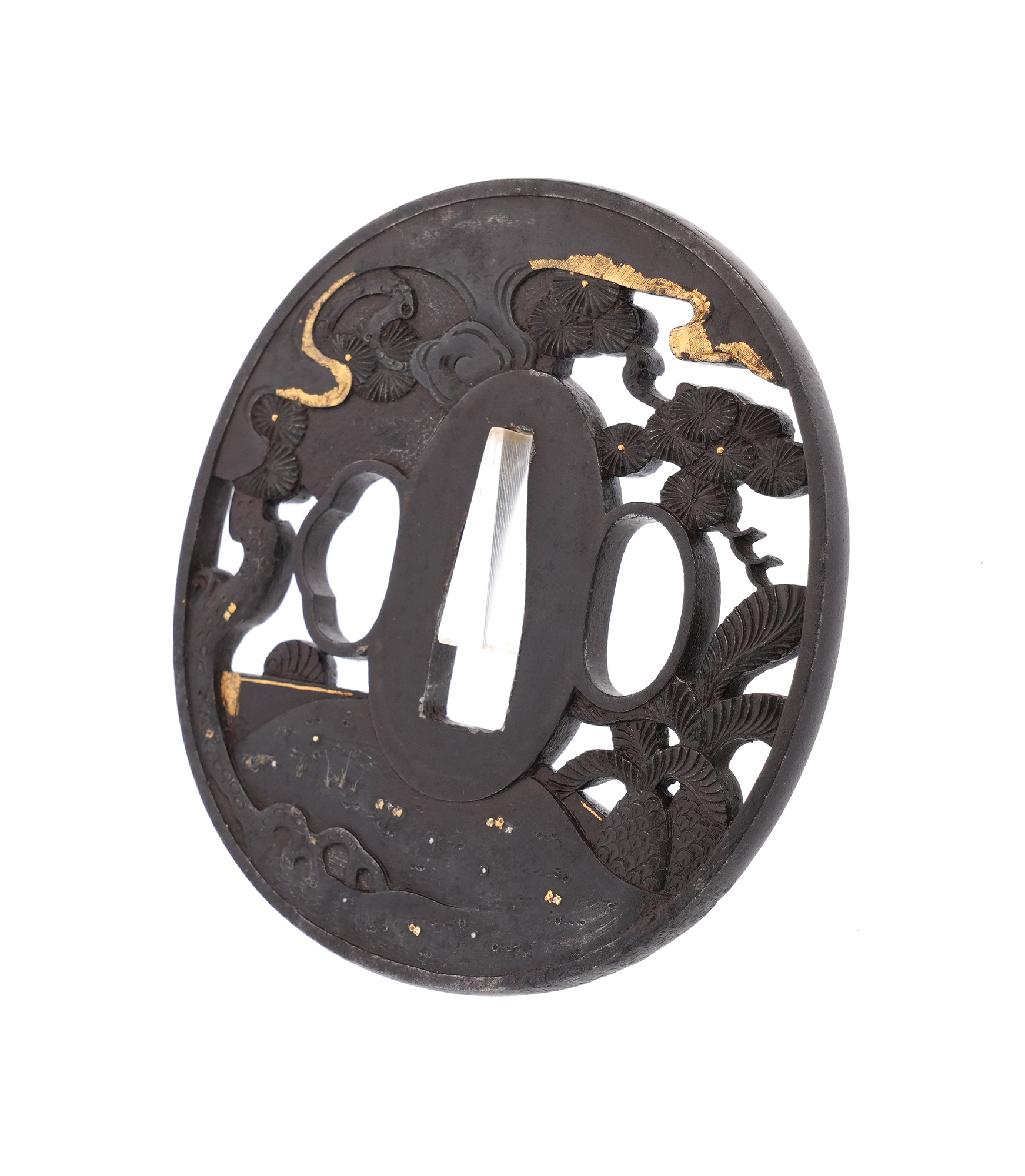
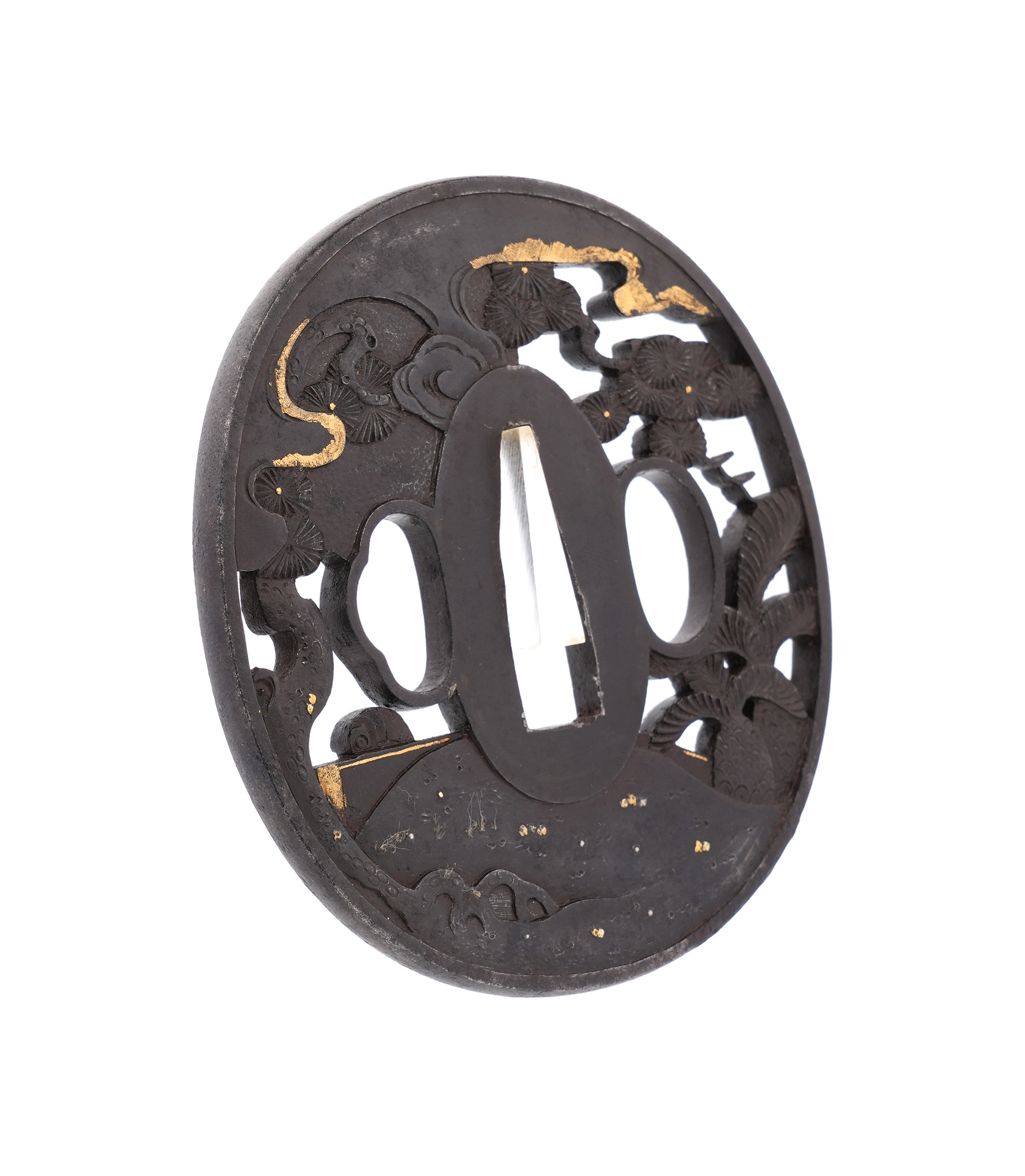
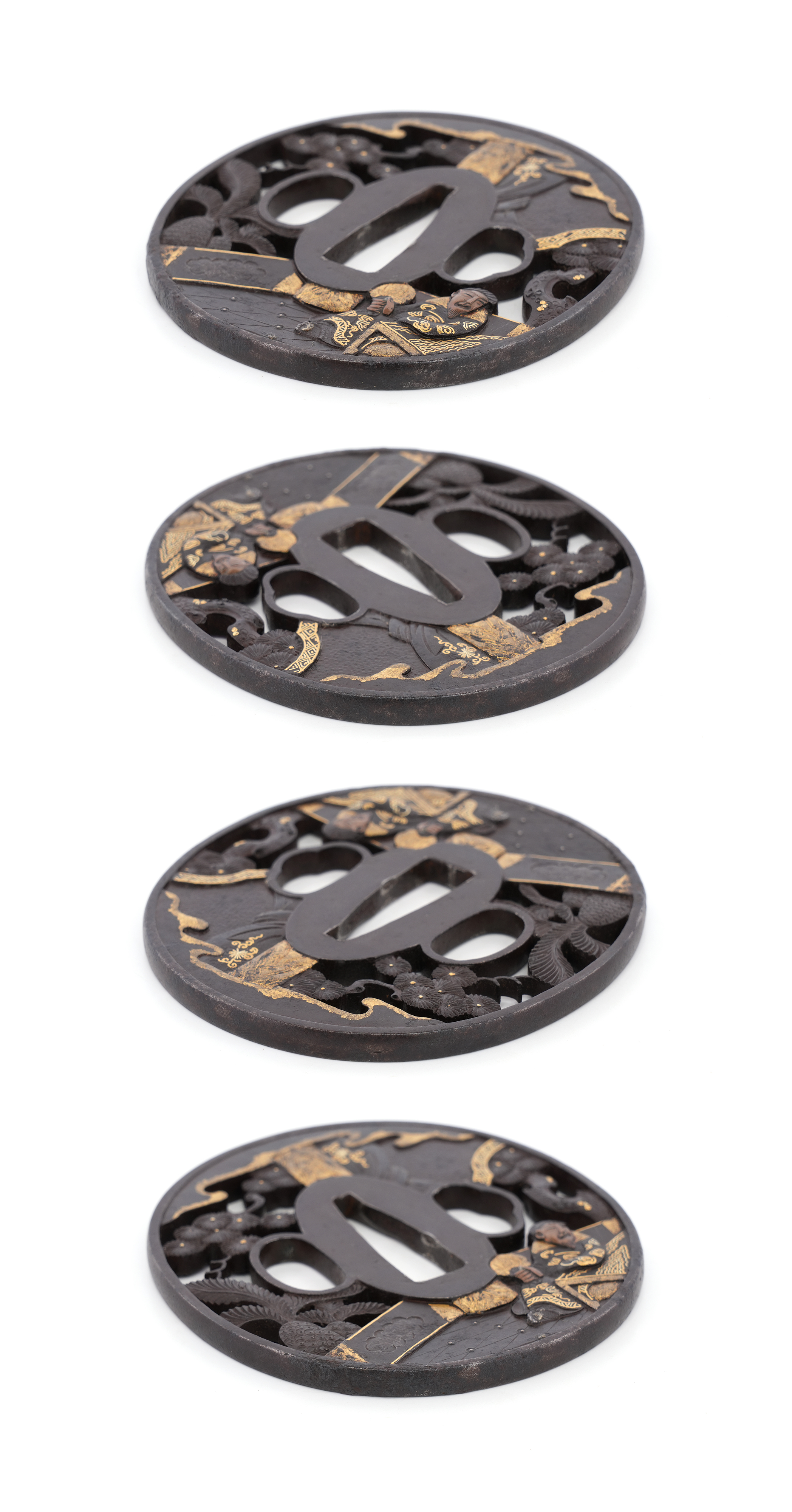
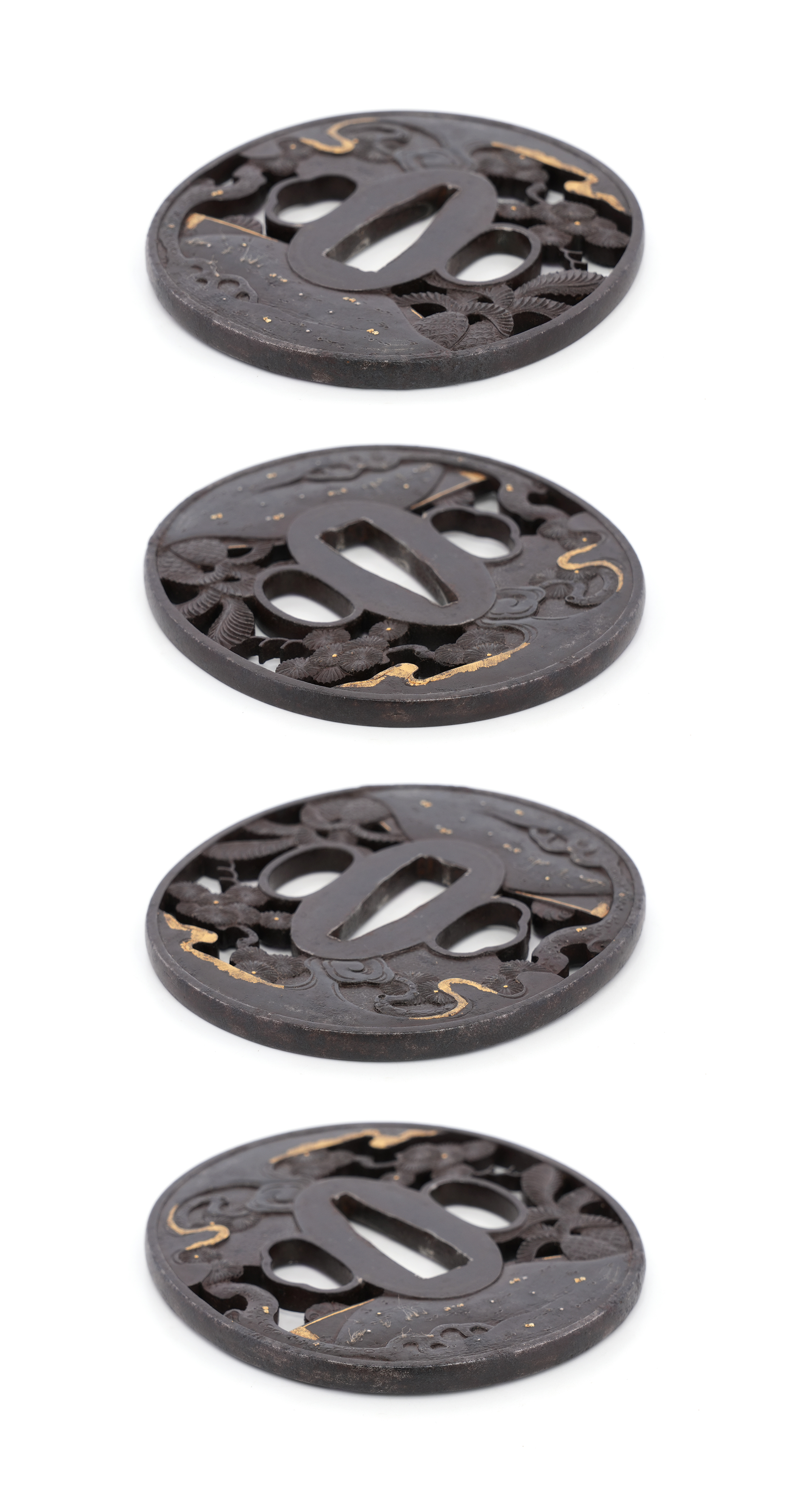
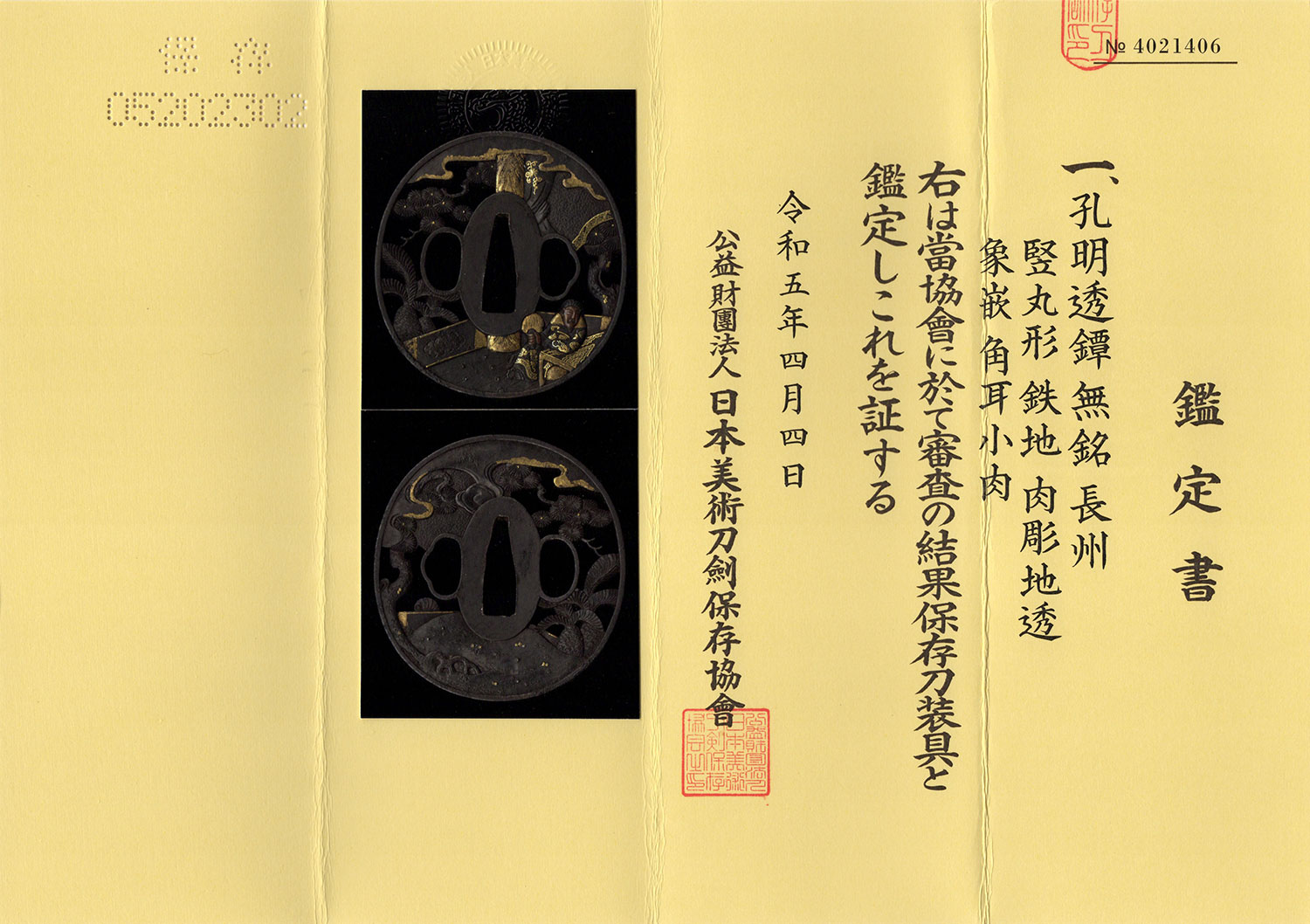
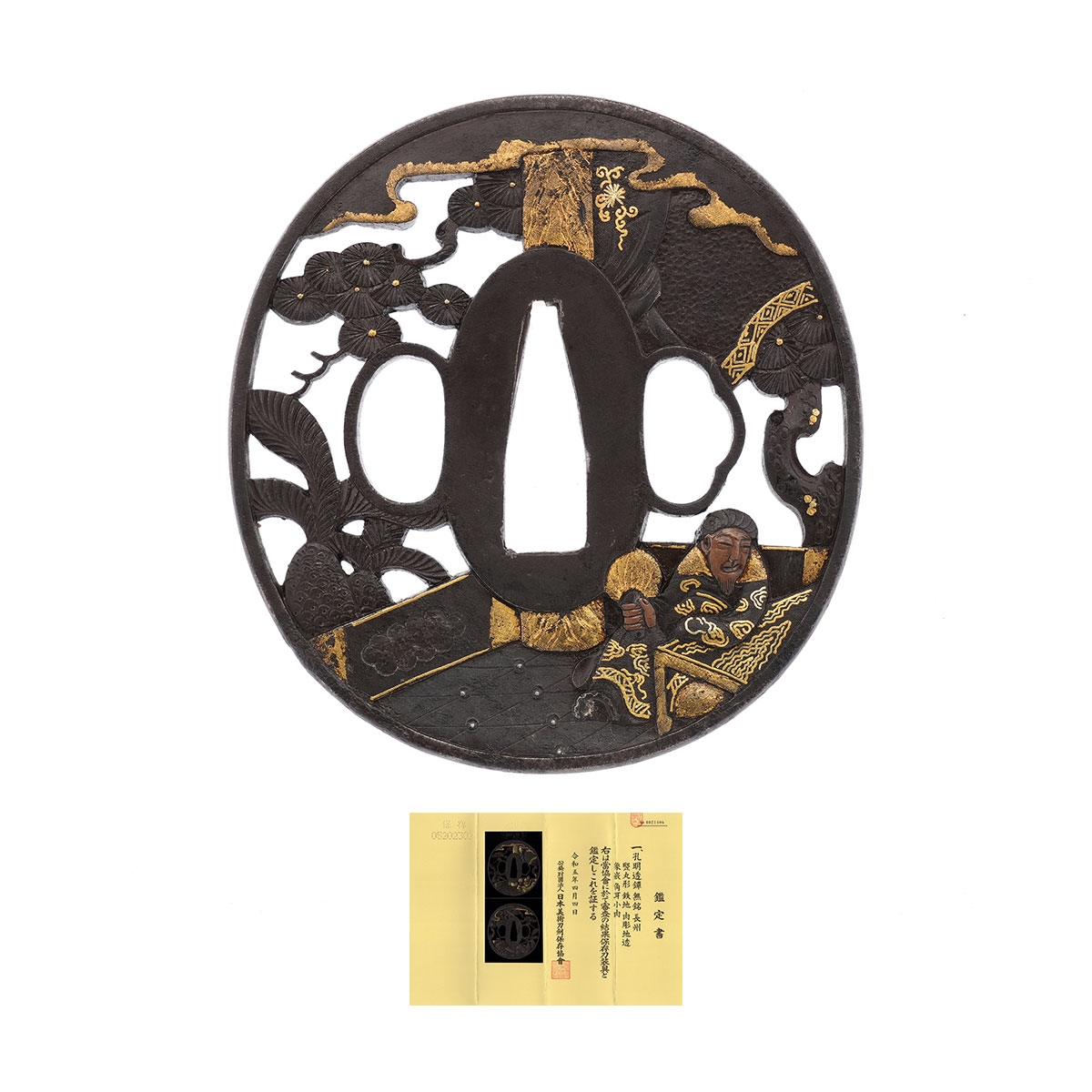
Zhuge Liang Kongming was a military strategist who served Shu Han during the Three Kingdoms period of China, revered as a distinguished minister possessing outstanding ingenuity and loyalty; his figure, contemplating with a usen in hand, is a motif symbolizing calm judgment and deep scholarship that has been frequently depicted in paintings as well as tosogu. Choshu tsuba were produced by a group of tsubako who flourished in Suo Province and Nagato Province, specializing in works that apply elaborate nikubori ji-sukashi to high-quality tetsu-ji, pictorially composing figures, sansui, vegetation, and historical events; this work is also attributed to Choshu by a Hozon Tosogu Kanteisho from the Nippon Bijutsu Token Hozon Kyokai. This work depicts Kongming seated with a usen in hand in nikubori on a kaku-maru gata tetsu-ji, arranging drifting clouds above, a pine tree with branches extending greatly from the right, and a shuro with spreading leaves at the lower left as ji-sukashi; furthermore, by passing pillars above and below the seppa-dai and depicting low walls and square shikigawara at the lower left and right, it richly portrays Kongming seated inside a building and the garden scenery spreading around him with great depth. Suwa-zogan is used for Kongming's face and hands, carefully depicting his finely groomed beard, gentle expression, and even the hand holding the usen, while kin-zogan is applied to the clothing, pillars, walls, and clouds, and dot-like gin-zogan is placed at the seams of the shikigawara forming the floor, causing the structure of the building and the figure of the person to emerge vividly within the blackish-brown tetsu-ji. The ura side does not depict a different scene, but is composed as the building and garden depicted on the omote viewed from the opposite side; the clouds flowing above, the pine tree with branches extending greatly from left to right, the shuro spreading its leaves on the right, and the gentle hill at the bottom continue from the motifs on the omote, forming a three-dimensional composition where one can appreciate the same space from different directions while moving between the omote and ura of the tsuba. The tetsu-ji with a thickness of 4.4 mm has a sufficient sense of volume, with the kaku-mimi featuring koniku and the large seppa-dai tightening the overall appearance; it is a piece where one can enjoy the pictorial quality and advanced carving techniques characteristic of Choshu tsuba in the skillful concept of depicting a single scene from both front and back using precise nikubori ji-sukashi and zogan of gold, silver, and suwa.
NihontoWatchOffered by Toushin
18 on the market

As written by the shop
Machine translation from the shop's Japanese · may contain errors ·
Iron-tsuba · Nagato
18 pieces on the market now
The tsuba-making traditions of Choshu domain (Nagato Province) trace their origins to the migration of Heianjo-sukashi openwork craftsmen from Kyoto, invited by the Ouchi family of Suo and Nagato during the Muromachi period. This transplanted lineage gave rise to the Ko-Hagi group, which flourished from the late Muromachi into the early Edo period and established a distinctive regional idiom in iron openwork. Under the subsequent patronage of the Mori clan, Choshu developed into one of Japan's foremost centres of tsuba production, earning the epithet that placed it alongside Aizu as the two great guard-making provinces: notable both for the number of artisans and the volume of work. Multiple lineages emerged — among them the Kawaji, Nakahara, Hatto, Okada, Okamoto, Kaneko, and Nakai — with Nakai Tomotsune (also known as Zensuke) achieving particular renown as a kakae-ko (retainer craftsman) of the Mori household, receiving a stipend from Horeki 8 (1758). The collective vocabulary of the Choshu tradition is grounded in iron: thin, carefully forged plates with rich surface character, including tsuchime-ji (hammered ground).
" The later Nakai school extended this foundation into a broader technical range, deploying sukidashi takabori high relief, kinzogan iroe (gold inlay with polychrome accents), shibuichi, and gold nunome-zogan in compositions of considerable ambition — naturalistic subjects such as frolicking tenaga-zaru monkeys and theatrical Shiki Samban scenes rendered with "taut, controlled modeling" and effective distribution of irogane colour metals. The Choshu tradition occupies a singular position within the tosogu canon as a regional milieu whose finest productions transcend mere provincial category. The NBTHK has recognised that the best works by Nakai Tomotsune surpass "what is ordinarily encompassed by the category of so-called Hagi tsuba,"[[c:1]] distinguished in composition, carving technique, and the character of the iron (tetsumi) alike[[c:2]]. At the same time, the Ko-Hagi group preserves an older and quieter aesthetic — rooted in the Kyoto openwork heritage yet transformed into something "not seen in other makers' work" — that testifies to the depth and continuity of metalworking practice in Nagato Province across several centuries. Learn more →
| Smith | Era | Designated |
|---|---|---|
| Tomonori友矩 | 1770-1800 | 0 |
| Tomohiro友広 | — | 0 |
| Tomotsune友恒 | 1670 | 2 |
| Nobushige信重 | 1781-1867 | 0 |
Certifies a genuine fitting worth preserving: a correct signature, or, if unsigned, an identifiable era and school, with recognized artistic and craft value.
The NBTHK (Nihon Bijutsu Tōken Hozon Kyōkai, the Society for the Preservation of Japanese Art Swords) is a public-interest incorporated foundation founded in 1948 and supervised by Japan’s Agency for Cultural Affairs (Bunkachō); it is based at the Japanese Sword Museum in Tokyo. Its expert panels physically examine each submitted work (shinsa) and issue a certificate (kanteishō) ranking it by artistic and historical merit. NBTHK papers are the most widely recognized standard of authentication for Japanese swords and fittings.
NBTHK official siteAs a rule we do not accept returns, except when we have sent a different item from the one ordered or when there is a significant discrepancy between the description and the item. If you wish to return an item, please contact us within 3 days of its arrival and then send it back.
¥297,000