Description

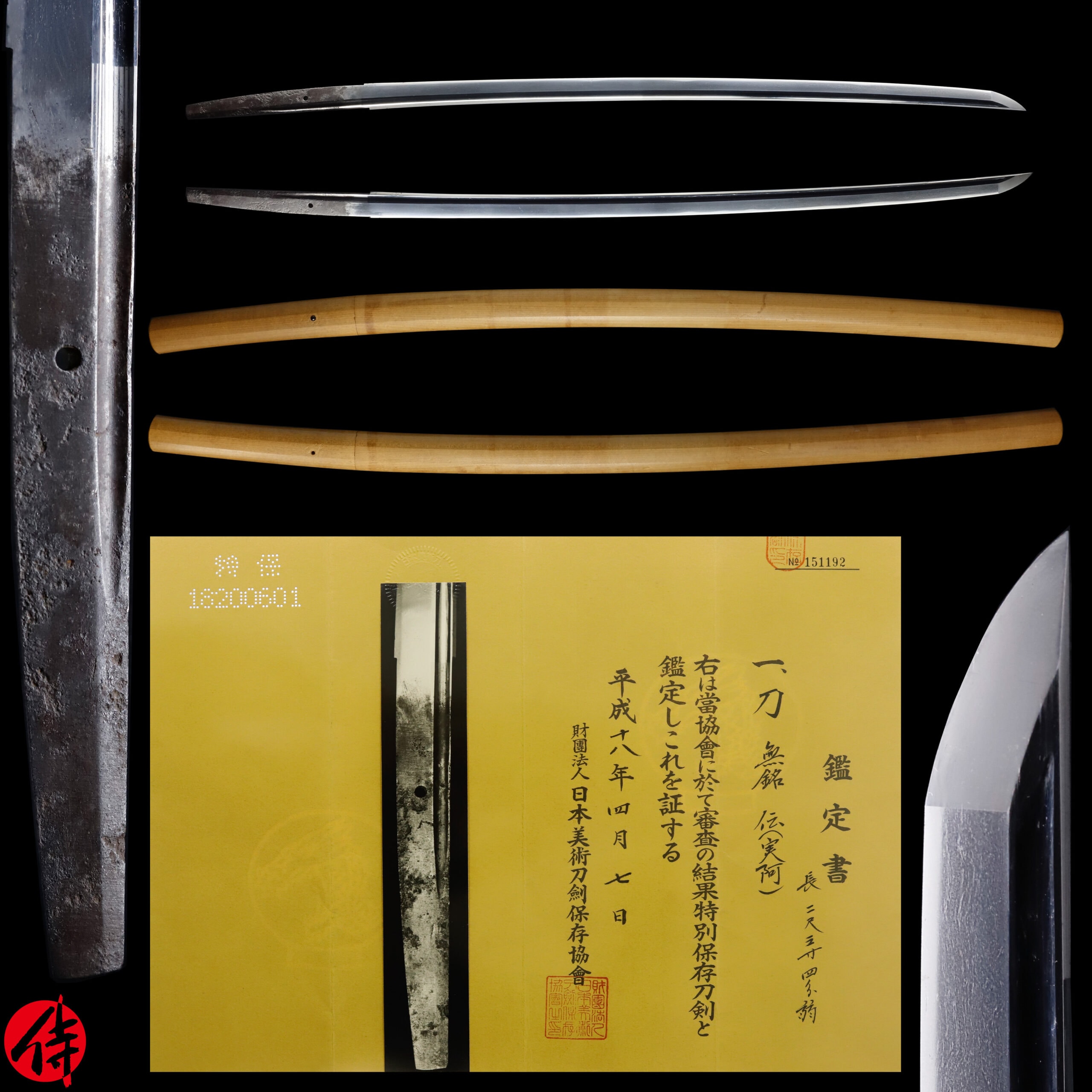
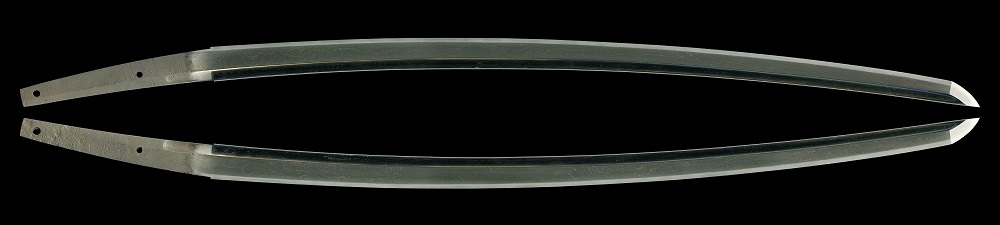
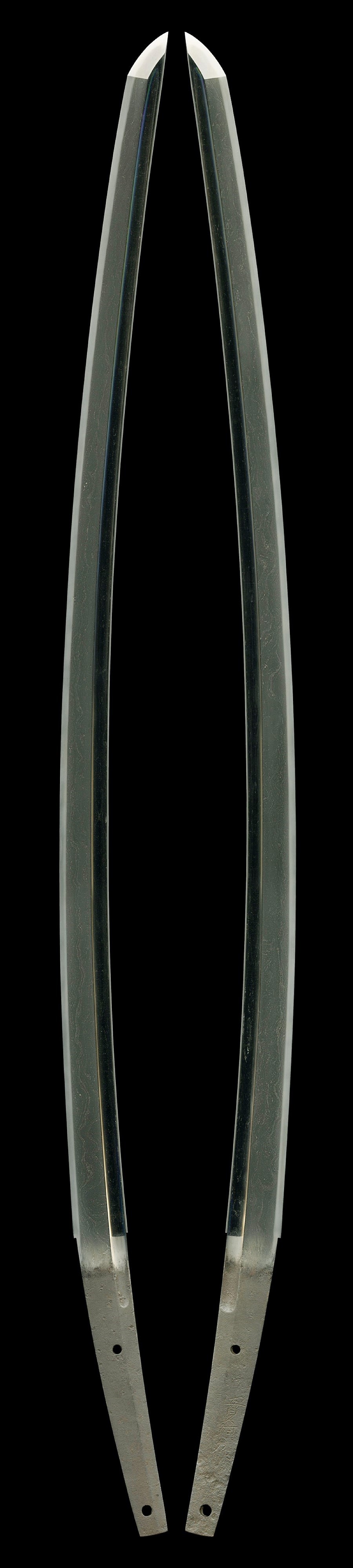
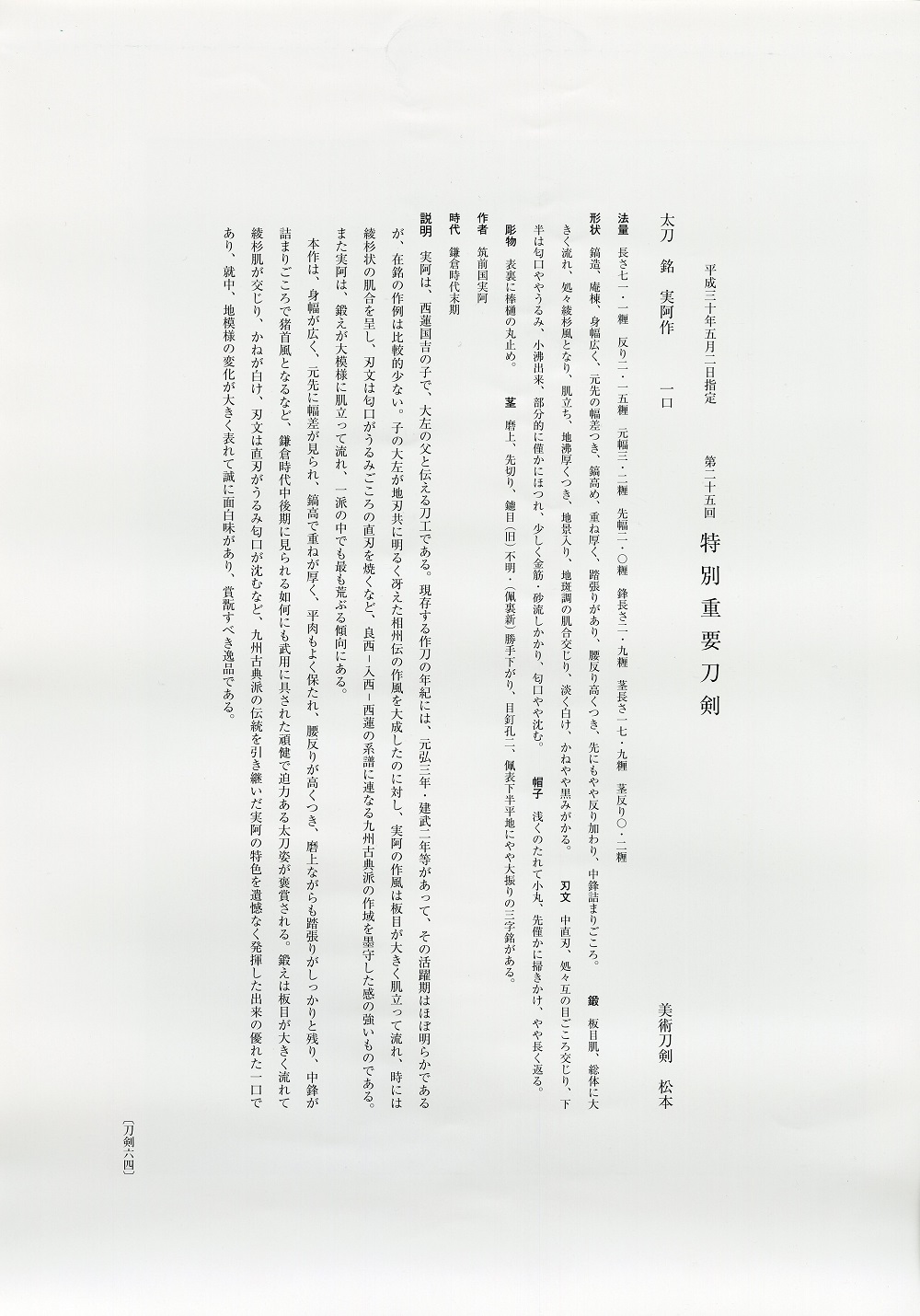
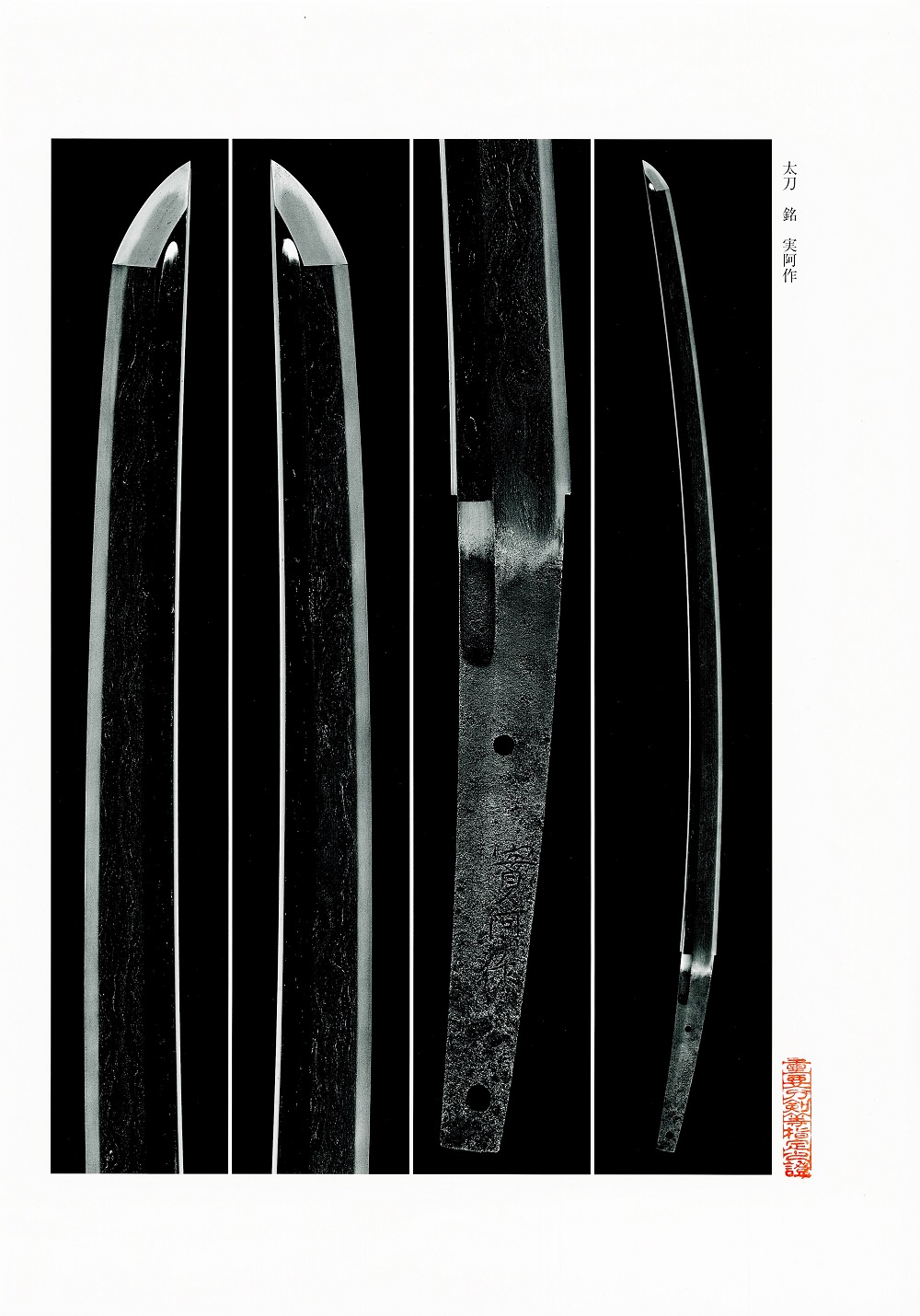
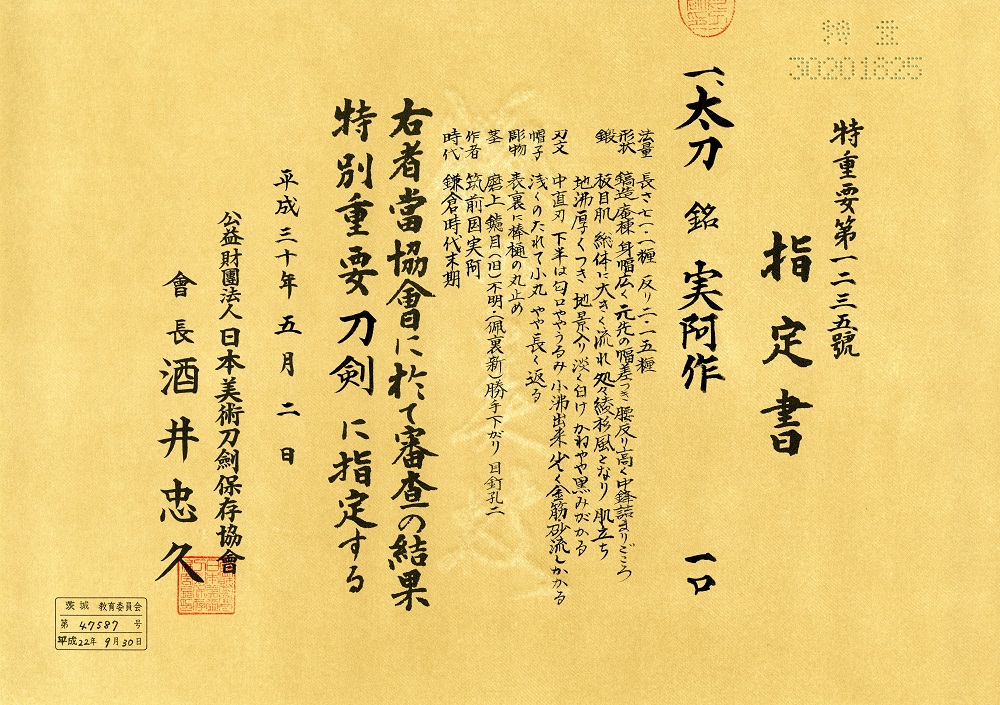
This is a katana signed by Sanetaka, said to have been handed down in the Kasama Makino family. It was designated as a Tokubetsu Juyo Token in the 25th session in 2018. The blade features a wide mihaba, deep sori, and a robust form characteristic of the late Kamakura period, with a prominent itame hada and a straight hamon with urumi nieguchi.

実阿作

実阿作

Katana

¥20,000,000

Tracked across 76 dealers worldwide · price history · sold archive

Specifications

Nagasa

71 cm

Sori

2.2 cm

Motohaba

3.3 cm

Sakihaba

2.1 cm

About the maker

Chikuzen Jitsua實阿

1 Jūyō Bunkazai2 Jūyō Bijutsuhin2 Tokubetsu Jūyō22 Jūyō Tōken

Jitsua of Chikuzen is dated by his own hand: tachi survive inscribed Genkō 3 (1333) and Kenmu 2 (1335), and a Kareki 2 (1327) sword drawing is recorded in the old swordbooks, so his period of activity is among the most securely fixed of his group. The published sources transmit him as the son of Sairen Kuniyoshi and the father of Ō-Sa, the prodigy Samonji, placing him at the hinge of the Kyūshū classical line just before it turned toward the bright Sōshū manner. He works within the tradition descending through Ryōsai, Nyūsai and Sairen, and the NBTHK reads his blades as adhering closely to that range, faithfully preserving, in their words, "the working domain of the Kyūshū classical group" (九州古典派の作域を墨守した). His characteristic hand is that classical Kyūshū manner carried to its most vigorous. The forging is a large *itame* mixed with *ō-itame* and *mokume* that stands out and flows into *nagare*, turning toward *masame* near the edge and, in his most distinctive pieces, taking on an *ayasugi*-like grain. The published sources single him out within the lineage as the roughest and most unruly forger, the one with "the strongest tendency in the group toward a vigorous, rough character" (一派の中で最も荒ぶる傾向にある); they note further that this standing, flowing *jigane* at times recalls the Naminohira of the same province. Over it he tempers a low or fine *suguha*, the *habuchi* fraying into *hotsure*, the published record characterizing his temper as a straight one in which "the *nioiguchi* tends toward *urumi*" (匂口がうるみごころの直刃を焼く), with *ko-nie* adhering and *sunagashi* and *kinsuji* running through. The *bōshi* runs straight with *hakikake* to a *ko-maru*, at times finishing as *yakitsume*. The *jigane* is the constant, and it is dark. Thick *ji-nie* scatters over the standing grain, *chikei* enter, and the steel takes on a blackish, iron tone over which a faint whitish *shirake-utsuri* rises along the *shinogi*. This is the Kyūshū *jigane*, distinct from the bright *midare-utsuri* of Bizen steel, and it stands together with the dark steel and the moist *nioiguchi* as the triad by which Jitsua is recognized. Where the forging tightens the *utsuri* grows clearer; where it loosens into the broad, flowing *ō-itame* the dark, rough character that the judges name as his comes forward. In both *ji* and *ha* the published commentary finds what one entry calls a "Kyūshū temperament" (九州物気質) of this period, distinct also from Yamato work, a regional coloration counted among the principal points of appreciation. His record divides naturally into two registers. On one side stands the small body of signed work, extremely few in number and the documentary anchor for the whole line: tachi, several broader in body than the slender constructions of Irinishi and Sairen, with thick *kasane*, strong *funbari* and a high *koshi-zori* even where shortened, alongside two slender signed tantō in orthodox *uchi-zori* form. What sets the signed pieces apart is the signature itself, a two- or three-character *mei* cut unusually large and bold near the *nakago-jiri*, the strokes ordinary in form but the characters far larger than usual, so bold that one Tokubetsu Jūyō entry calls it "large to a degree without parallel among other examples" (他に類がない程に大振り). On the other side stands the broad body of his record, the *ō-suriage mumei* katana and *naginata-naoshi* affirmed to him from era and school, in which the same forging and the same subdued straight temper appear. What separates Jitsua from his neighbours is exactly what the judges name. He is set apart from his quieter forebears Sairen and Nyūsai by his broader construction and his rougher, more flowing *jigane*; and he is held apart from his celebrated son by temper and steel alike, for where the published sources say "Ō-Sa perfected a Sōshū-den manner in which both *ji* and *ha* are bright and clear" (大左が地刃共に明るく冴えた相州伝の作風を大成した), Jitsua's own *suguha* stays low and subdued, the *nioiguchi* moist over a dark, standing *jigane*. His is the classical Kyūshū root from which that brilliance grew, and the judges read his blades as the very foundation from which the prodigy of the next generation would emerge. For the collector he is a rare early Kyūshū name. Fujishiro grades him Jō saku. He has no National Treasures; his record runs instead through one Important Cultural Property, the Tokubetsu Jūyō and Jūyō ranks, and the prewar Jūyō Bijutsuhin, with twenty-four blades in the Tokubetsu Jūyō and Jūyō tiers. Of recorded whereabouts his blades are preserved in long-held collections and institutions: the dignified signed tachi transmitted in the Uesugi family, others descending through the Shimazu and the Yanagawa Tachibana houses, a Jūyō Bijutsuhin held at the Sano Art Museum from the Ninomiya collection and another at the Kurokawa Institute, with further blades recorded at Kyoto National Museum and Atsuta Jingū. Signed work is the scarcer thing by far, the signed tantō scarcely to be found at all, so an in-mei Jitsua comes to light only seldom; even among the *ō-suriage mumei* attributions, most are held rather than traded, and a privately held example is a notable thing for a collector to encounter, a document of the Kyūshū hand from which Samonji was born.

Dealer

Touken Matsumoto

touken-matsumoto.jp

¥20,000,000

View on Touken Matsumoto