
NihontoWatch Mon

NihontoWatchBETA

MarketAuctions
Encyclopedia
NihontoWatch Mon

NihontoWatchBETA

MarketAuctions
Encyclopedia

Description

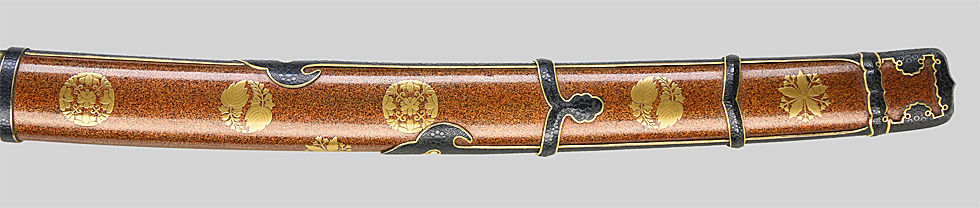
This is a magnificent Higo Itomaki Tachi Koshirae from the late Edo period, featuring a gold nashiji lacquer finish adorned with paulownia and cherry blossom motifs in gold makie. It comes with a long fukuwa saya (scabbard) and is attributed to the Hosokawa family. The koshirae has been designated as the 46th Juyo Tosogu by the NBTHK, indicating its exceptional quality and historical significance.

NihontoWatch MonNihontoWatchBETA
MarketAuctionsEncyclopedia
Fittings›Edo Period›Higo›Gold Nashiji with Paulownia and Cherry Blossom Makie Long Fukuwa Saya Higo Itomaki Tachi Koshirae (46th Juyo Tosogu)
koshiraeJūyō
Edo Period School

Gold Nashiji with Paulownia and Cherry Blossom Makie Long Fukuwa Saya Higo Itomaki Tachi Koshirae (46th Juyo Tosogu)

Edo

¥4,500,000
Visit seller website →
Edo Period School — 1 of 9
Edo Period School — 2 of 9
Edo Period School — 3 of 9
Edo Period School — 4 of 9
Edo Period School — 5 of 9
Edo Period School — 6 of 9
Edo Period School — 7 of 9
Edo Period School — 8 of 9
Edo Period School — 9 of 9
1 / 9
1 / 9
Edo Period School — 1 of 9Edo Period School — 2 of 9Edo Period School — 3 of 9Edo Period School — 4 of 9Edo Period School — 5 of 9Edo Period School — 6 of 9Edo Period School — 7 of 9Edo Period School — 8 of 9Edo Period School — 9 of 9
Measurements & details
Era

early Edo

Province

Higo

Papers

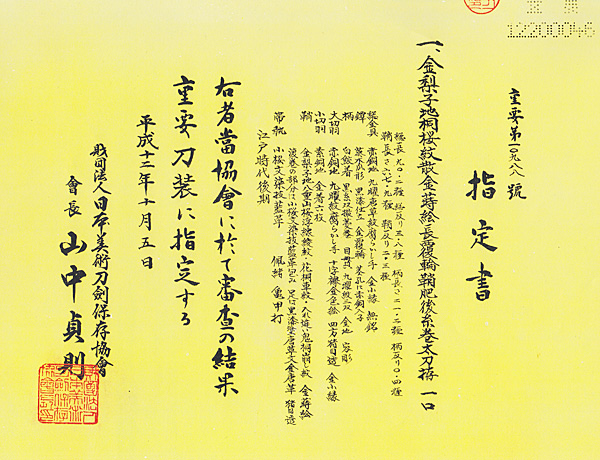
Jūyō #46 (NBTHK)

Description

This is a magnificent Higo Itomaki Tachi Koshirae from the late Edo period, featuring a gold nashiji lacquer finish adorned with paulownia and cherry blossom motifs in gold makie. It comes with a long fukuwa saya (scabbard) and is attributed to the Hosokawa family. The koshirae has been designated as the 46th Juyo Tosogu by the NBTHK, indicating its exceptional quality and historical significance.

Official Catalog Translation

Tokubetsu Juyo

-, 26th Session — Designated May 28, 2020

, with scattered crests in gold-shell and (金梨子地葵紋散金貝蒔絵鞘糸巻太刀拵)

by Shimada Nobuo (嶋田伸夫)

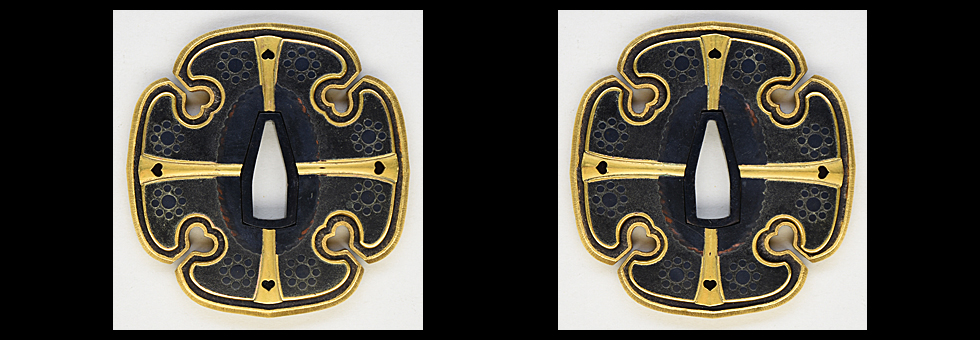
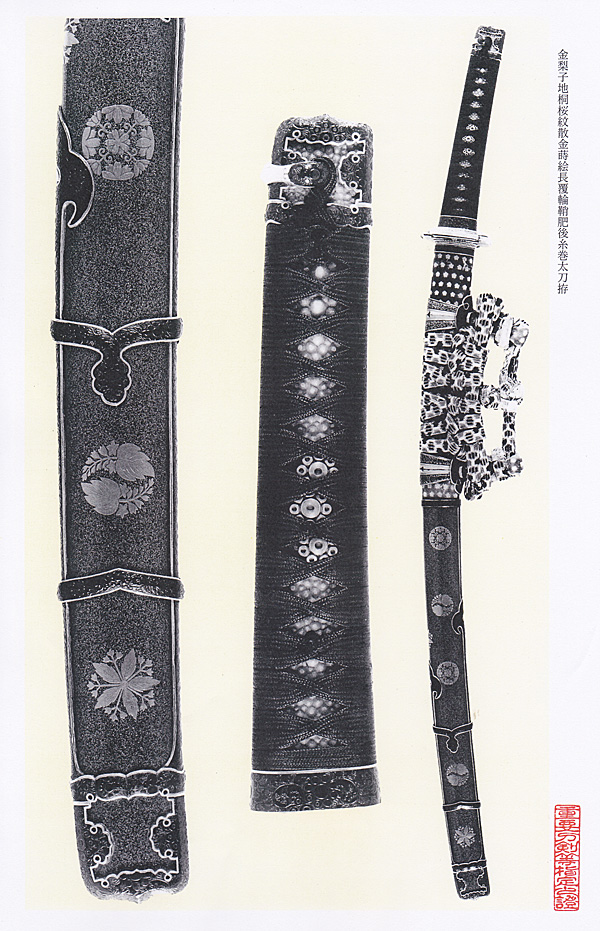
A formally appointed in which the () is dispersed across the entire ensemble. The mount combines sumptuous, courtly splendor—gold and gold-shell decoration on the scabbard—with orthodox Gotō-style fittings in enriched by high-relief carving and gold .

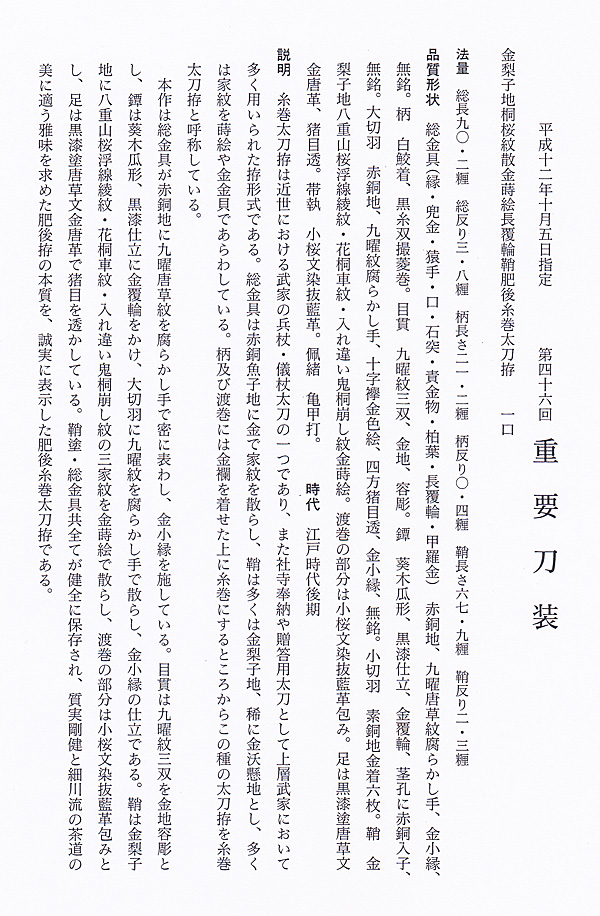
Measurements Total length: 98.0 cm; overall curvature (): 5.3 cm; hilt length: 23.2 cm; hilt curvature: 0.2 cm; scabbard length: 74.5 cm; scabbard curvature: 3.5 cm.

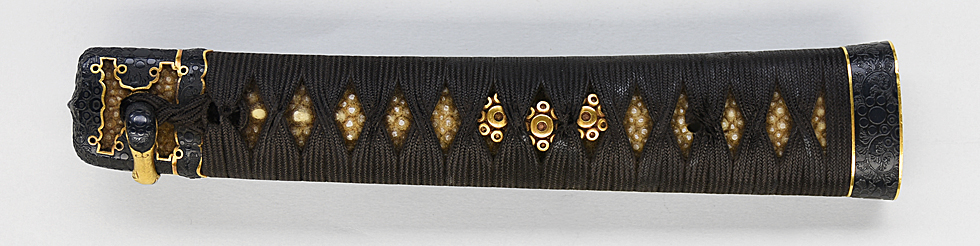
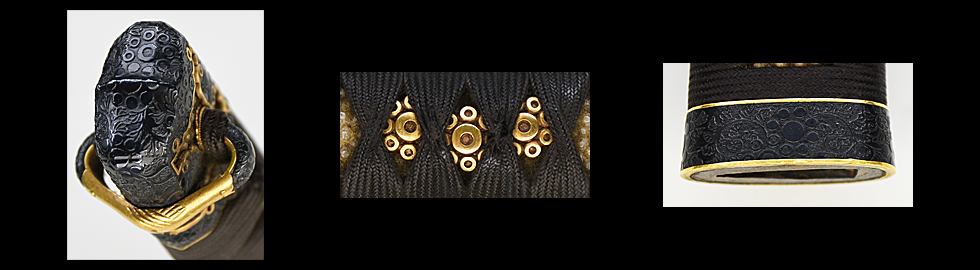
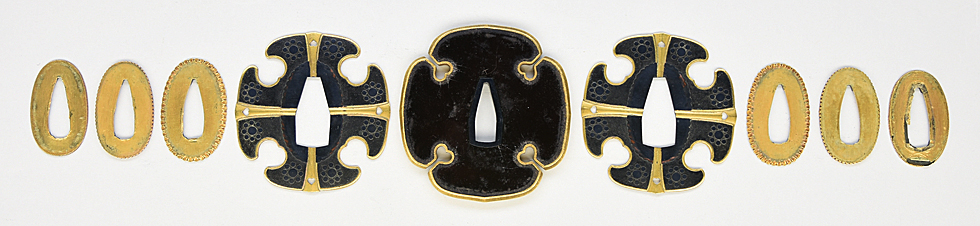
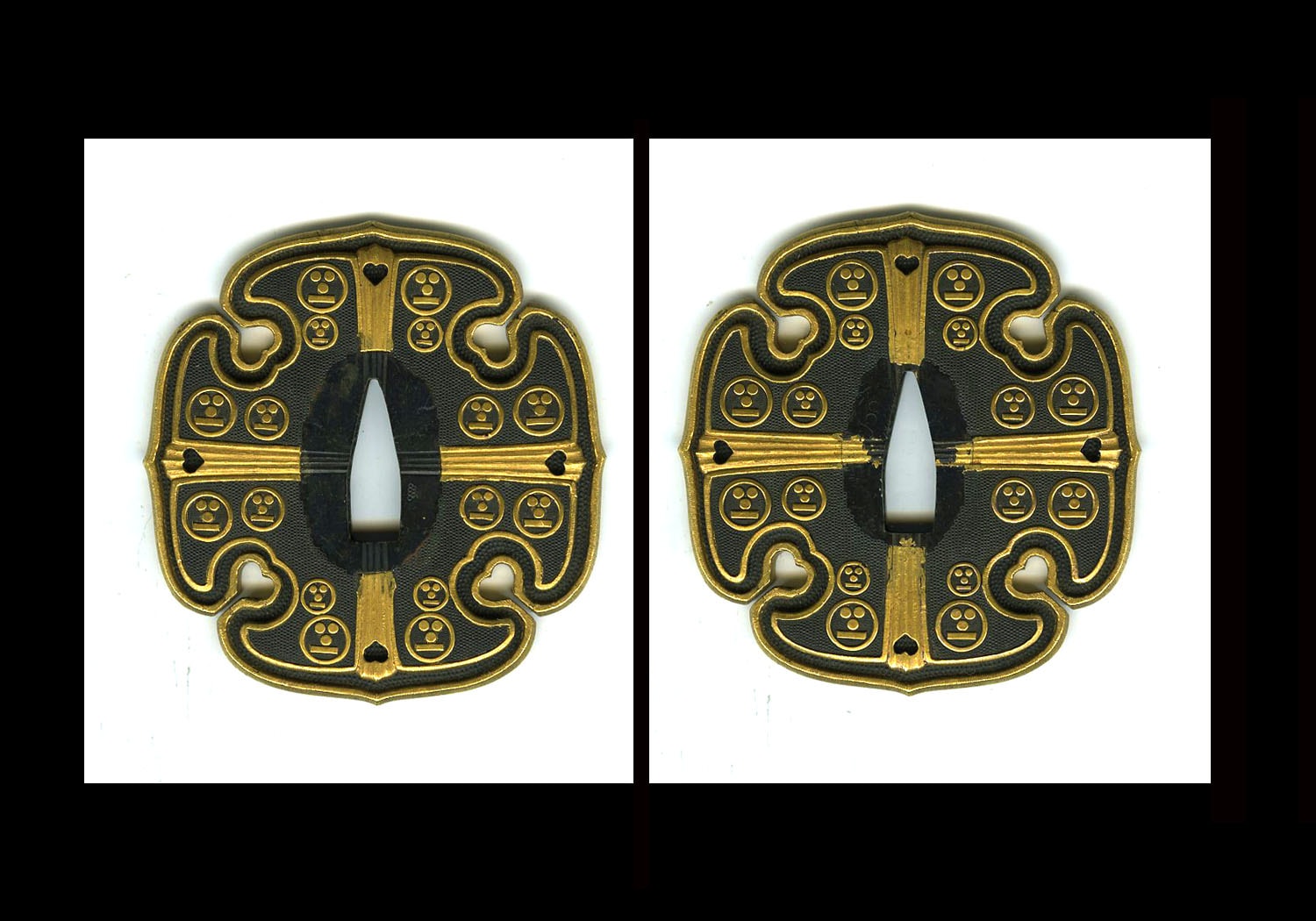
Components : Gold () ground, decorated with scattered crests executed in gold-shell () and (金梨子地葵紋散金貝蒔絵). : Covered in gold brocade () dyed kuchinashi (梔染金襴着); wrapped in flat wrap () with “shrimp-brown” (ebicha) cord (海老茶色糸平巻). The is made in the manner as the hilt wrapping (渡巻 柄巻に仕立同様). : Carved-in (kurikomi) shape (刳込葵木瓜形); with bucket-bottom, three-ridge rim treatment and gold (桶底三棟金色絵耳). Signed: Gotō Etsujō with (銘 後藤悦乗〔花押〕). : Included within the “overall fittings” (sō-kanagu): , , , , , and —all with scattered crests; ; with gold ; small gold rim (); unsigned (総金具…葵紋散図、赤銅魚子地、鋤出高彫、金色絵、金小縁、無銘). : Three pairs of crests; ; rounded relief carving (yōbori) with gold (目貫…赤銅魚子地、容彫、金色絵). /: Not mentioned. : Included within the “overall fittings” as the (石突). Other fittings: Two large : scattered crests; ; ; cross- undercut carving (十字襷鋤下彫); four-direction openwork; gold ; unsigned (大切羽二枚…無銘). Small : four with gold ground and two of ground (小切羽 金地四枚、赤銅地二枚). : crest design; round; ; yōbori with gold (太鼓金…). Belt fastener (obi-tori): indigo-dyed leather (帯執 藍染革). Suspension cord (): silk in white, purple, light green, and orange; tortoiseshell-pattern braid (kikkō-gumi) (佩緒…糸亀甲組). The interval between suspension mounts (ashima) is wrapped in (足間 金襴包).

Artisan/Origin* The guard is signed “Gotō Etsujō” with (後藤悦乗〔花押〕). Given this, it is inferred that the remaining fittings were likewise assembled as a coherent set by Etsujō.

Era Early period (江戸時代前期).

Explanation The is one of the early modern () forms of warrior-class ceremonial and procession mountings (heijō / gijō ). It was also widely employed among high-ranking samurai as mountings for presentation purposes and for dedication to shrines and temples. Typically, the complete suite of fittings (sō-kanagu) is executed in , with the family crest scattered in gold. The scabbard is finished in gold —more rarely in a fully gold-lacquered ground—and the crest is frequently expressed in and/or gold-shell decoration. Because the hilt and the are dressed in and then bound with cord wrapping (), this class of ceremonial mounting is termed .

Etsujō was the second son of Jōjō, who succeeded as the ninth head of the Gotō main line. Born in Kyoto in ’ei 19 (1642), he used the personal name Mitsukuni (光邦). He strengthened the Rihei family line, and received a stipend of 150 from the Maeda house. Alternating by year with Enjō of the Kanbee line, he resided in Kanazawa in Province, served the Maeda house, trained many pupils, and worked toward the development of metalwork. In later life he was granted a residence in Shitaya, , and together with the main family served the Tokugawa bakufu. He died at age sixty-seven in Hōei 5 (1708). He signed “Gotō Mitsukuni” with and “Gotō Etsujō” with . His workmanship adheres exclusively to the orthodox Gotō house style (o-ie-ryū), and his skill is in no way inferior to that of his father Jōjō.

This mounting is a formally correct (shikishō) unified by the crest: the complete fittings set employs the crest, and the gold scabbard is likewise adorned with crests in gold-shell and . Its manufacture is judged to date to the early period. Because the guard bears the signature of Gotō Etsujō with , the other fittings are also likely to have been organized as a set of his work. The scabbard’s gold-shell and are of high quality and possess refinement and dignity, producing a luxurious mounting commensurate with Etsujō’s fittings, a maker who contributed to the flourishing of the Gotō. The signature is also of high documentary value. In both fittings and scabbard, this is an elegant .

[Tōsō 44]

Source: Yuhinkai Catalog
About the school

Edo Period

江戸時代

Period-Attributed

›
0 recorded smiths296 designated works
Explore the Edo Period school →
NBTHK Certificate
Jūyō Tōken重要刀剣
Important Sword
›

A blade of top-grade workmanship and condition, formally judged to rank with a nationally recognized Important Art Object (Jūyō Bijutsuhin). Awarded only at the NBTHK’s competitive annual examination.

Of Japan’s roughly 2.5 million registered swords, only 12,358 (about 1 in 202) have ever attained Jūyō.

About the NBTHK›

The NBTHK (Nihon Bijutsu Tōken Hozon Kyōkai, the Society for the Preservation of Japanese Art Swords) is a public-interest incorporated foundation founded in 1948 and supervised by Japan’s Agency for Cultural Affairs (Bunkachō); it is based at the Japanese Sword Museum in Tokyo. Its expert panels physically examine each submitted work (shinsa) and issue a certificate (kanteishō) ranking it by artistic and historical merit. NBTHK papers are the most widely recognized standard of authentication for Japanese swords and fittings.

NBTHK official site→
Seller
T
Token-Net
Established 1981 · 45 yrs on the market
🇯🇵Ships from Japan
›
✓Verified dealertoken-net.com
Settles in JPY
✓Ships worldwideWire transferCredit card
Return policy

Within one week of the item's arrival (cooling-off is possible within Japan only). For defects that differ from the purchase conditions, we will accept the return and refund the payment. For other cases such as overseas, we will consult separately.

View all of Token-Net’s listings→View this item on the dealer’s site→

Previously sold — Edo Period School

Nihon Art
Koshirae - by Edo Period School - Daimyo Tachi Koshirae with Matching FittingsKoshirae - by Edo Period School - Daimyo Tachi Koshirae with Matching Fittings
Sold

Koshirae

ByEdo Period School
SOLD
Nihon Art
by Edo Period School - Sakai Clan Mon Koshiraeby Edo Period School - Sakai Clan Mon Koshirae
Sold

Sakai Clan Mon Koshirae

ByEdo Period School
SOLD

More from the Edo Period school

View all →
Giuseppe Piva
Jūyō
Koshirae - Jūyō - by Edo Period School - Kazari-tachi: Juyo TosoguKoshirae - Jūyō - by Edo Period School - Kazari-tachi: Juyo Tosogu

Koshirae

ByEdo Period School
Ask
Nihonto.com
Jūyō
Koshirae - Jūyō - by Edo Period School - Daimyo Juyo Tachi KoshiraeKoshirae - Jūyō - by Edo Period School - Daimyo Juyo Tachi Koshirae

Koshirae

ByEdo Period School
¥35,500

Swords

  • Katana
  • Wakizashi
  • Tantō
  • Tachi
  • Naginata
  • Yari

Fittings

  • Tsuba
  • Fuchi-Kashira
  • Kozuka
  • Menuki

By Certification

  • Tokujū
  • Jūyō
  • Tokuho
  • Hozon

Resources

  • Dealer Directory
  • Artist Directory
  • Glossary
  • Browse All
Nihontowatch© 2026
TermsPrivacyCookies

Description

This is a magnificent Higo Itomaki Tachi Koshirae from the late Edo period, featuring a gold nashiji lacquer finish adorned with paulownia and cherry blossom motifs in gold makie. It comes with a long fukuwa saya (scabbard) and is attributed to the Hosokawa family. The koshirae has been designated as the 46th Juyo Tosogu by the NBTHK, indicating its exceptional quality and historical significance.

NihontoWatch MonNihontoWatchBETA
MarketAuctionsEncyclopedia
Fittings›Edo Period›Higo›Gold Nashiji with Paulownia and Cherry Blossom Makie Long Fukuwa Saya Higo Itomaki Tachi Koshirae (46th Juyo Tosogu)
koshiraeJūyō
Edo Period School

Gold Nashiji with Paulownia and Cherry Blossom Makie Long Fukuwa Saya Higo Itomaki Tachi Koshirae (46th Juyo Tosogu)

Edo

¥4,500,000
Visit seller website →
Edo Period School — 1 of 9
Edo Period School — 2 of 9
Edo Period School — 3 of 9
Edo Period School — 4 of 9
Edo Period School — 5 of 9
Edo Period School — 6 of 9
Edo Period School — 7 of 9
Edo Period School — 8 of 9
Edo Period School — 9 of 9
1 / 9
1 / 9
Edo Period School — 1 of 9Edo Period School — 2 of 9Edo Period School — 3 of 9Edo Period School — 4 of 9Edo Period School — 5 of 9Edo Period School — 6 of 9Edo Period School — 7 of 9Edo Period School — 8 of 9Edo Period School — 9 of 9
Measurements & details
Era

early Edo

Province

Higo

Papers

Jūyō #46 (NBTHK)

Description

This is a magnificent Higo Itomaki Tachi Koshirae from the late Edo period, featuring a gold nashiji lacquer finish adorned with paulownia and cherry blossom motifs in gold makie. It comes with a long fukuwa saya (scabbard) and is attributed to the Hosokawa family. The koshirae has been designated as the 46th Juyo Tosogu by the NBTHK, indicating its exceptional quality and historical significance.

Official Catalog Translation

Tokubetsu Juyo

-, 26th Session — Designated May 28, 2020

, with scattered crests in gold-shell and (金梨子地葵紋散金貝蒔絵鞘糸巻太刀拵)

by Shimada Nobuo (嶋田伸夫)

A formally appointed in which the () is dispersed across the entire ensemble. The mount combines sumptuous, courtly splendor—gold and gold-shell decoration on the scabbard—with orthodox Gotō-style fittings in enriched by high-relief carving and gold .

Measurements Total length: 98.0 cm; overall curvature (): 5.3 cm; hilt length: 23.2 cm; hilt curvature: 0.2 cm; scabbard length: 74.5 cm; scabbard curvature: 3.5 cm.

Components : Gold () ground, decorated with scattered crests executed in gold-shell () and (金梨子地葵紋散金貝蒔絵). : Covered in gold brocade () dyed kuchinashi (梔染金襴着); wrapped in flat wrap () with “shrimp-brown” (ebicha) cord (海老茶色糸平巻). The is made in the manner as the hilt wrapping (渡巻 柄巻に仕立同様). : Carved-in (kurikomi) shape (刳込葵木瓜形); with bucket-bottom, three-ridge rim treatment and gold (桶底三棟金色絵耳). Signed: Gotō Etsujō with (銘 後藤悦乗〔花押〕). : Included within the “overall fittings” (sō-kanagu): , , , , , and —all with scattered crests; ; with gold ; small gold rim (); unsigned (総金具…葵紋散図、赤銅魚子地、鋤出高彫、金色絵、金小縁、無銘). : Three pairs of crests; ; rounded relief carving (yōbori) with gold (目貫…赤銅魚子地、容彫、金色絵). /: Not mentioned. : Included within the “overall fittings” as the (石突). Other fittings: Two large : scattered crests; ; ; cross- undercut carving (十字襷鋤下彫); four-direction openwork; gold ; unsigned (大切羽二枚…無銘). Small : four with gold ground and two of ground (小切羽 金地四枚、赤銅地二枚). : crest design; round; ; yōbori with gold (太鼓金…). Belt fastener (obi-tori): indigo-dyed leather (帯執 藍染革). Suspension cord (): silk in white, purple, light green, and orange; tortoiseshell-pattern braid (kikkō-gumi) (佩緒…糸亀甲組). The interval between suspension mounts (ashima) is wrapped in (足間 金襴包).

Artisan/Origin* The guard is signed “Gotō Etsujō” with (後藤悦乗〔花押〕). Given this, it is inferred that the remaining fittings were likewise assembled as a coherent set by Etsujō.

Era Early period (江戸時代前期).

Explanation The is one of the early modern () forms of warrior-class ceremonial and procession mountings (heijō / gijō ). It was also widely employed among high-ranking samurai as mountings for presentation purposes and for dedication to shrines and temples. Typically, the complete suite of fittings (sō-kanagu) is executed in , with the family crest scattered in gold. The scabbard is finished in gold —more rarely in a fully gold-lacquered ground—and the crest is frequently expressed in and/or gold-shell decoration. Because the hilt and the are dressed in and then bound with cord wrapping (), this class of ceremonial mounting is termed .

Etsujō was the second son of Jōjō, who succeeded as the ninth head of the Gotō main line. Born in Kyoto in ’ei 19 (1642), he used the personal name Mitsukuni (光邦). He strengthened the Rihei family line, and received a stipend of 150 from the Maeda house. Alternating by year with Enjō of the Kanbee line, he resided in Kanazawa in Province, served the Maeda house, trained many pupils, and worked toward the development of metalwork. In later life he was granted a residence in Shitaya, , and together with the main family served the Tokugawa bakufu. He died at age sixty-seven in Hōei 5 (1708). He signed “Gotō Mitsukuni” with and “Gotō Etsujō” with . His workmanship adheres exclusively to the orthodox Gotō house style (o-ie-ryū), and his skill is in no way inferior to that of his father Jōjō.

This mounting is a formally correct (shikishō) unified by the crest: the complete fittings set employs the crest, and the gold scabbard is likewise adorned with crests in gold-shell and . Its manufacture is judged to date to the early period. Because the guard bears the signature of Gotō Etsujō with , the other fittings are also likely to have been organized as a set of his work. The scabbard’s gold-shell and are of high quality and possess refinement and dignity, producing a luxurious mounting commensurate with Etsujō’s fittings, a maker who contributed to the flourishing of the Gotō. The signature is also of high documentary value. In both fittings and scabbard, this is an elegant .

[Tōsō 44]
Source: Yuhinkai Catalog
About the school

Edo Period

江戸時代

Period-Attributed

›
0 recorded smiths296 designated works
Explore the Edo Period school →
NBTHK Certificate
Jūyō Tōken重要刀剣
Important Sword
›

A blade of top-grade workmanship and condition, formally judged to rank with a nationally recognized Important Art Object (Jūyō Bijutsuhin). Awarded only at the NBTHK’s competitive annual examination.

Of Japan’s roughly 2.5 million registered swords, only 12,358 (about 1 in 202) have ever attained Jūyō.

About the NBTHK›

The NBTHK (Nihon Bijutsu Tōken Hozon Kyōkai, the Society for the Preservation of Japanese Art Swords) is a public-interest incorporated foundation founded in 1948 and supervised by Japan’s Agency for Cultural Affairs (Bunkachō); it is based at the Japanese Sword Museum in Tokyo. Its expert panels physically examine each submitted work (shinsa) and issue a certificate (kanteishō) ranking it by artistic and historical merit. NBTHK papers are the most widely recognized standard of authentication for Japanese swords and fittings.

NBTHK official site→
Seller
T
Token-Net
Established 1981 · 45 yrs on the market
🇯🇵Ships from Japan
›
✓Verified dealertoken-net.com
Settles in JPY
✓Ships worldwideWire transferCredit card
Return policy

Within one week of the item's arrival (cooling-off is possible within Japan only). For defects that differ from the purchase conditions, we will accept the return and refund the payment. For other cases such as overseas, we will consult separately.

View all of Token-Net’s listings→View this item on the dealer’s site→

Previously sold — Edo Period School

Nihon Art
Koshirae - by Edo Period School - Daimyo Tachi Koshirae with Matching FittingsKoshirae - by Edo Period School - Daimyo Tachi Koshirae with Matching Fittings
Sold

Koshirae

ByEdo Period School
SOLD
Nihon Art
by Edo Period School - Sakai Clan Mon Koshiraeby Edo Period School - Sakai Clan Mon Koshirae
Sold

Sakai Clan Mon Koshirae

ByEdo Period School
SOLD

More from the Edo Period school

View all →
Giuseppe Piva
Jūyō
Koshirae - Jūyō - by Edo Period School - Kazari-tachi: Juyo TosoguKoshirae - Jūyō - by Edo Period School - Kazari-tachi: Juyo Tosogu

Koshirae

ByEdo Period School
Ask
Nihonto.com
Jūyō
Koshirae - Jūyō - by Edo Period School - Daimyo Juyo Tachi KoshiraeKoshirae - Jūyō - by Edo Period School - Daimyo Juyo Tachi Koshirae

Koshirae

ByEdo Period School
¥35,500

Swords

  • Katana
  • Wakizashi
  • Tantō
  • Tachi
  • Naginata
  • Yari

Fittings

  • Tsuba
  • Fuchi-Kashira
  • Kozuka
  • Menuki

By Certification

  • Tokujū
  • Jūyō
  • Tokuho
  • Hozon

Resources

  • Dealer Directory
  • Artist Directory
  • Glossary
  • Browse All
Nihontowatch© 2026
TermsPrivacyCookies
NihontoWatch Mon

NihontoWatchBETA

MarketAuctions
Encyclopedia
NihontoWatch Mon

NihontoWatchBETA

MarketAuctions
Encyclopedia