NihontoWatch MonNihontoWatch
Market
Encyclopedia
Kantei
NihontoWatch MonNihontoWatch
Market
Encyclopedia
Kantei

Description

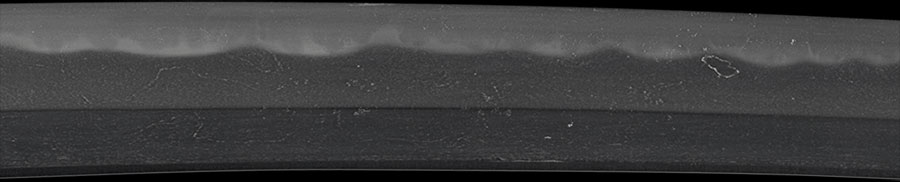
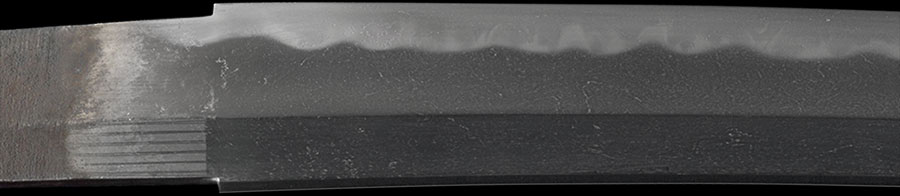
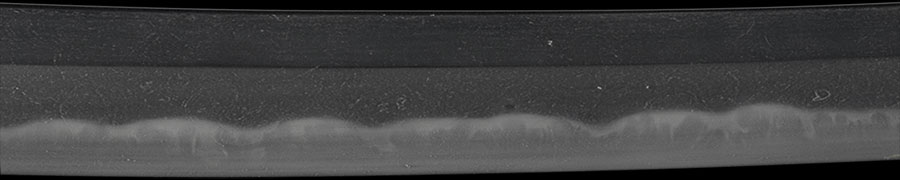
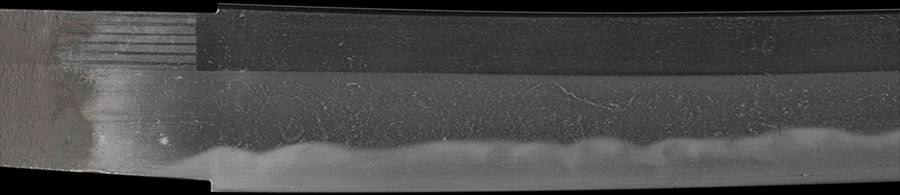
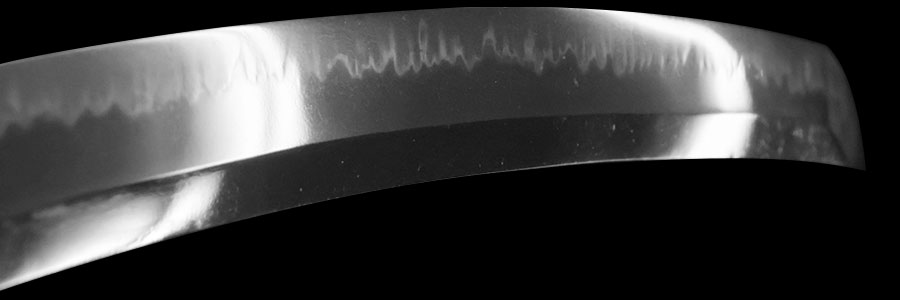
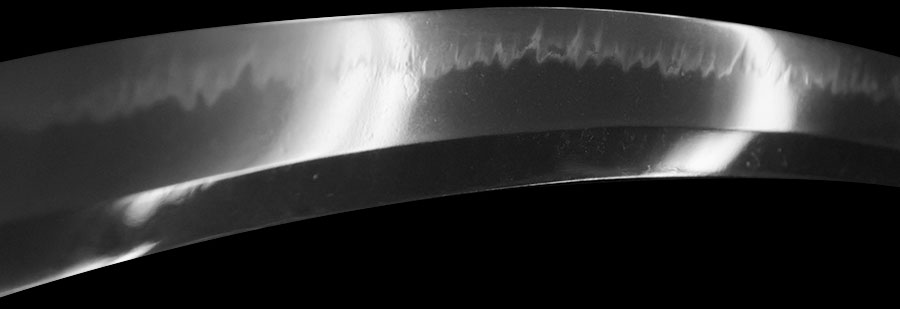
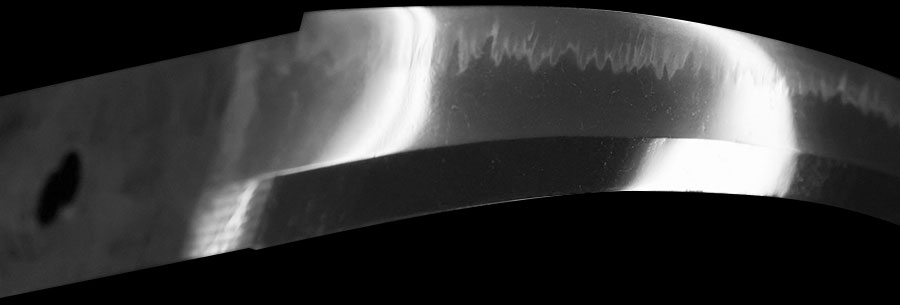
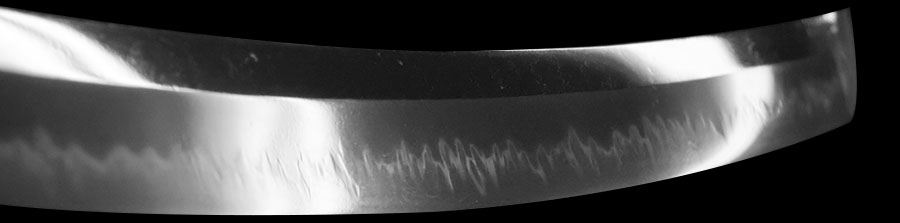
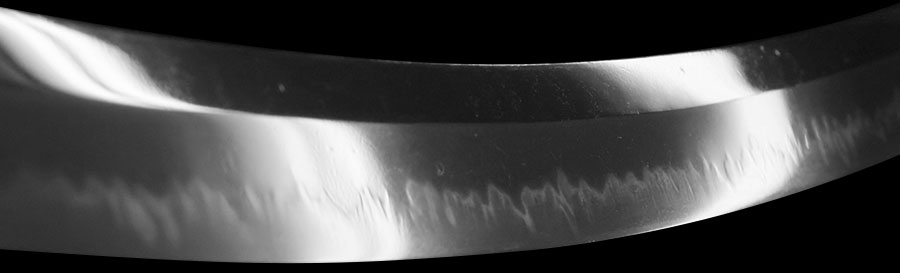
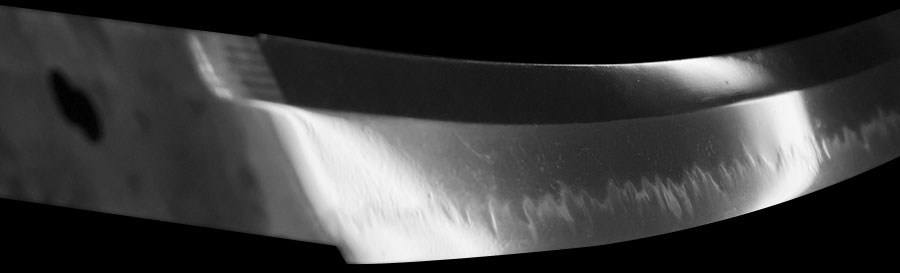
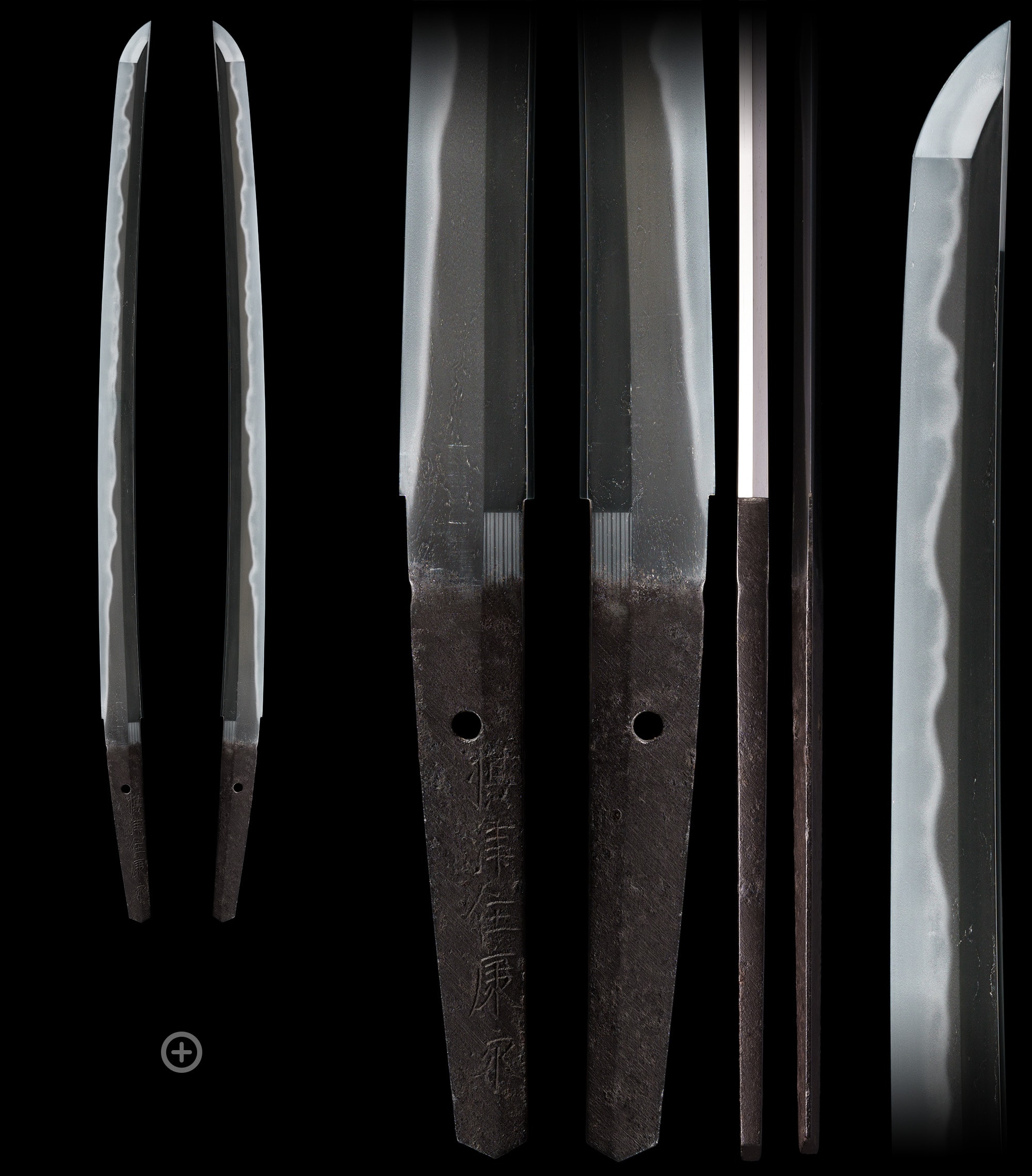
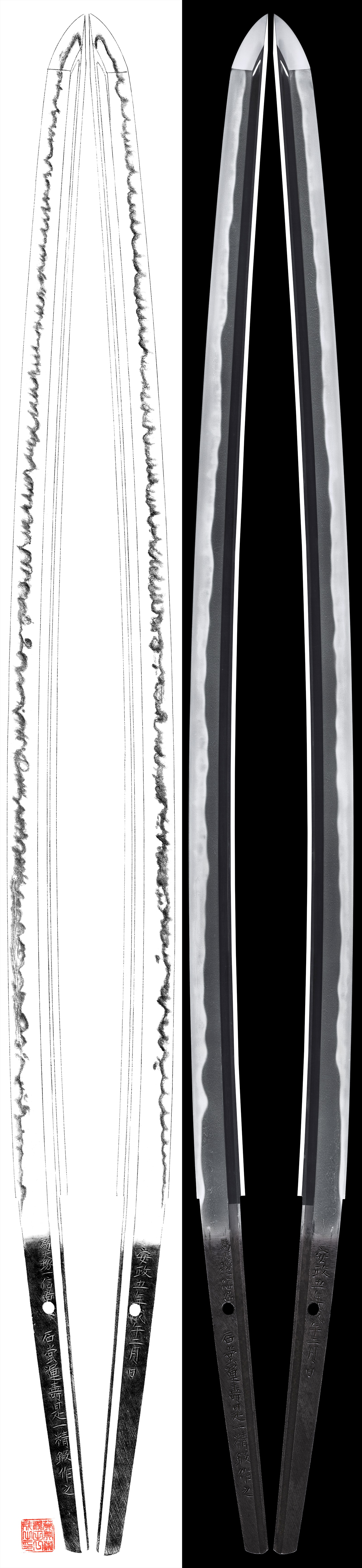
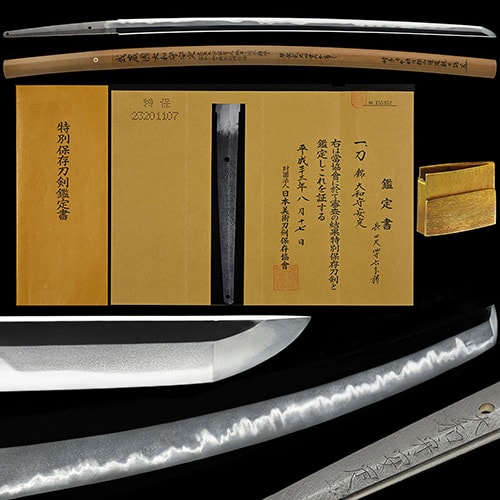
It’s here, it’s here! A truly magnificent and precious masterpiece by Tatara Nagayuki has appeared—one of the most famous among the twelve Saijo Owazamono smiths, alongside Nagasone Kotetsu Nyudo Okisato. Tatara Nagayuki, a titan of Osaka Shinto and a Saijo Owazamono smith, is incredibly famous, but unfortunately, his extant works are so few that since ancient times, his blades have been considered "phantom" swords. His real name was Tatara Shirobei. Around the Tenna era of the Edo period (1681, 344 years ago), he moved from Kishu to Osaka. A pupil of Kawachi no Kami Yasunaga, he is an exceptional representative among the smiths known as the "Osaka Ishido." This sword is a copy of a masterpiece by the Bizen Fukuoka Ichimonji school from the Kamakura period. The sugata shows a wide motohaba with a significant difference from the sakihaba, presenting a grand and powerful silhouette. The jigane is a well-forged, tightly-knit itame-hada, displaying a strong steel. The hamon is a nioi-deki gunome choji-ba fired high, with many nioi-ashi within the ha, creating a magnificent and spirited blade. Because his work was so exceptionally skillful, during the Edo period, the mei of Tatara Nagayuki was often removed (mumei) to pass the swords off as Bizen Fukuoka Ichimonji masterpieces for daimyo collections; as a result, almost no blades with the Tatara Nagayuki zaimei remain. Sword enthusiasts have long yearned to own one, but due to the lack of extant works, it was impossible. On this occasion, an elderly connoisseur who has cherished this sword for a long time has entrusted it to us, saying, "I have grown old, so please pass this on to someone who will treasure it." Thus, this precious masterpiece has come into the light for the first time. Please enjoy this "phantom" masterpiece by Tatara Nagayuki.

NihontoWatch MonNihontoWatch
MarketEncyclopediaKantei
Swords›Ishido›Osaka Ishido›Nagayuki›Katana by Tatara Nagayuki of Settsu, Saijo O-wazamono
katanaTokubetsu Hozon
Ishido Nagayuki

Katana by Tatara Nagayuki of Settsu, Saijo O-wazamono

Enpo (1673-1681) · nagasa 69.6cm · sori 2.4cm

Price on request
Visit seller website →
Ishido Nagayuki (長幸) · Enpo (1673-1681)1 work for sale →
Katana
Could you name the smith from the blade alone? Today’s kantei →
Ishido Nagayuki — 1 of 22
Ishido Nagayuki — 2 of 22
Ishido Nagayuki — 3 of 22
Ishido Nagayuki — 4 of 22
Ishido Nagayuki — 5 of 22
Ishido Nagayuki — 6 of 22
Ishido Nagayuki — 7 of 22
Ishido Nagayuki — 8 of 22
Ishido Nagayuki — 9 of 22
Ishido Nagayuki — 10 of 22
Ishido Nagayuki — 11 of 22
Ishido Nagayuki — 12 of 22
Ishido Nagayuki — 13 of 22
Ishido Nagayuki — 14 of 22
Ishido Nagayuki — 15 of 22
Ishido Nagayuki — 16 of 22
Ishido Nagayuki — 17 of 22
Ishido Nagayuki — 18 of 22
Ishido Nagayuki — 19 of 22
Ishido Nagayuki — 20 of 22
Ishido Nagayuki — 21 of 22
Ishido Nagayuki — 22 of 22
1 / 22
1 / 22
Ishido Nagayuki — 1 of 22Ishido Nagayuki — 2 of 22Ishido Nagayuki — 3 of 22Ishido Nagayuki — 4 of 22Ishido Nagayuki — 5 of 22Ishido Nagayuki — 6 of 22Ishido Nagayuki — 7 of 22Ishido Nagayuki — 8 of 22Ishido Nagayuki — 9 of 22Ishido Nagayuki — 10 of 22Ishido Nagayuki — 11 of 22Ishido Nagayuki — 12 of 22Ishido Nagayuki — 13 of 22Ishido Nagayuki — 14 of 22Ishido Nagayuki — 15 of 22Ishido Nagayuki — 16 of 22Ishido Nagayuki — 17 of 22Ishido Nagayuki — 18 of 22Ishido Nagayuki — 19 of 22Ishido Nagayuki — 20 of 22Ishido Nagayuki — 21 of 22Ishido Nagayuki — 22 of 22
Ishido Nagayuki (長幸) · Enpo (1673-1681)1 work for sale →
Katana
Could you name the smith from the blade alone? Today’s kantei →
Measurements & details
Smith
Ishido Nagayuki
Type
Katana
School
Osaka Ishido
Period
Around 1673–1681(Enpo)
Province
摂津
Measurements
Nagasa 69.6cmSori 2.4cmMotohaba 3.22cmSakihaba 2cmKasane 0.76cm
Description

It’s here, it’s here! A truly magnificent and precious masterpiece by Tatara Nagayuki has appeared—one of the most famous among the twelve Saijo Owazamono smiths, alongside Nagasone Kotetsu Nyudo Okisato. Tatara Nagayuki, a titan of Osaka Shinto and a Saijo Owazamono smith, is incredibly famous, but unfortunately, his extant works are so few that since ancient times, his blades have been considered "phantom" swords. His real name was Tatara Shirobei. Around the Tenna era of the Edo period (1681, 344 years ago), he moved from Kishu to Osaka. A pupil of Kawachi no Kami Yasunaga, he is an exceptional representative among the smiths known as the "Osaka Ishido." This sword is a copy of a masterpiece by the Bizen Fukuoka Ichimonji school from the Kamakura period. The sugata shows a wide motohaba with a significant difference from the sakihaba, presenting a grand and powerful silhouette. The jigane is a well-forged, tightly-knit itame-hada, displaying a strong steel. The hamon is a nioi-deki gunome choji-ba fired high, with many nioi-ashi within the ha, creating a magnificent and spirited blade. Because his work was so exceptionally skillful, during the Edo period, the mei of Tatara Nagayuki was often removed (mumei) to pass the swords off as Bizen Fukuoka Ichimonji masterpieces for daimyo collections; as a result, almost no blades with the Tatara Nagayuki zaimei remain. Sword enthusiasts have long yearned to own one, but due to the lack of extant works, it was impossible. On this occasion, an elderly connoisseur who has cherished this sword for a long time has entrusted it to us, saying, "I have grown old, so please pass this on to someone who will treasure it." Thus, this precious masterpiece has come into the light for the first time. Please enjoy this "phantom" masterpiece by Tatara Nagayuki.

About the maker

Nagayuki

長幸

Osaka Ishidō (Tatara Nagayuki), of Kishū origin · Settsu · around 1673-1681

Fujishiro Jo-jo saku · Tōken Taikan top 15%

1 piece on the market now

›

A katana signed in full Tatara Nagayuki and dated Jōkyō 4 (1687), inscribed on the reverse that it was forged with nanban-tetsu, is the kind of blade by which this Osaka master is known: a wide, robust body, a fine ko-itame jigane over which a clear midare-utsuri stands, and a chōji temper that revives the old Bizen Ichimonji in the Shintō age. The published sources record Nagayuki as a native of Kishū who styled himself Shirōbei, became a disciple of Kawachi no Kami Yasunaga of the Kishū Ishidō line, and moved with that vein to Osaka, where he took the name Osaka Ishidō and was active in the Tenna and Jōkyō years of the late seventeenth century. They describe him as a craftsman 「師に優る技量の持主」[[c:1]], one whose skill surpassed that of his teacher, and rank him the foremost maker of the Bizen tradition among Shintō smiths, 「新刀の備前伝中の第一人者」[[c:2]]. Dated work by him is exceedingly rare, only Tenna and Jōkyō years surviving, so a dated piece is treated as precious documentary material for the study of his career.

The hand for which Nagayuki is named is the Ichimonji-aim, which the published sources call the Ishidō school's hereditary art, 「石堂派本来の御家芸ともいうべき一文字」[[c:3]]. On a wide, lofty katana he tempers a flamboyant chōji-midare in which ō-chōji is mixed with ko-chōji and pointed togariba, with ashi and yō entering vigorously and juka-chōji-style double clusters appearing in places. The nioiguchi is tight and bright, with ko-nie added and small tobiyaki interspersed, and on the longest blades the chōji is fired tall and grand without being overwhelmed by the imposing form. The opposite pole of his work takes Sue-Bizen as its model: a koshi-no-hiraita gunome carried as the principal theme, into which a compound fukushiki manner is woven, what the older commentary names 「いわゆる蟹爪風の複式互の目」[[c:4]], the so-called crab-claw compound gunome. The published sources read this vein as taken chiefly from Yosozaemon Sukesada, and note that one chōji-led example may instead have looked to Katsumitsu, the Sue-Bizen smith in whom clove stands out most conspicuously.

The jigane beneath both manners is the foundation of his standing. Nagayuki forges a fine ko-itame, at times mixing mokume or a flowing nagare-hada near the shinogi, with dust-fine ji-nie adhering thickly and fine chikei entering, and over it a clear midare-utsuri stands. This Bizen-revival reflection is rare among the Osaka smiths and is the feature the published sources warn makes his work 「時代を古く見あやまり易い」[[c:5]], easy to mistake for an older Bizen date, the masame in the shinogi-ji and a comparatively unpolished bōshi being the points by which the Shintō hand is told. Within the temper run ashi and yō, ko-nie and fine sunagashi, with small kinsuji and stray yubashiri in places, the nioiguchi tightening and clearing. The bōshi closes in midare-komi, the tip turning pointed and returning deeply or long, a feature the published sources name as consistent through his work and the personal mark that separates his revival from the Ichimonji and Sue-Bizen models he copies.

The two manners are not periods but choices the same hand makes, and the published sources draw them as a single 二様, two types under one craftsman. On the Sue-Bizen side his copying reaches beyond the temper to the bearing of the model, the short, somewhat stubby length with sakizori, so that the sugata too follows Sue-Bizen, and one wide ō-kissaki katana with a gold-inlaid cutting-test inscription is read as a faithful Yosozaemon Sukesada copy even in its silhouette. On the Ichimonji side the chōji is read as a personal devotion to Bizen Ichimonji, the shisuku of an ideal rather than a school inheritance worn lightly. His surviving production is concentrated in robust, wide katana, signed in long-mei, several carrying added inscriptions that the steel was nanban-tetsu or chigusa-tetsu, the latter a Harima iron the published sources explain he obtained through the Osaka iron wholesalers, a detail that opens a window onto the iron trade of his day. A matched daishō, both blades dated Jōkyō 3 and inscribed as forged with chigusa-tetsu, survives as well, exceptionally rare among his dated work and thought to have been a special commission.

What sets Nagayuki apart within the Ishidō family, spread across Kishū, Osaka, Edo and Fukuoka, is the completeness of his Bizen revival, the published sources singling him out as 「新刀中備前伝作家の第一人者」[[c:6]]. The Ishidō schools carried the Bizen Ichimonji tradition transplanted into Shintō centers, and the clove temper was their house art, but Nagayuki is the hand that reproduced jigane, temper and form together, the midare-utsuri standing as convincingly as the chōji is florid. His finest Ichimonji-aim katana are called works in which 「長幸の本領が遺憾なく発揮された一作」[[c:7]], his true strengths fully manifested, and the best of his Sukesada copies are read as faithful down to the silhouette. The pointed, deep-returning bōshi and the tight, bright nioiguchi remain his own throughout, the steady undertone beneath whichever Bizen model he sets out to recover.

For the collector Nagayuki is graded Jō-jō saku by Fujishiro, and his work has no National Treasures or Important Cultural Properties; the designated record runs instead through two Tokubetsu Jūyō katana and a body of Jūyō blades, ten in the Tokubetsu Jūyō and Jūyō tiers among the pieces here. Provenance is thin but real, the recorded name being General Tani Tateki, the Meiji military figure and noted sword enthusiast whose collection held more than one of his katana, recorded in red lacquer and as a former holding. Most designated blades by him are held rather than traded, and a robust dated example carries enough scholarly weight that it is treated as study material first, so one reaching the market is uncommon, a landmark for a private collector when it does. The published sources call his masterworks 「同工屈指の名品」, among the finest of his production, the high point of the Shintō Bizen revival set down by a Kishū smith who carried the Ichimonji and Sukesada into the swords of early-Edo Osaka.


Historical importance

Where Nagayuki stands among comparable artisans: across all of nihontō, and within tradition, era, and period. The tiers (Foremost · Leading · Major · Notable) weigh official designations from the NBTHK and Japan's Agency for Cultural Affairs, together with historical honors of lasting repute such as the Sansaku and Meibutsu-chō.

随一
Foremost
屈指
Leading
有数
Major
著名
Notable

Select a lens to see how it's measured.

Designation record
10 designated works
Tokubetsu Jūyō
2
Jūyō
8
1 work by Nagayuki on the market→
Nagayuki — full profileOsaka Ishidō (Tatara Nagayuki), of Kishū origin school

Study this maker →

About the school

Osaka Ishido

大坂石堂

Shinto · Settsu

2 pieces on the market now

›

Settsu Province, and Osaka in particular, gathered the smiths the setsumei group under the name Osaka Ishido (大坂石堂). " Within that movement the setsumei trace a clear chain of teaching. Bicchu no Kami Yasuhiro stood at the head of the Kishu group, his followers sharing the "yasu"[[c:1]] element in their names; Kawachi no Kami Yasunaga, styled Hachizaemon, studied under Yasuhiro, moved from Kishu to Osaka, and took the title Kawachi no Kami. " Hanabusa Bizen no Kami Sukekuni and his nephew Sukeharu, also originally of the Kishu Ishido group, are named among the same body. The unifying aim the setsumei attach to all of them is the revival of Kamakura Bizen Ichimonji choji, "the Ishido lineage's traditional specialty," carried into the shinto era. The shared vocabulary is consistent across the register. " The temper divides into two modes the setsumei repeatedly distinguish: a flamboyant choji-midare aimed at Ichimonji, mixing o-choji, juka-choji-like blossoms, ko-choji, gunome, and togariba, with ashi and yo entering vigorously; and a gunome with an opened "waist" (koshi no hiraita) compounded in fukushiki-fu manner, taking Sue-Bizen, and Yosazaemon no Jo Sukesada in particular, as its model. Through both runs a ko-nie-deki, nioi-dominant edge whose nioiguchi tends to tighten yet stays bright and clear, with tobiyaki, fine sunagashi, and kinsuji.

Sukekuni and Sukeharu are set slightly apart, working nie-laden gunome, notare mixed with gunome, hako-ba, and toran-like o-gunome, with suguha also frequent. To recognize the hand, the setsumei point to the boshi that enters midare-komi, sharpens to a point, and returns deeply, together with the tightening nioiguchi and intermixed togariba. " Nagayuki's Sue-Bizen copies are said to reproduce even the sugata and nakago, with compact proportions and sakizori capturing the late-Bizen silhouette; one example was thought aimed at Katsumitsu, in whom choji stands out. Named works anchor the standing of the group. A matched daisho dated Jokyo 3 (1686) bears the inscription "forged using Chigusa iron" (chigusa-tetsu), a piece read as a special commission; a dated katana of Jokyo 4 carries an added "nanban-tetsu" inscription; one blade holds a kinpun-mei reading "White Cloud / Tatara"[[c:2]]. Two Ujinagayuki katana descend from General Tani Tateki, the Meiji military figure and sword enthusiast. On the strength of his command of the choji edge and the Bizen tradition, the register names Tatara Nagayuki the leading master of Bizen-den among shinto smiths. Learn more →

3 recorded smiths12 designated works
Leading smiths
SmithEraDesignated
Nagayuki長幸1673-168110
Sukekuni祐國1661-16731
Yasunaga康永1661-16731
Sukeharu祐春1661-16900
Explore the Osaka Ishido school →

Historical context

Ōsaka: swords for the merchant capital

›

Ōsaka was the merchant capital, and its swords followed the money: luxury wakizashi for townsmen permitted no more than one, and the brilliant showpieces of Sukehiro’s tōranba and of Shinkai, called the Ōsaka Masamune. Swords made, frankly, to be looked at.

Ōsaka: swords for the merchant capital →

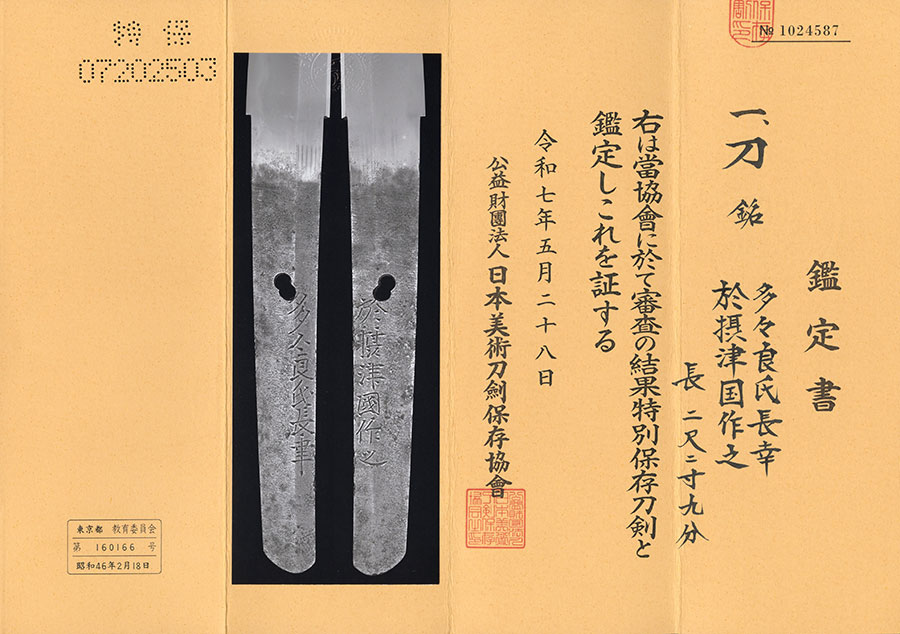
NBTHK Certificate
Tokubetsu Hozon Tōken特別保存刀剣
Sword Especially Worthy of Preservation
›

A Hozon-certified blade judged to show notably superior workmanship and a better state of preservation. The bar is higher: re-tempered blades and most unsigned Muromachi/Edo works are excluded.

About the NBTHK›

The NBTHK (Nihon Bijutsu Tōken Hozon Kyōkai, the Society for the Preservation of Japanese Art Swords) is a public-interest incorporated foundation founded in 1948 and supervised by Japan’s Agency for Cultural Affairs (Bunkachō); it is based at the Japanese Sword Museum in Tokyo. Its expert panels physically examine each submitted work (shinsa) and issue a certificate (kanteishō) ranking it by artistic and historical merit. NBTHK papers are the most widely recognized standard of authentication for Japanese swords and fittings.

NBTHK official site→
Seller
N
Nipponto
Established 1953 · 73 yrs on the market
🇯🇵Ships from Japan
›
✓Verified dealernipponto.co.jp
✓Ships worldwide✓English supportPayPalCredit card
Return policy

For returns due to customer circumstances, the cost is the customer's responsibility. For returns due to our mis-shipment or a defective item, we bear the cost.

View all of Nipponto’s listings→View this item on the dealer’s site→

Previously sold by Ishido Nagayuki

View all →
Iida Koendo
Tokujū
Katana - Tokuju - by Ishido Nagayuki - Shinto Katana: Tadara Nagayuki, NBTHK Tokubetsu Juyo Token No.24Katana - Tokuju - by Ishido Nagayuki - Shinto Katana: Tadara Nagayuki, NBTHK Tokubetsu Juyo Token No.24
Sold

Katana

ByIshido Nagayuki
SOLD

More from the Osaka Ishido school

View all →
Asahi Token
Tokuho
Wakizashi - Tokuho - by Ishido Yasunaga - Settsu YasunagaWakizashi - Tokuho - by Ishido Yasunaga - Settsu Yasunaga

Wakizashi

ByIshido Yasunaga
¥308,000

More from the Ishido school

View all →
Nipponto
Tokuho
Katana - Tokuho - by Ishido Yasusada - Japanese Sword Katana by Yamatonokami Yasusada (Famous as the beloved sword of Shinsengumi Captain Okita Soji)Katana - Tokuho - by Ishido Yasusada - Japanese Sword Katana by Yamatonokami Yasusada (Famous as the beloved sword of Shinsengumi Captain Okita Soji)

Katana

ByIshido Yasusada
Ask
Aoi Art
Jūyō
Katana - Jūyō - by Ishido Korekazu - Sekido Unju KorekazuKatana - Jūyō - by Ishido Korekazu - Sekido Unju Korekazu

Katana

ByIshido Korekazu
¥4,500,000
Eirakudo
Tokuho
Katana - Tokuho - by Ishido Yasusada - Yamatonokami Yasusada - Tokubetsu Hozon TokenKatana - Tokuho - by Ishido Yasusada - Yamatonokami Yasusada - Tokubetsu Hozon Token

Katana

ByIshido Yasusada
¥3,300,000
Nihonto Australia
Tokuho
Katana - Tokuho - by Ishido Yasusada - YasusadaKatana - Tokuho - by Ishido Yasusada - Yasusada

Katana

ByIshido Yasusada
Ask
E-sword
Tokuho
Katana - Tokuho - by Ishido Yasusada - Yamato no Kami YasusadaKatana - Tokuho - by Ishido Yasusada - Yamato no Kami Yasusada

Katana

ByIshido Yasusada
¥1,980,000
Aoi Art
Hozon
Katana - Hozon - by Kishu Ishido Masatoshi - Ecchu-no-kami MasatoshiKatana - Hozon - by Kishu Ishido Masatoshi - Ecchu-no-kami Masatoshi

Katana

ByKishu Ishido Masatoshi
Starting Bid¥1,150,000
Touken Hataya
Tokuho
Katana - Tokuho - by Ishido Yasutsuna - Tokubetsu Hozon Katana by Yasutsuna of KinokuniKatana - Tokuho - by Ishido Yasutsuna - Tokubetsu Hozon Katana by Yasutsuna of Kinokuni

Katana

ByIshido Yasutsuna
¥770,000
Token-Net
Jūyō
Katana - Jūyō - by Ishido Korekazu - Fujiwara Korekazu, August, Bunkyu 2Katana - Jūyō - by Ishido Korekazu - Fujiwara Korekazu, August, Bunkyu 2

Katana

ByIshido Korekazu
¥5,500,000

Swords

  • Katana
  • Wakizashi
  • Tantō
  • Tachi
  • Naginata
  • Yari
  • Japanese Swords
  • Samurai Swords

Fittings

  • Tsuba
  • Fuchi-Kashira
  • Kozuka
  • Menuki
  • Sword Guards (Tsuba)

Armor

  • Kabuto
  • Samurai Armor
  • All Samurai Armor

By Certification

  • Tokujū
  • Jūyō
  • Tokuho
  • Hozon

Resources

  • Dealer Directory
  • Artist Directory
  • The Daily Kantei
  • Glossary
  • Browse All
Nihontowatch© 2026
TermsPrivacyCookiesAbout

Price on request

View on Nipponto

Description

It’s here, it’s here! A truly magnificent and precious masterpiece by Tatara Nagayuki has appeared—one of the most famous among the twelve Saijo Owazamono smiths, alongside Nagasone Kotetsu Nyudo Okisato. Tatara Nagayuki, a titan of Osaka Shinto and a Saijo Owazamono smith, is incredibly famous, but unfortunately, his extant works are so few that since ancient times, his blades have been considered "phantom" swords. His real name was Tatara Shirobei. Around the Tenna era of the Edo period (1681, 344 years ago), he moved from Kishu to Osaka. A pupil of Kawachi no Kami Yasunaga, he is an exceptional representative among the smiths known as the "Osaka Ishido." This sword is a copy of a masterpiece by the Bizen Fukuoka Ichimonji school from the Kamakura period. The sugata shows a wide motohaba with a significant difference from the sakihaba, presenting a grand and powerful silhouette. The jigane is a well-forged, tightly-knit itame-hada, displaying a strong steel. The hamon is a nioi-deki gunome choji-ba fired high, with many nioi-ashi within the ha, creating a magnificent and spirited blade. Because his work was so exceptionally skillful, during the Edo period, the mei of Tatara Nagayuki was often removed (mumei) to pass the swords off as Bizen Fukuoka Ichimonji masterpieces for daimyo collections; as a result, almost no blades with the Tatara Nagayuki zaimei remain. Sword enthusiasts have long yearned to own one, but due to the lack of extant works, it was impossible. On this occasion, an elderly connoisseur who has cherished this sword for a long time has entrusted it to us, saying, "I have grown old, so please pass this on to someone who will treasure it." Thus, this precious masterpiece has come into the light for the first time. Please enjoy this "phantom" masterpiece by Tatara Nagayuki.

NihontoWatch MonNihontoWatch
MarketEncyclopediaKantei
Swords›Ishido›Osaka Ishido›Nagayuki›Katana by Tatara Nagayuki of Settsu, Saijo O-wazamono
katanaTokubetsu Hozon
Ishido Nagayuki

Katana by Tatara Nagayuki of Settsu, Saijo O-wazamono

Enpo (1673-1681) · nagasa 69.6cm · sori 2.4cm

Price on request
Visit seller website →
Ishido Nagayuki (長幸) · Enpo (1673-1681)1 work for sale →
Katana
Could you name the smith from the blade alone? Today’s kantei →
Ishido Nagayuki — 1 of 22
Ishido Nagayuki — 2 of 22
Ishido Nagayuki — 3 of 22
Ishido Nagayuki — 4 of 22
Ishido Nagayuki — 5 of 22
Ishido Nagayuki — 6 of 22
Ishido Nagayuki — 7 of 22
Ishido Nagayuki — 8 of 22
Ishido Nagayuki — 9 of 22
Ishido Nagayuki — 10 of 22
Ishido Nagayuki — 11 of 22
Ishido Nagayuki — 12 of 22
Ishido Nagayuki — 13 of 22
Ishido Nagayuki — 14 of 22
Ishido Nagayuki — 15 of 22
Ishido Nagayuki — 16 of 22
Ishido Nagayuki — 17 of 22
Ishido Nagayuki — 18 of 22
Ishido Nagayuki — 19 of 22
Ishido Nagayuki — 20 of 22
Ishido Nagayuki — 21 of 22
Ishido Nagayuki — 22 of 22
1 / 22
1 / 22
Ishido Nagayuki — 1 of 22Ishido Nagayuki — 2 of 22Ishido Nagayuki — 3 of 22Ishido Nagayuki — 4 of 22Ishido Nagayuki — 5 of 22Ishido Nagayuki — 6 of 22Ishido Nagayuki — 7 of 22Ishido Nagayuki — 8 of 22Ishido Nagayuki — 9 of 22Ishido Nagayuki — 10 of 22Ishido Nagayuki — 11 of 22Ishido Nagayuki — 12 of 22Ishido Nagayuki — 13 of 22Ishido Nagayuki — 14 of 22Ishido Nagayuki — 15 of 22Ishido Nagayuki — 16 of 22Ishido Nagayuki — 17 of 22Ishido Nagayuki — 18 of 22Ishido Nagayuki — 19 of 22Ishido Nagayuki — 20 of 22Ishido Nagayuki — 21 of 22Ishido Nagayuki — 22 of 22
Ishido Nagayuki (長幸) · Enpo (1673-1681)1 work for sale →
Katana
Could you name the smith from the blade alone? Today’s kantei →
Measurements & details
Smith
Ishido Nagayuki
Type
Katana
School
Osaka Ishido
Period
Around 1673–1681(Enpo)
Province
摂津
Measurements
Nagasa 69.6cmSori 2.4cmMotohaba 3.22cmSakihaba 2cmKasane 0.76cm
Description

It’s here, it’s here! A truly magnificent and precious masterpiece by Tatara Nagayuki has appeared—one of the most famous among the twelve Saijo Owazamono smiths, alongside Nagasone Kotetsu Nyudo Okisato. Tatara Nagayuki, a titan of Osaka Shinto and a Saijo Owazamono smith, is incredibly famous, but unfortunately, his extant works are so few that since ancient times, his blades have been considered "phantom" swords. His real name was Tatara Shirobei. Around the Tenna era of the Edo period (1681, 344 years ago), he moved from Kishu to Osaka. A pupil of Kawachi no Kami Yasunaga, he is an exceptional representative among the smiths known as the "Osaka Ishido." This sword is a copy of a masterpiece by the Bizen Fukuoka Ichimonji school from the Kamakura period. The sugata shows a wide motohaba with a significant difference from the sakihaba, presenting a grand and powerful silhouette. The jigane is a well-forged, tightly-knit itame-hada, displaying a strong steel. The hamon is a nioi-deki gunome choji-ba fired high, with many nioi-ashi within the ha, creating a magnificent and spirited blade. Because his work was so exceptionally skillful, during the Edo period, the mei of Tatara Nagayuki was often removed (mumei) to pass the swords off as Bizen Fukuoka Ichimonji masterpieces for daimyo collections; as a result, almost no blades with the Tatara Nagayuki zaimei remain. Sword enthusiasts have long yearned to own one, but due to the lack of extant works, it was impossible. On this occasion, an elderly connoisseur who has cherished this sword for a long time has entrusted it to us, saying, "I have grown old, so please pass this on to someone who will treasure it." Thus, this precious masterpiece has come into the light for the first time. Please enjoy this "phantom" masterpiece by Tatara Nagayuki.

About the maker

Nagayuki

長幸

Osaka Ishidō (Tatara Nagayuki), of Kishū origin · Settsu · around 1673-1681

Fujishiro Jo-jo saku · Tōken Taikan top 15%

1 piece on the market now

›

A katana signed in full Tatara Nagayuki and dated Jōkyō 4 (1687), inscribed on the reverse that it was forged with nanban-tetsu, is the kind of blade by which this Osaka master is known: a wide, robust body, a fine ko-itame jigane over which a clear midare-utsuri stands, and a chōji temper that revives the old Bizen Ichimonji in the Shintō age. The published sources record Nagayuki as a native of Kishū who styled himself Shirōbei, became a disciple of Kawachi no Kami Yasunaga of the Kishū Ishidō line, and moved with that vein to Osaka, where he took the name Osaka Ishidō and was active in the Tenna and Jōkyō years of the late seventeenth century. They describe him as a craftsman 「師に優る技量の持主」[[c:1]], one whose skill surpassed that of his teacher, and rank him the foremost maker of the Bizen tradition among Shintō smiths, 「新刀の備前伝中の第一人者」[[c:2]]. Dated work by him is exceedingly rare, only Tenna and Jōkyō years surviving, so a dated piece is treated as precious documentary material for the study of his career.

The hand for which Nagayuki is named is the Ichimonji-aim, which the published sources call the Ishidō school's hereditary art, 「石堂派本来の御家芸ともいうべき一文字」[[c:3]]. On a wide, lofty katana he tempers a flamboyant chōji-midare in which ō-chōji is mixed with ko-chōji and pointed togariba, with ashi and yō entering vigorously and juka-chōji-style double clusters appearing in places. The nioiguchi is tight and bright, with ko-nie added and small tobiyaki interspersed, and on the longest blades the chōji is fired tall and grand without being overwhelmed by the imposing form. The opposite pole of his work takes Sue-Bizen as its model: a koshi-no-hiraita gunome carried as the principal theme, into which a compound fukushiki manner is woven, what the older commentary names 「いわゆる蟹爪風の複式互の目」[[c:4]], the so-called crab-claw compound gunome. The published sources read this vein as taken chiefly from Yosozaemon Sukesada, and note that one chōji-led example may instead have looked to Katsumitsu, the Sue-Bizen smith in whom clove stands out most conspicuously.

The jigane beneath both manners is the foundation of his standing. Nagayuki forges a fine ko-itame, at times mixing mokume or a flowing nagare-hada near the shinogi, with dust-fine ji-nie adhering thickly and fine chikei entering, and over it a clear midare-utsuri stands. This Bizen-revival reflection is rare among the Osaka smiths and is the feature the published sources warn makes his work 「時代を古く見あやまり易い」[[c:5]], easy to mistake for an older Bizen date, the masame in the shinogi-ji and a comparatively unpolished bōshi being the points by which the Shintō hand is told. Within the temper run ashi and yō, ko-nie and fine sunagashi, with small kinsuji and stray yubashiri in places, the nioiguchi tightening and clearing. The bōshi closes in midare-komi, the tip turning pointed and returning deeply or long, a feature the published sources name as consistent through his work and the personal mark that separates his revival from the Ichimonji and Sue-Bizen models he copies.

The two manners are not periods but choices the same hand makes, and the published sources draw them as a single 二様, two types under one craftsman. On the Sue-Bizen side his copying reaches beyond the temper to the bearing of the model, the short, somewhat stubby length with sakizori, so that the sugata too follows Sue-Bizen, and one wide ō-kissaki katana with a gold-inlaid cutting-test inscription is read as a faithful Yosozaemon Sukesada copy even in its silhouette. On the Ichimonji side the chōji is read as a personal devotion to Bizen Ichimonji, the shisuku of an ideal rather than a school inheritance worn lightly. His surviving production is concentrated in robust, wide katana, signed in long-mei, several carrying added inscriptions that the steel was nanban-tetsu or chigusa-tetsu, the latter a Harima iron the published sources explain he obtained through the Osaka iron wholesalers, a detail that opens a window onto the iron trade of his day. A matched daishō, both blades dated Jōkyō 3 and inscribed as forged with chigusa-tetsu, survives as well, exceptionally rare among his dated work and thought to have been a special commission.

What sets Nagayuki apart within the Ishidō family, spread across Kishū, Osaka, Edo and Fukuoka, is the completeness of his Bizen revival, the published sources singling him out as 「新刀中備前伝作家の第一人者」[[c:6]]. The Ishidō schools carried the Bizen Ichimonji tradition transplanted into Shintō centers, and the clove temper was their house art, but Nagayuki is the hand that reproduced jigane, temper and form together, the midare-utsuri standing as convincingly as the chōji is florid. His finest Ichimonji-aim katana are called works in which 「長幸の本領が遺憾なく発揮された一作」[[c:7]], his true strengths fully manifested, and the best of his Sukesada copies are read as faithful down to the silhouette. The pointed, deep-returning bōshi and the tight, bright nioiguchi remain his own throughout, the steady undertone beneath whichever Bizen model he sets out to recover.

For the collector Nagayuki is graded Jō-jō saku by Fujishiro, and his work has no National Treasures or Important Cultural Properties; the designated record runs instead through two Tokubetsu Jūyō katana and a body of Jūyō blades, ten in the Tokubetsu Jūyō and Jūyō tiers among the pieces here. Provenance is thin but real, the recorded name being General Tani Tateki, the Meiji military figure and noted sword enthusiast whose collection held more than one of his katana, recorded in red lacquer and as a former holding. Most designated blades by him are held rather than traded, and a robust dated example carries enough scholarly weight that it is treated as study material first, so one reaching the market is uncommon, a landmark for a private collector when it does. The published sources call his masterworks 「同工屈指の名品」, among the finest of his production, the high point of the Shintō Bizen revival set down by a Kishū smith who carried the Ichimonji and Sukesada into the swords of early-Edo Osaka.

Historical importance

Where Nagayuki stands among comparable artisans: across all of nihontō, and within tradition, era, and period. The tiers (Foremost · Leading · Major · Notable) weigh official designations from the NBTHK and Japan's Agency for Cultural Affairs, together with historical honors of lasting repute such as the Sansaku and Meibutsu-chō.

随一
Foremost
屈指
Leading
有数
Major
著名
Notable

Select a lens to see how it's measured.

Designation record
10 designated works
Tokubetsu Jūyō
2
Jūyō
8
1 work by Nagayuki on the market→
Nagayuki — full profileOsaka Ishidō (Tatara Nagayuki), of Kishū origin school

Study this maker →

About the school

Osaka Ishido

大坂石堂

Shinto · Settsu

2 pieces on the market now

›

Settsu Province, and Osaka in particular, gathered the smiths the setsumei group under the name Osaka Ishido (大坂石堂). " Within that movement the setsumei trace a clear chain of teaching. Bicchu no Kami Yasuhiro stood at the head of the Kishu group, his followers sharing the "yasu"[[c:1]] element in their names; Kawachi no Kami Yasunaga, styled Hachizaemon, studied under Yasuhiro, moved from Kishu to Osaka, and took the title Kawachi no Kami. " Hanabusa Bizen no Kami Sukekuni and his nephew Sukeharu, also originally of the Kishu Ishido group, are named among the same body. The unifying aim the setsumei attach to all of them is the revival of Kamakura Bizen Ichimonji choji, "the Ishido lineage's traditional specialty," carried into the shinto era. The shared vocabulary is consistent across the register. " The temper divides into two modes the setsumei repeatedly distinguish: a flamboyant choji-midare aimed at Ichimonji, mixing o-choji, juka-choji-like blossoms, ko-choji, gunome, and togariba, with ashi and yo entering vigorously; and a gunome with an opened "waist" (koshi no hiraita) compounded in fukushiki-fu manner, taking Sue-Bizen, and Yosazaemon no Jo Sukesada in particular, as its model. Through both runs a ko-nie-deki, nioi-dominant edge whose nioiguchi tends to tighten yet stays bright and clear, with tobiyaki, fine sunagashi, and kinsuji.

Sukekuni and Sukeharu are set slightly apart, working nie-laden gunome, notare mixed with gunome, hako-ba, and toran-like o-gunome, with suguha also frequent. To recognize the hand, the setsumei point to the boshi that enters midare-komi, sharpens to a point, and returns deeply, together with the tightening nioiguchi and intermixed togariba. " Nagayuki's Sue-Bizen copies are said to reproduce even the sugata and nakago, with compact proportions and sakizori capturing the late-Bizen silhouette; one example was thought aimed at Katsumitsu, in whom choji stands out. Named works anchor the standing of the group. A matched daisho dated Jokyo 3 (1686) bears the inscription "forged using Chigusa iron" (chigusa-tetsu), a piece read as a special commission; a dated katana of Jokyo 4 carries an added "nanban-tetsu" inscription; one blade holds a kinpun-mei reading "White Cloud / Tatara"[[c:2]]. Two Ujinagayuki katana descend from General Tani Tateki, the Meiji military figure and sword enthusiast. On the strength of his command of the choji edge and the Bizen tradition, the register names Tatara Nagayuki the leading master of Bizen-den among shinto smiths. Learn more →

3 recorded smiths12 designated works
Leading smiths
SmithEraDesignated
Nagayuki長幸1673-168110
Sukekuni祐國1661-16731
Yasunaga康永1661-16731
Sukeharu祐春1661-16900
Explore the Osaka Ishido school →

Historical context

Ōsaka: swords for the merchant capital

›

Ōsaka was the merchant capital, and its swords followed the money: luxury wakizashi for townsmen permitted no more than one, and the brilliant showpieces of Sukehiro’s tōranba and of Shinkai, called the Ōsaka Masamune. Swords made, frankly, to be looked at.

Ōsaka: swords for the merchant capital →

NBTHK Certificate
Tokubetsu Hozon Tōken特別保存刀剣
Sword Especially Worthy of Preservation
›

A Hozon-certified blade judged to show notably superior workmanship and a better state of preservation. The bar is higher: re-tempered blades and most unsigned Muromachi/Edo works are excluded.

About the NBTHK›

The NBTHK (Nihon Bijutsu Tōken Hozon Kyōkai, the Society for the Preservation of Japanese Art Swords) is a public-interest incorporated foundation founded in 1948 and supervised by Japan’s Agency for Cultural Affairs (Bunkachō); it is based at the Japanese Sword Museum in Tokyo. Its expert panels physically examine each submitted work (shinsa) and issue a certificate (kanteishō) ranking it by artistic and historical merit. NBTHK papers are the most widely recognized standard of authentication for Japanese swords and fittings.

NBTHK official site→
Seller
N
Nipponto
Established 1953 · 73 yrs on the market
🇯🇵Ships from Japan
›
✓Verified dealernipponto.co.jp
✓Ships worldwide✓English supportPayPalCredit card
Return policy

For returns due to customer circumstances, the cost is the customer's responsibility. For returns due to our mis-shipment or a defective item, we bear the cost.

View all of Nipponto’s listings→View this item on the dealer’s site→

Previously sold by Ishido Nagayuki

View all →
Iida Koendo
Tokujū
Katana - Tokuju - by Ishido Nagayuki - Shinto Katana: Tadara Nagayuki, NBTHK Tokubetsu Juyo Token No.24Katana - Tokuju - by Ishido Nagayuki - Shinto Katana: Tadara Nagayuki, NBTHK Tokubetsu Juyo Token No.24
Sold

Katana

ByIshido Nagayuki
SOLD

More from the Osaka Ishido school

View all →
Asahi Token
Tokuho
Wakizashi - Tokuho - by Ishido Yasunaga - Settsu YasunagaWakizashi - Tokuho - by Ishido Yasunaga - Settsu Yasunaga

Wakizashi

ByIshido Yasunaga
¥308,000

More from the Ishido school

View all →
Nipponto
Tokuho
Katana - Tokuho - by Ishido Yasusada - Japanese Sword Katana by Yamatonokami Yasusada (Famous as the beloved sword of Shinsengumi Captain Okita Soji)Katana - Tokuho - by Ishido Yasusada - Japanese Sword Katana by Yamatonokami Yasusada (Famous as the beloved sword of Shinsengumi Captain Okita Soji)

Katana

ByIshido Yasusada
Ask
Aoi Art
Jūyō
Katana - Jūyō - by Ishido Korekazu - Sekido Unju KorekazuKatana - Jūyō - by Ishido Korekazu - Sekido Unju Korekazu

Katana

ByIshido Korekazu
¥4,500,000
Eirakudo
Tokuho
Katana - Tokuho - by Ishido Yasusada - Yamatonokami Yasusada - Tokubetsu Hozon TokenKatana - Tokuho - by Ishido Yasusada - Yamatonokami Yasusada - Tokubetsu Hozon Token

Katana

ByIshido Yasusada
¥3,300,000
Nihonto Australia
Tokuho
Katana - Tokuho - by Ishido Yasusada - YasusadaKatana - Tokuho - by Ishido Yasusada - Yasusada

Katana

ByIshido Yasusada
Ask
E-sword
Tokuho
Katana - Tokuho - by Ishido Yasusada - Yamato no Kami YasusadaKatana - Tokuho - by Ishido Yasusada - Yamato no Kami Yasusada

Katana

ByIshido Yasusada
¥1,980,000
Aoi Art
Hozon
Katana - Hozon - by Kishu Ishido Masatoshi - Ecchu-no-kami MasatoshiKatana - Hozon - by Kishu Ishido Masatoshi - Ecchu-no-kami Masatoshi

Katana

ByKishu Ishido Masatoshi
Starting Bid¥1,150,000
Touken Hataya
Tokuho
Katana - Tokuho - by Ishido Yasutsuna - Tokubetsu Hozon Katana by Yasutsuna of KinokuniKatana - Tokuho - by Ishido Yasutsuna - Tokubetsu Hozon Katana by Yasutsuna of Kinokuni

Katana

ByIshido Yasutsuna
¥770,000
Token-Net
Jūyō
Katana - Jūyō - by Ishido Korekazu - Fujiwara Korekazu, August, Bunkyu 2Katana - Jūyō - by Ishido Korekazu - Fujiwara Korekazu, August, Bunkyu 2

Katana

ByIshido Korekazu
¥5,500,000

Swords

  • Katana
  • Wakizashi
  • Tantō
  • Tachi
  • Naginata
  • Yari
  • Japanese Swords
  • Samurai Swords

Fittings

  • Tsuba
  • Fuchi-Kashira
  • Kozuka
  • Menuki
  • Sword Guards (Tsuba)

Armor

  • Kabuto
  • Samurai Armor
  • All Samurai Armor

By Certification

  • Tokujū
  • Jūyō
  • Tokuho
  • Hozon

Resources

  • Dealer Directory
  • Artist Directory
  • The Daily Kantei
  • Glossary
  • Browse All
Nihontowatch© 2026
TermsPrivacyCookiesAbout

Price on request

View on Nipponto
NihontoWatch MonNihontoWatch
Market
Encyclopedia
Kantei
NihontoWatch MonNihontoWatch
Market
Encyclopedia
Kantei