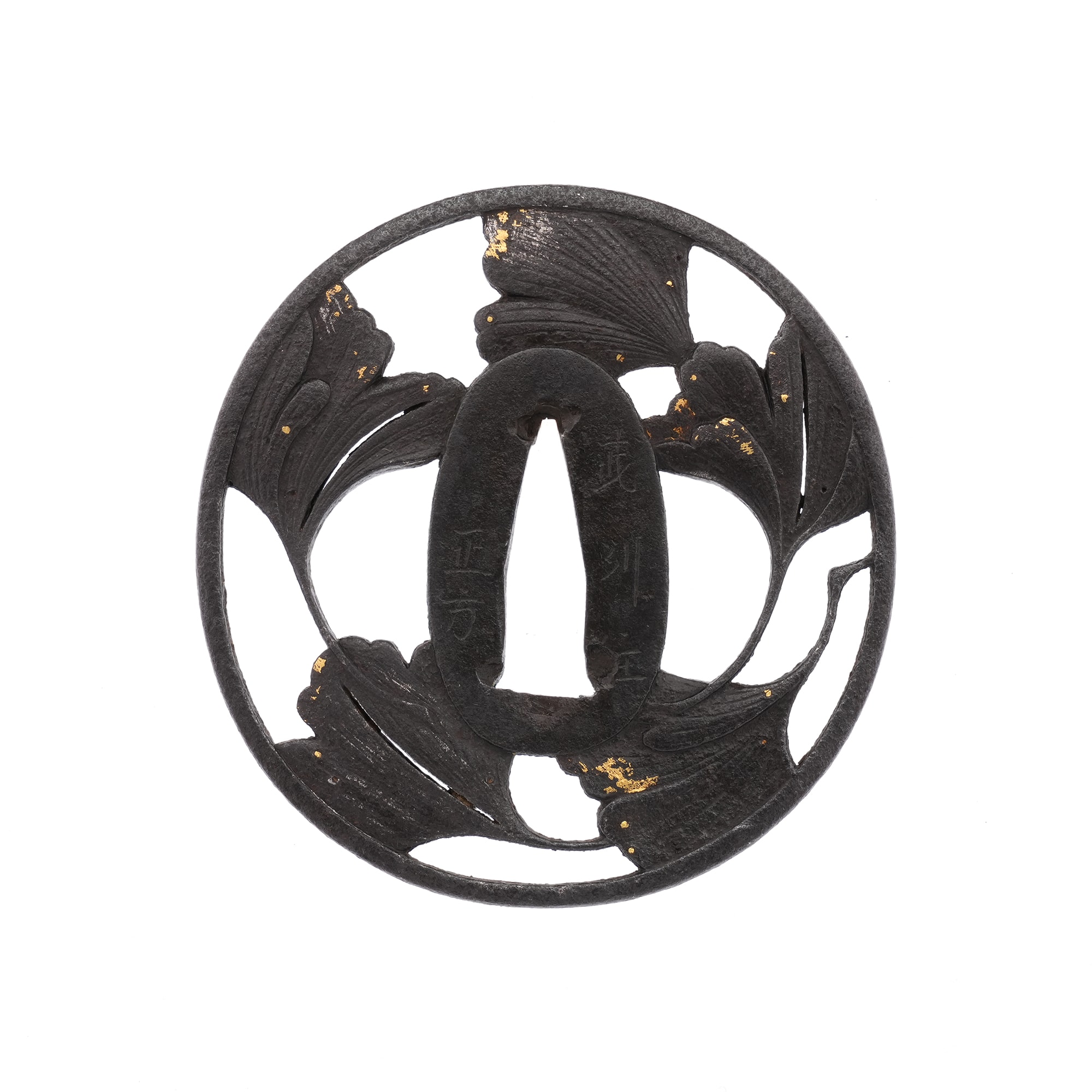
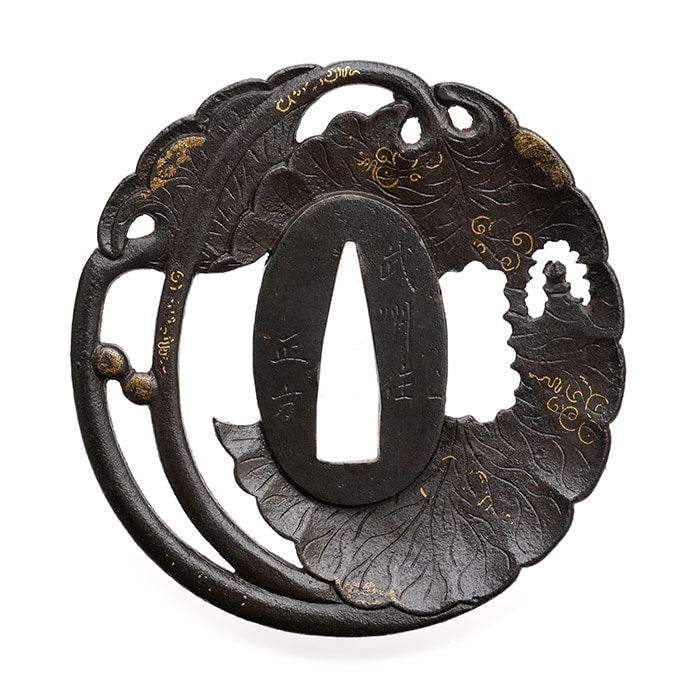
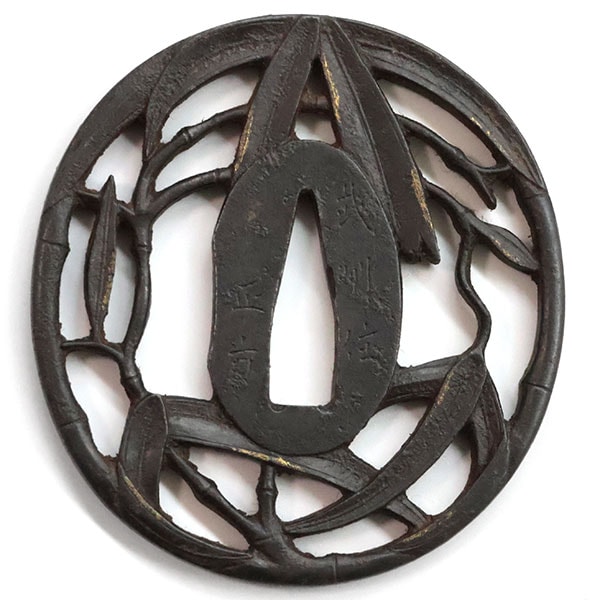
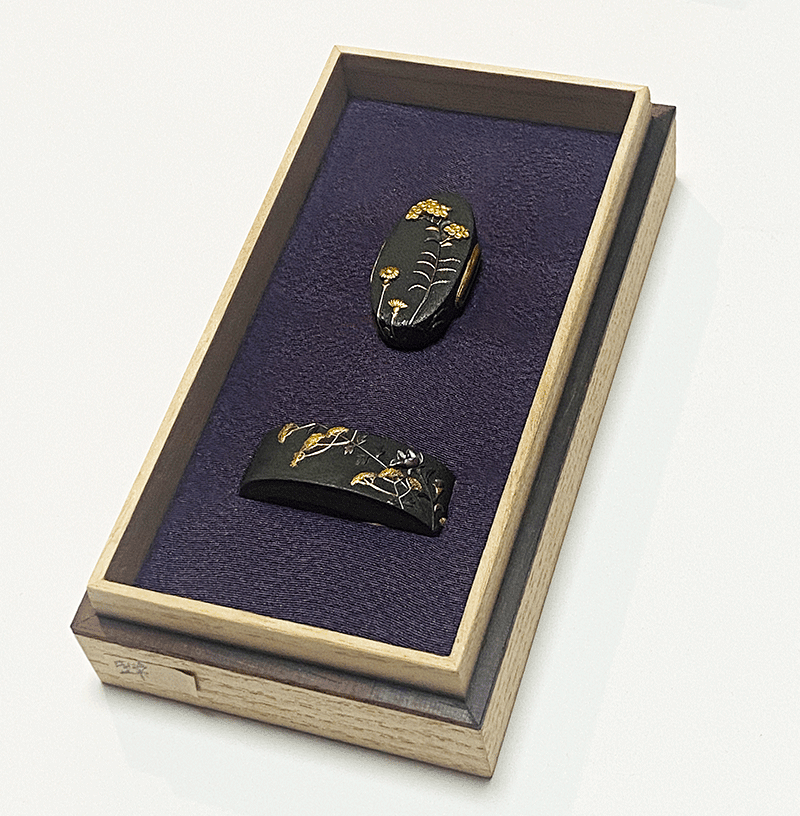
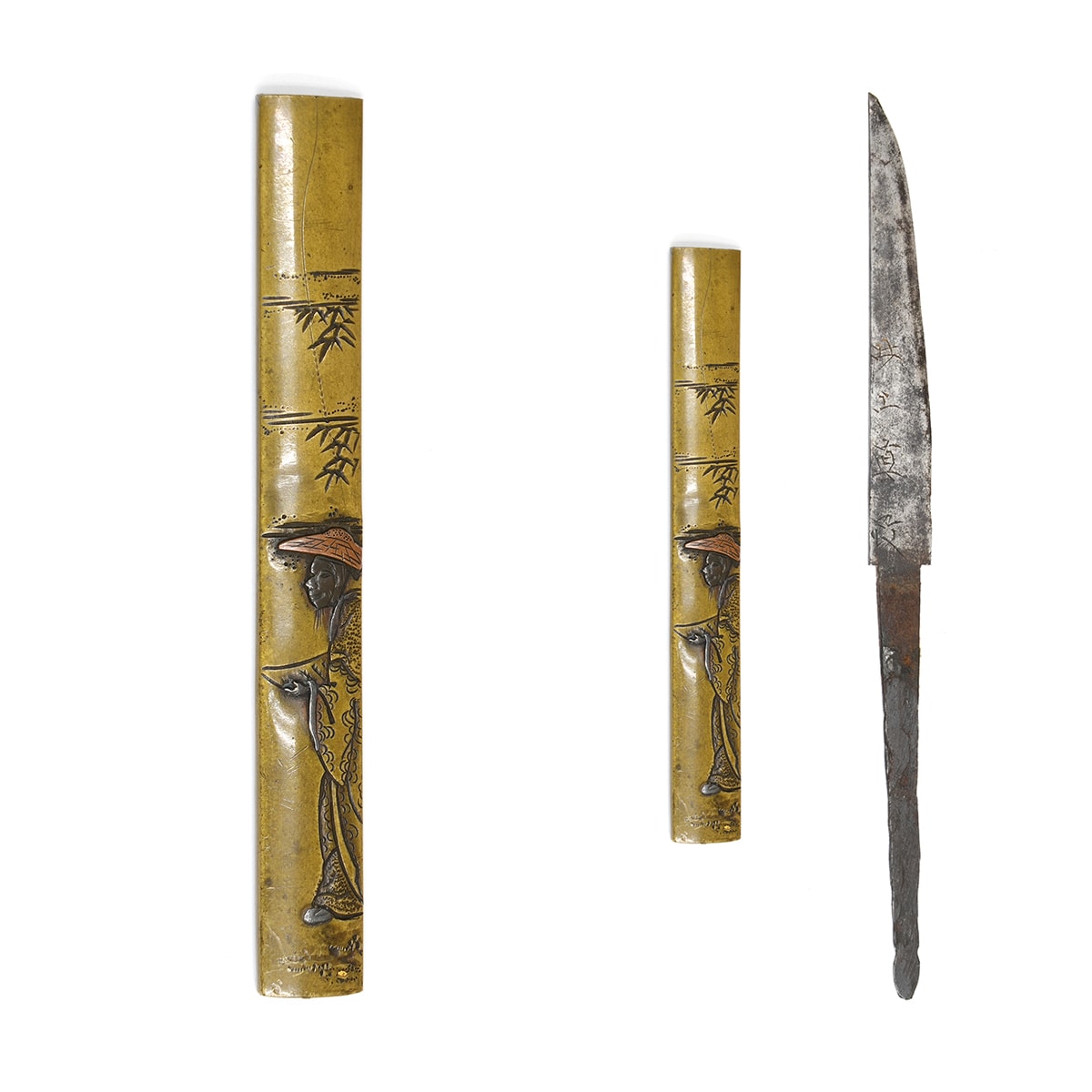
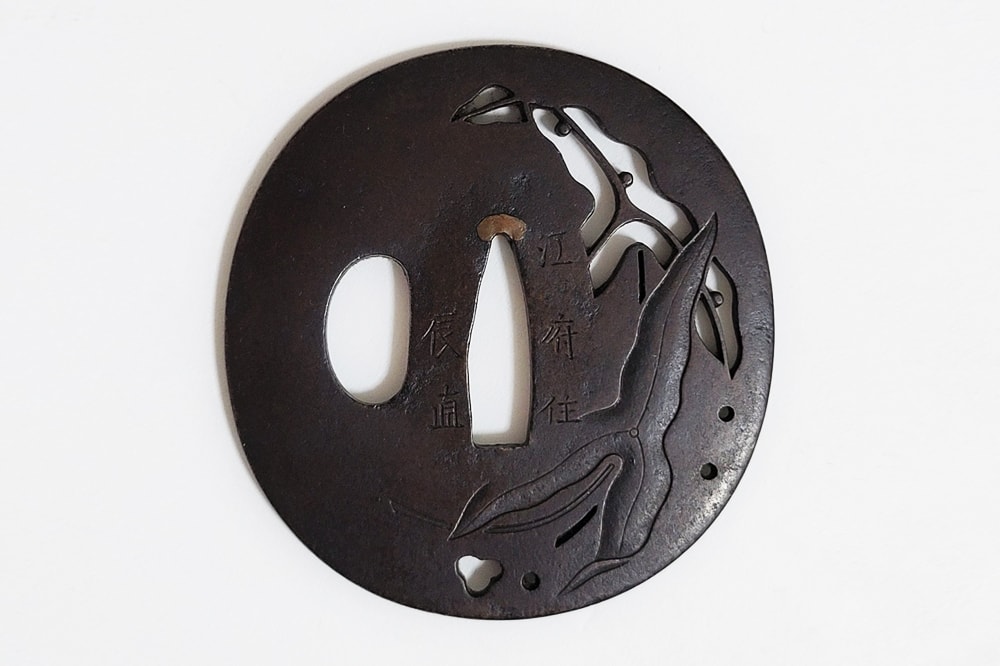
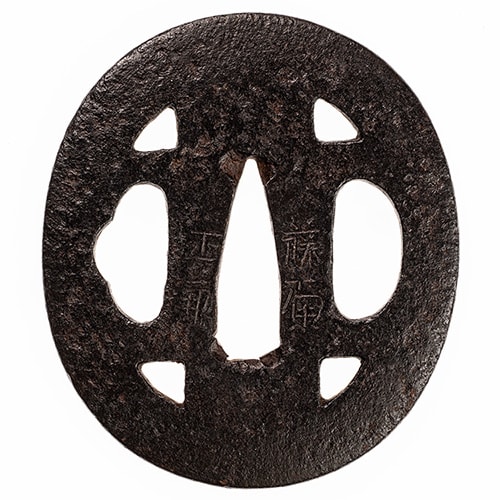
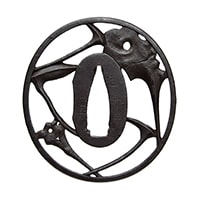
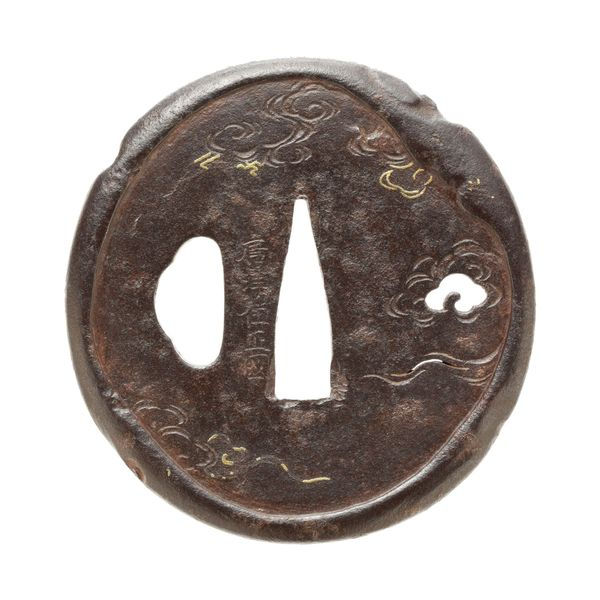
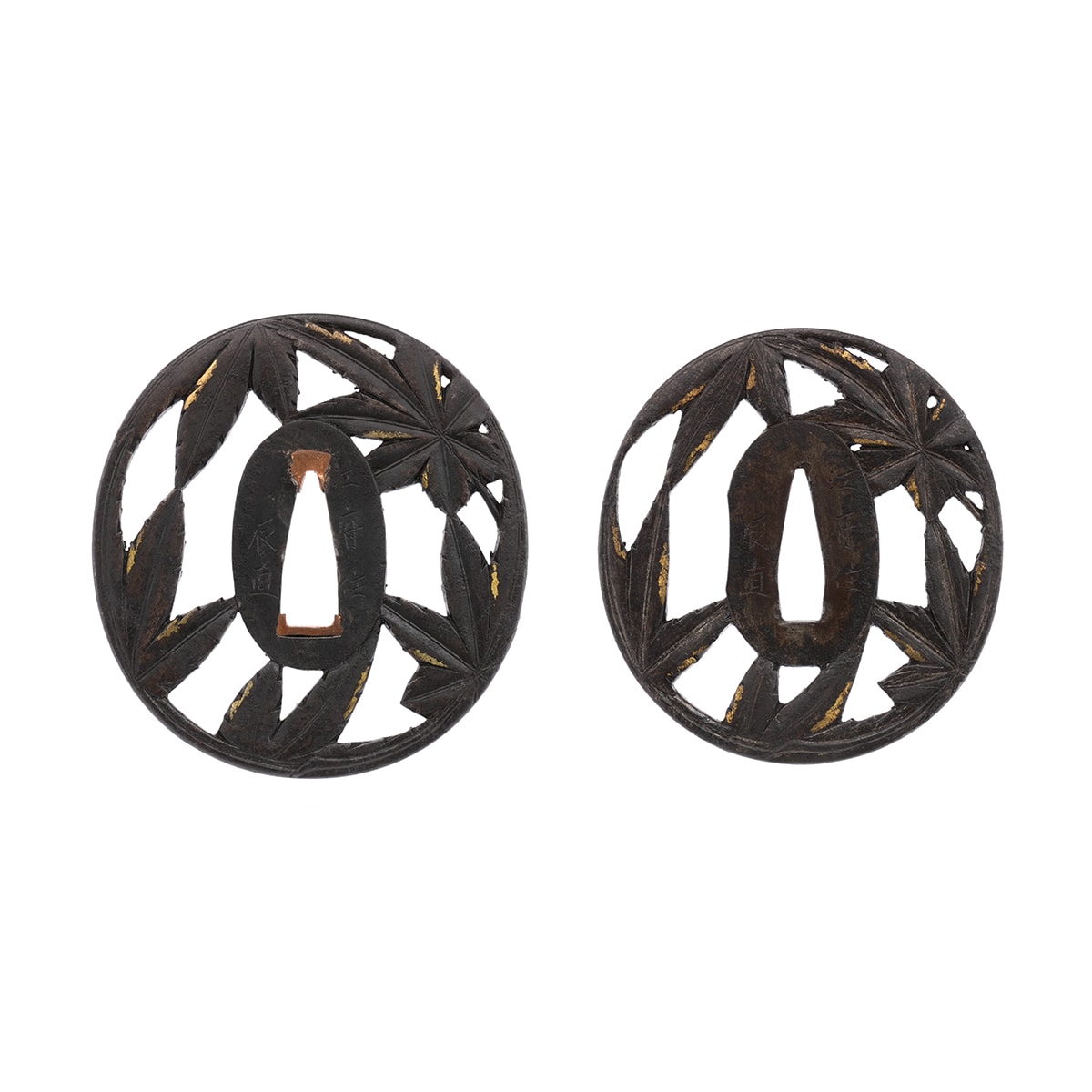
This is an Ito school tsuba by Masakata, featuring a round iron ground with nikuborijisukashi (meat carved openwork) depicting bamboo grass. Masakata, active during the Edo period, was known for his fine openwork and was the third generation of the Ito school, which specialized in tsuba for the Edo Shogunate. The tsuba comes with a Hozon guarantee.
 NihontoWatch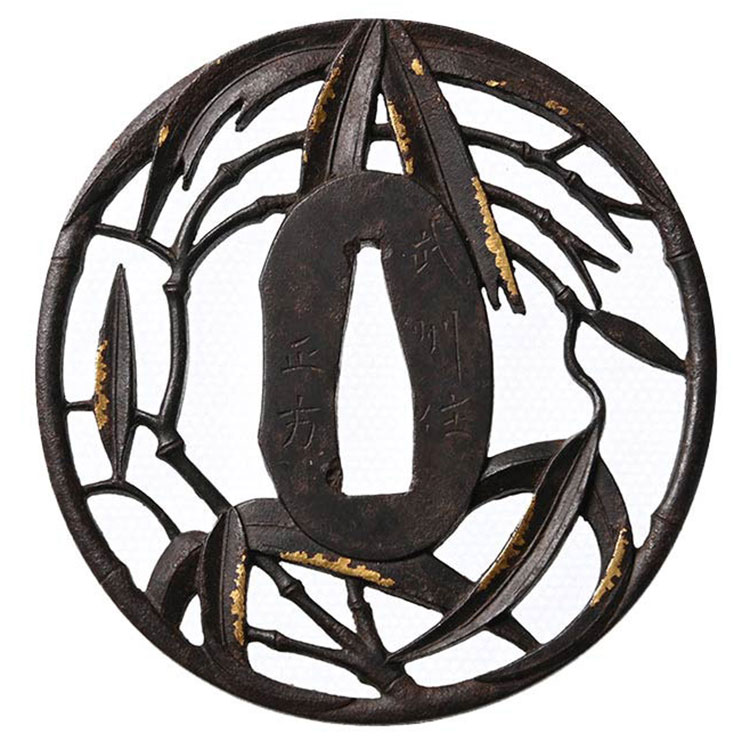
Iron-tsuba · Musashi
2 pieces on the market now
Iron-tsuba · Musashi
57 pieces on the market now
The Ito school (伊藤派) was a prolific kinkō lineage based in Kanda, Edo, in Musashi province. The line was established by Masanaga (正長, d. 1727), who received appointment as official tsuba maker (kōgi o-kakae tsubashi) to the Tokugawa Shogunate following an audience with Shogun Ienobu in 1710. Successive heads bore the character 正 (Masa-) in their art names, producing ten recorded generations from the Genroku era through the Meiji period. The second-generation master Masatsune (正恒) developed ito-sukashi (糸透かし), the school's signature technique of extremely fine saw-cut openwork. The tenth and final head, Itō Katsumi (伊藤勝見, 1829--1910), originally named Masataka (正隆), entered the school of Tanaka Seiju (田中清寿) at twelve, was adopted into his master's household at seventeen, and received the rank of Hōkyō (法橋) while still young, together with the art name Tōryūsai (東竜斎). After parting ways with Seiju, Katsumi studied maki-e under Shibata Zeshin (柴田是真), and in Man'en 1 (1860) was adopted into the Itō Masahiro family, becoming the tenth-generation head. This dual formation -- kinkō discipline under the Tanaka lineage and lacquer refinement under Zeshin -- profoundly shaped the school's late output.
The Ito school's collective style is characterised by mastery of zōgan (象嵌, inlay) and iroe (色絵, polychrome metalwork) deployed with what the setsumei repeatedly describe as precision and accuracy. Works are executed on plates of iron, shibuichi (四分一), oboro-gin (朧銀), or shakudō (赤銅), frequently with nanako-ji (魚子地) grounds. The technical repertoire encompasses takabori (高彫, high relief), sukidashi takabori (鋤出高彫), katakiribori (片切彫), fine kebori (毛彫, hairline engraving), suemon-zōgan (据文象嵌), and nunome-zōgan (布目象嵌), often combined within a single composition. Masatsune's work employs shippō (七宝, cloisonné enamel) on iron plate, as seen in a unified uchigatana koshirae signed "Bushū-jū Masatsune" whose tsuba, fuchi-kashira, kurikata, and kaerizuno are coordinated as a single aesthetic programme[[c:1]] with raden (螺鈿, mother-of-pearl) and gold uchikomi (打込) work. Katsumi's mature output favours figural and narrative subjects: the Frog Battle after the celebrated Chōjū-giga scrolls attributed to Toba Sōjō, Gama Sennin with his toad beneath a willow, and Daisē Fudō Myōō realised with emphatic devotional presence. "[[c:6]] The Ito school occupies a distinctive place in the tsuba canon as a Musashi-based lineage that sustained high-level production across the entire Edo period. Its works were widely disseminated through the sankin-kōtai system, as samurai from all provinces acquired Ito tsuba during their attendance in Edo. "[[c:7]] That his tsuba depicting the Chōjū-giga Frog Battle is described as a "forceful work from his later years"[[c:5]] whose "composition, which successfully preserves the spirit of the original painting, is outstanding" confirms the school's enduring capacity to unite pictorial invention with metalworking virtuosity. Learn more →
| Smith | Era | Designated |
|---|---|---|
| Katsumi勝見 | — | 4 |
| Sadatsune貞恒 | — | 0 |
| Masayoshi正備 | — | 0 |
| Masatsune正常 | — | 0 |
| Masakane正金 | — | 0 |
We could not find an authenticity certificate on the seller’s listing. Japanese swords and fittings are normally papered by the NBTHK (or the NTHK). Without one, the attribution is the seller’s own assessment and has not been independently verified — treat it with caution and ask the dealer about certification before buying.
Returns/exchanges/cancellations not accepted after shipment except for significant defects; if defective, return/exchange possible within 3 days of arrival (return shipping paid by customer).
This is an Ito school tsuba by Masakata, featuring a round iron ground with nikuborijisukashi (meat carved openwork) depicting bamboo grass. Masakata, active during the Edo period, was known for his fine openwork and was the third generation of the Ito school, which specialized in tsuba for the Edo Shogunate. The tsuba comes with a Hozon guarantee.
NihontoWatchIron-tsuba · Musashi
2 pieces on the market now
Iron-tsuba · Musashi
57 pieces on the market now
The Ito school (伊藤派) was a prolific kinkō lineage based in Kanda, Edo, in Musashi province. The line was established by Masanaga (正長, d. 1727), who received appointment as official tsuba maker (kōgi o-kakae tsubashi) to the Tokugawa Shogunate following an audience with Shogun Ienobu in 1710. Successive heads bore the character 正 (Masa-) in their art names, producing ten recorded generations from the Genroku era through the Meiji period. The second-generation master Masatsune (正恒) developed ito-sukashi (糸透かし), the school's signature technique of extremely fine saw-cut openwork. The tenth and final head, Itō Katsumi (伊藤勝見, 1829--1910), originally named Masataka (正隆), entered the school of Tanaka Seiju (田中清寿) at twelve, was adopted into his master's household at seventeen, and received the rank of Hōkyō (法橋) while still young, together with the art name Tōryūsai (東竜斎). After parting ways with Seiju, Katsumi studied maki-e under Shibata Zeshin (柴田是真), and in Man'en 1 (1860) was adopted into the Itō Masahiro family, becoming the tenth-generation head. This dual formation -- kinkō discipline under the Tanaka lineage and lacquer refinement under Zeshin -- profoundly shaped the school's late output.
The Ito school's collective style is characterised by mastery of zōgan (象嵌, inlay) and iroe (色絵, polychrome metalwork) deployed with what the setsumei repeatedly describe as precision and accuracy. Works are executed on plates of iron, shibuichi (四分一), oboro-gin (朧銀), or shakudō (赤銅), frequently with nanako-ji (魚子地) grounds. The technical repertoire encompasses takabori (高彫, high relief), sukidashi takabori (鋤出高彫), katakiribori (片切彫), fine kebori (毛彫, hairline engraving), suemon-zōgan (据文象嵌), and nunome-zōgan (布目象嵌), often combined within a single composition. Masatsune's work employs shippō (七宝, cloisonné enamel) on iron plate, as seen in a unified uchigatana koshirae signed "Bushū-jū Masatsune" whose tsuba, fuchi-kashira, kurikata, and kaerizuno are coordinated as a single aesthetic programme[[c:1]] with raden (螺鈿, mother-of-pearl) and gold uchikomi (打込) work. Katsumi's mature output favours figural and narrative subjects: the Frog Battle after the celebrated Chōjū-giga scrolls attributed to Toba Sōjō, Gama Sennin with his toad beneath a willow, and Daisē Fudō Myōō realised with emphatic devotional presence. "[[c:6]] The Ito school occupies a distinctive place in the tsuba canon as a Musashi-based lineage that sustained high-level production across the entire Edo period. Its works were widely disseminated through the sankin-kōtai system, as samurai from all provinces acquired Ito tsuba during their attendance in Edo. "[[c:7]] That his tsuba depicting the Chōjū-giga Frog Battle is described as a "forceful work from his later years"[[c:5]] whose "composition, which successfully preserves the spirit of the original painting, is outstanding" confirms the school's enduring capacity to unite pictorial invention with metalworking virtuosity. Learn more →
| Smith | Era | Designated |
|---|---|---|
| Katsumi勝見 | — | 4 |
| Sadatsune貞恒 | — | 0 |
| Masayoshi正備 | — | 0 |
| Masatsune正常 | — | 0 |
| Masakane正金 | — | 0 |
We could not find an authenticity certificate on the seller’s listing. Japanese swords and fittings are normally papered by the NBTHK (or the NTHK). Without one, the attribution is the seller’s own assessment and has not been independently verified — treat it with caution and ask the dealer about certification before buying.
Returns/exchanges/cancellations not accepted after shipment except for significant defects; if defective, return/exchange possible within 3 days of arrival (return shipping paid by customer).