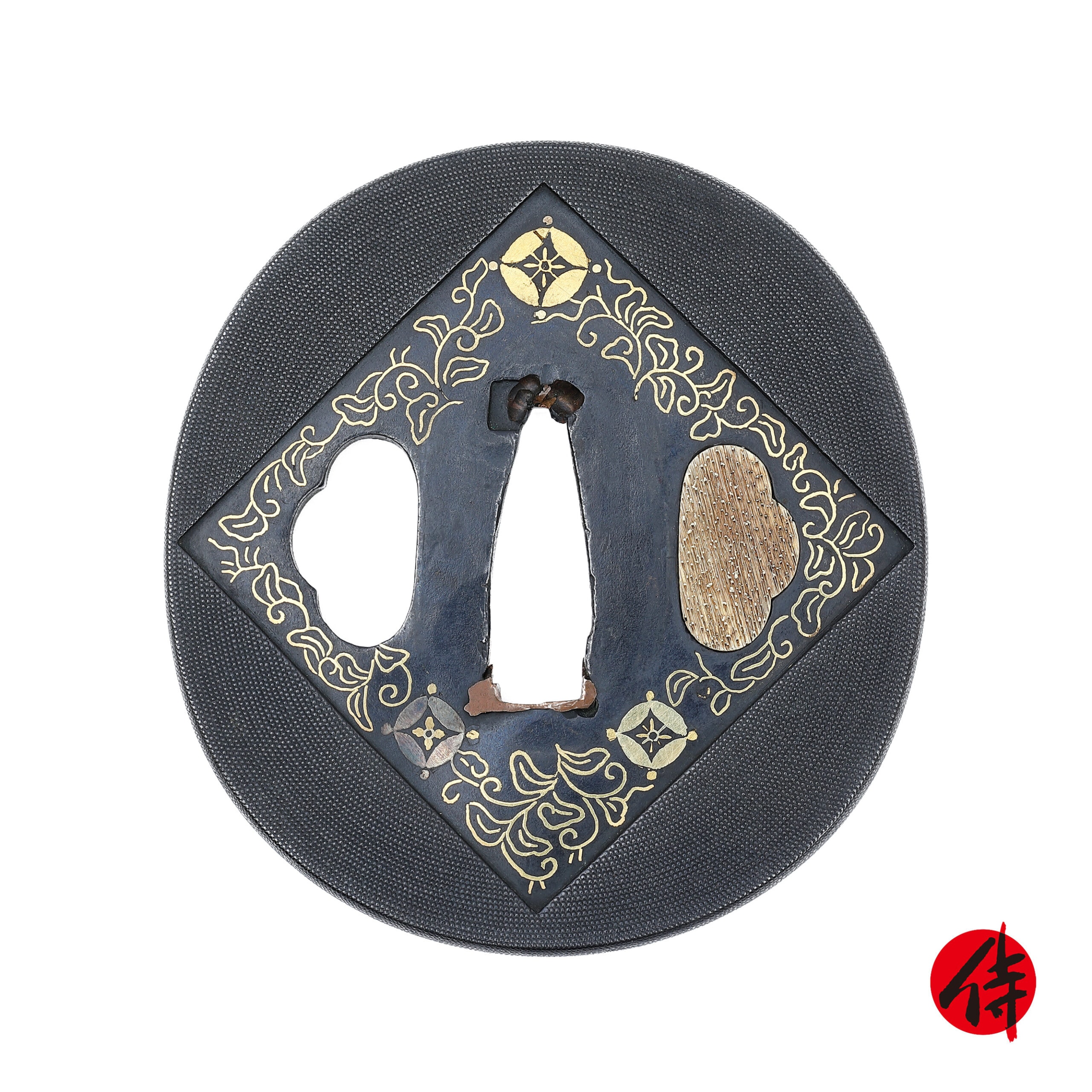
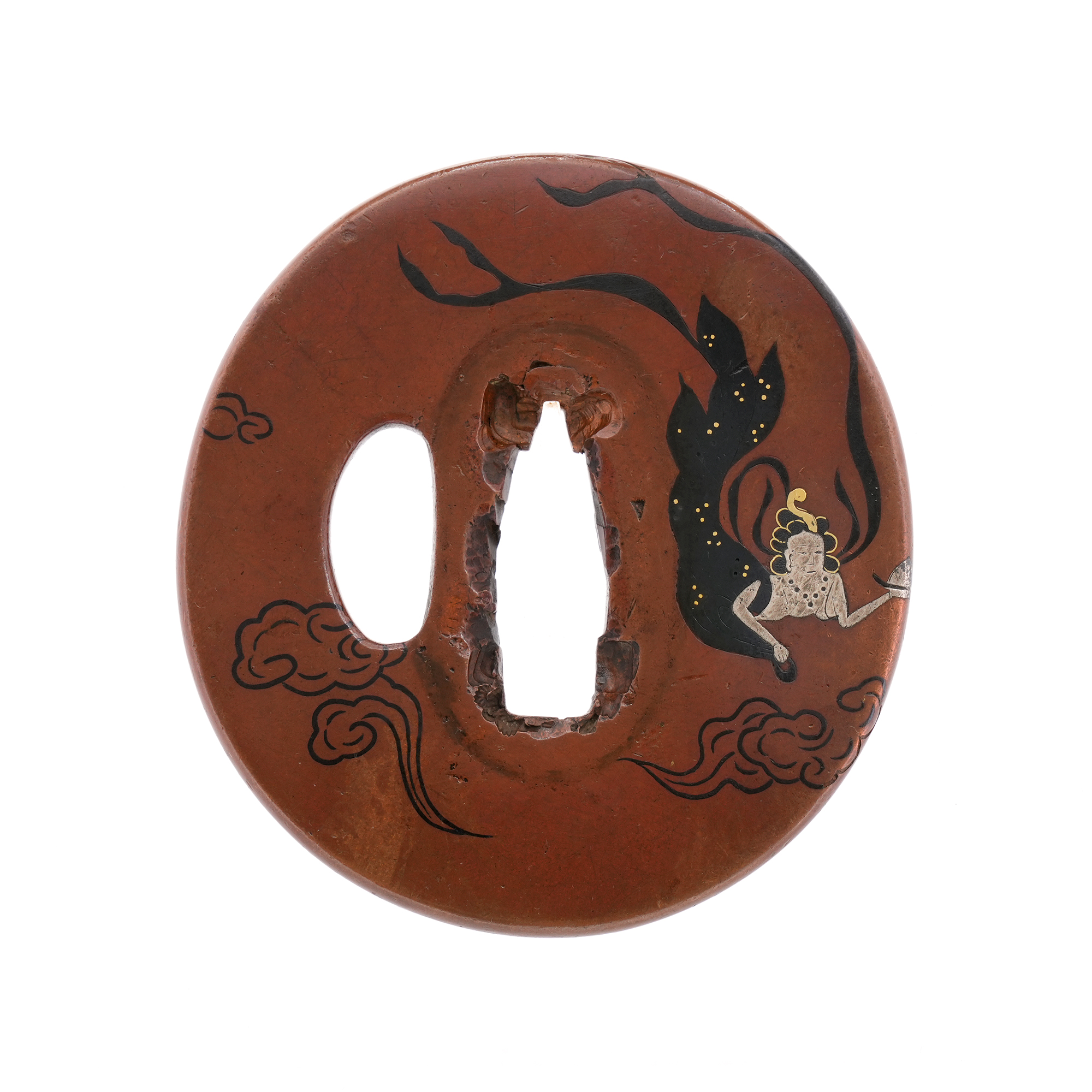
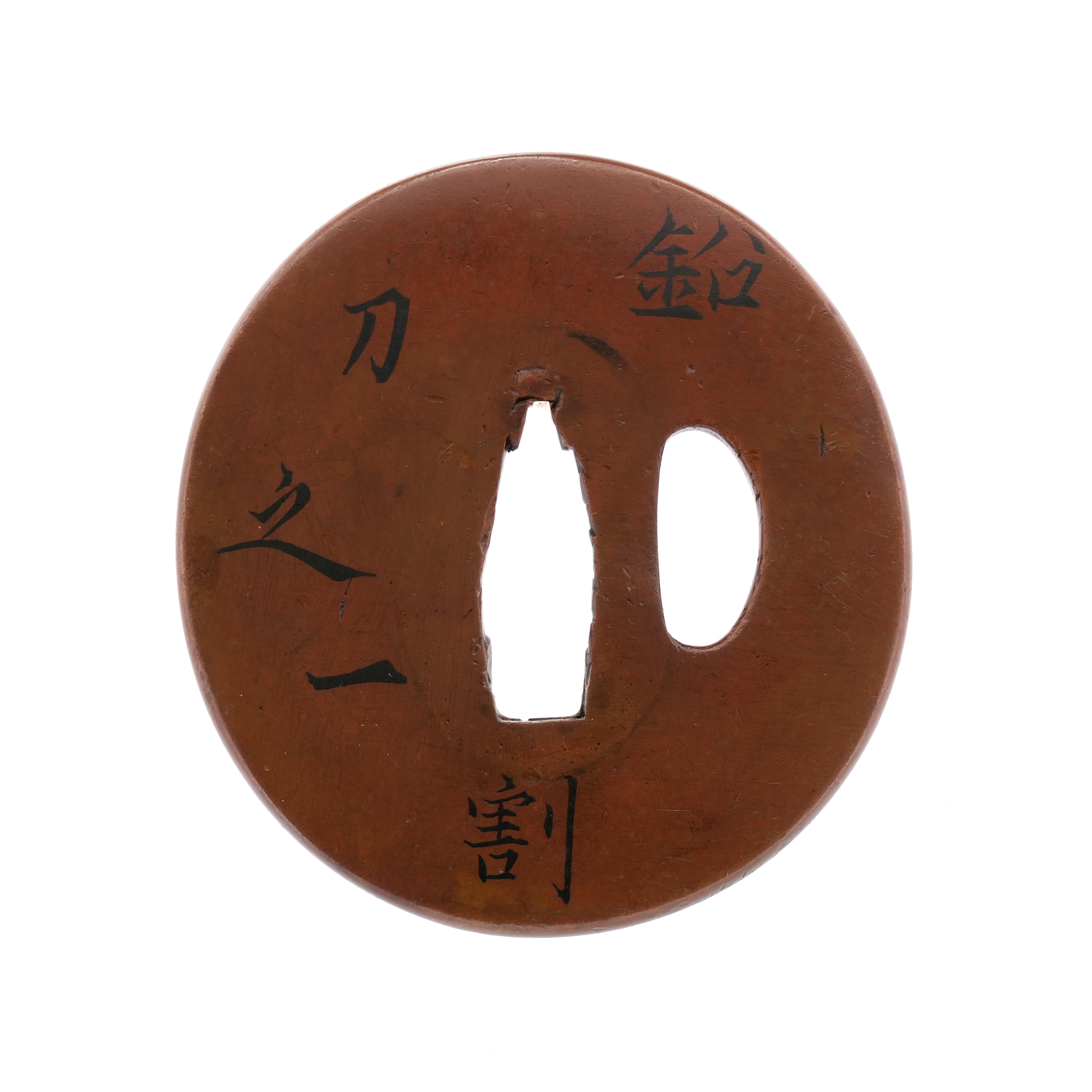
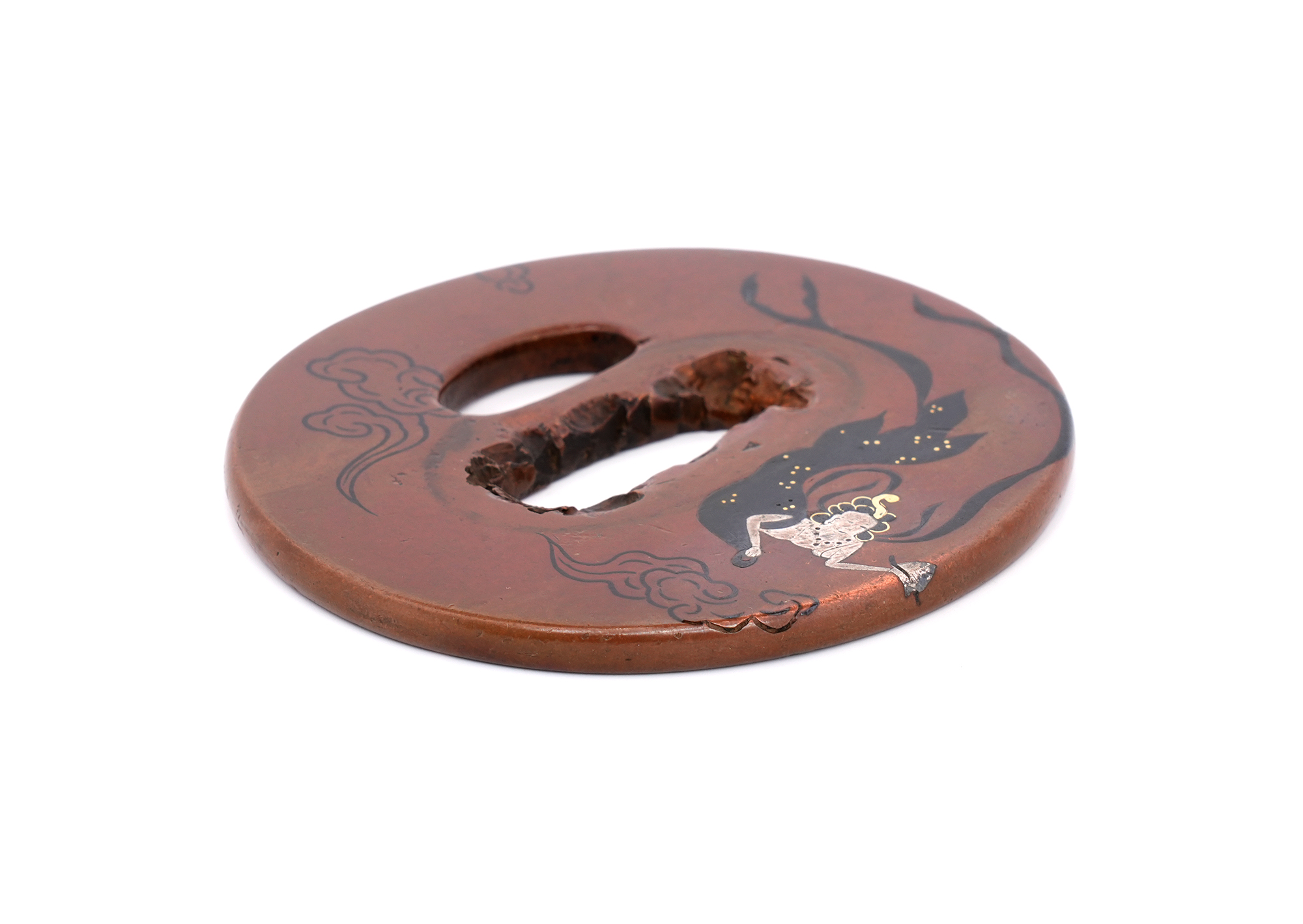
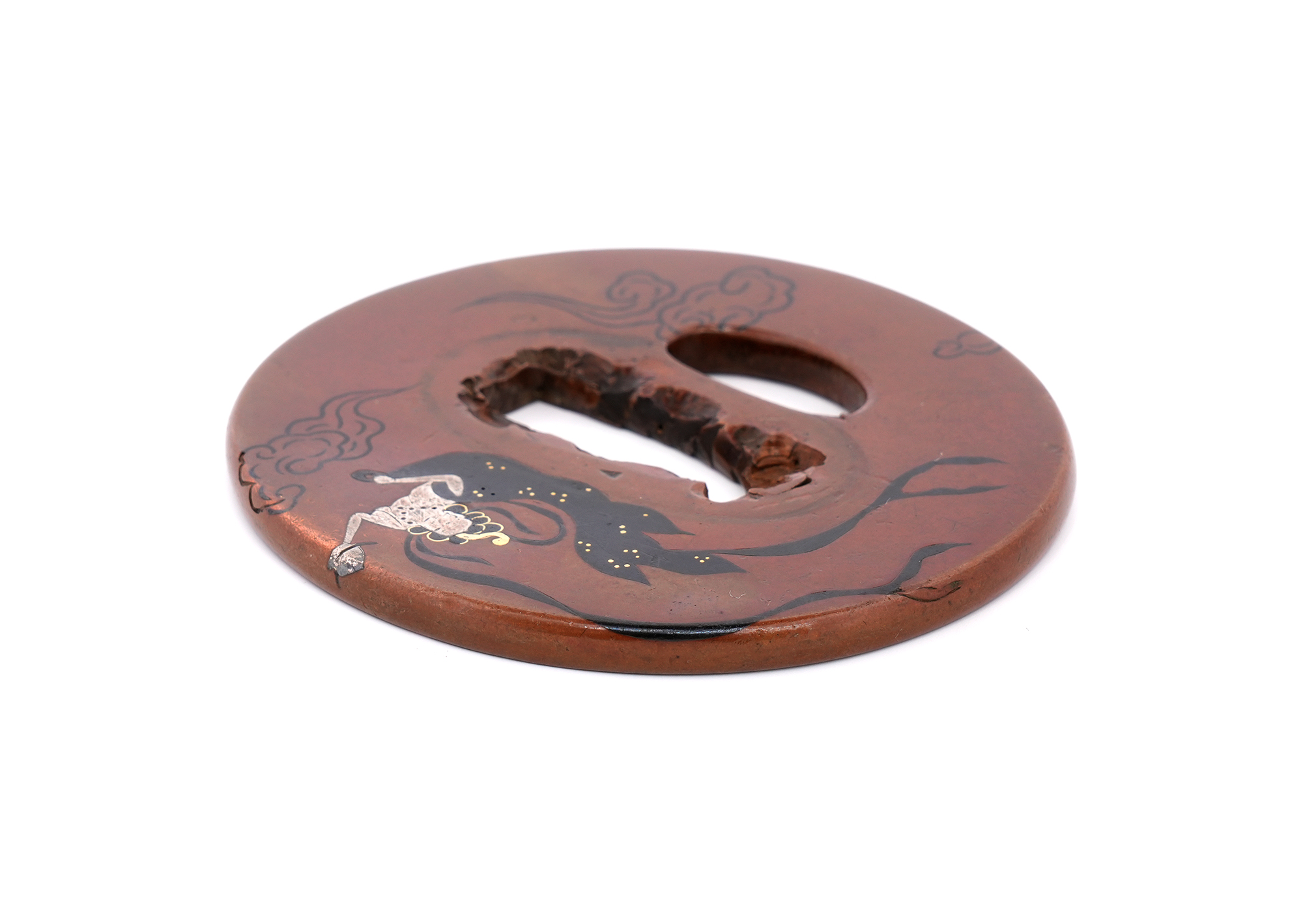
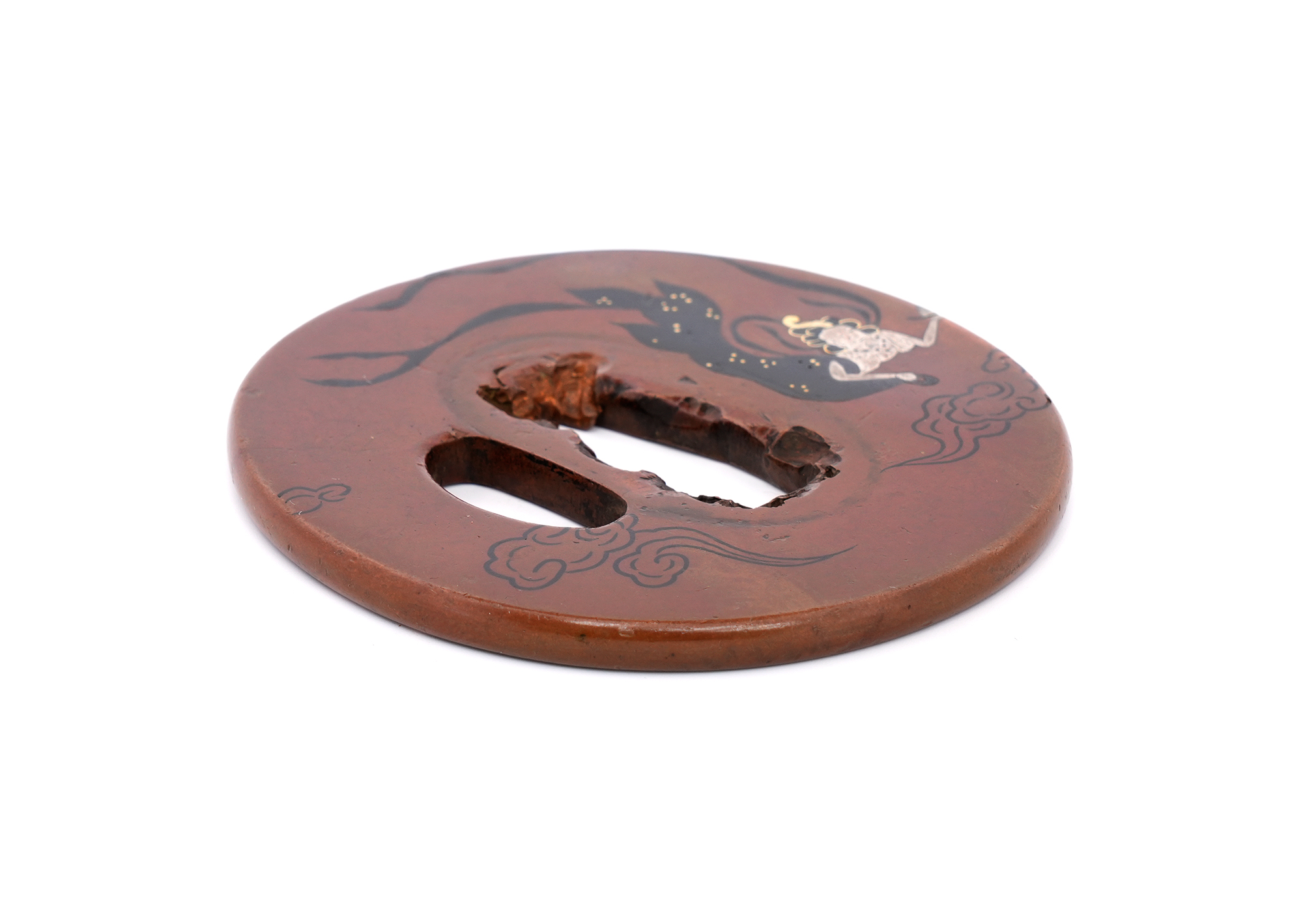
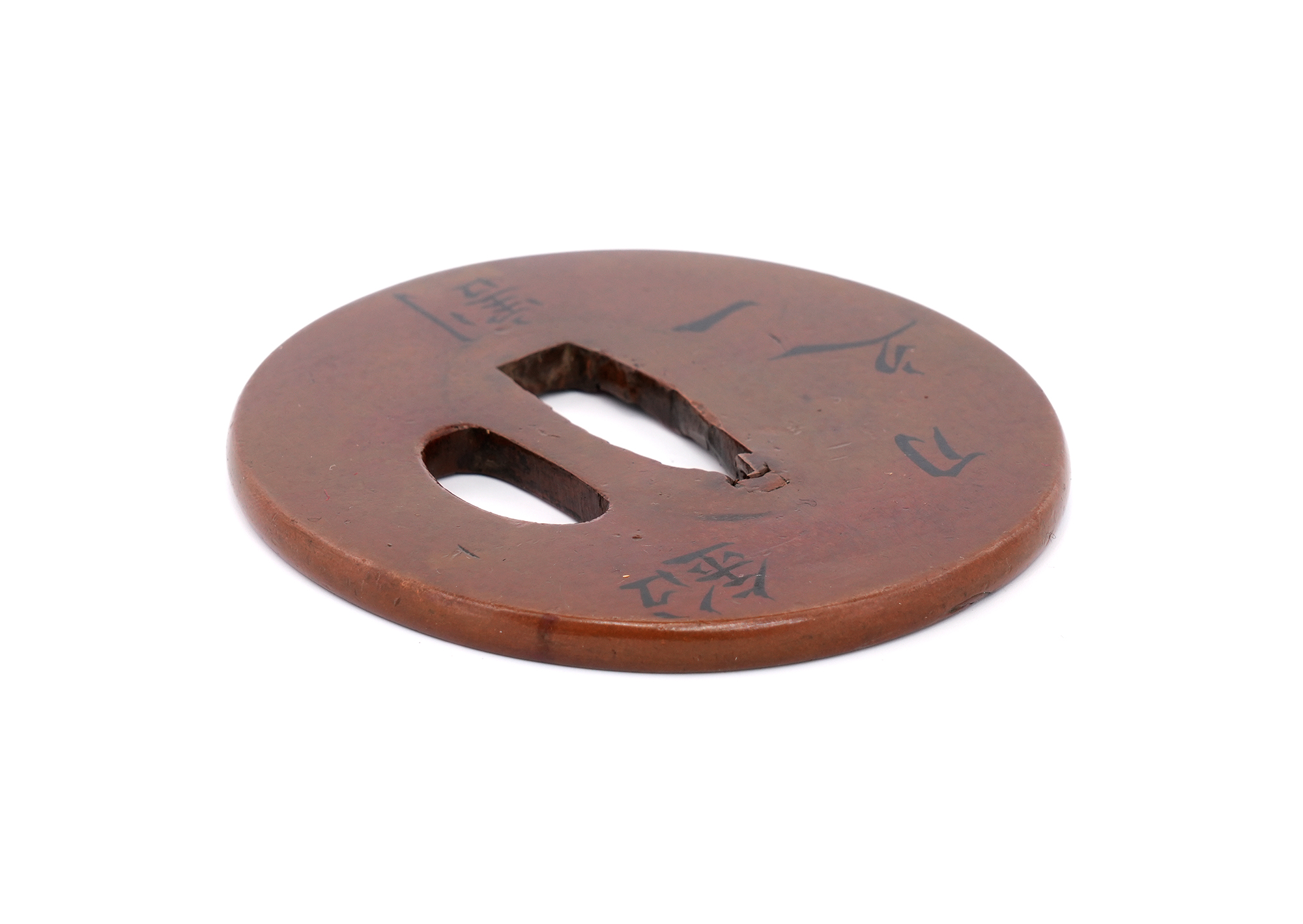
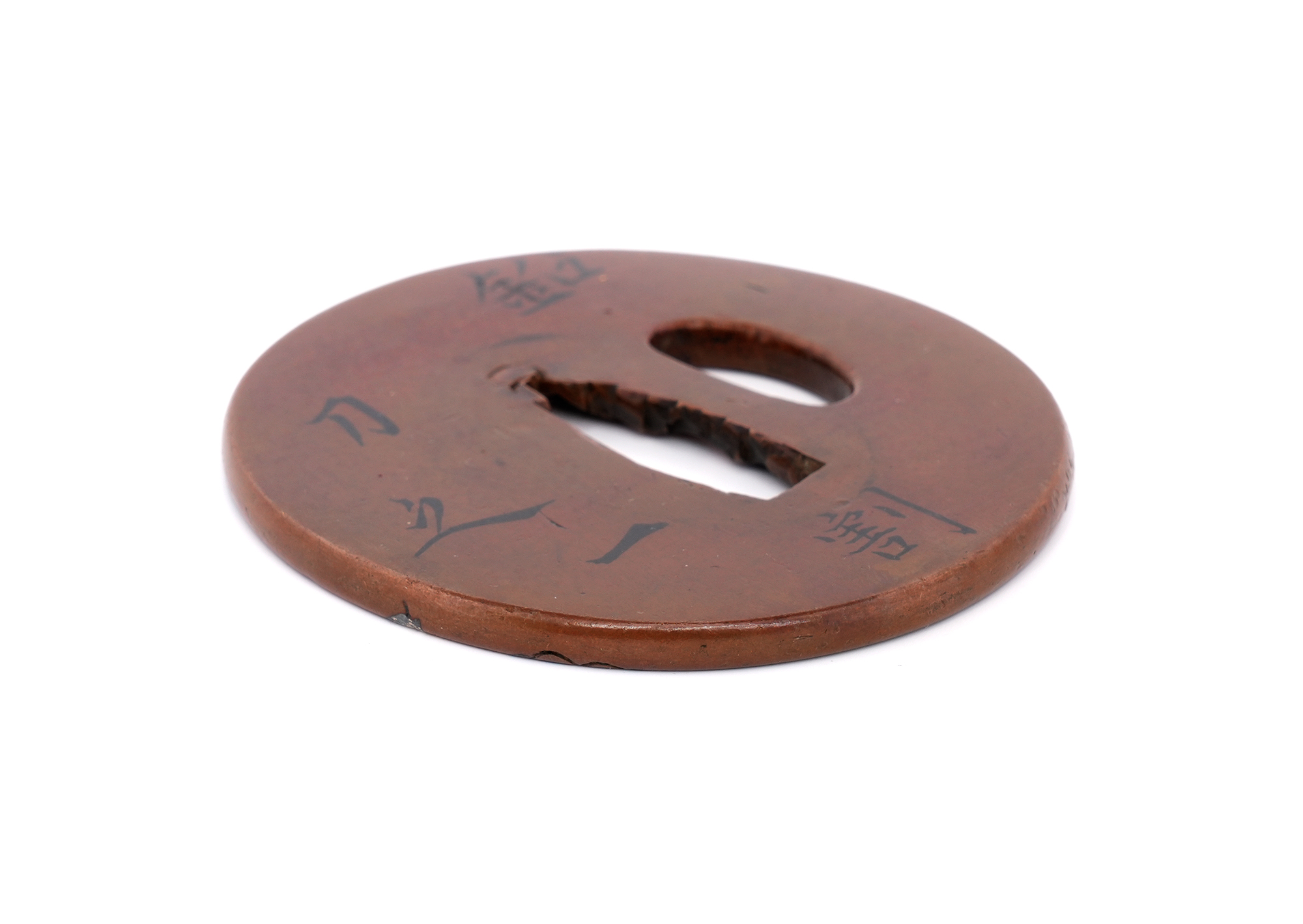
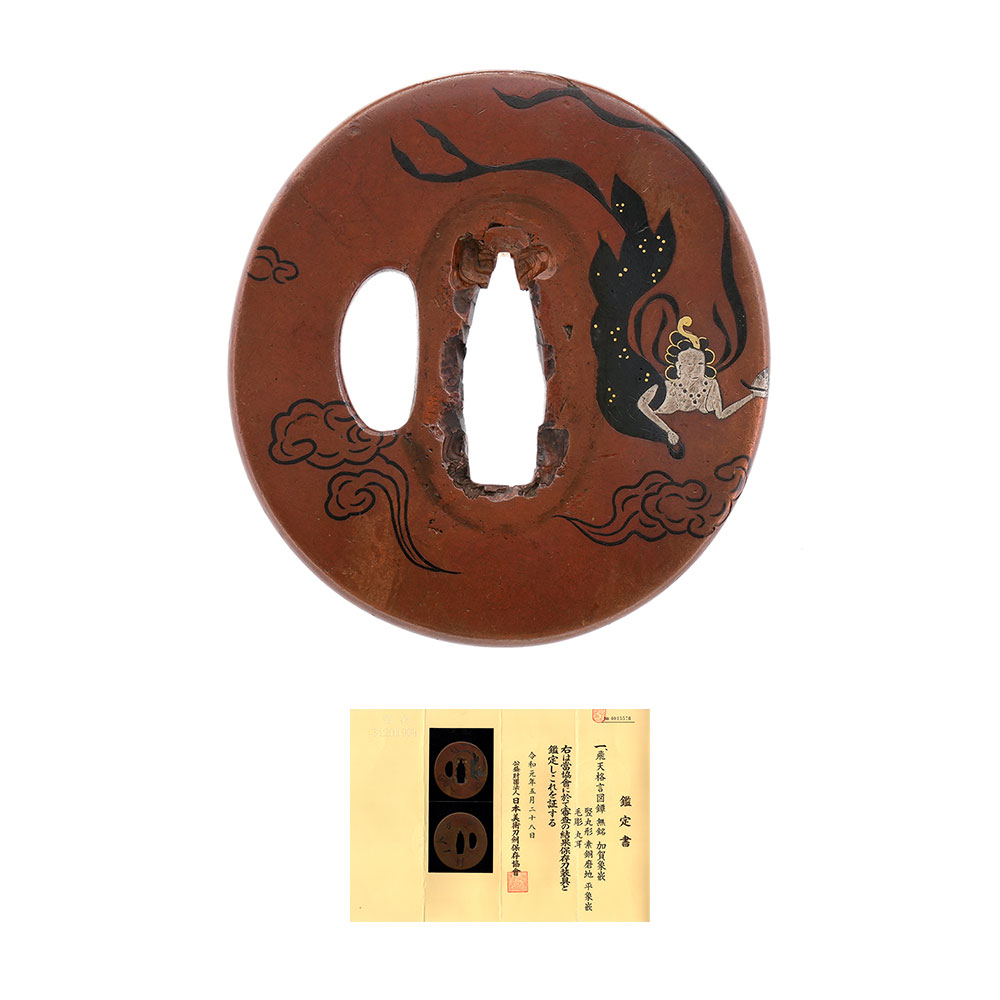
This is an old tsuba made of suaka (copper alloy). The front depicts a Hiten (flying celestial being) and the reverse features an inlaid proverb, 'En-to no Ichi-wari' (鉛刀之一割). This proverb signifies that even an ordinary person can sometimes exert great power, or that something can only be used once. The tsuba expresses the spirit of a samurai who is ready to demonstrate their strength when needed.
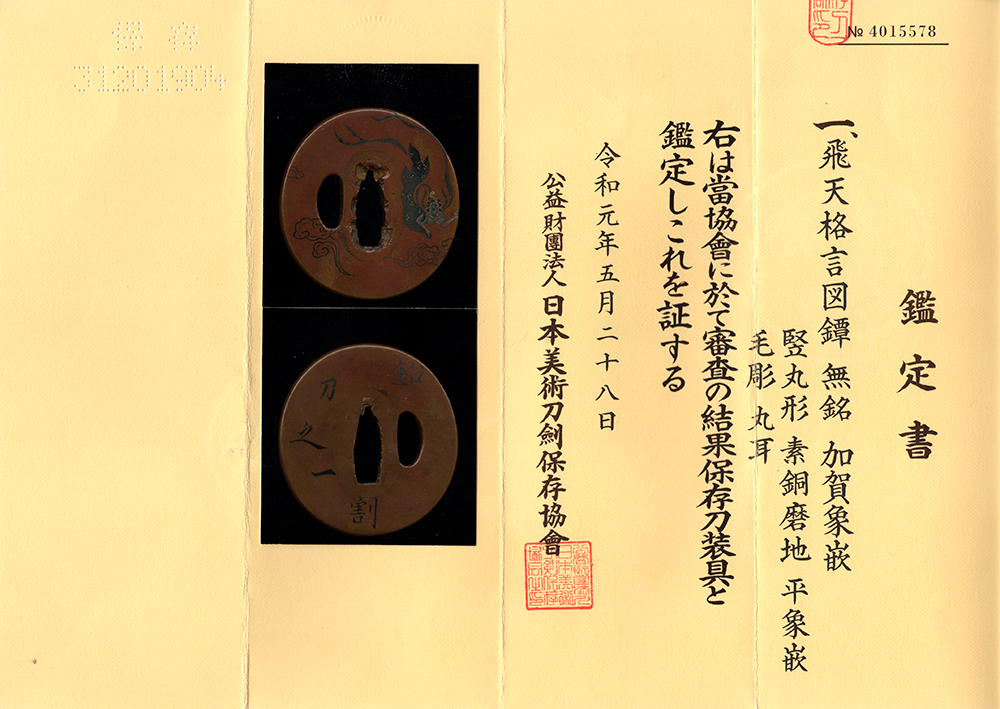
Certificate reading — 無銘(加賀象嵌)
 NihontoWatch
mumei · Kaga Zogan · Edo
Kinko · Kaga
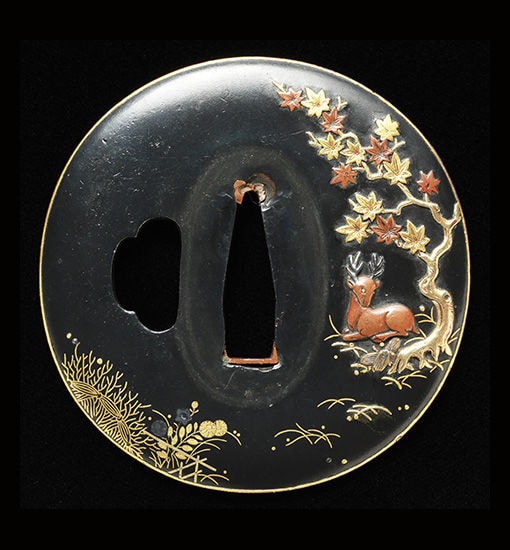
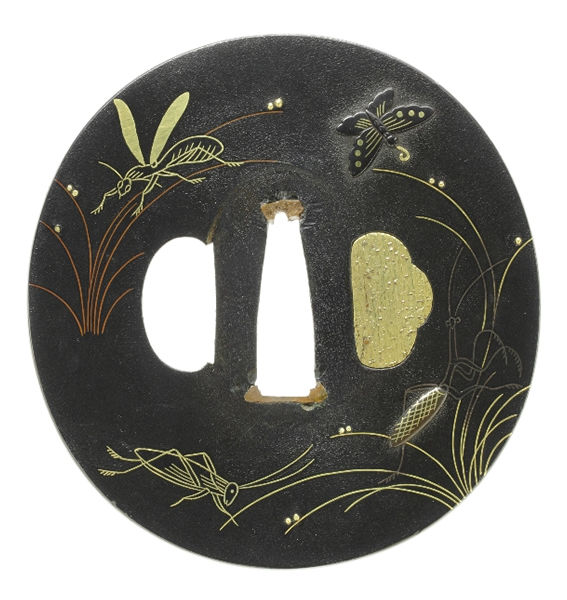
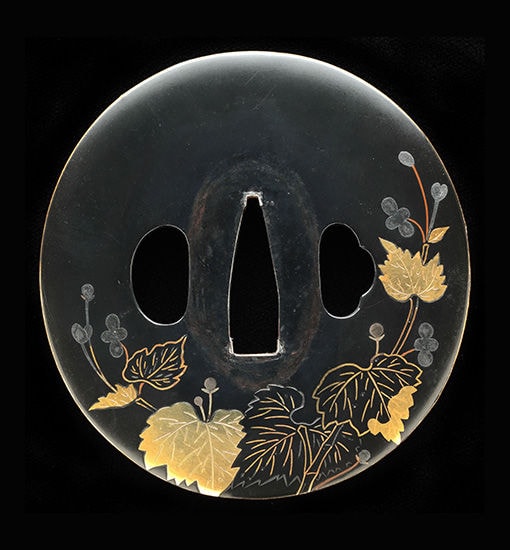
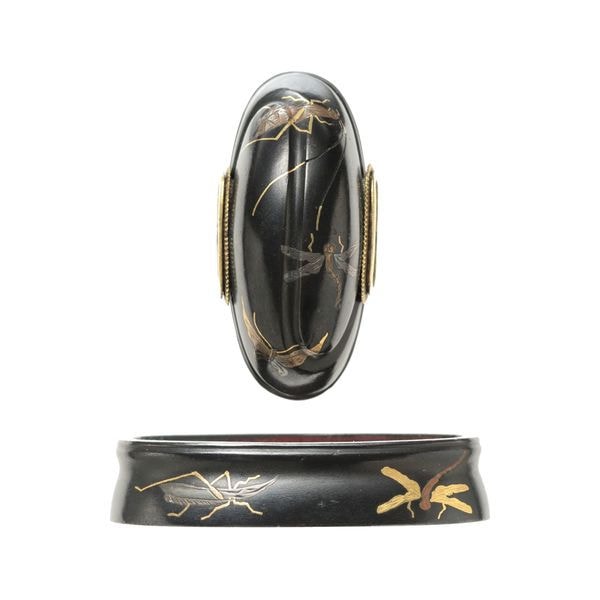
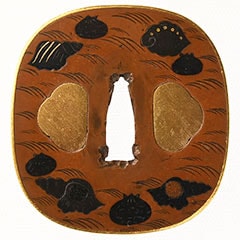
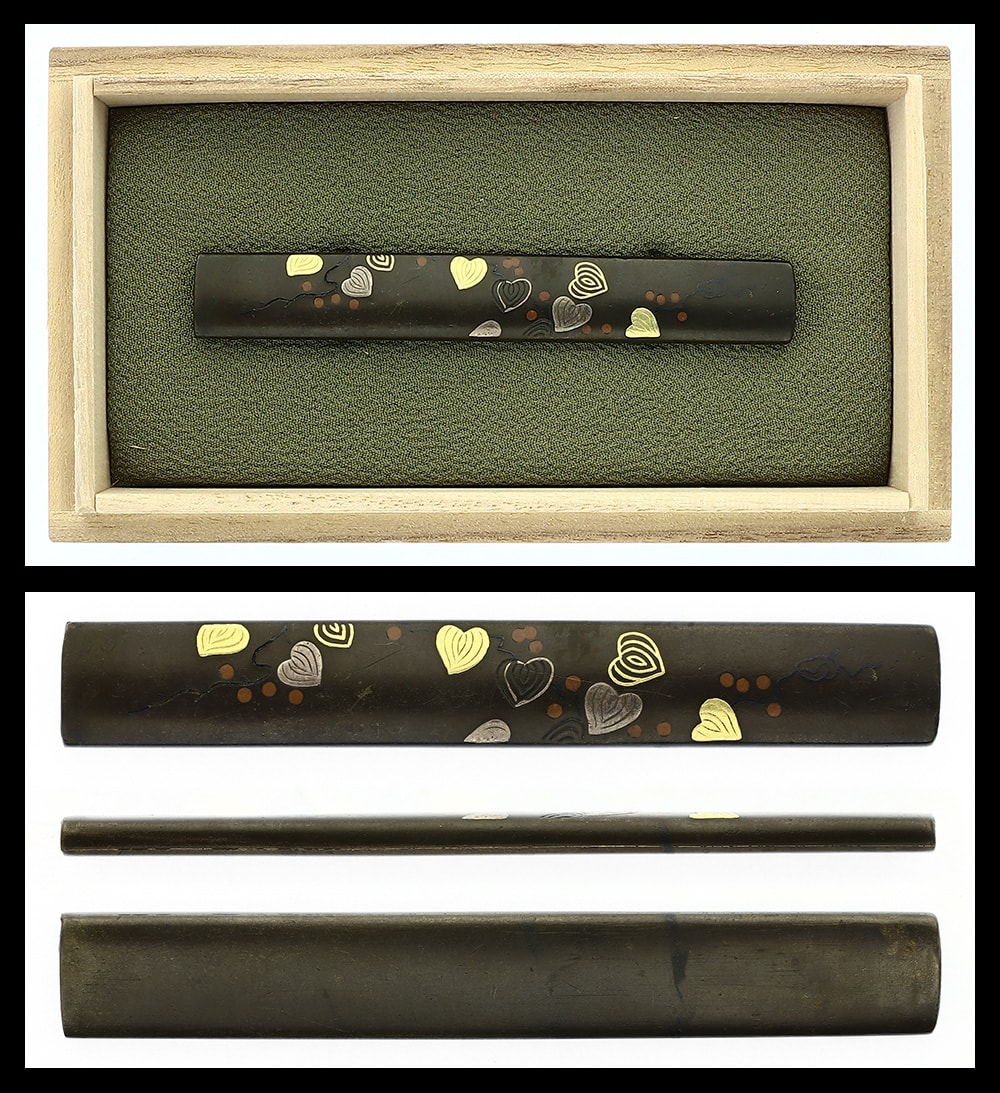
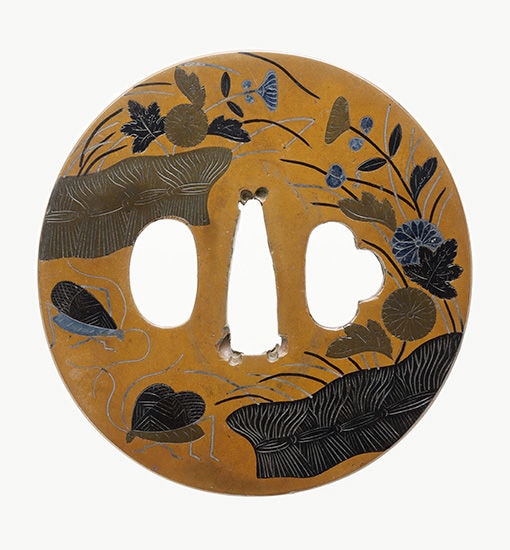
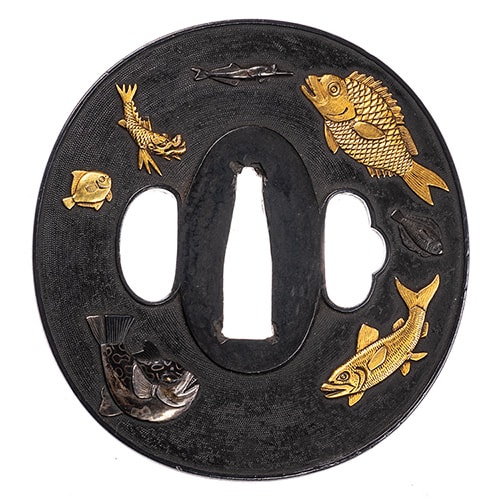
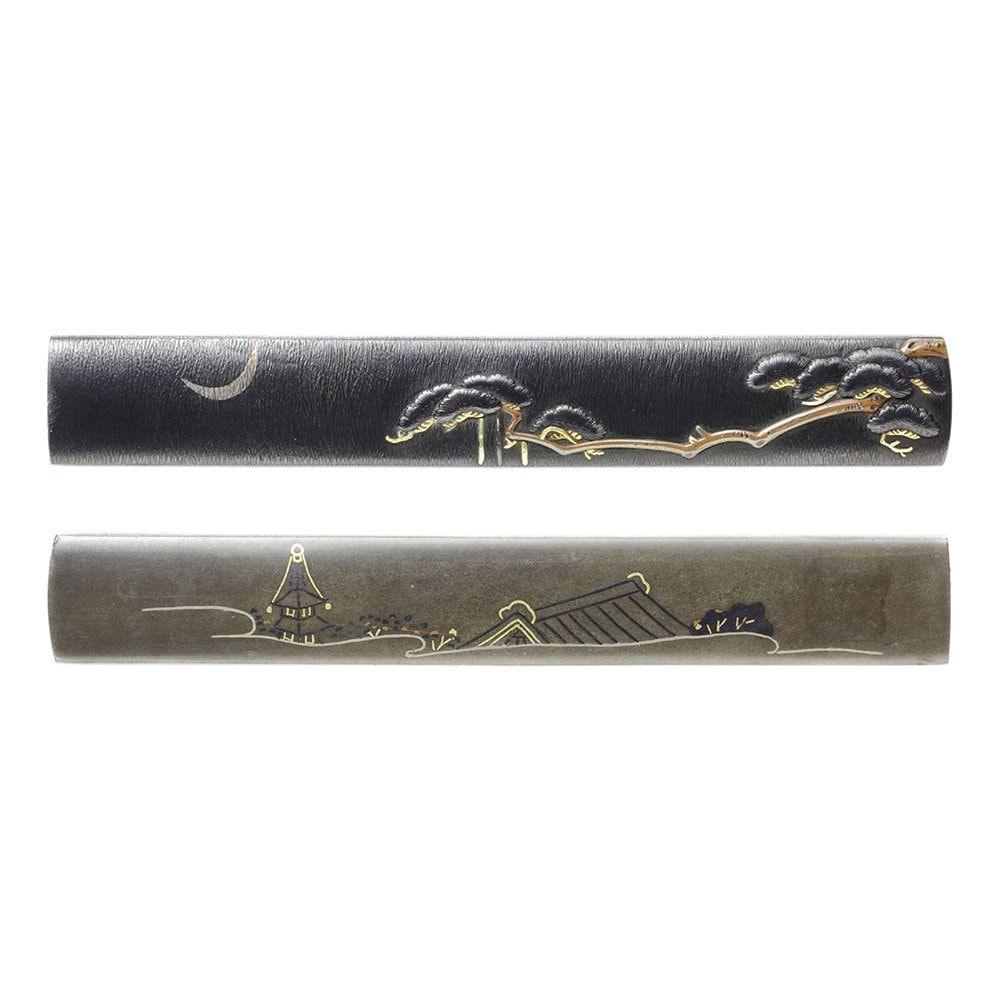
Kaga zōgan is a distinctive technique of flat inlay (hira-zōgan) that developed in Kaga Province, centered on the castle town of Kanazawa, from the early Edo period through approximately the Kyōhō era (1716–1736). The tradition emerged under the patronage of the Maeda family, lords of the famed "million-koku domain," when craftsmen's families including Kuwamura, Tsuji, Katsuki, and Koichi reportedly migrated from Kyoto around the Kan'ei and Jōō eras. The technique is said to have flourished through the adaptation of the flat-inlay methods practiced by stirrup makers (abumi-shi) and armorers to tsuba and other sword fittings, establishing a regionally distinct metalworking tradition. The hallmark of Kaga zōgan work lies in its compositional sophistication and technical versatility. Working on polished grounds (migaki-ji) of shakudō or shibuichi—occasionally using "hazy" silver (oboro-gin)—artisans deployed a remarkably wide palette of colored metals: gold, silver, scarlet copper (hi-irodō), and various alloys, often differentiating multiple tonal gradations within a single metal. The flat inlay is frequently enhanced with fine hairline engraving (kebori), allowing for precise definition of pictorial elements.
Characteristic motifs range from naturalistic scenes—autumn grasses, butterflies, dianthus with brushwood fences—to geometric abstractions and elegant Genji monogatari vignettes rendered through architectural elements. The compositional planning is notably skillful: dense, all-over arrangements are organized with clarity, spatial balance maintained through strategic placement of contrasting elements, and pictorial fields often enlivened by rhythmic movement. Most surviving Kaga zōgan examples date from the mid-Edo period, a time when the tradition reached its mature expression. Works characteristically remain unsigned (mumei), reflecting the collective nature of this regional school rather than individual workshop identities. The tradition fully manifests the aesthetic ideals of Kanazawa's courtly culture under Maeda patronage: splendor tempered by precision, technical virtuosity deployed in service of refined compositional elegance, and a distinctive regional voice within the broader spectrum of Edo-period tōsōgu craftsmanship. Learn more →
Certifies a genuine fitting worth preserving: a correct signature, or, if unsigned, an identifiable era and school, with recognized artistic and craft value.
The NBTHK (Nihon Bijutsu Tōken Hozon Kyōkai, the Society for the Preservation of Japanese Art Swords) is a public-interest incorporated foundation founded in 1948 and supervised by Japan’s Agency for Cultural Affairs (Bunkachō); it is based at the Japanese Sword Museum in Tokyo. Its expert panels physically examine each submitted work (shinsa) and issue a certificate (kanteishō) ranking it by artistic and historical merit. NBTHK papers are the most widely recognized standard of authentication for Japanese swords and fittings.
NBTHK official siteReturns accepted within 3 days of delivery for defective items or significant discrepancies; customer bears return shipping and bank fees.
¥220,000
This is an old tsuba made of suaka (copper alloy). The front depicts a Hiten (flying celestial being) and the reverse features an inlaid proverb, 'En-to no Ichi-wari' (鉛刀之一割). This proverb signifies that even an ordinary person can sometimes exert great power, or that something can only be used once. The tsuba expresses the spirit of a samurai who is ready to demonstrate their strength when needed.
Certificate reading — 無銘(加賀象嵌)
NihontoWatchmumei · Kaga Zogan · Edo
Kinko · Kaga
Kaga zōgan is a distinctive technique of flat inlay (hira-zōgan) that developed in Kaga Province, centered on the castle town of Kanazawa, from the early Edo period through approximately the Kyōhō era (1716–1736). The tradition emerged under the patronage of the Maeda family, lords of the famed "million-koku domain," when craftsmen's families including Kuwamura, Tsuji, Katsuki, and Koichi reportedly migrated from Kyoto around the Kan'ei and Jōō eras. The technique is said to have flourished through the adaptation of the flat-inlay methods practiced by stirrup makers (abumi-shi) and armorers to tsuba and other sword fittings, establishing a regionally distinct metalworking tradition. The hallmark of Kaga zōgan work lies in its compositional sophistication and technical versatility. Working on polished grounds (migaki-ji) of shakudō or shibuichi—occasionally using "hazy" silver (oboro-gin)—artisans deployed a remarkably wide palette of colored metals: gold, silver, scarlet copper (hi-irodō), and various alloys, often differentiating multiple tonal gradations within a single metal. The flat inlay is frequently enhanced with fine hairline engraving (kebori), allowing for precise definition of pictorial elements.
Characteristic motifs range from naturalistic scenes—autumn grasses, butterflies, dianthus with brushwood fences—to geometric abstractions and elegant Genji monogatari vignettes rendered through architectural elements. The compositional planning is notably skillful: dense, all-over arrangements are organized with clarity, spatial balance maintained through strategic placement of contrasting elements, and pictorial fields often enlivened by rhythmic movement. Most surviving Kaga zōgan examples date from the mid-Edo period, a time when the tradition reached its mature expression. Works characteristically remain unsigned (mumei), reflecting the collective nature of this regional school rather than individual workshop identities. The tradition fully manifests the aesthetic ideals of Kanazawa's courtly culture under Maeda patronage: splendor tempered by precision, technical virtuosity deployed in service of refined compositional elegance, and a distinctive regional voice within the broader spectrum of Edo-period tōsōgu craftsmanship. Learn more →
Certifies a genuine fitting worth preserving: a correct signature, or, if unsigned, an identifiable era and school, with recognized artistic and craft value.
The NBTHK (Nihon Bijutsu Tōken Hozon Kyōkai, the Society for the Preservation of Japanese Art Swords) is a public-interest incorporated foundation founded in 1948 and supervised by Japan’s Agency for Cultural Affairs (Bunkachō); it is based at the Japanese Sword Museum in Tokyo. Its expert panels physically examine each submitted work (shinsa) and issue a certificate (kanteishō) ranking it by artistic and historical merit. NBTHK papers are the most widely recognized standard of authentication for Japanese swords and fittings.
NBTHK official siteReturns accepted within 3 days of delivery for defective items or significant discrepancies; customer bears return shipping and bank fees.
¥220,000