 NihontoWatchNihontoWatch
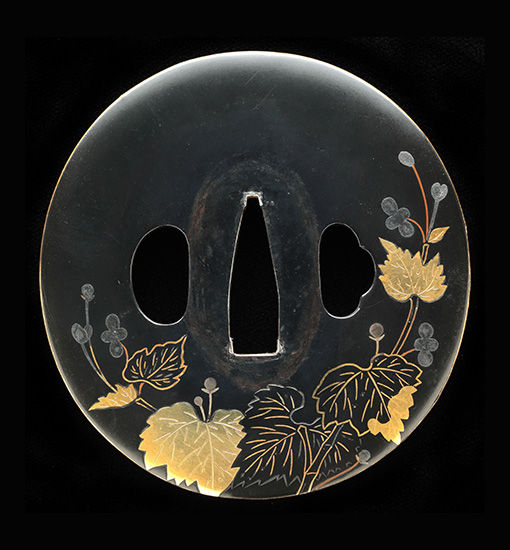
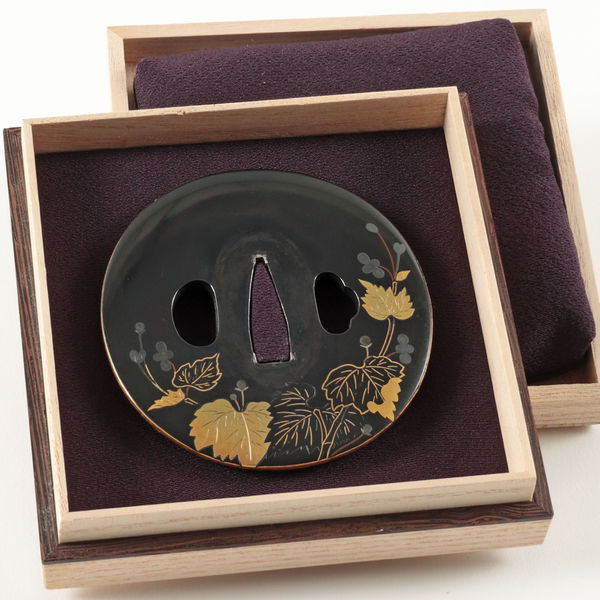
木蔭を彩る秋海棠(しゅうかいどう)の花を題に得た鐔。加賀金工による平(ひら)象嵌(ぞうがん)は、艶のある極上の赤銅地が持つ美観と、そこに描かれた多彩な題材の、写実性と文様化が鬩ぎ合う平面構成の景色に突き詰められよう。この鐔では、秋海棠の清楚な花弁を銀の渋い色調で表現し、緑の葉を鮮やかな金の平面と線描写として、鑑賞者の意識と視覚を逆転させる巧みな企てが為されている。造り込みは、光の反射を揺らぎとさせるべく地面に抑揚をつけた布袋(ほてい)腹(ばら)形とし、薄手となった耳には細い金覆(きんふく)輪(りん)を施している。島津家に伝来(注)した逸品で、ごくわずかに平象嵌の脱落がある。 特別保存刀装具鑑定書(加賀象嵌) 昭和三年の『公爵島津家蔵品入札目録』に所載。
NihontoWatchOffered by Choshuya
This piece has sold
Get an email when new Kaga zogan School work hits the market.

As written by the shop
Kinko · Kaga
Kaga zōgan is a distinctive technique of flat inlay (hira-zōgan) that developed in Kaga Province, centered on the castle town of Kanazawa, from the early Edo period through approximately the Kyōhō era (1716–1736). The tradition emerged under the patronage of the Maeda family, lords of the famed "million-koku domain," when craftsmen's families including Kuwamura, Tsuji, Katsuki, and Koichi reportedly migrated from Kyoto around the Kan'ei and Jōō eras. The technique is said to have flourished through the adaptation of the flat-inlay methods practiced by stirrup makers (abumi-shi) and armorers to tsuba and other sword fittings, establishing a regionally distinct metalworking tradition. The hallmark of Kaga zōgan work lies in its compositional sophistication and technical versatility. Working on polished grounds (migaki-ji) of shakudō or shibuichi—occasionally using "hazy" silver (oboro-gin)—artisans deployed a remarkably wide palette of colored metals: gold, silver, scarlet copper (hi-irodō), and various alloys, often differentiating multiple tonal gradations within a single metal. The flat inlay is frequently enhanced with fine hairline engraving (kebori), allowing for precise definition of pictorial elements.
Characteristic motifs range from naturalistic scenes—autumn grasses, butterflies, dianthus with brushwood fences—to geometric abstractions and elegant Genji monogatari vignettes rendered through architectural elements. The compositional planning is notably skillful: dense, all-over arrangements are organized with clarity, spatial balance maintained through strategic placement of contrasting elements, and pictorial fields often enlivened by rhythmic movement. Most surviving Kaga zōgan examples date from the mid-Edo period, a time when the tradition reached its mature expression. Works characteristically remain unsigned (mumei), reflecting the collective nature of this regional school rather than individual workshop identities. The tradition fully manifests the aesthetic ideals of Kanazawa's courtly culture under Maeda patronage: splendor tempered by precision, technical virtuosity deployed in service of refined compositional elegance, and a distinctive regional voice within the broader spectrum of Edo-period tōsōgu craftsmanship. Learn more →
A Hozon-certified fitting of notably superior craftsmanship and condition, often with signature or workmanship of high reference value.
The NBTHK (Nihon Bijutsu Tōken Hozon Kyōkai, the Society for the Preservation of Japanese Art Swords) is a public-interest incorporated foundation founded in 1948 and supervised by Japan’s Agency for Cultural Affairs (Bunkachō); it is based at the Japanese Sword Museum in Tokyo. Its expert panels physically examine each submitted work (shinsa) and issue a certificate (kanteishō) ranking it by artistic and historical merit. NBTHK papers are the most widely recognized standard of authentication for Japanese swords and fittings.
NBTHK official siteIf, due to our fault, the item differs significantly from its proper condition, the item may be returned. Cooling-off is within one week of the item's arrival.