Real name Kita Hiroshi. A disciple of Gassan Sadakatsu, he shared a brother-disciple relationship with the late Gassan Teiichi, who was a Ningen Kokuho. His forge was located near Horyuji in Ikaruga, Yamato, and starting with the Mainichi Shimbun President's Award in Showa 44, he received numerous honors at Shinsakuto exhibitions, and in his later years was designated an Juyo Mugei Bunkazai of Nara Prefecture.
At the time, the great master of the sword world, Sato Kanzan Sensei, gave his seal of approval to swordsmith Sadahiro as the most capable smith in Japan, stating that no one could surpass him when it came to making copies of old works, especially swords in the Soshu-den style.
However, his superior sword-making skills proved to be a curse; antique dealers who took notice of his ability falsified the nakago of his works, leading them to circulate as old masterpiece swords. According to one theory, copies of old masterpieces made to match vacant registration papers even received Juyo Token designation, causing a shockwave in the sword world and leading to a large-scale police investigation. It is said that he returned his Nara Prefecture Juyo Mugei Bunkazai designation to take responsibility for the crime of creating these fakes.
Furthermore, because he used his high level of skill at the time to produce many non-tanren swords made of western steel that could be mistaken for hon-tanren swords, the status of Sadahiro's swords fell into a state of instability. The inexpensive Sadahiro swords seen on the market are such non-tanren swords.
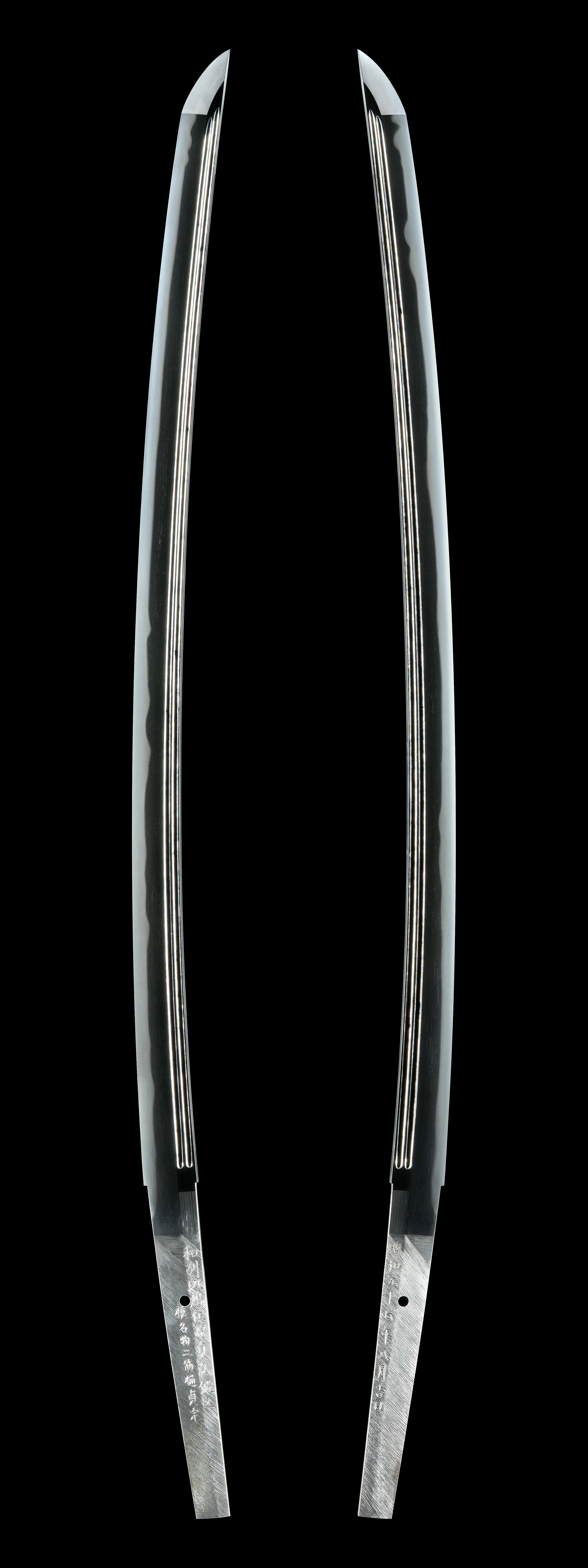
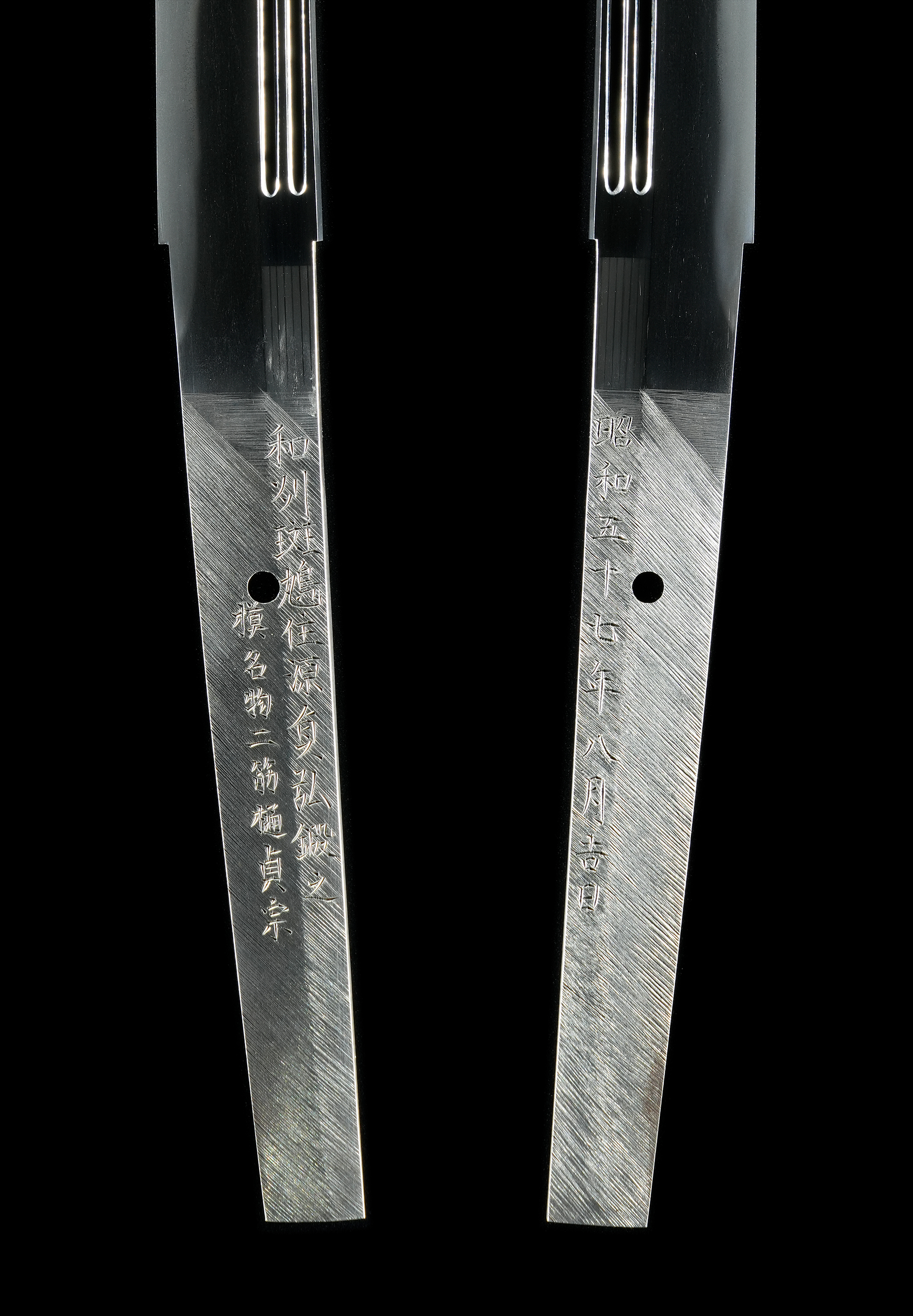
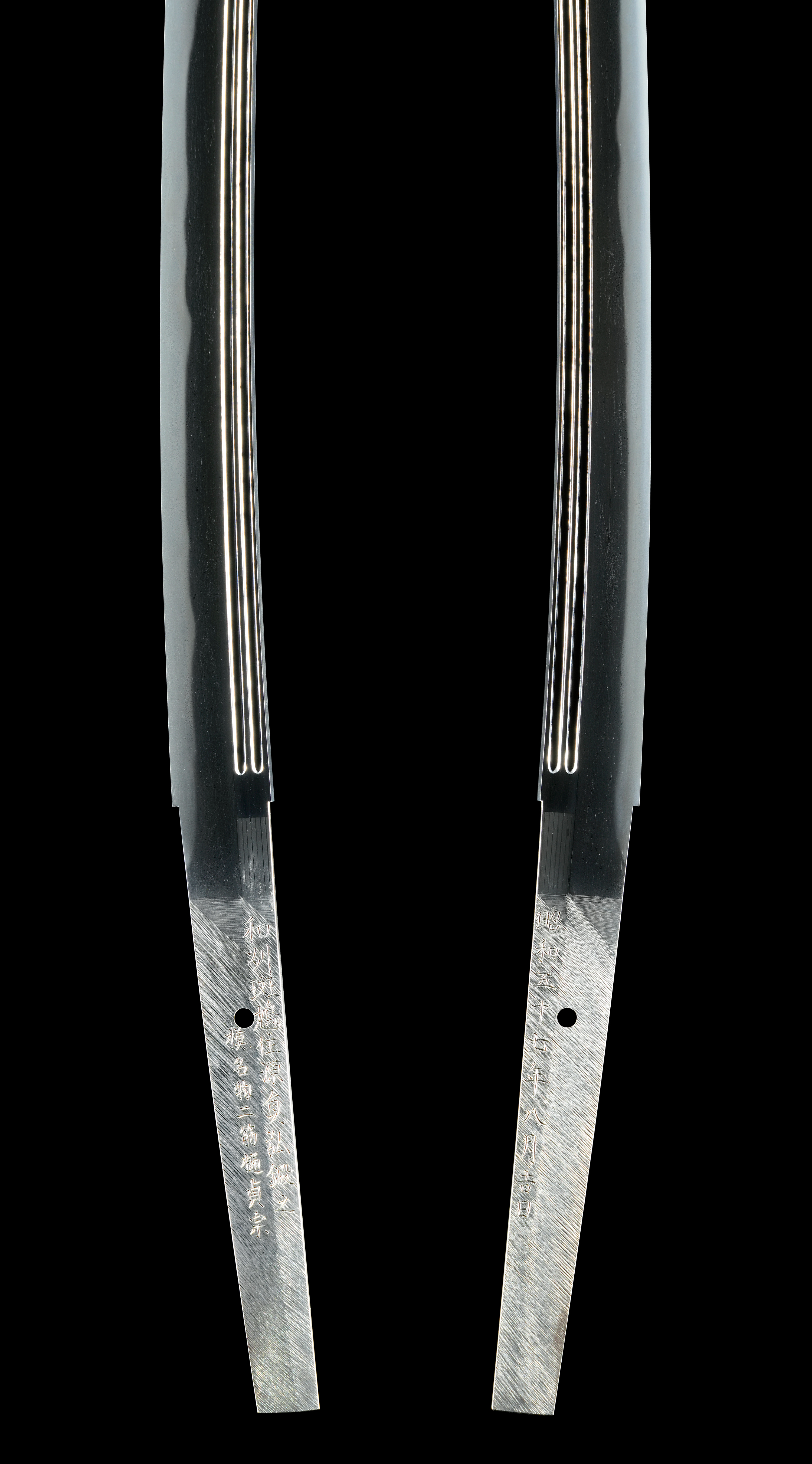
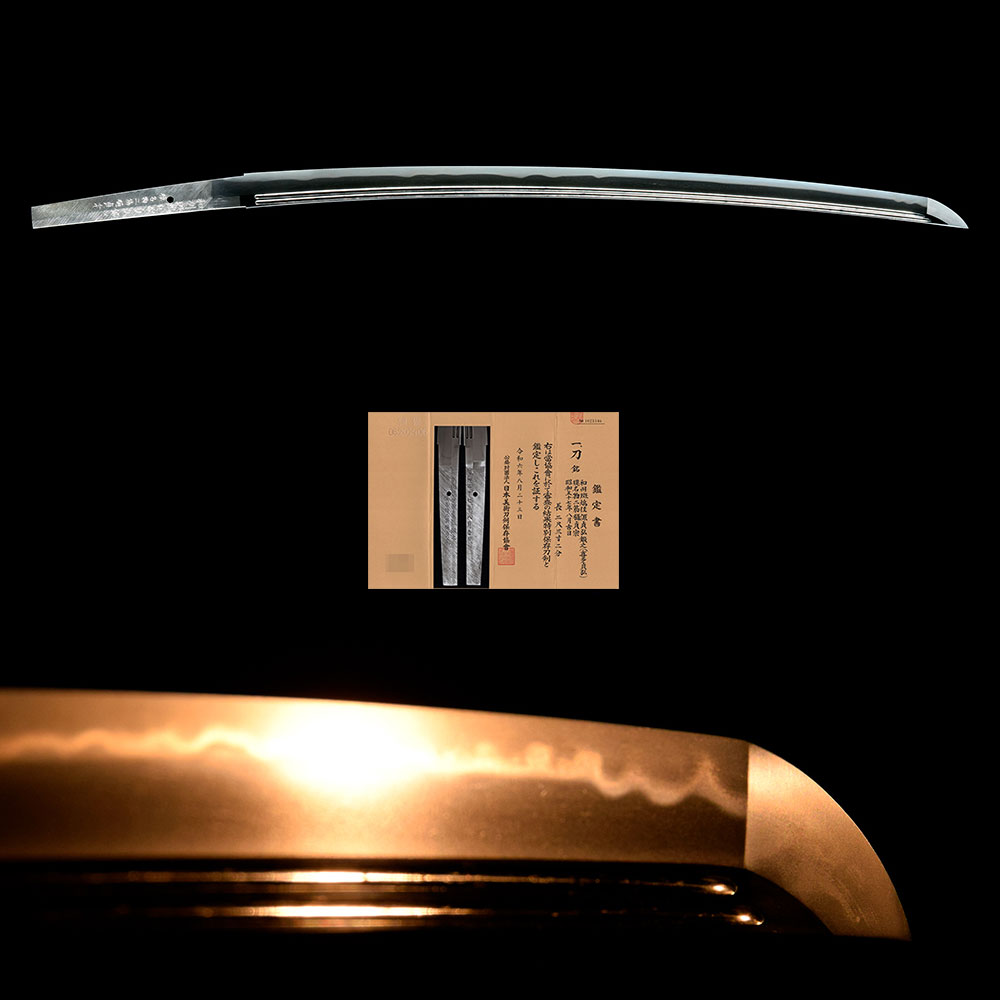
This sword is a powerful work in the style of the Meibutsu Futasuji-hi Sadamune, created by the hands of swordsmith Sadahiro who lived such a turbulent life as a smith. Swordsmith Sadahiro forged several copies of the Futasuji-hi Sadamune, one of which won a special prize at the Shinsaku Meito Exhibition sponsored by the Nippon Bijutsu Token Hozon Kyokai, and this sword is conjectured to be a work from the period when he devoted himself to such Futasuji-hi Sadamune.
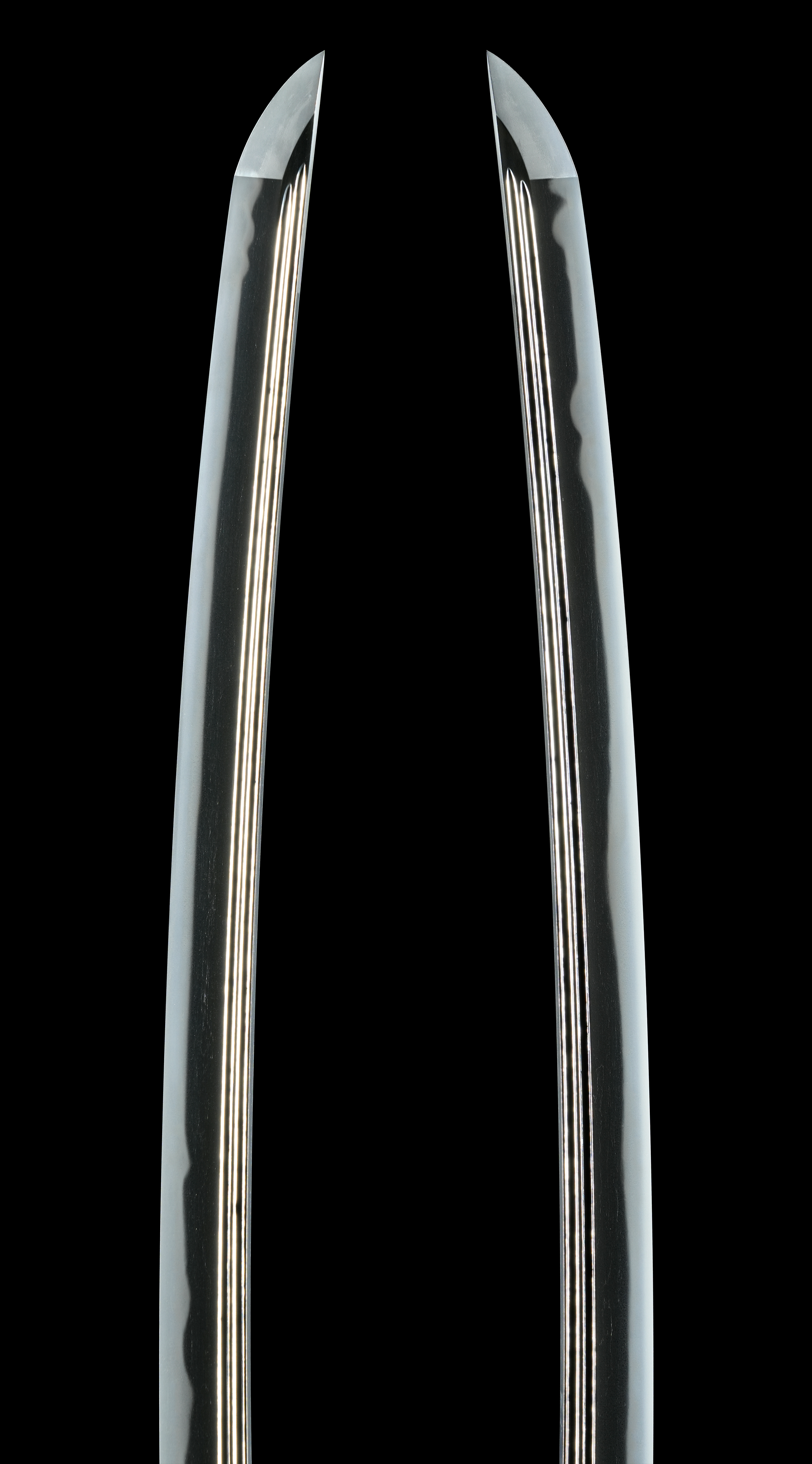
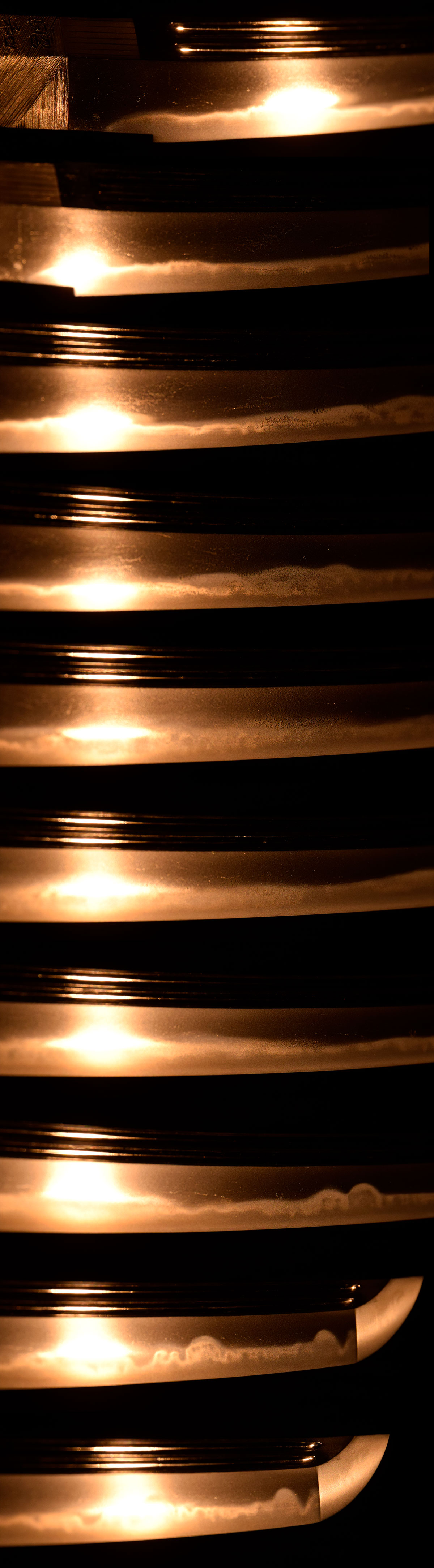
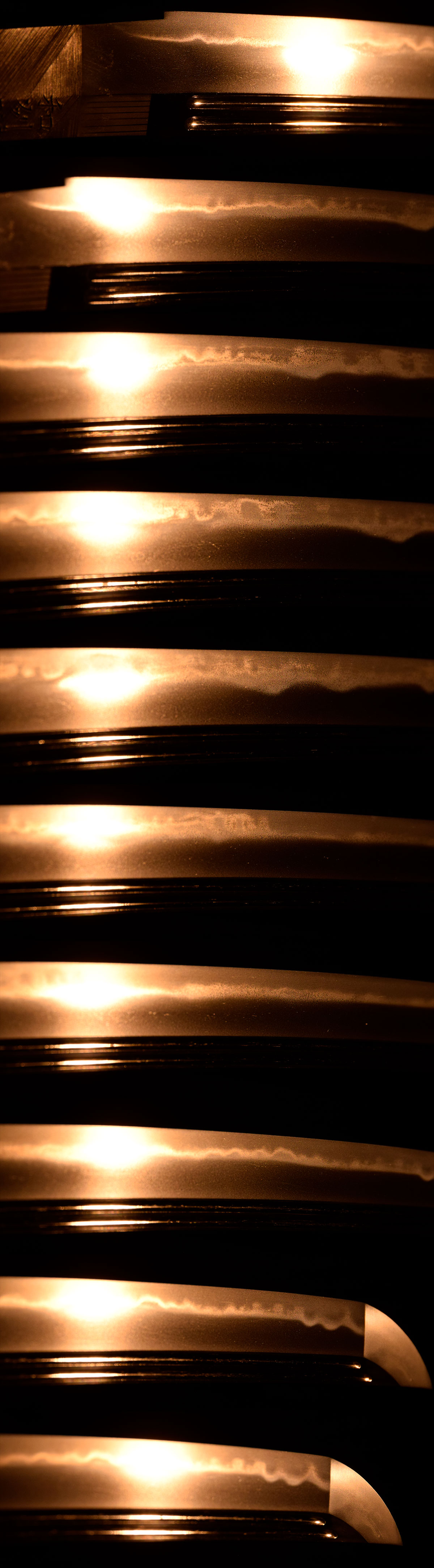
With a high level of skill that lives up to the rumors, the sugata is beautiful, featuring a mitsumune, with a well-forged itame hada, and the ji-nie overflows and attaches thickly. The nioiguchi is bright and clear, truly magnificent, and the boshi becomes midare below the yokote and returns with a maru tip.
A Showa era masterpiece that reproduces a workmanship approaching the original Meibutsu Futasuji-hi Sadamune. It is a masterpiece suitable to be held as a family treasure for generations to come.
*Meibutsu Futasuji-hi Sadamune: nagasa 2 shaku 3 sun 1 bu 5 rin. Shin no mune (mitsumune), with carvings of a bonji and a so-no-kenmaki-ryu in the center of the haki-omote. A bonji and a bo-hi in the center of the haki-ura. From below the habaki to the top, there are futasuji-hi on both the omote and ura. The boshi also has a shallow notare-komi, becoming a small Jizo style with a somewhat deep kaeri. The nakago is o-suriage mumei. 2 mekugi-ana. The nakago tip is kiri. The name comes from the presence of the futasuji-hi. Also, it was originally an "Osaka Gyobutsu" owned by Toyotomi Hideyoshi, and because of that, it is also called "Osaka Sadamune" or "Futasuji-hi Osaka Sadamune." After Toyotomi Hideyoshi, Yuki Hideyasu received it. In the Kyoho Meibutsu Cho, it is listed under the name of Matsudaira Nobutomi, the Lord of the Tsuyama Domain in Sakushu and great-grandson of Yuki Hideyasu. It left the Matsudaira family after the war and received Juyo Bunkazai designation on November 14, Showa 28 (1953). It is currently in a private collection.
Machine translation from the shop's Japanese · may contain errors ·
Real name Kita Hiroshi. A disciple of Gassan Sadakatsu, he shared a brother-disciple relationship with the late Gassan Teiichi, who was a Ningen Kokuho. His forge was located near Horyuji in Ikaruga, Yamato, and starting with the Mainichi Shimbun President's Award in Showa 44, he received numerous honors at Shinsakuto exhibitions, and in his later years was designated an Juyo Mugei Bunkazai of Nara Prefecture.
At the time, the great master of the sword world, Sato Kanzan Sensei, gave his seal of approval to swordsmith Sadahiro as the most capable smith in Japan, stating that no one could surpass him when it came to making copies of old works, especially swords in the Soshu-den style.
However, his superior sword-making skills proved to be a curse; antique dealers who took notice of his ability falsified the nakago of his works, leading them to circulate as old masterpiece swords. According to one theory, copies of old masterpieces made to match vacant registration papers even received Juyo Token designation, causing a shockwave in the sword world and leading to a large-scale police investigation. It is said that he returned his Nara Prefecture Juyo Mugei Bunkazai designation to take responsibility for the crime of creating these fakes.
Furthermore, because he used his high level of skill at the time to produce many non-tanren swords made of western steel that could be mistaken for hon-tanren swords, the status of Sadahiro's swords fell into a state of instability. The inexpensive Sadahiro swords seen on the market are such non-tanren swords.
This sword is a powerful work in the style of the Meibutsu Futasuji-hi Sadamune, created by the hands of swordsmith Sadahiro who lived such a turbulent life as a smith. Swordsmith Sadahiro forged several copies of the Futasuji-hi Sadamune, one of which won a special prize at the Shinsaku Meito Exhibition sponsored by the Nippon Bijutsu Token Hozon Kyokai, and this sword is conjectured to be a work from the period when he devoted himself to such Futasuji-hi Sadamune.
With a high level of skill that lives up to the rumors, the sugata is beautiful, featuring a mitsumune, with a well-forged itame hada, and the ji-nie overflows and attaches thickly. The nioiguchi is bright and clear, truly magnificent, and the boshi becomes midare below the yokote and returns with a maru tip.
A Showa era masterpiece that reproduces a workmanship approaching the original Meibutsu Futasuji-hi Sadamune. It is a masterpiece suitable to be held as a family treasure for generations to come.
*Meibutsu Futasuji-hi Sadamune: nagasa 2 shaku 3 sun 1 bu 5 rin. Shin no mune (mitsumune), with carvings of a bonji and a so-no-kenmaki-ryu in the center of the haki-omote. A bonji and a bo-hi in the center of the haki-ura. From below the habaki to the top, there are futasuji-hi on both the omote and ura. The boshi also has a shallow notare-komi, becoming a small Jizo style with a somewhat deep kaeri. The nakago is o-suriage mumei. 2 mekugi-ana. The nakago tip is kiri. The name comes from the presence of the futasuji-hi. Also, it was originally an "Osaka Gyobutsu" owned by Toyotomi Hideyoshi, and because of that, it is also called "Osaka Sadamune" or "Futasuji-hi Osaka Sadamune." After Toyotomi Hideyoshi, Yuki Hideyasu received it. In the Kyoho Meibutsu Cho, it is listed under the name of Matsudaira Nobutomi, the Lord of the Tsuyama Domain in Sakushu and great-grandson of Yuki Hideyasu. It left the Matsudaira family after the war and received Juyo Bunkazai designation on November 14, Showa 28 (1953). It is currently in a private collection.
The twentieth century nearly killed the craft twice: wartime distortion, then the occupation ban. The NBTHK’s founding in 1948 and licensed forging from 1953 rebuilt the sword as an art, crowned by Living National Treasures and the mukansa rank.
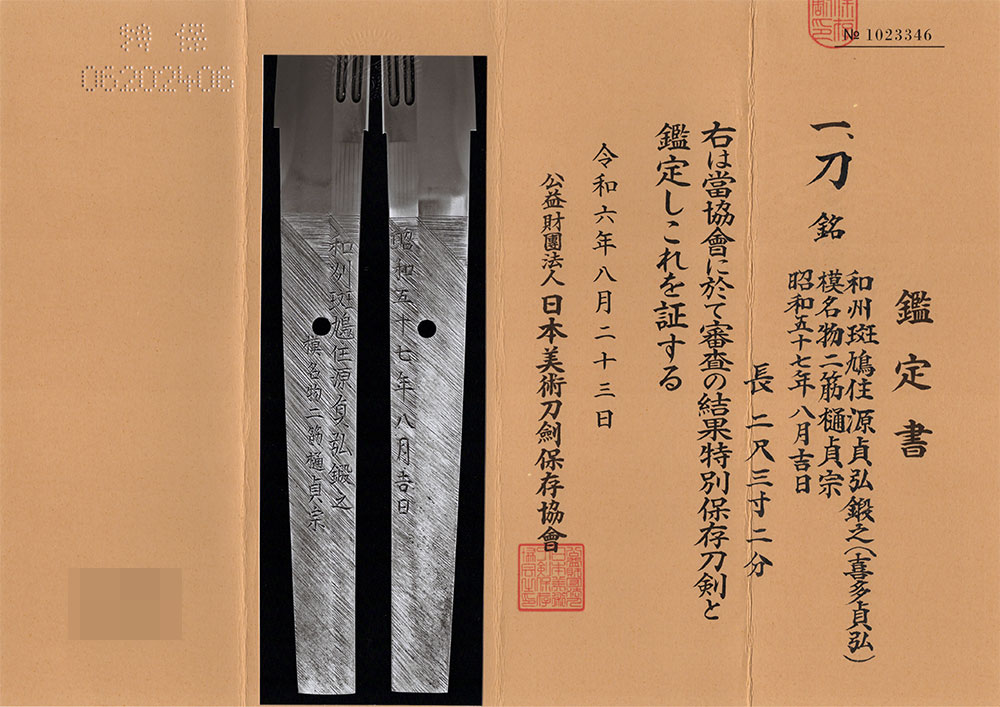
A Hozon-certified blade judged to show notably superior workmanship and a better state of preservation. The bar is higher: re-tempered blades and most unsigned Muromachi/Edo works are excluded.
The NBTHK (Nihon Bijutsu Tōken Hozon Kyōkai, the Society for the Preservation of Japanese Art Swords) is a public-interest incorporated foundation founded in 1948 and supervised by Japan’s Agency for Cultural Affairs (Bunkachō); it is based at the Japanese Sword Museum in Tokyo. Its expert panels physically examine each submitted work (shinsa) and issue a certificate (kanteishō) ranking it by artistic and historical merit. NBTHK papers are the most widely recognized standard of authentication for Japanese swords and fittings.
As a rule we do not accept returns, except when we have sent a different item from the one ordered or when there is a significant discrepancy between the description and the item. If you wish to return an item, please contact us within 3 days of its arrival and then send it back.

 NihontoWatch