 NihontoWatchNihontoWatch
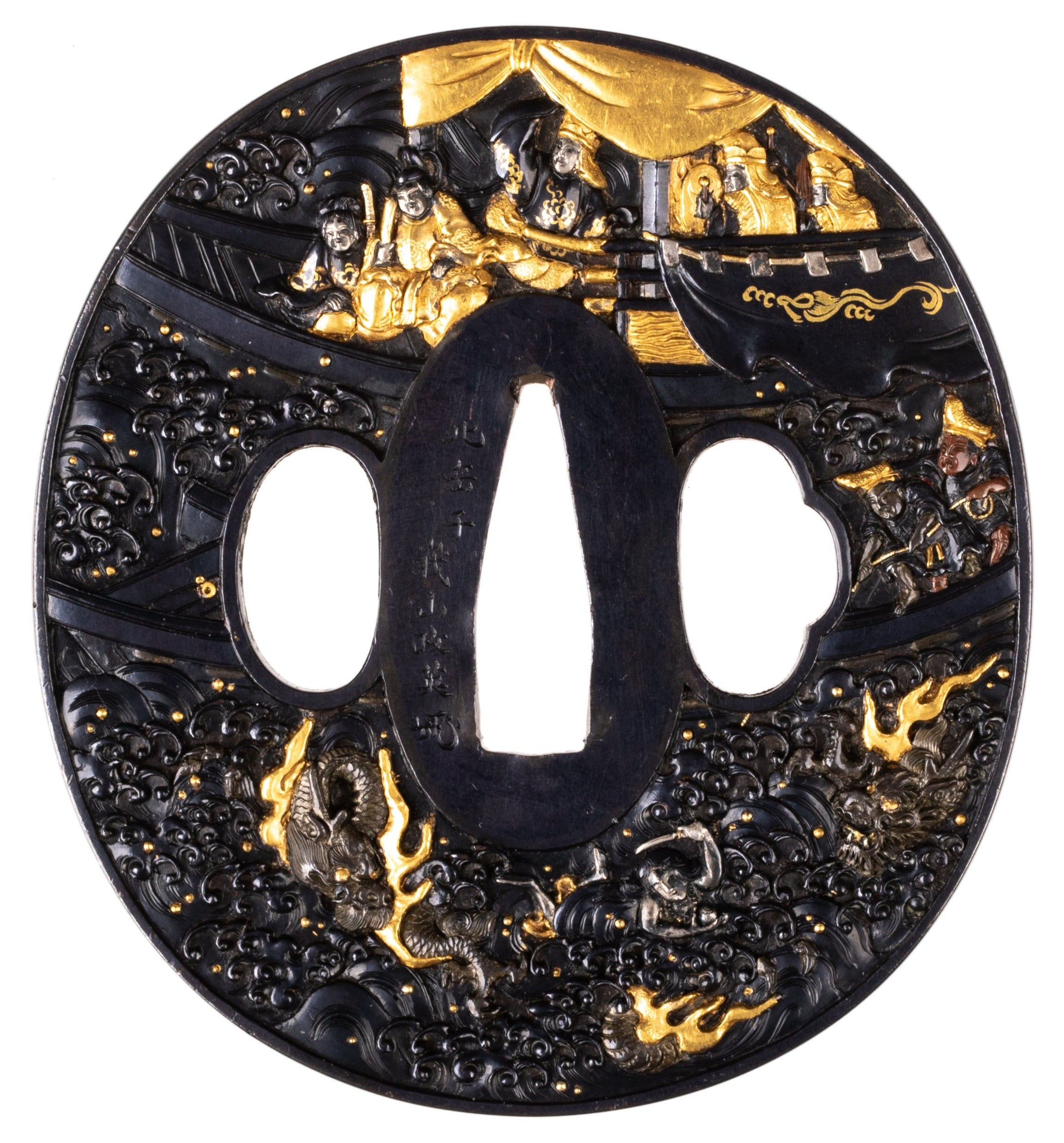
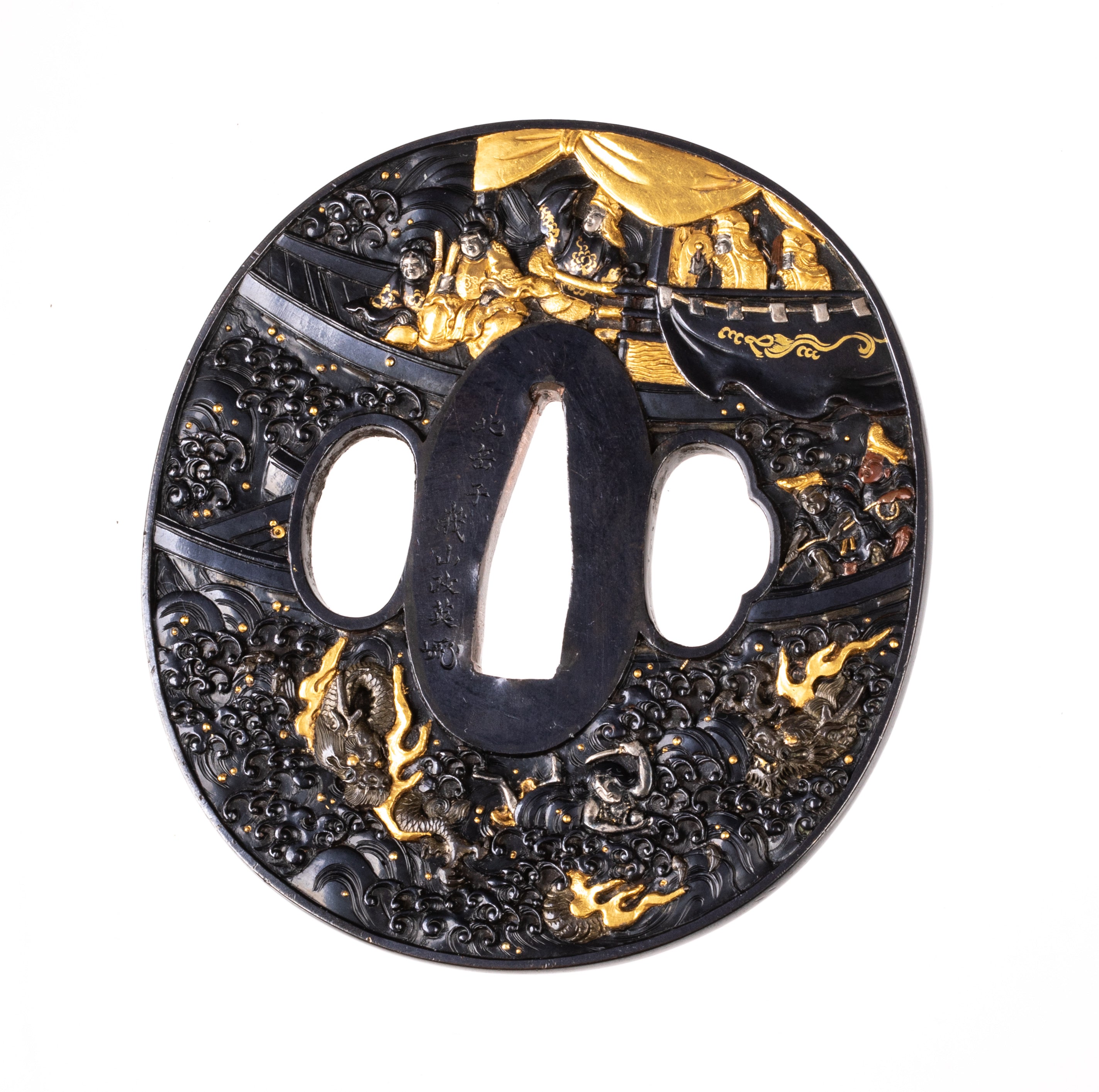
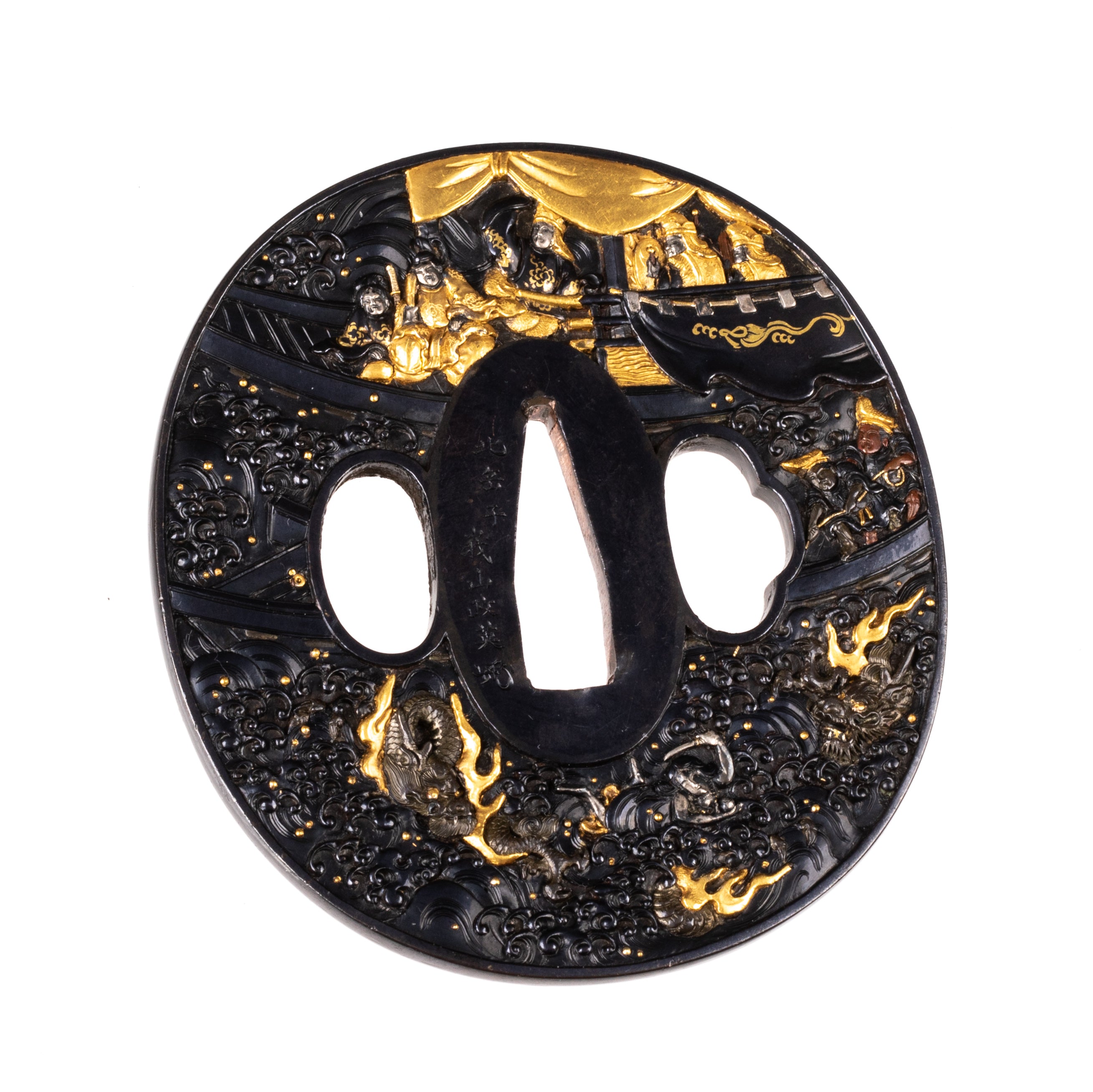
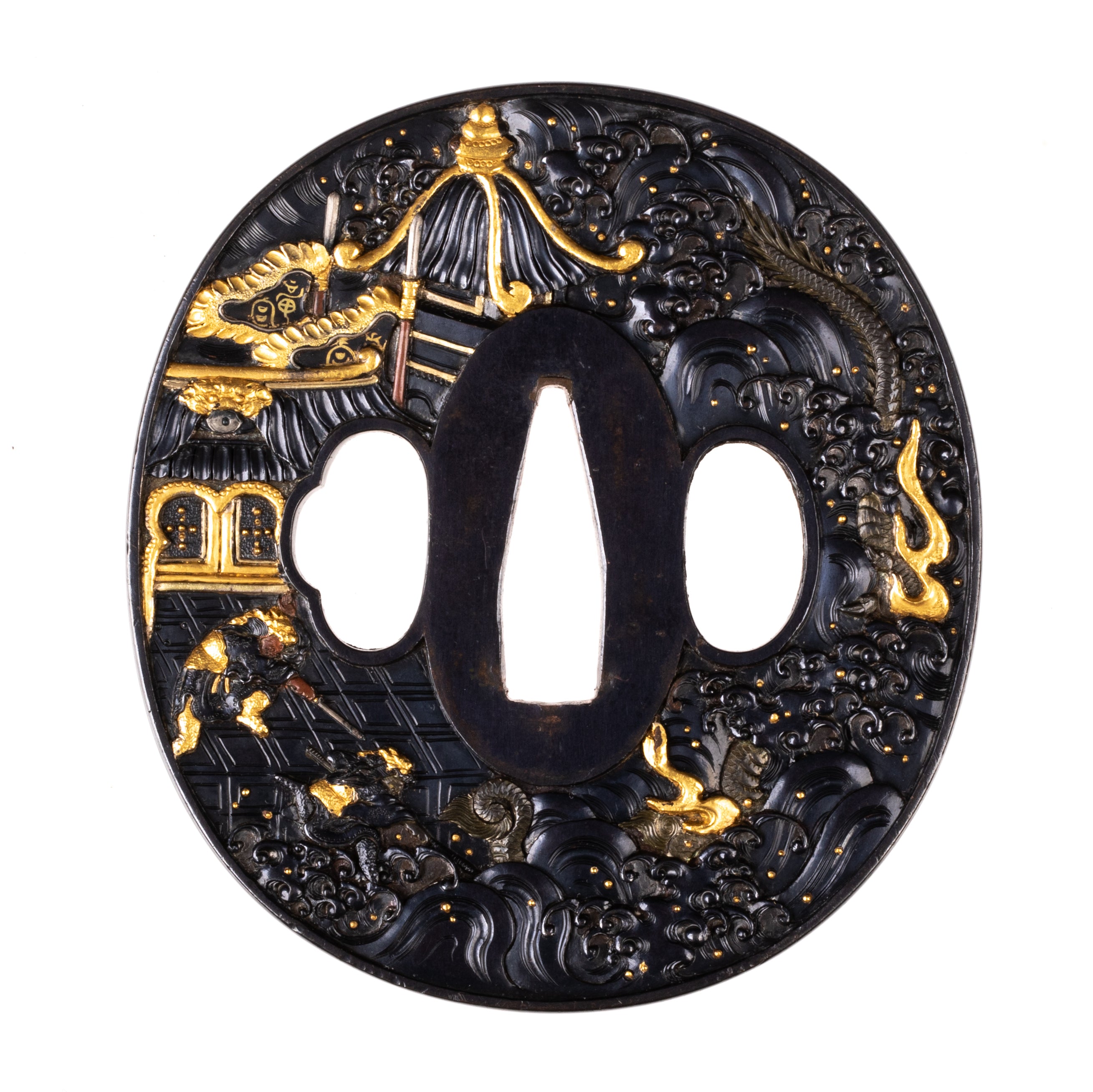
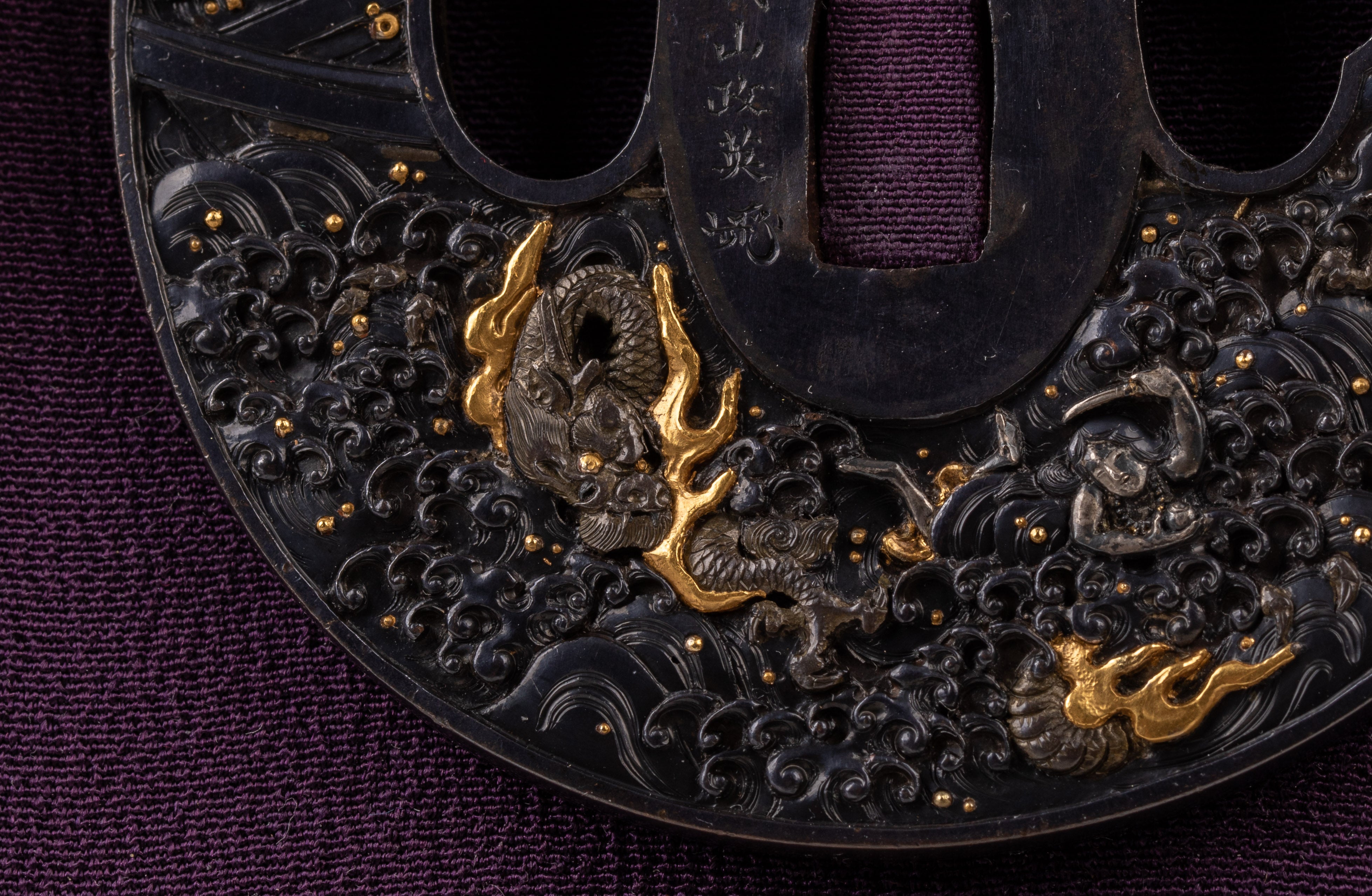
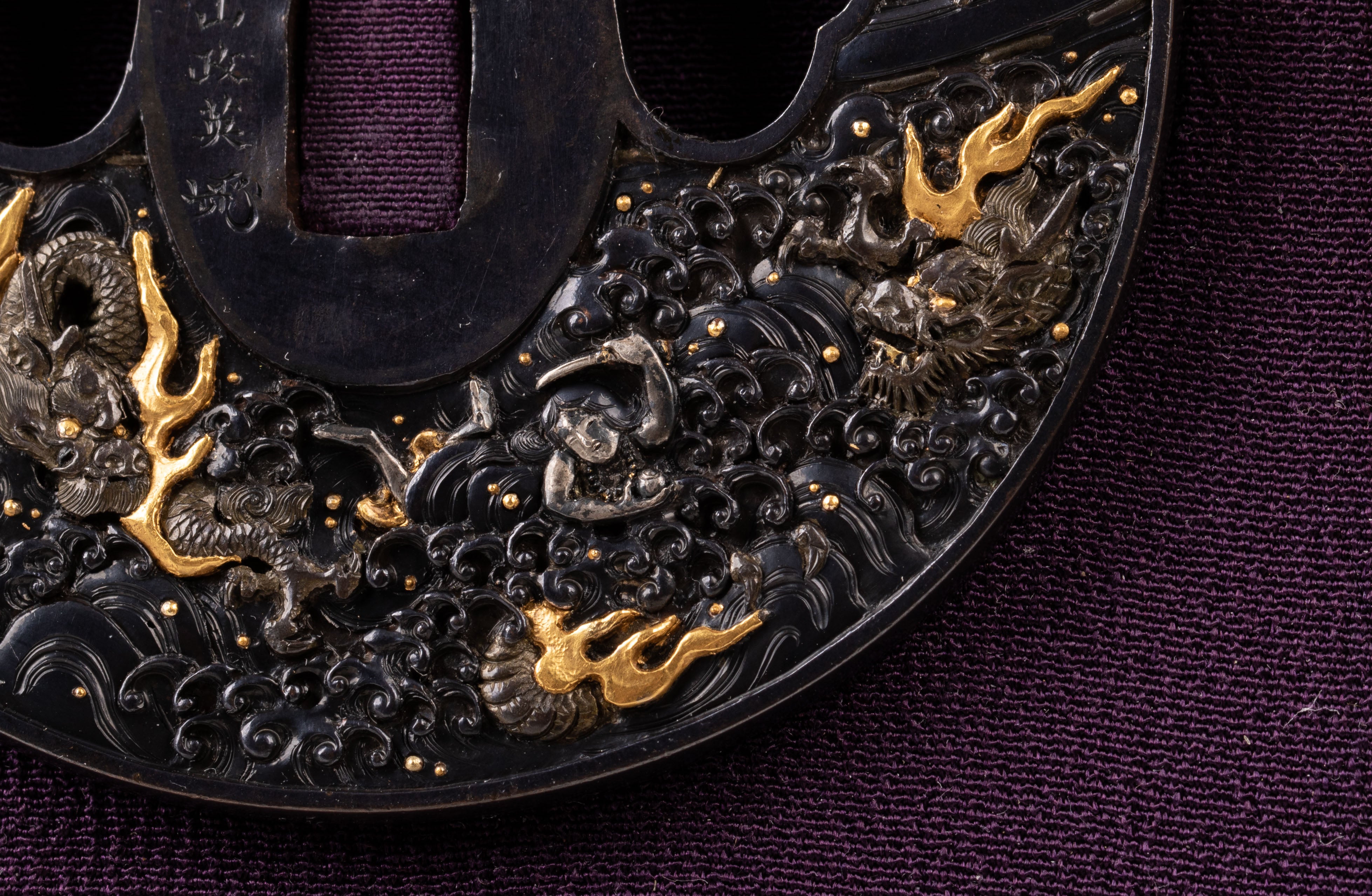
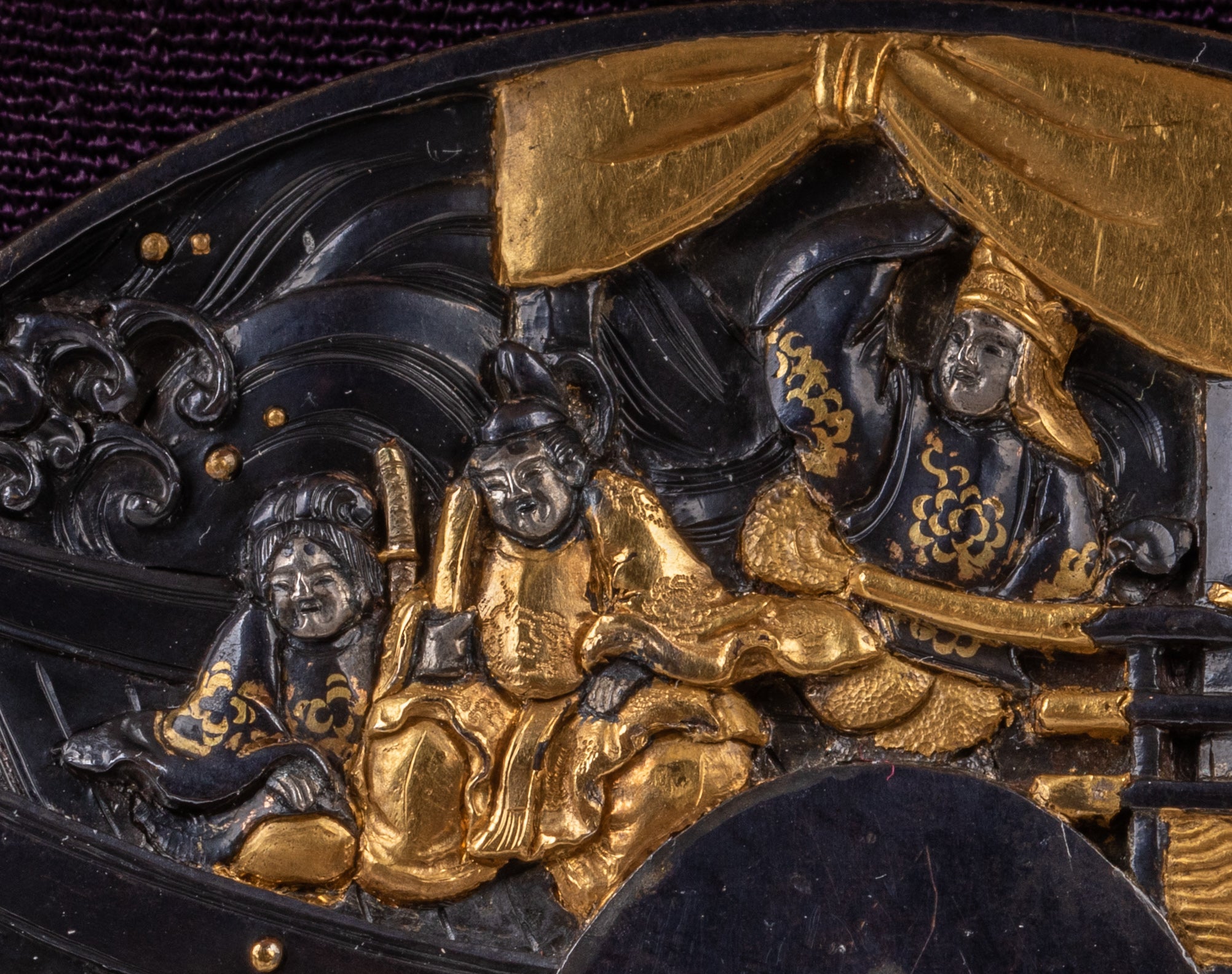
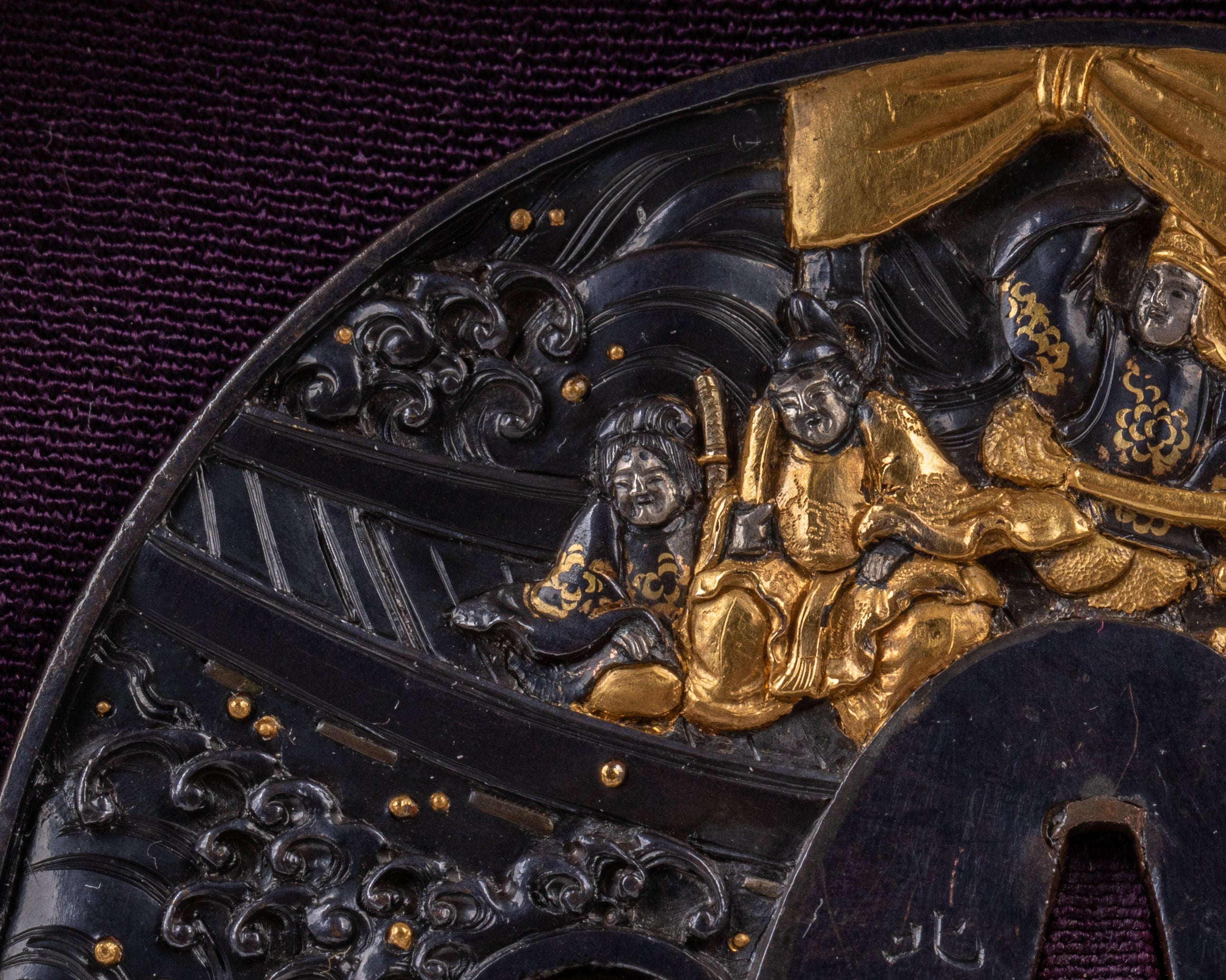
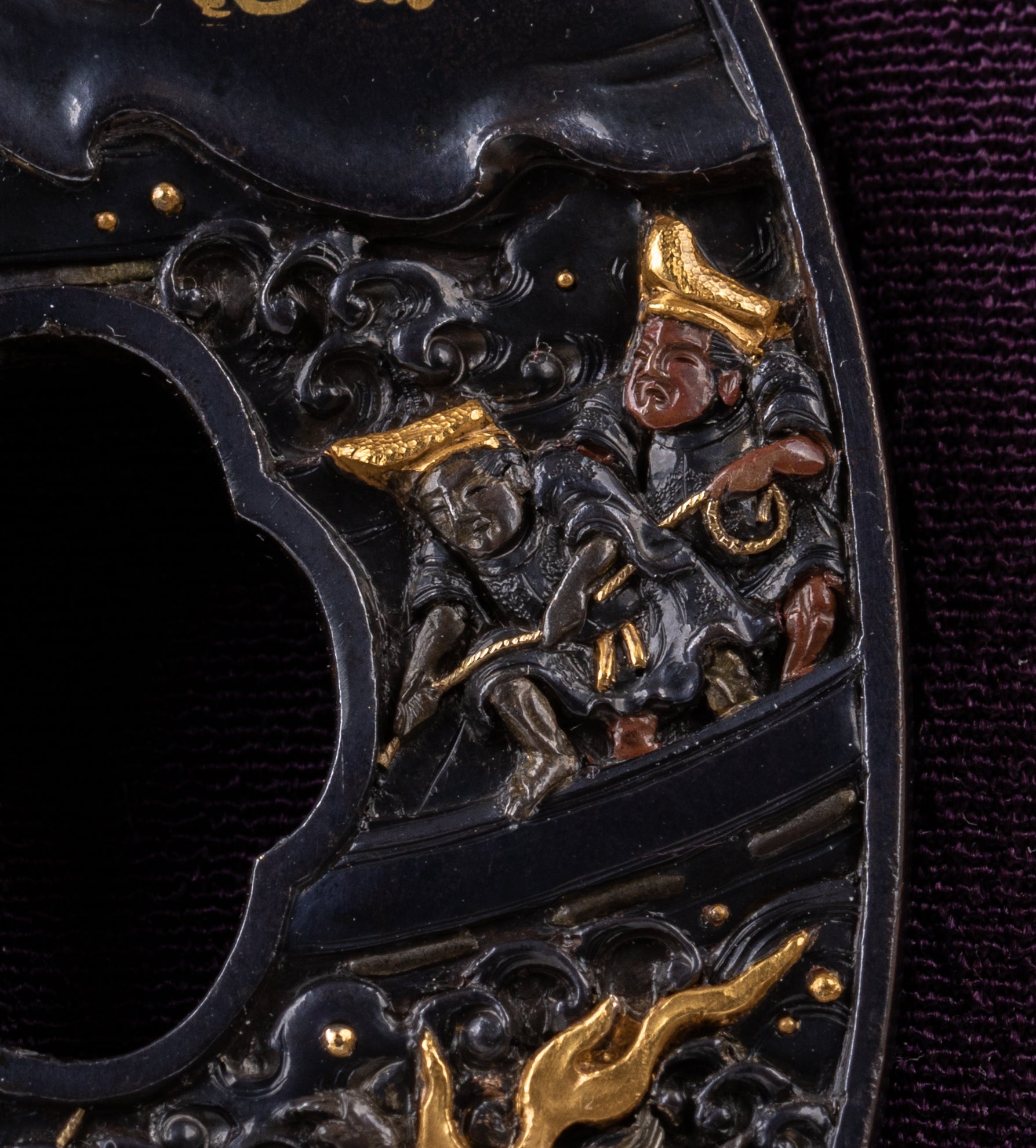
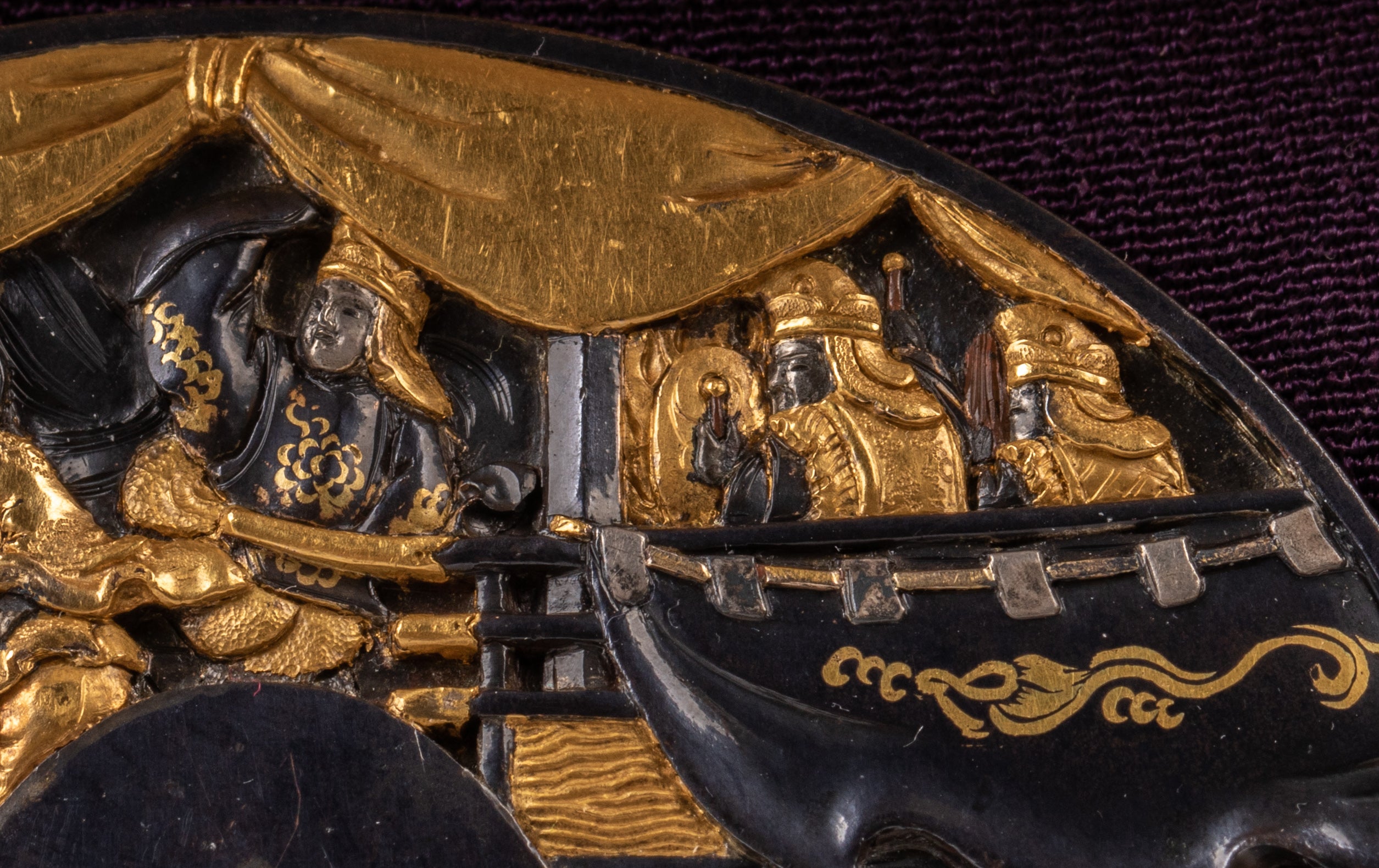
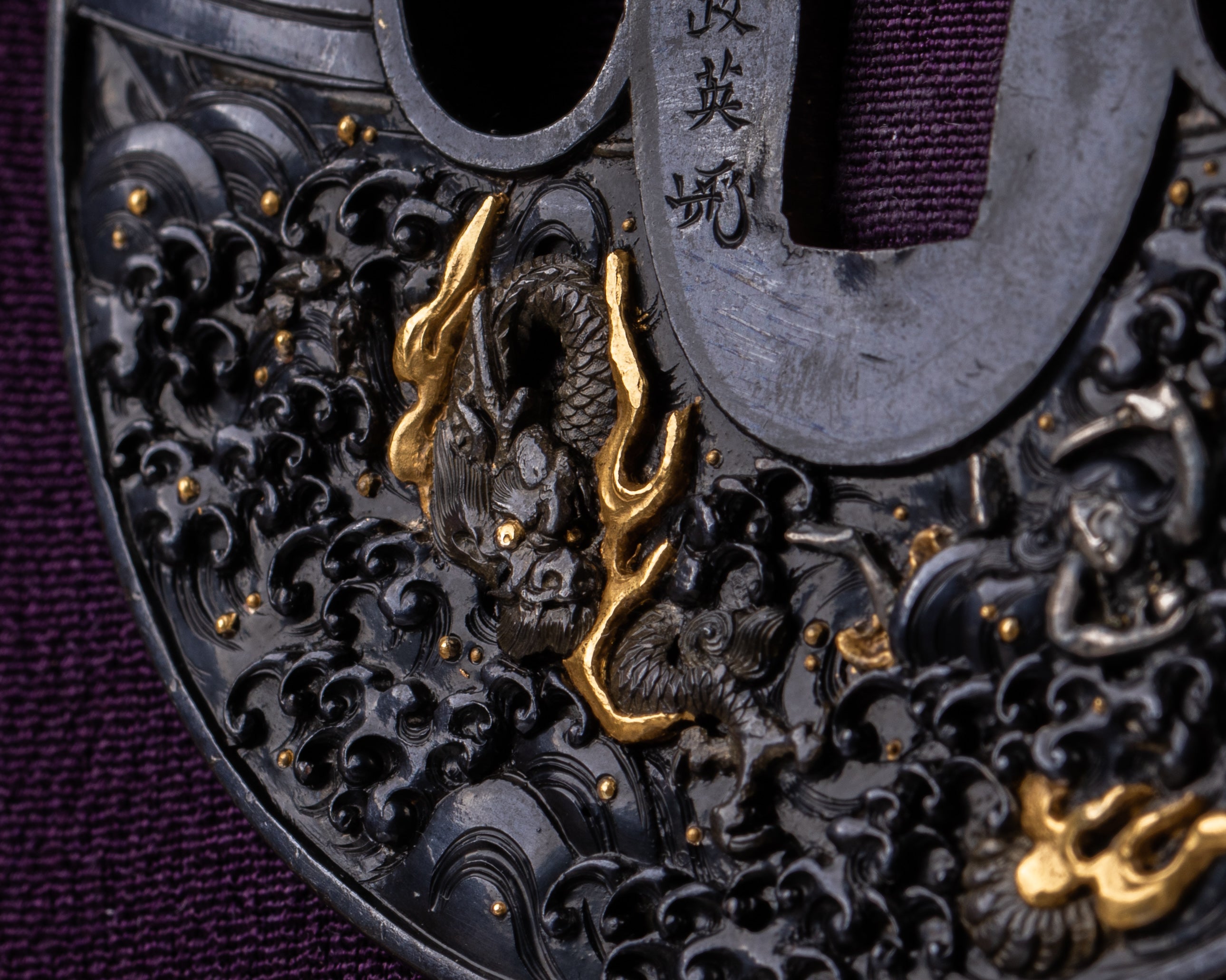
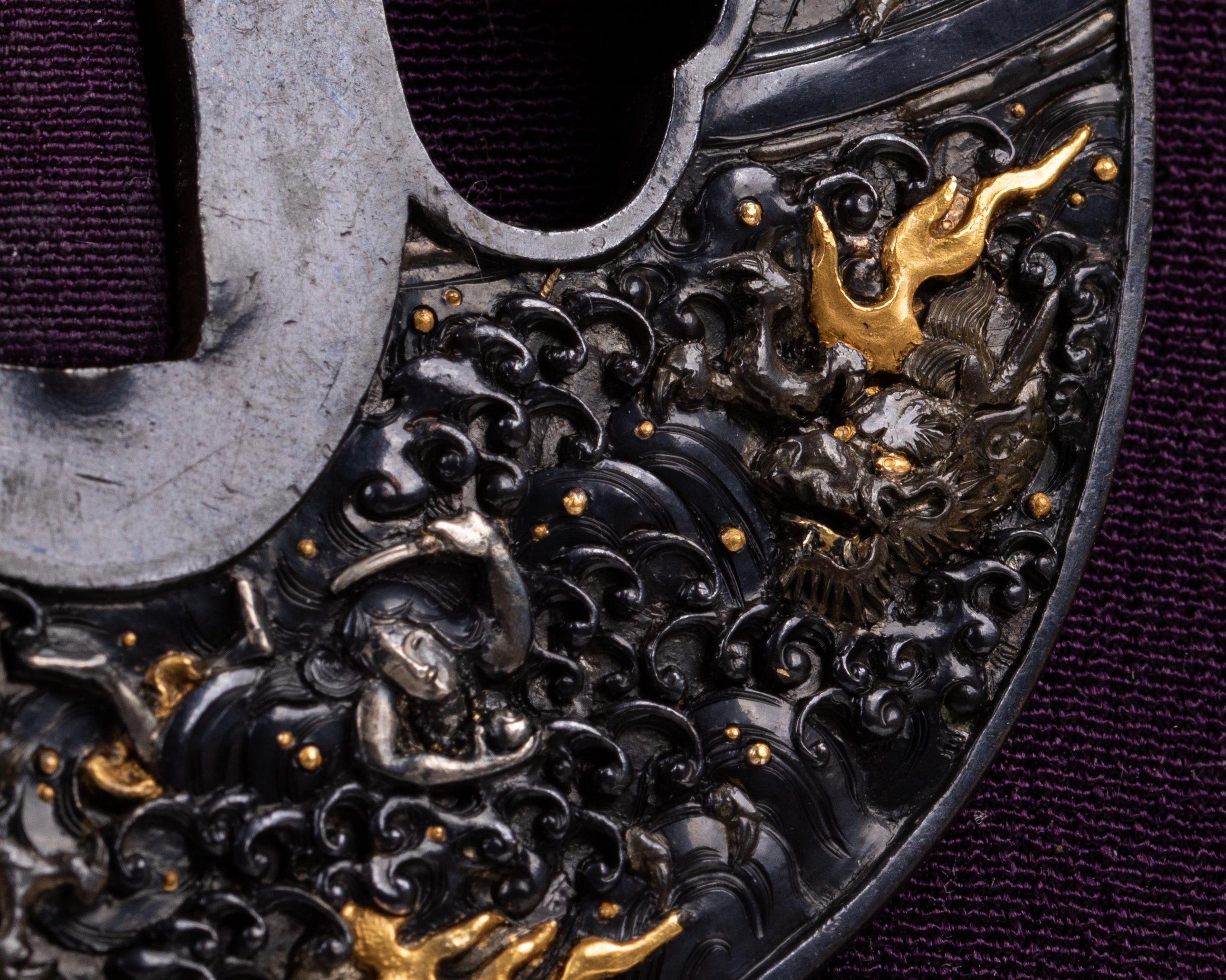
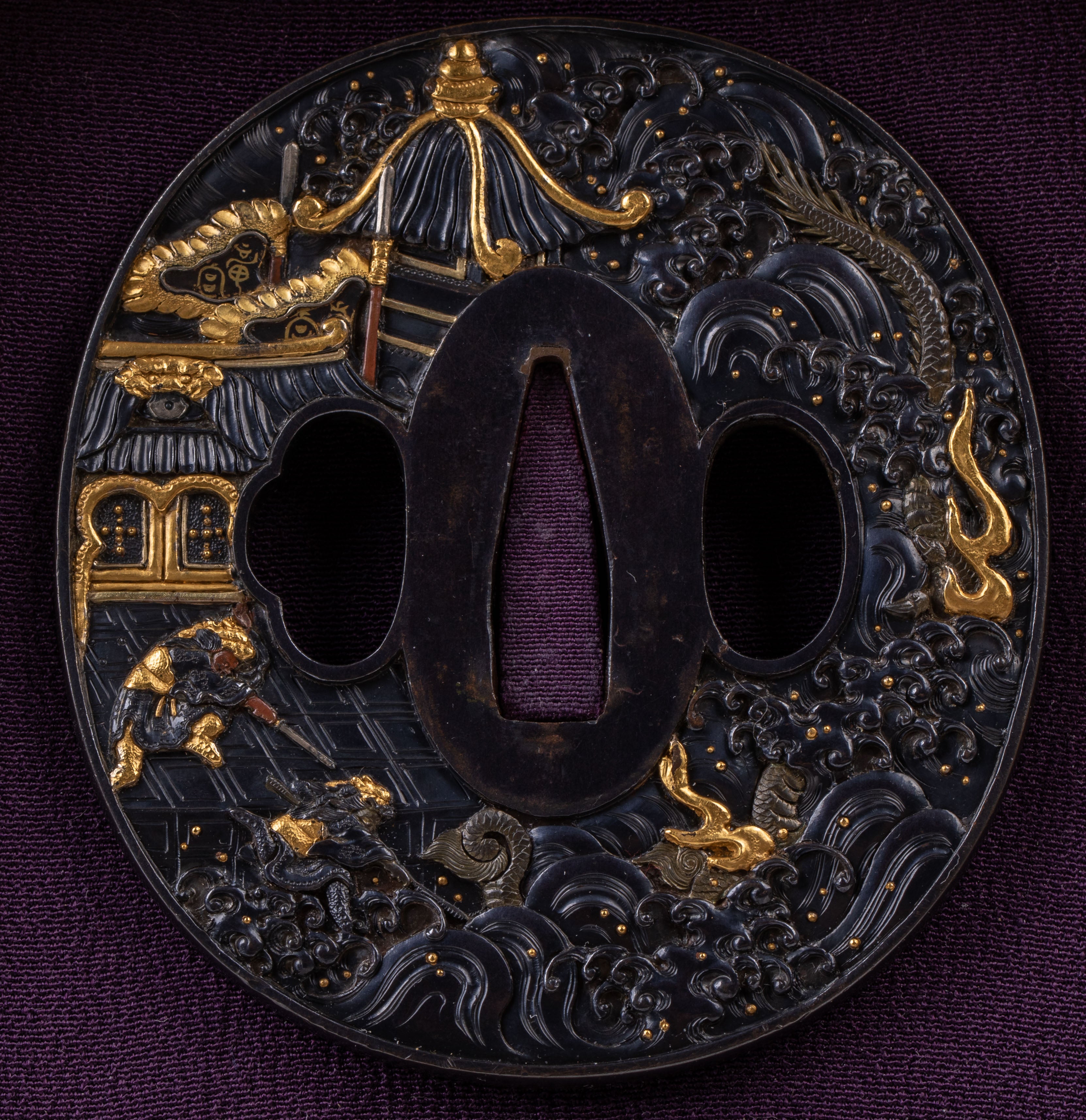
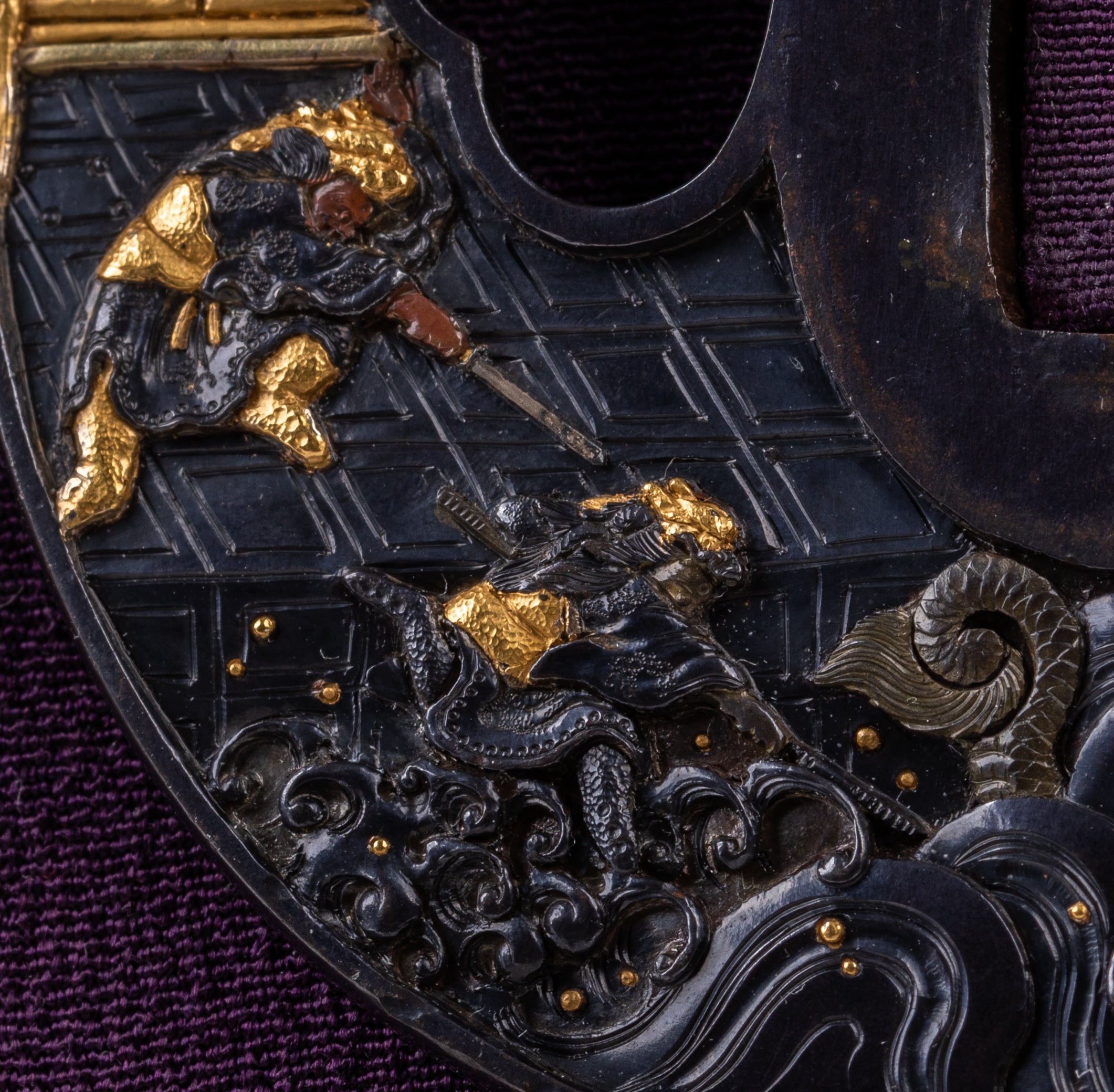
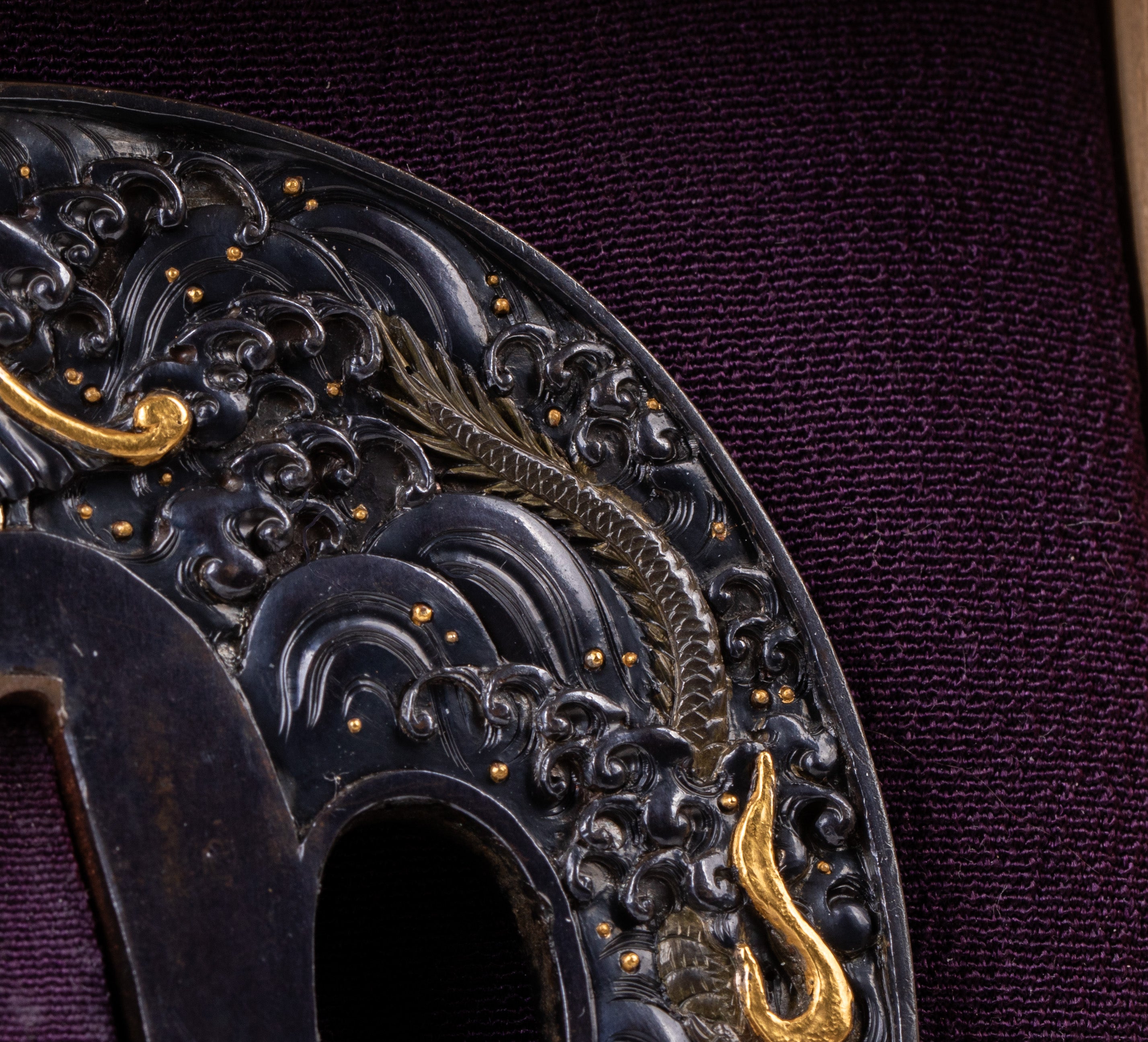
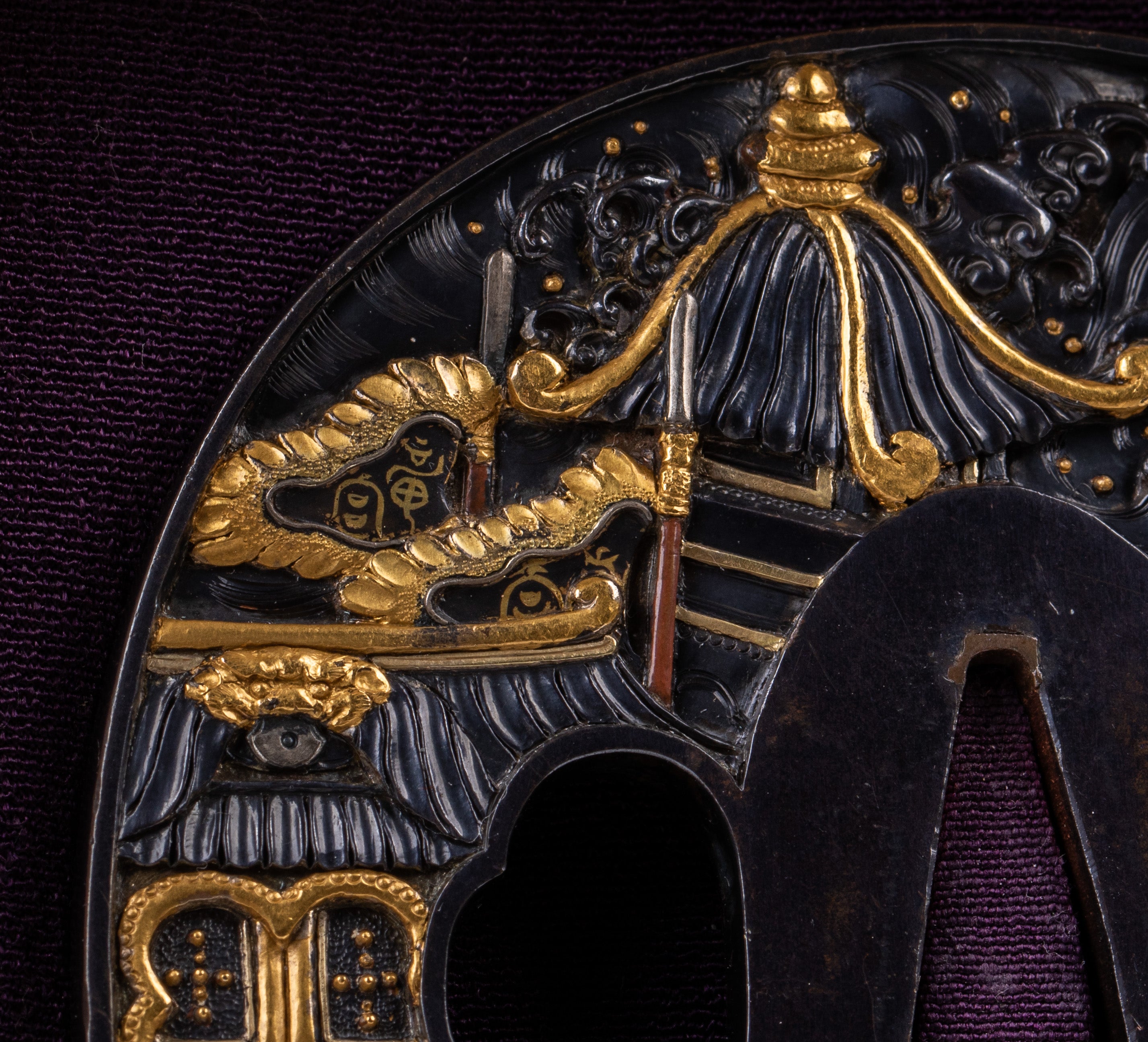
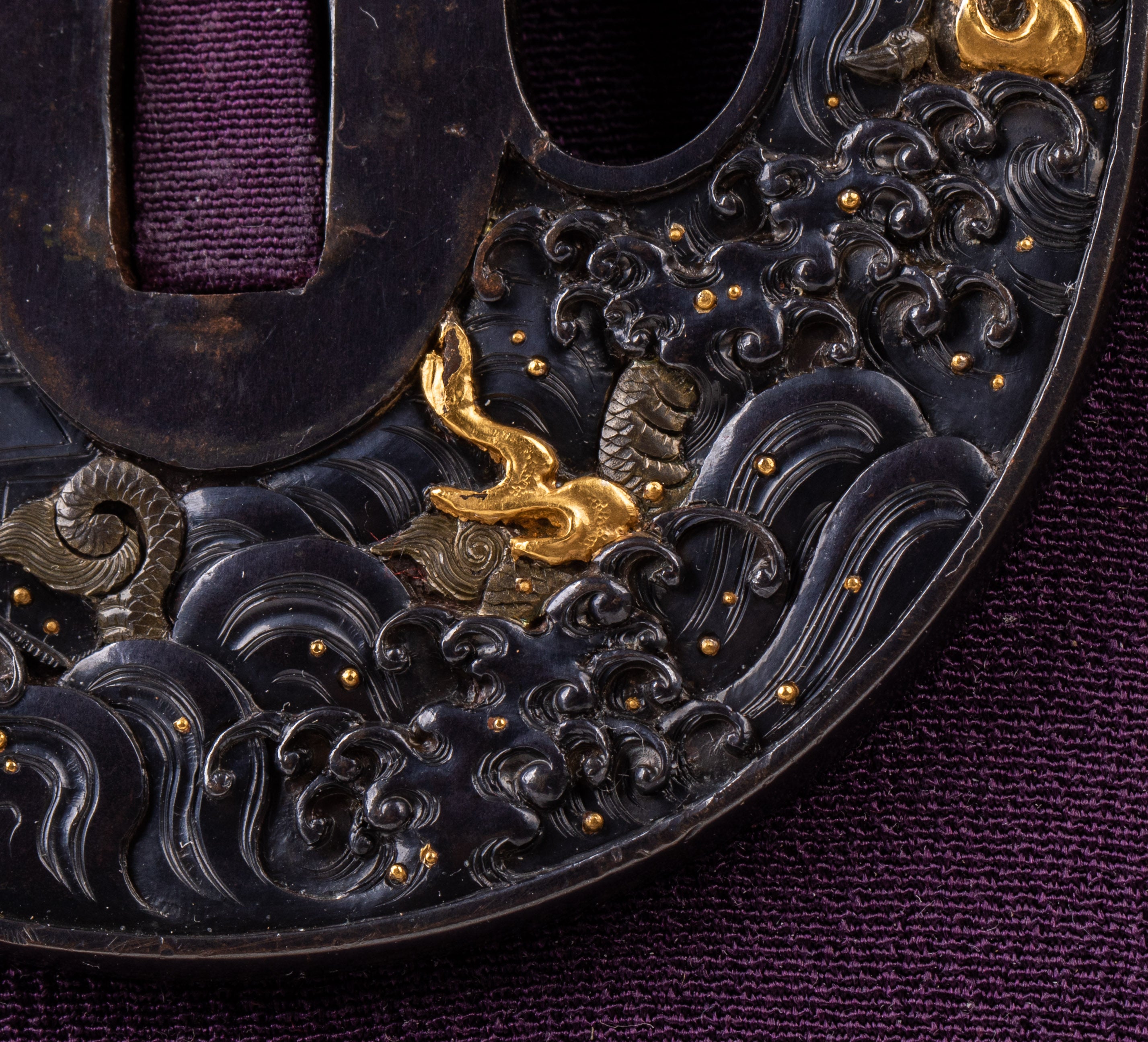
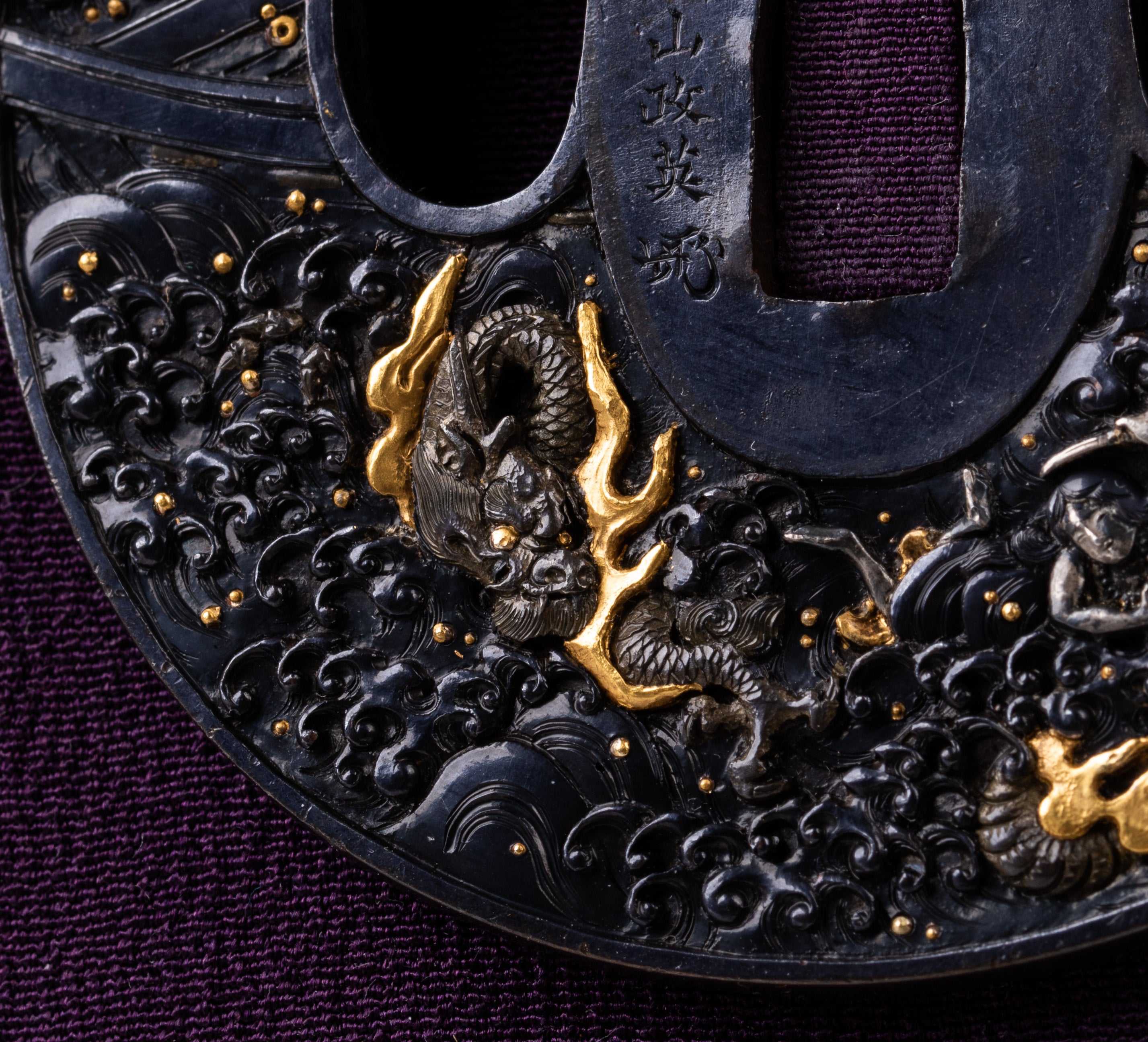
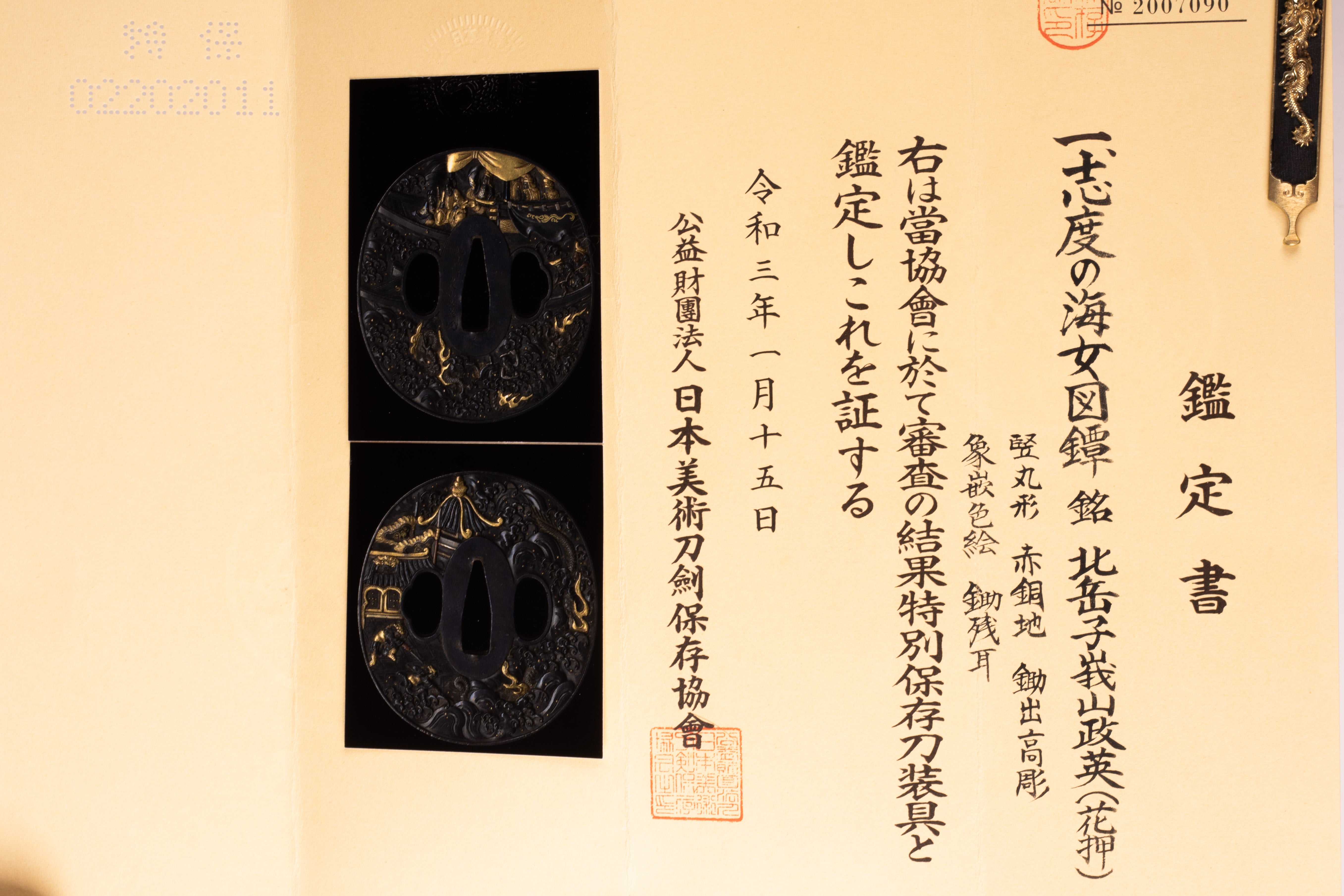
Shakudo tsuba signed "Hokugakushi Gasan Masahide" with Kao with NBTHK Tokubetsu Hozon Tosogu. Decorated with the story of Ama, a beautiful tale of a mother that sacrifices her life for the prosperity of her son. Not much is known by this artist other than that he was active around 1850. There are few of his works recorded, including two tsuba in the collection of Museum of Fine Arts in Boston. Both with the same style of waves and similar dragons as the one presented. However it seems that this particular piece is of higher quality than any other work of this craftsman I was able to find. This tsuba might not represent the prevailing style of the times it was made, with every single millimeter of the piece covered with huge amounts of detail. To the point that it looks like a full size canvas not a small metal plate. I fairly believe that this was a conscious choice of the craftsman, who wanted to show devotion to the theme by making this tsuba as challenging and time consuming as possible. He was making a sacrifice that corresponded with the one from the story. I am sorry if I am not able to properly convey my thoughts here, however I hope that they can be understood to some degree. This tsuba depicts the story of Ama, a female diver who managed to retrieve the stolen jade from a Dragon King. It is a somewhat complicated story of a mother that sacrifices her life for the prosperity of her son, who in turn prays for his mother, allowing her to become a dragon herself. It is a beautiful tale of the relationship between mother and son. While this is a popular Noh story, it is extremely rare to see this motive on sword fittings. I believe this is one of very few themes on sword fittings that we can relate to so strongly today. Here is a full version of the story, however please keep in mind that there are many versions so a lot of details may vary. According to the story, the younger sister of court minister Fujiwara no Fuhito traveled to China to marry Chinese Emperor
NihontoWatchOffered by Soryu
This piece has sold
5 on the market
Get an email when a new Nomura Masahide piece hits the market.

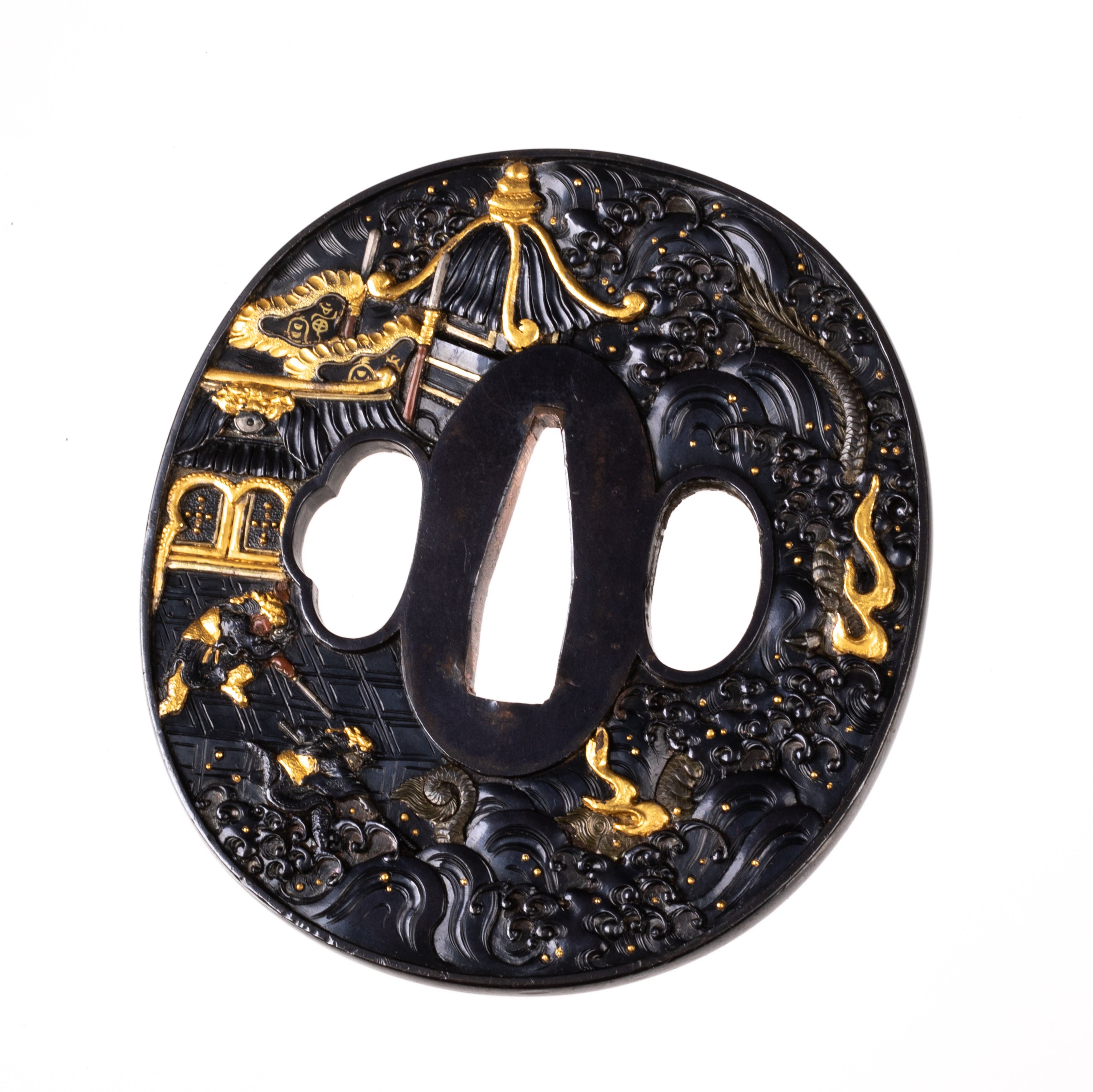
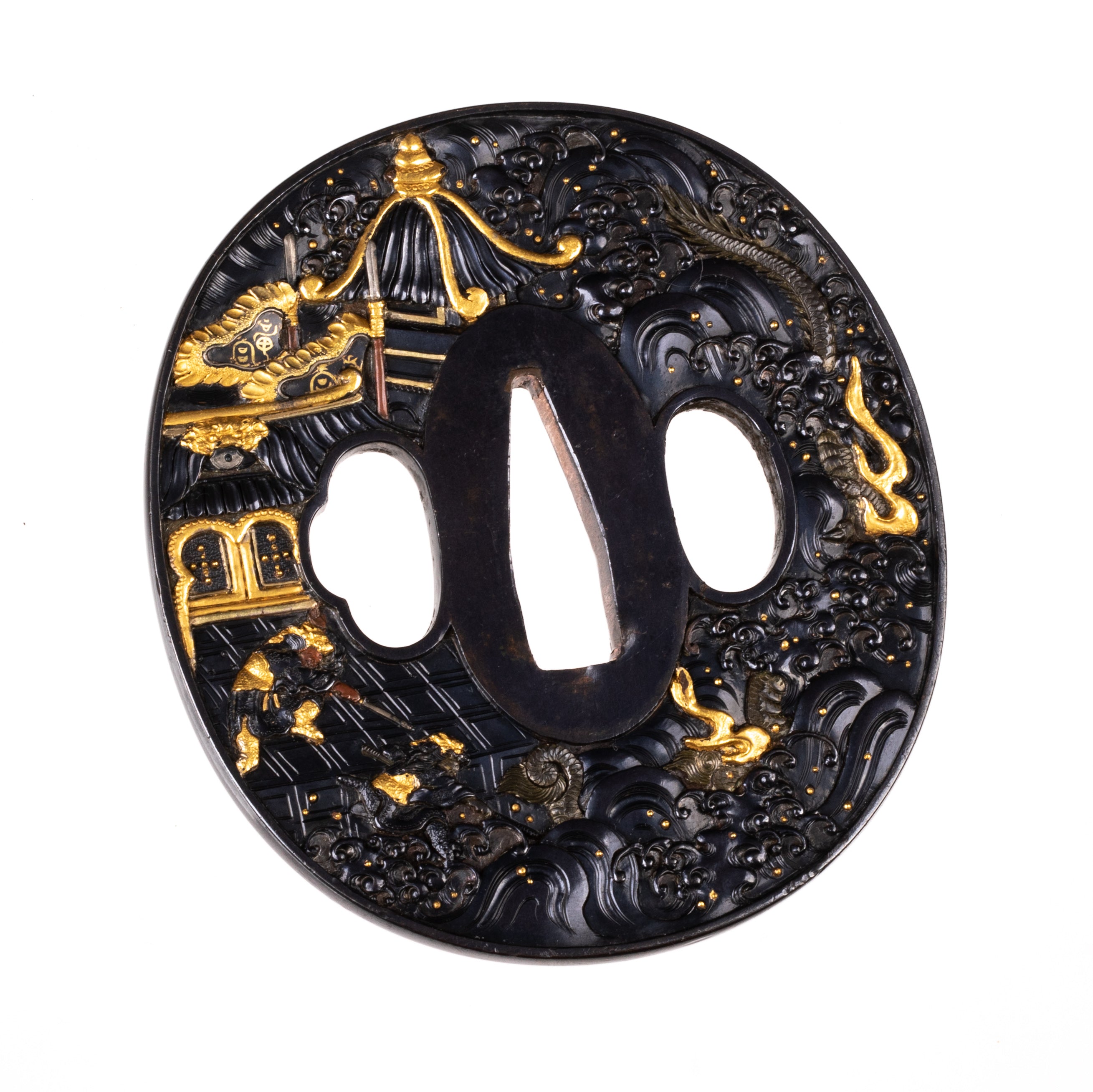
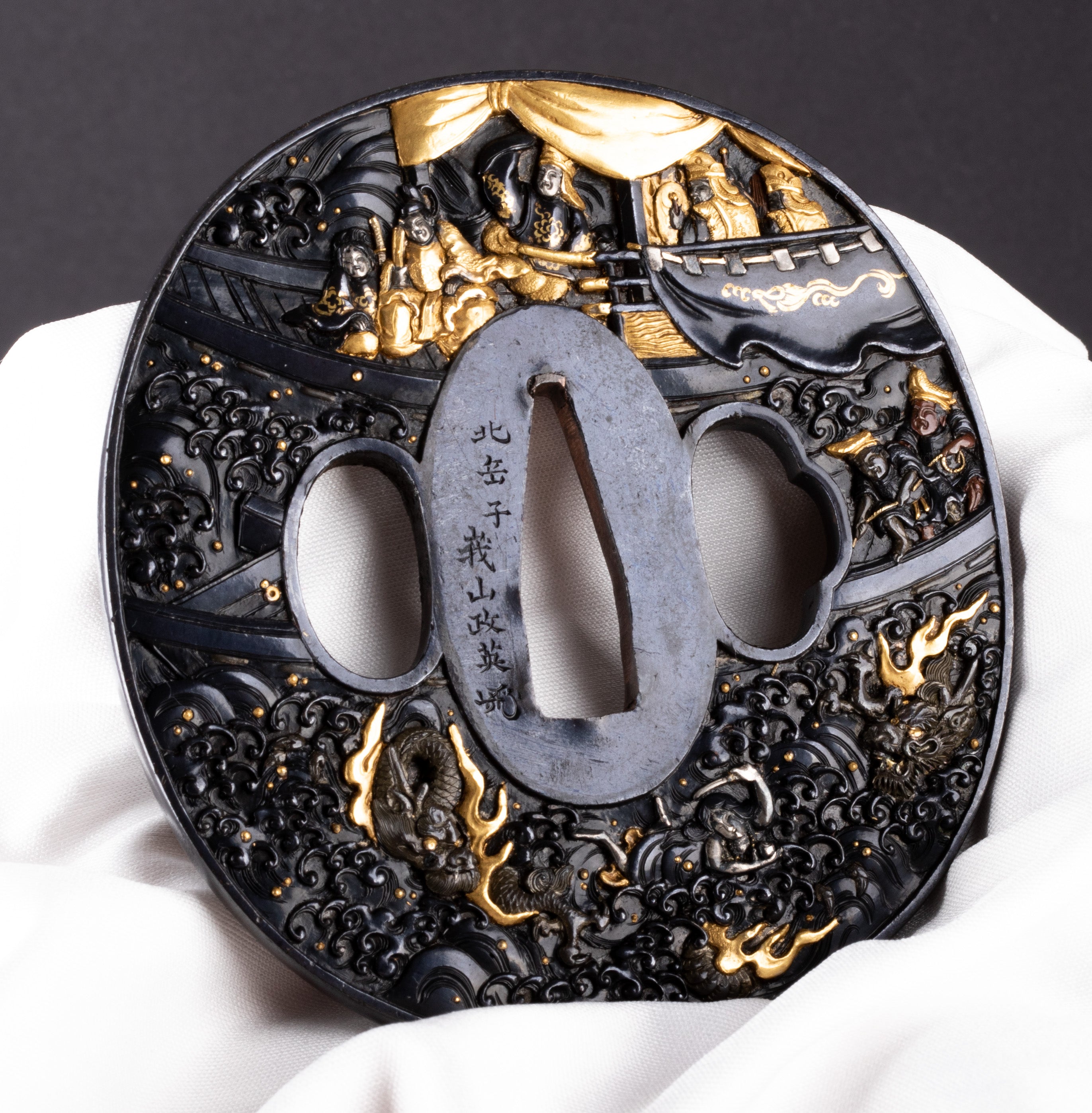
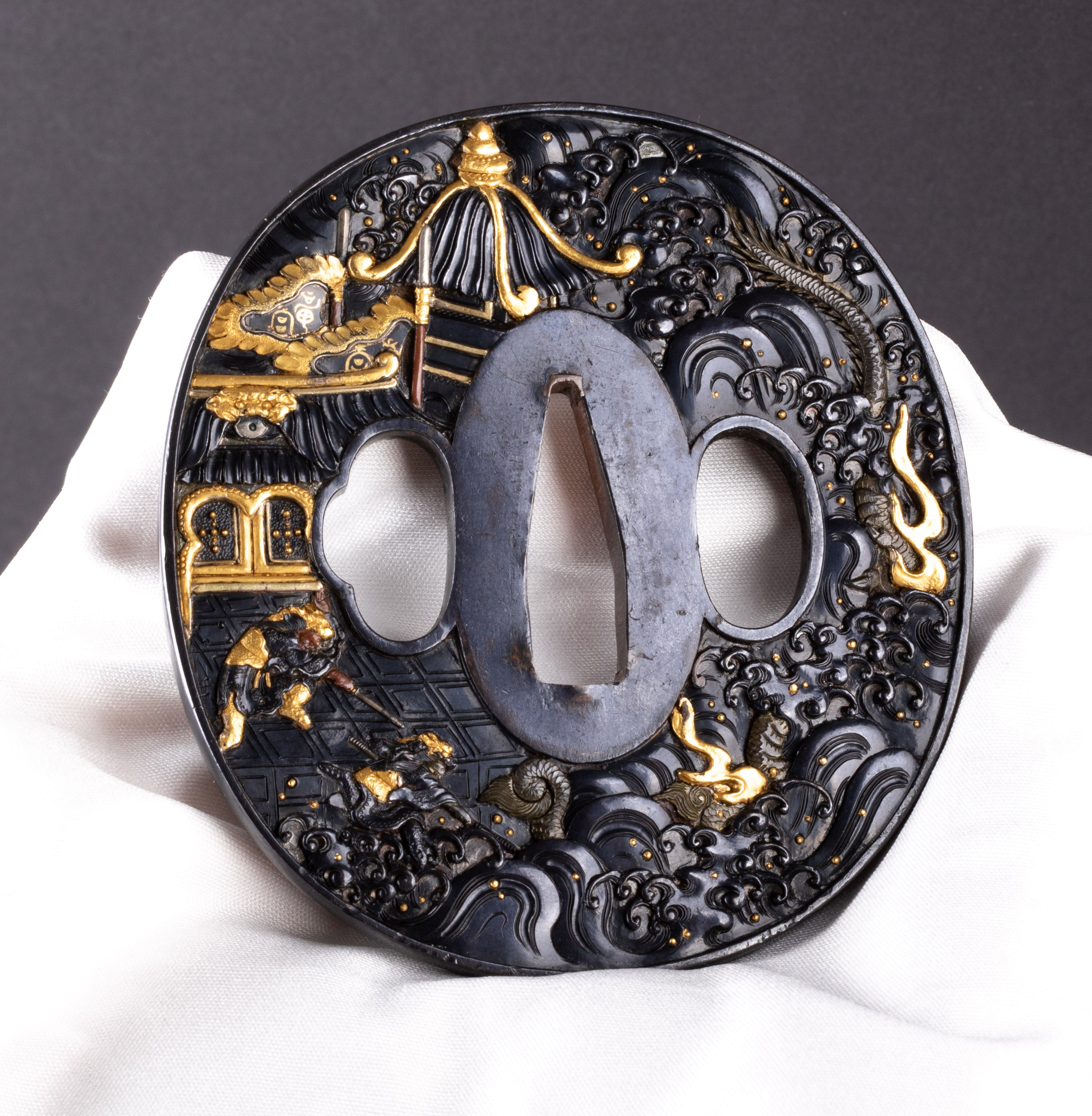
Kinko · around 1670
Where Masahide stands among comparable artisans: across all of nihontō, and within tradition, era, and period. The tiers (Foremost · Leading · Major · Notable) weigh official designations from the NBTHK and Japan's Agency for Cultural Affairs, together with historical honors of lasting repute such as the Sansaku and Meibutsu-chō.
Select a lens to see how it's measured.
Kinko
5 pieces on the market now
The Nomura school (野村) is a lineage of kinko (金工) metalworkers based in Edo, active from the mid-Edo period. The school's eponymous tradition is anchored by Nomura Masahide (野村正秀), recorded in the NBTHK setsumei as "a highly skilled artist of the Edo Nomura school," and by Nomura Masamichi (野村正道), also known as Nomura Shodo, who served as the principal teacher of the school's most prolific designated member, Tsu Jinpo (津尋甫). Jinpo, whose personal name was Otsu Hachizaemon[[c:1]], is documented as having lived in the vicinity of Ginza in Edo and as having been active from Kyoho 7 (1722) until his death in Horeki 12 (1762). The teacher-pupil axis from Masamichi to Jinpo constitutes the core documented lineage of the school, situating it firmly within the broader Edo-period kinko milieu. The collective style of the Nomura school is defined by a rigorous commitment to realism and by a distinctive technical vocabulary rooted in shakudo (赤銅) nanako-ji (魚子地) grounds worked in takabori (高彫, high relief). This combination of deep-black shakudo surface with precisely punched nanako and boldly sculptural relief carving is the school's signature idiom, recurring across virtually every designated work. Motifs are drawn overwhelmingly from the natural world: raptors poised on oak trees (kashiwa, 柏), lilies (yuri, 百合), shrimp (ebi, 海老), and small birds amid branches.
" Polychrome enrichment through iroe (色絵) and kin-iroe (金色絵), as well as applied motifs in gold and suaka (素銅), lends chromatic depth to the relief compositions. Several works also demonstrate the influence of the Goto house tradition, exhibiting what the setsumei describe as "Goto-like dignity of style" alongside "a power and freshness distinctive to" the Nomura lineage. " Fuchi-kashira (縁頭) constitute the predominant format, followed by tsuba, kozuka, and mitokoromono (三所物) sets. The Nomura school occupies a distinctive position within the Edo-period kinko canon as a lineage that channeled the formal discipline of the Goto tradition into an intensely naturalistic mode of expression. While the school drew on Goto prototypes, particularly in nanako technique and in certain mitokoromono compositions modeled after "early Goto masterworks," the Nomura idiom is distinguished by a sculptural forcefulness and a commitment to observed nature that the setsumei consistently single out. Among Jinpo's fuchi-kashira, designs of raptors alighting upon oak branches are described as possessing "an extremely forceful impact," with "masterpieces" among them, while his lily subjects are noted as a particular strength. The school's legacy, as attested across the designated corpus, resides in this synthesis of technical rigor, vivid realism, and the bold relief carving that constitutes its most recognizable hallmark. Learn more →
| Smith | Era | Designated |
|---|---|---|
| Tsu Jinpo津尋甫 | — | 7 |
| Masayoshi正芳 | — | 0 |
| Masahide正英 | — | 0 |
| Masatsugu正次 | — | 0 |
| Masamichi正道 | — | 0 |
A Hozon-certified fitting of notably superior craftsmanship and condition, often with signature or workmanship of high reference value.
The NBTHK (Nihon Bijutsu Tōken Hozon Kyōkai, the Society for the Preservation of Japanese Art Swords) is a public-interest incorporated foundation founded in 1948 and supervised by Japan’s Agency for Cultural Affairs (Bunkachō); it is based at the Japanese Sword Museum in Tokyo. Its expert panels physically examine each submitted work (shinsa) and issue a certificate (kanteishō) ranking it by artistic and historical merit. NBTHK papers are the most widely recognized standard of authentication for Japanese swords and fittings.
NBTHK official siteInspection period (per the shop's shipping policy): after receiving the item, each customer has two weeks for inspection. In that time you may decide to return it, and the item will be refunded in full. Shipping costs are not refunded. Returns (per the shop's refund policy): the policy lasts 30 days; once 30 days have passed since purchase, no refund or exchange is possible. To be eligible for a return, the item must be in the same condition in which it was received and in its original packaging. Customized products cannot be returned. In certain situations only a partial refund is granted. Return shipping is at the customer's expense, and shipping costs are non-refundable.