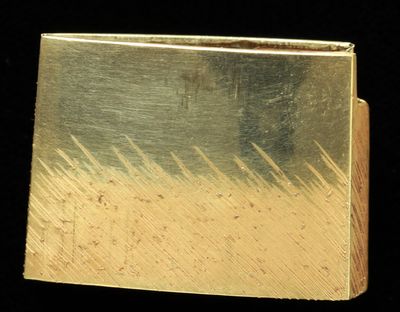
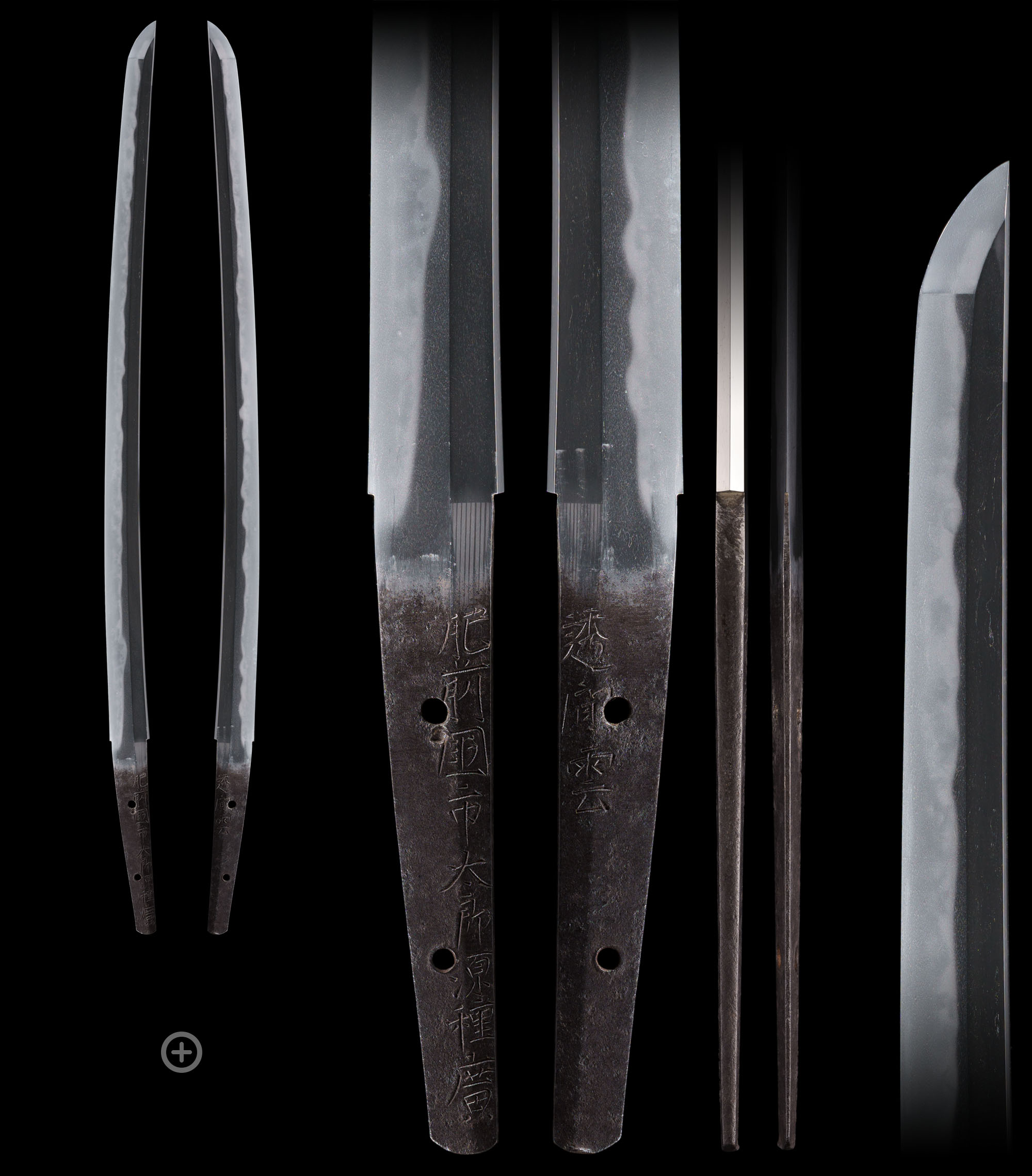
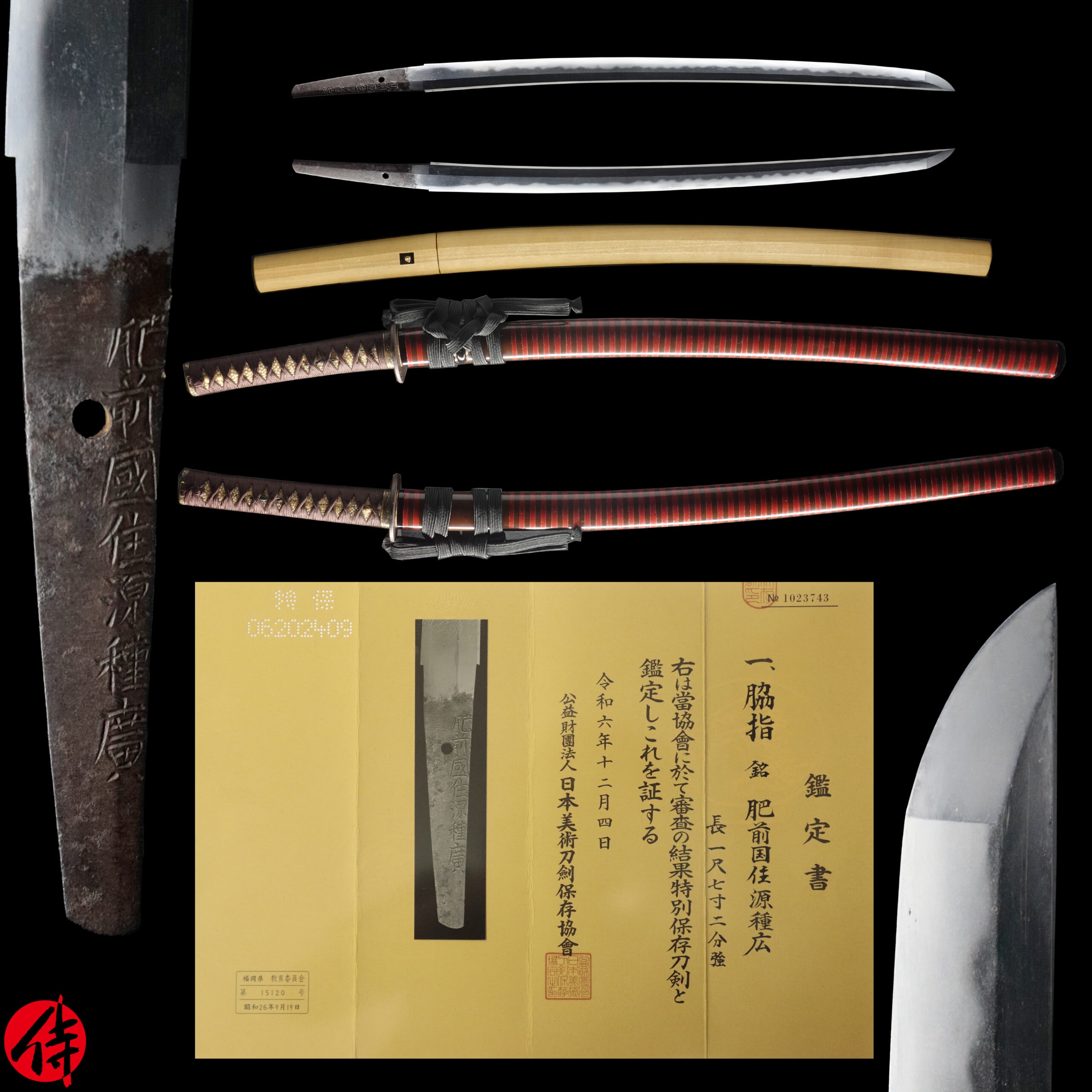
This wakizashi is by Tanehiro, a smith of the Ichita lineage who resided in Hizen Hirado and Kanzaki. Though his extant works are few, they are known for their tightly forged jigane and bright, flamboyant midareba, resembling works by Hizen Masahiro and Yukihiro. This piece features a slightly extended length with a refined chu-kissaki, a masame hada on the shinogi-ji and a ko-mokume mixed with ko-itame on the hiraji, with fine ji-nie and chikei. The suguha hamon has shallow notare mixed with small patterns, bright nie, and nioi in the ha-chu. The deep yakidashi boshi is well-nie'd and returns in a ko-maru along the fukura. The tang, with suji-kai yasurime, is in good condition, and the mei is distinctive.
mei · Kanei (1624-1644) · nagasa 52.4cm · sori 1cm


Hizen · around 1624-1644
1 piece on the market now
Where Tanehiro stands among comparable artisans: across all of nihontō, and within tradition, era, and period. The tiers (Foremost · Leading · Major · Notable) weigh official designations from the NBTHK and Japan's Agency for Cultural Affairs, together with historical honors of lasting repute such as the Sansaku and Meibutsu-chō.
Select a lens to see how it's measured.
A blade of top-grade workmanship and condition, formally judged to rank with a nationally recognized Important Art Object (Jūyō Bijutsuhin). Awarded only at the NBTHK’s competitive annual examination.
Of Japan’s roughly 2.5 million registered swords, only 12,307 (about 1 in 203) have ever attained Jūyō.
The NBTHK (Nihon Bijutsu Tōken Hozon Kyōkai, the Society for the Preservation of Japanese Art Swords) is a public-interest incorporated foundation founded in 1948 and supervised by Japan’s Agency for Cultural Affairs (Bunkachō); it is based at the Japanese Sword Museum in Tokyo. Its expert panels physically examine each submitted work (shinsa) and issue a certificate (kanteishō) ranking it by artistic and historical merit. NBTHK papers are the most widely recognized standard of authentication for Japanese swords and fittings.
NBTHK official siteIf, due to our fault, the item differs significantly from its proper condition, the item may be returned. Cooling-off is within one week of the item's arrival.
This wakizashi is by Tanehiro, a smith of the Ichita lineage who resided in Hizen Hirado and Kanzaki. Though his extant works are few, they are known for their tightly forged jigane and bright, flamboyant midareba, resembling works by Hizen Masahiro and Yukihiro. This piece features a slightly extended length with a refined chu-kissaki, a masame hada on the shinogi-ji and a ko-mokume mixed with ko-itame on the hiraji, with fine ji-nie and chikei. The suguha hamon has shallow notare mixed with small patterns, bright nie, and nioi in the ha-chu. The deep yakidashi boshi is well-nie'd and returns in a ko-maru along the fukura. The tang, with suji-kai yasurime, is in good condition, and the mei is distinctive.
mei · Kanei (1624-1644) · nagasa 52.4cm · sori 1cm


Hizen · around 1624-1644
1 piece on the market now
Where Tanehiro stands among comparable artisans: across all of nihontō, and within tradition, era, and period. The tiers (Foremost · Leading · Major · Notable) weigh official designations from the NBTHK and Japan's Agency for Cultural Affairs, together with historical honors of lasting repute such as the Sansaku and Meibutsu-chō.
Select a lens to see how it's measured.
A blade of top-grade workmanship and condition, formally judged to rank with a nationally recognized Important Art Object (Jūyō Bijutsuhin). Awarded only at the NBTHK’s competitive annual examination.
Of Japan’s roughly 2.5 million registered swords, only 12,307 (about 1 in 203) have ever attained Jūyō.
The NBTHK (Nihon Bijutsu Tōken Hozon Kyōkai, the Society for the Preservation of Japanese Art Swords) is a public-interest incorporated foundation founded in 1948 and supervised by Japan’s Agency for Cultural Affairs (Bunkachō); it is based at the Japanese Sword Museum in Tokyo. Its expert panels physically examine each submitted work (shinsa) and issue a certificate (kanteishō) ranking it by artistic and historical merit. NBTHK papers are the most widely recognized standard of authentication for Japanese swords and fittings.
NBTHK official siteIf, due to our fault, the item differs significantly from its proper condition, the item may be returned. Cooling-off is within one week of the item's arrival.