 NihontoWatchNihontoWatch
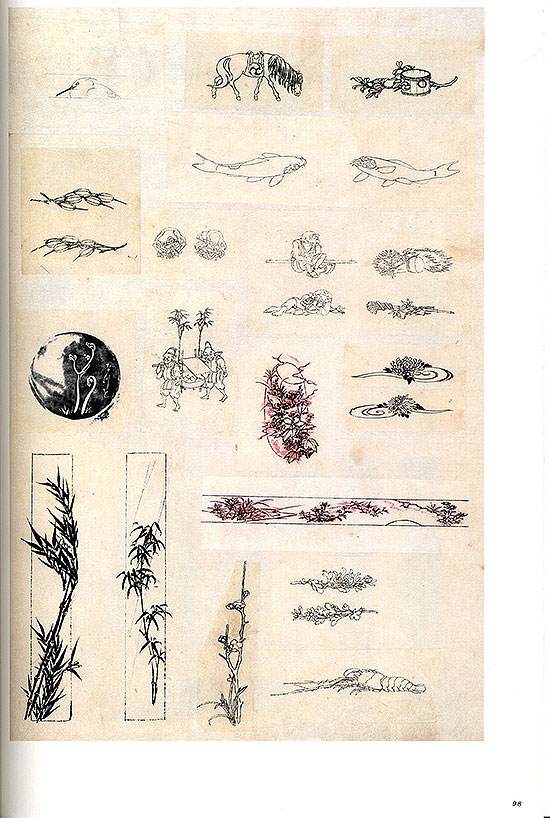
A work by Kano Natsuo, who is hailed as the pinnacle of metalwork and the last great master of machibori. Kano Natsuo was born in Bunsei 11 and became the adopted son of the sword merchant Kano Jisuke; at age 12, he studied metalwork, Chinese classics, and painting under the masters Okumura Shohachi, Tanimori Tanematsu, and Nakajima Raisho, respectively. At age 27, he went to Edo to continue his studies and achieved great success; in the Meiji era, he was entrusted by the government with the production of the original molds for the new coinage, and in Meiji 23, he became a professor at the Tokyo Bijutsu Gakko and was selected as a Teishitsu Gigeiin, leaving behind a brilliant legacy. This work depicts a scene of bamboo in the rain on a shibuichi migaki-ji using the katakiribori technique at which Natsuo excelled, allowing one to enjoy Natsuo's transcendent katakiri skill. The kozuka has a mei of "Masatoshi"; while several people with the same name are listed in the Kinko Meikan, it is not certain which Masatoshi this work corresponds to, but it was likely produced after the Meiji era by the order of the owner of the koganira. It is a superior work with sharp carving that suits the design of the koganira well and further enhances the piece.
NihontoWatchOffered by Iida Koendo

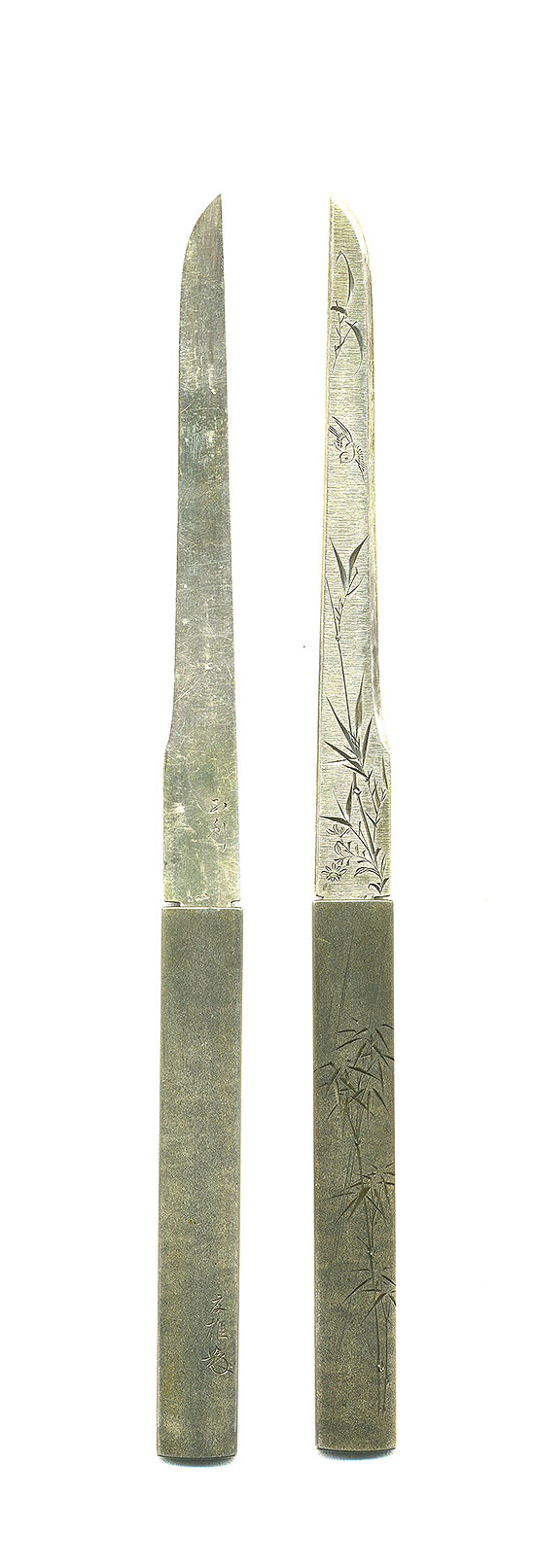
Kano Natsuo
Edo
Signed
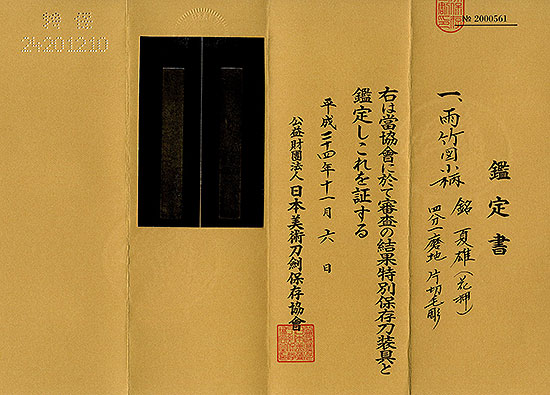
Tokuho (NBTHK)
As written by the shop
Machine translation from the shop's Japanese · may contain errors ·
Kinko · Musashi · around 1828-1898
1 piece on the market now
A tsuba of the Seven Sages of the Bamboo Grove, signed and dated to the autumn of Bunkyu 1 (1861) when Kano Natsuo was thirty-four, is recorded in his own working notes, the Saiku Shirabe no Ki[[c:1]], as taking two days and a night for the drawing and more than a month for the carving. The published sources call Natsuo "the last great master of machibori"[[c:2]], the town-carvers who worked outside the official Goto house. He was born in Kyoto in the Bunsei era and adopted as a child by the sword dealer Kano Jisuke. At twelve he entered the workshop of the metalworker Okumura Shohachi, and at fourteen he learned metalwork under Ikeda Koju of the Otsuki school, signing Juro before he took the name Natsuo. In the same years he read the Chinese classics under Tanimori Tanematsu and studied painting under Nakajima Raisho, the Maruyama-Shijo master, and the sources hold that his standing as the last machibori master owed most "to the grounding cultivated in these Kyoto years"[[c:3]]. At twenty-seven he went to Edo, where his art matured. After the Restoration the government entrusted him with the prototype models for the new coinage, and in 1890 he became a professor at the Tokyo School of Fine Arts and, in the same year, one of the first Teishitsu Gigeiin, the artists appointed to the court. He died in 1898 at seventy-one.
His hand is a painter's naturalism carried in a disciplined chisel. The published sources praise again and again his outstanding power of drawing from life joined to minute carving. Of the bamboo-grove guard they admire the composition that values empty space and the clear, lifelike chisel work, and close by calling it "a celebrated tsuba taut with living spirit"[[c:4]]. On an iron tsuba of peonies of 1863 the great flower sways in an early-summer breeze on the front, while the reverse carries only the leaves, cut quietly from close sketching. On a guard of wind-blown bamboo and flowing water, set on a shibuichi day-and-night plate, they judge that "the sensibility and carving that seize at once the real and its spirit are outstanding"[[c:5]].
His technical range runs across the soft metals and iron. He works shakudo, both on a rough-finished plate and on nanako, iron, and shibuichi in the day-and-night manner, in takabori and sukidashi relief, sukisage and sukidashi-bori, with gold, silver and copper inlay and iro-e. He often finishes the rim as an uchikaeshi-mimi. His nanako, the sources note, is uncommon and found mainly in early work. His colour can be held to a minimum, as on one guard where the iro-e is limited to touches of gold, and his rain is singled out as a subject handled in a way all his own, falling on pine, peony, lotus and orchid as well as on wild geese.
The published sources trace his debt to the past precisely. A rain-and-geese tsuba of 1862 is one that "Natsuo's own records explicitly call in the Kaneie manner"[[c:6]], its composition and its turned-back rim modelled on Kaneie, with the influence of Yasuchika also seen. On a late iron guard of geese beneath the moon, made in 1882, the open space filled with layers of air, the perspective and the high relief of the parent birds show that "the traces of his study of Kaneie, called the father of the pictorial tsuba, are unmistakable"[[c:7]]. His subjects range from Chinese themes such as the Seven Sages and the Four Gentlemen to the kyogen play Suehirogari, peonies, egrets in willows and the creatures of the sea.
Across his career the dated works allow the hand to be followed. A daisho pair of the four seasons, signed in Kyoto in his mid-twenties just before he left for Edo, is one of his rare daisho guards. A mitokoromono of the Four Gentlemen, dated Ansei 3 (1856) the year after he reached Edo and signed proudly as a man of the capital, is a rare example of his three-piece sets. Several of his finest guards date to the Bunkyu years, and his late iron guards of the Meiji era carry the same quality: one of 1884 crowded with fish and shells in many coloured metals is called "a tsuba that may be called the culmination of Natsuo's craft"[[c:8]].
For the collector Natsuo stands at the head of his field on the designation record: ten of his works have been raised to Tokubetsu Juyo, a count among fittings makers matched only by Yasuchika, beside sixty-two at the Juyo level. Recorded provenance is thin, but the wind-and-bamboo tsuba descended in the Satake house, the lords of Akita, through the domain period. Signed Natsuo fittings at the designated level appear only from time to time and are sought by the most serious collectors of late Edo and Meiji metalwork, so a documented example is a rare encounter rather than an expected one.
Where Natsuo stands among comparable artisans: across all of nihontō, and within tradition, era, and period. The tiers (Foremost · Leading · Major · Notable) weigh official designations from the NBTHK and Japan's Agency for Cultural Affairs, together with historical honors of lasting repute such as the Sansaku and Meibutsu-chō.
Select a lens to see how it's measured.
Kinko · Yamashiro
2 pieces on the market now
The Kano (加納) school of kinko metalwork centers on the towering figure of Kanō Natsuo (1828–1898), the master whom the NBTHK setsumei consistently acclaim as "the last great master of machibori" (町彫, town carving). Born in Kyoto in Bunsei 11 (1828), Natsuo was adopted while still young by the sword dealer Kanō Jisuke, whose family name the lineage bears. At twelve he entered the atelier of the metalworker Okumura Shōhachi, and at fourteen he studied metalworking techniques under Ikeda Kōju of the Ōtsuki school, signing his early work Jurō (寿朗) before adopting the name Natsuo. " At twenty-seven he went to Edo, where he refined his art and achieved full maturity, answering the commissions of daimyo houses and private patrons alike: a tsuba "made at the request of the Katō family," and a celebrated wind-blown bamboo tsuba transmitted in the Satake family, lords of Akita domain. The school's shared vocabulary unites an exceptional range of grounds and techniques under a painter's discipline. Grounds include polished iron (migaki-ji), shakudō in nanako-ji (rare, and characteristic of the early period) and arashi-ji, the "day-and-night" composite of iron and shibuichi (chūya-jitate), and the hallmark tiger-stripe (torafu) shibuichi.
Upon these, relief in sukidashi-takabori of "markedly dignified" character is joined by katakiribori and kebori — the V-cut engraving that mimics the ink brush — together with hira-zōgan, suemon-zōgan, nunome-zōgan, and keshikomi-zōgan, and polychrome iroe employing gold, silver, shakudō, suaka, shibuichi, brass, and even shell inlay. " Grounded in meticulous sketching from life in the Maruyama–Shijō spirit, the compositions reserve broad expanses of space and give particular weight to "the layers of atmosphere that fill that space"; the ability to express a subject "with tasteful restraint and an effortless clarity" despite employing a variety of metals and methods is, the setsumei observe, the school's true strength. The pictorial tsuba tradition is consciously invoked — Natsuo's study of Kaneie, "revered as the founder of so-called pictorial-style tsuba (efū tsuba)," is explicit in his own notes, and the influence of Yasuchika is likewise discerned — across motifs ranging from fish, egrets and willows, geese in rain, peonies, and the Four Gentlemen to the Seven Sages of the Bamboo Grove, kyōgen scenes, and the moon upon the water. With the Meiji Restoration the school's legacy passed beyond sword fittings into the new nation's artistic metalwork: Natsuo was entrusted by the government with the master models for casting the new coinage, entered the Osaka Mint in Meiji 2, and in Meiji 23 (1890) became a professor at the Tokyo School of Fine Arts, being selected that same year as one of the first Teishitsu Gigeiin (Imperial Household Artists). " Bridging the late Edo decorative tradition and Meiji artistic metalwork, the Kano school stands at the very summit of the tosogu canon. Learn more →
| Smith | Era | Designated |
|---|---|---|
| Natsuo夏雄 | 1828-1898 | 76 |
| Shukyo/Hideaki秀鏡 | — | 2 |
| Takao隆雄 | 1670 | 1 |
A Hozon-certified fitting of notably superior craftsmanship and condition, often with signature or workmanship of high reference value.
The NBTHK (Nihon Bijutsu Tōken Hozon Kyōkai, the Society for the Preservation of Japanese Art Swords) is a public-interest incorporated foundation founded in 1948 and supervised by Japan’s Agency for Cultural Affairs (Bunkachō); it is based at the Japanese Sword Museum in Tokyo. Its expert panels physically examine each submitted work (shinsa) and issue a certificate (kanteishō) ranking it by artistic and historical merit. NBTHK papers are the most widely recognized standard of authentication for Japanese swords and fittings.
NBTHK official siteFor returns at the customer's convenience, please notify us within two days of the item's arrival. Items that have been altered cannot be accepted. Return shipping is at the customer's expense. Costs other than the item price (bank transfer fees, cash-on-delivery fees, etc.) cannot be refunded. Items delivered overseas cannot be returned or refunded.