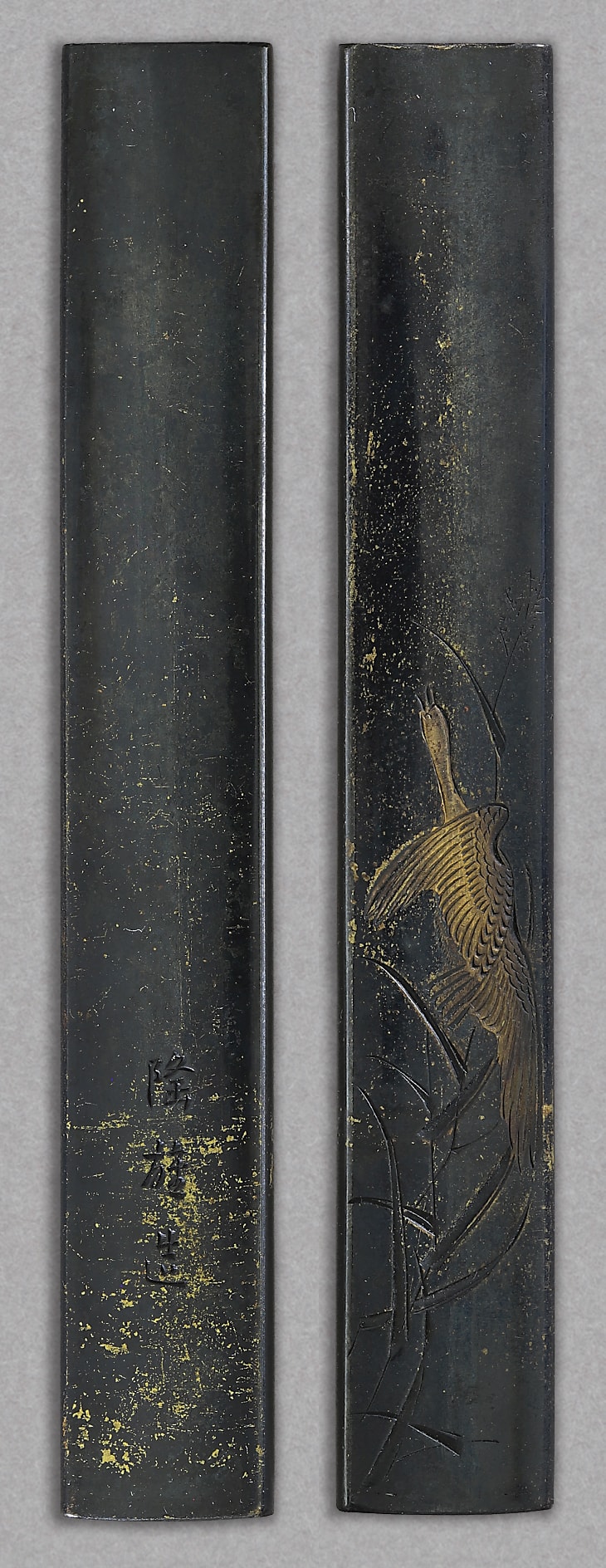
Kano Natsuo (1828–1898) was born in Kyoto and adopted as a youth by the sword dealer Kano Jisuke. He began formal metalwork training at the age of twelve under Okumura Shohachi, and at fourteen advanced to study soft-metal techniques with Ikeda Koju of the Otsuki school, initially signing his work "Juro" before adopting the art name Natsuo. Concurrently he pursued a broad humanistic education: classical Chinese reading under Tanimori Tanematsu and painting in the Maruyama-Shijo tradition under Nakajima Raisho. This interdisciplinary grounding during his formative Kyoto years proved decisive, and he is universally acclaimed as the last great master of — the independent "town-carver" lineage working outside official domain patronage. At twenty-seven he relocated to , where he achieved artistic maturity. Following the Meiji Restoration, the government entrusted him with producing prototype dies for the new national coinage. In 1890 he was appointed professor at the Tokyo Fine Arts School and simultaneously selected as one of the inaugural Imperial Household Artists (Teishitsu Gigeiin), distinctions that confirmed his standing as the preeminent metalwork artist of his generation.
Natsuo's technical command encompassed the full vocabulary of decorative metalwork and ranged freely across media and method. His and demonstrate consummate mastery of high-relief carving and the subtler technique, in which motifs emerge from carefully lowered grounds with sculptural presence. He employed single-chisel engraving and fine hairline work with equal fluency, often combining both on a single piece. His palette of ground metals was characteristically varied: iron, , and — the last frequently exhibiting his signature torafu tiger-stripe patterning — served as foils for polychrome inlay in gold, silver, , and , supplemented by - flat inlay, fabric-impression inlay, and fish-roe stippling where the design demanded it. His deep study of the Maruyama-Shijo painterly tradition is everywhere evident in compositions that balance bold naturalistic observation with refined atmospheric space, while his acknowledged reverence for the -period master Kaneie and the family informed his approach to pictorial design and iron-ground rim treatments.
Natsuo's oeuvre is distinguished by an extraordinary breadth of subject matter — from classical Chinese literary themes such as the Seven Sages of the Bamboo Grove and the Four Gentlemen to lyrical naturalistic studies of marine life, geese, peonies, and plovers, and even narrative kyogen theater scenes — all rendered with a quality the examiners repeatedly characterize as possessing "spirit resonance and vitality." His ability to conjure expansive atmospheric depth within the confined format of a or , controlling the interplay of carved relief, empty space, and restrained color, places him at the apex of late and Meiji period metalwork. Works spanning his entire career, from ambitious pieces made in his late twenties through masterworks of his fifties, consistently demonstrate the union of penetrating observation from life with poetic sensibility and virtuosic chisel technique that defines his enduring importance in the history of Japanese decorative metalwork.