NihontoWatch Mon

NihontoWatchBETA

Market
Encyclopedia
NihontoWatch Mon

NihontoWatchBETA

Market
Encyclopedia

Description

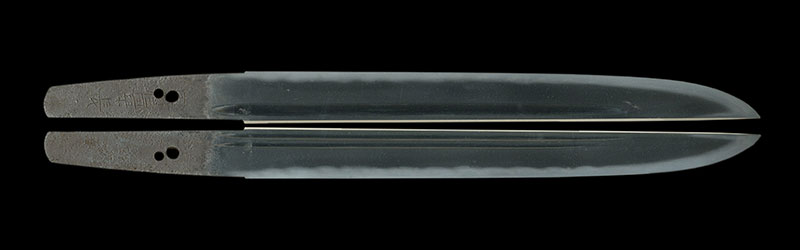
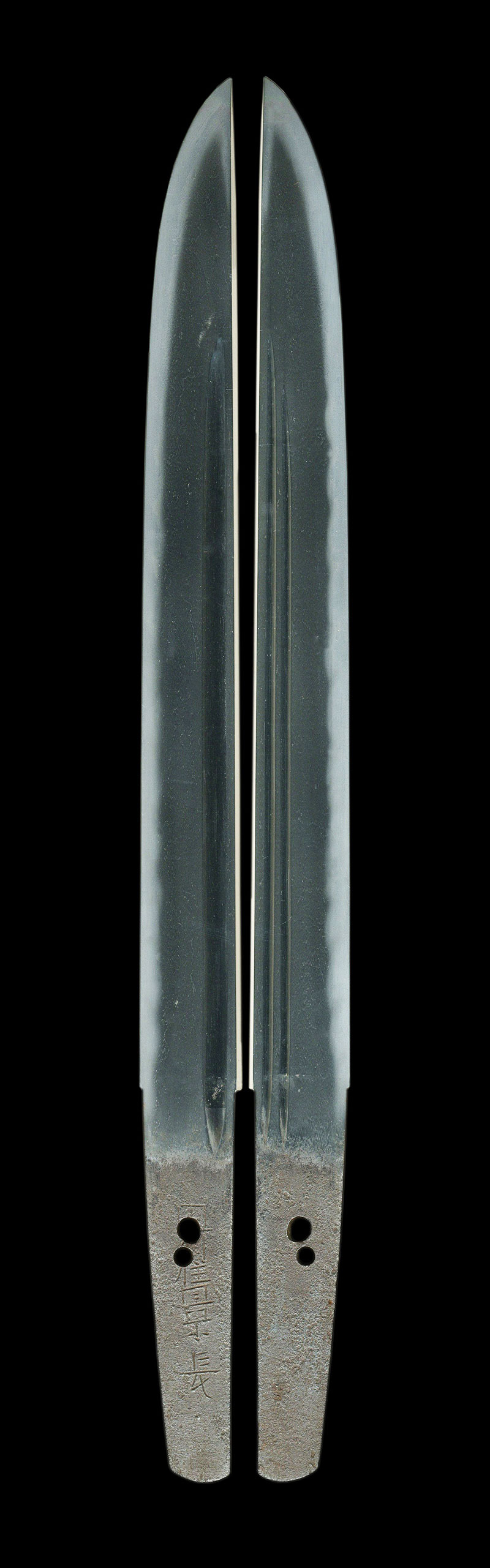
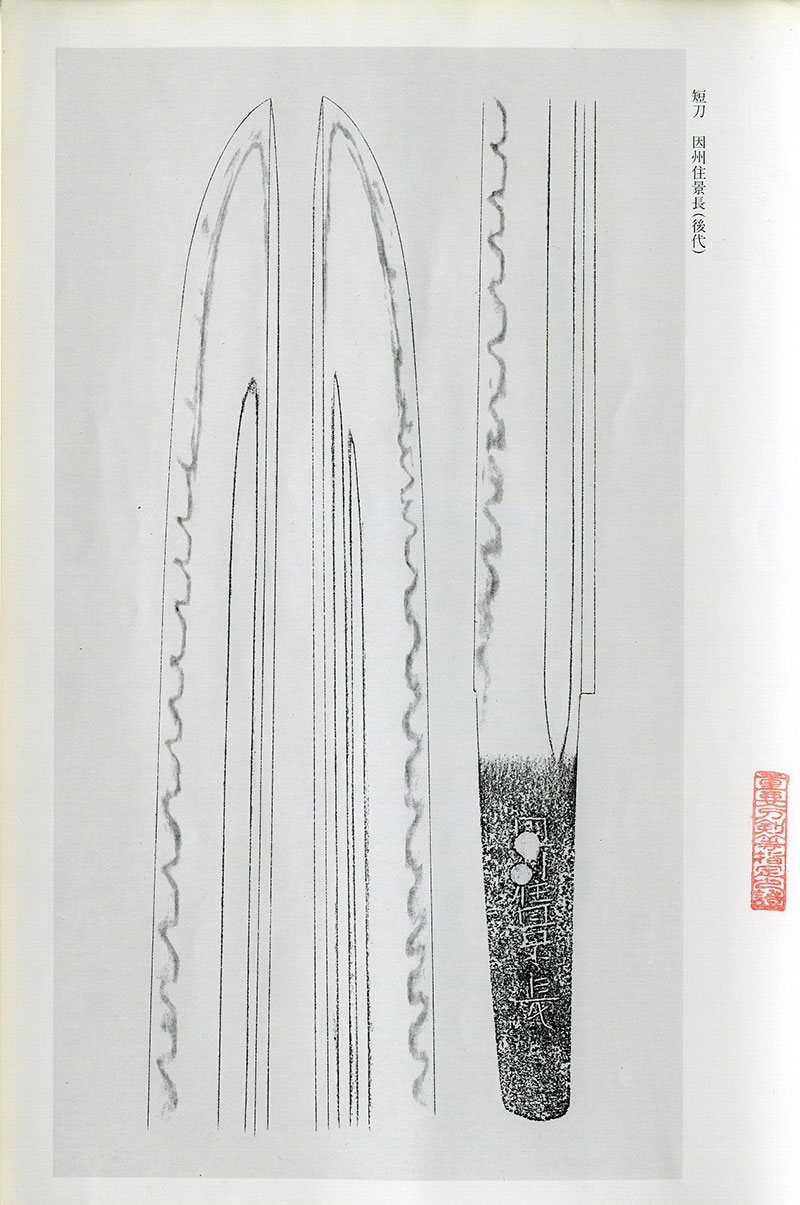
This is a Juyo Token designated tanto by Inshu Kanenaga, active in Inaba Province (Tottori Prefecture) during the Nanbokucho period. Kanenaga is said to be a disciple of Yamashiro Awataguchi Yoshimasa. This piece features an unusual katachi-gunome hamon, deviating from the traditional suguha, suggesting interaction between Inaba and Bizen provinces during that era.

NBTHK Setsumei

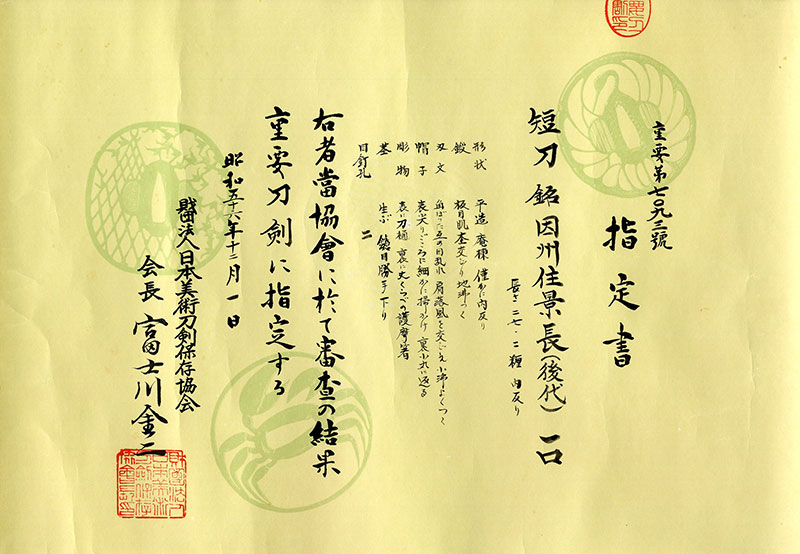
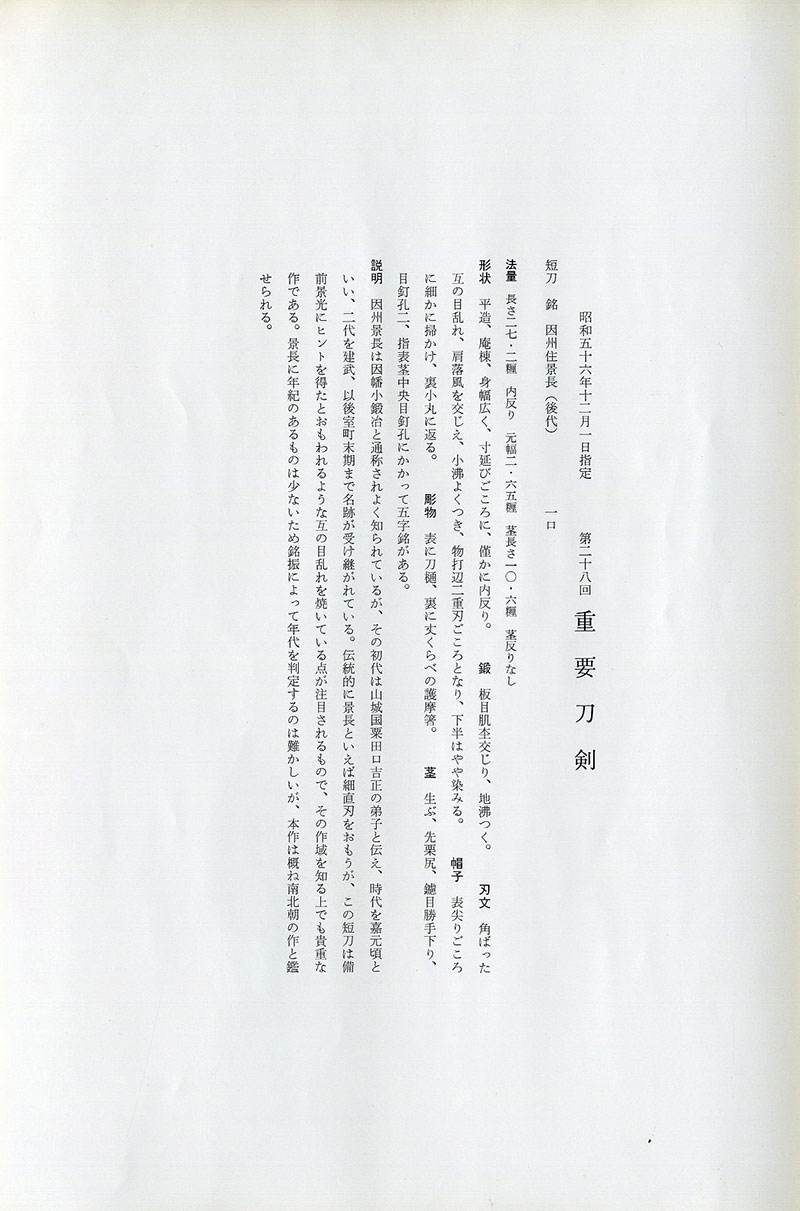
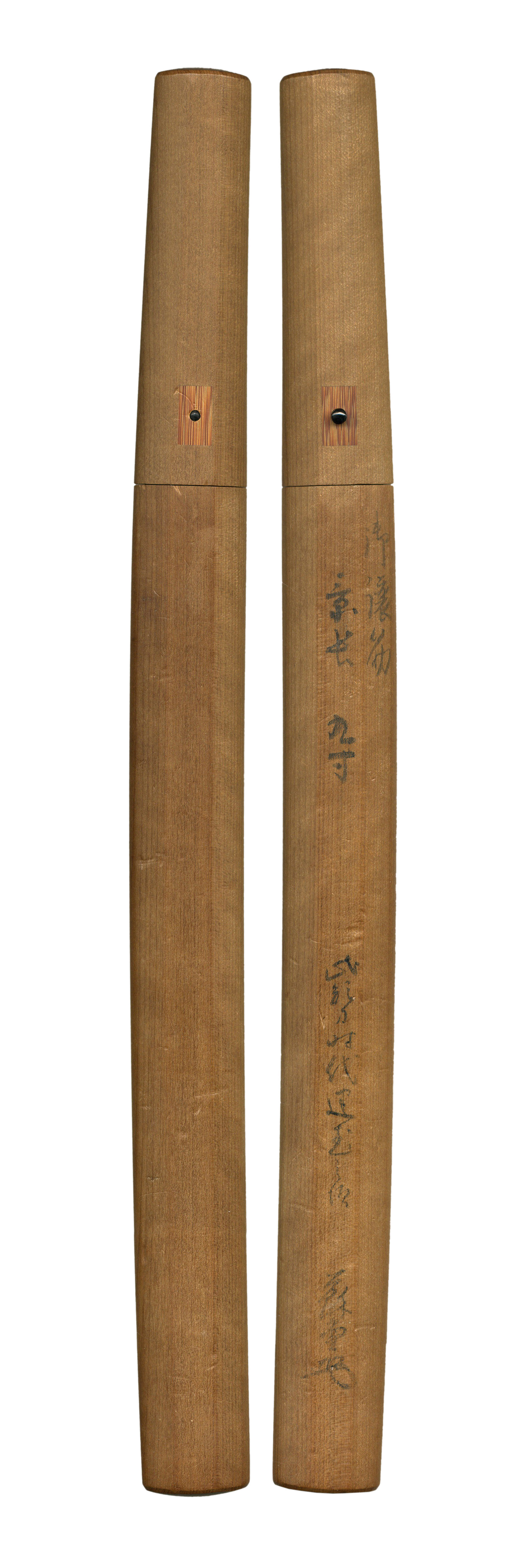
Jūyō-Tōken, 28th Session — Designated December 1, 1981 Tantō, mei: Inshū-jū Kagenaga (later generation) (因州住景長) Measurements Nagasa 27.2 cm, uchizori (value not stated), motohaba 2.65 cm, nakago-nagasa 10.6 cm Description Keijō: hira-zukuri construction with iori-mune; wide mihaba; a slightly elongated (sun-nobi) impression; with slight uchizori (inward curvature). Kitae: itame-hada mixed with mokume; ji-nie adheres. Hamon: gunome-midare mixed with a kataochi-like manner and somewhat angular elements; ko-nie adheres well; around the monouchi it tends toward a nijūba-like appearance; the lower half shows slight shimi (staining). Bōshi: On the omote, with a pointed tendency and fine hakikake; on the ura it turns back in ko-maru. Horimono: Omote: tōmen; ura: jōkurabe gomabashi (paired ritual chopsticks of differing lengths). Nakago: ubu; tip kurijiri; katte-sagari yasurime; two mekugi-ana; a five-character signature is cut on the sashi-omote, running into/overlapping the central mekugi-ana. Artisan Inshū-jū Kagenaga (later generation) Era Nanbokuchō period (appraisal) Explanation Inshū Kagenaga is well known under the sobriquet “Inaba no Kaji” (the Inaba smith). Tradition holds that the first generation was a pupil of Awataguchi Yoshimasa of Yamashiro Province; he is said to have worked around the Kagen era (1303–1306). The second generation is placed around the Kenmu era (1334–1338), and thereafter the name continued to be inherited down to the end of the Muromachi period. Conventionally, when one speaks of Kagenaga one tends to call to mind a fine suguha (straight temper). What merits attention in this tantō, however, is that it hardens a gunome-midare that appears to have taken inspiration from Bizen Kagemitsu. In this respect it is a valuable work for understanding the breadth of Kagenaga’s working manner. Since there are few works by Kagenaga bearing an inscribed date, it is difficult to determine chronology solely from the manner of the signature. Nevertheless, this work is appraised overall as a production of the Nanbokuchō period.

NihontoWatch MonNihontoWatchBETA
MarketEncyclopedia
Swords›Inaba Kagenaga›Kagenaga›Koto Tanto: Inshu jyu Kanenaga - NBTHK Juyo Token No.28
tantoJūyō
Inaba Kagenaga

Koto Tanto: Inshu jyu Kanenaga - NBTHK Juyo Token No.28

mei · Nanbokucho · nagasa 27.2cm

SOLD
Inaba Kagenaga — 1 of 6
Inaba Kagenaga — 2 of 6
Inaba Kagenaga — 3 of 6
Inaba Kagenaga — 4 of 6
Inaba Kagenaga — 5 of 6
Inaba Kagenaga — 6 of 6
1 / 6
1 / 6
Inaba Kagenaga — 1 of 6Inaba Kagenaga — 2 of 6Inaba Kagenaga — 3 of 6Inaba Kagenaga — 4 of 6Inaba Kagenaga — 5 of 6Inaba Kagenaga — 6 of 6
Measurements & details
Smith
Inaba Kagenaga
Type
Tanto
School
Inaba Kagenaga
Period
Around 1362–1368(Teiji ND)
Province
Inaba
Signature
Signed(100% of this smith's designated works are signed)
Measurements
Nagasa 27.2cmMotohaba 2.6cmKasane 0.6cm
Description

This is a Juyo Token designated tanto by Inshu Kanenaga, active in Inaba Province (Tottori Prefecture) during the Nanbokucho period. Kanenaga is said to be a disciple of Yamashiro Awataguchi Yoshimasa. This piece features an unusual katachi-gunome hamon, deviating from the traditional suguha, suggesting interaction between Inaba and Bizen provinces during that era.

NBTHK Zufu Commentary

Juyo #28

AI translation — may contain errors

-, 28th Session — Designated December 1, 1981

, : Inshū-jū Kagenaga (later generation) (因州住景長)

Measurements 27.2 cm, (value not stated), 2.65 cm, 10.6 cm

Description Keijō: construction with ; wide ; a slightly elongated () impression; with slight (inward curvature). : mixed with ; adheres. : mixed with a -like manner and somewhat angular elements; adheres well; around the it tends toward a -like appearance; the lower half shows slight (staining). : On the , with a pointed tendency and fine ; on the it turns back in . : : tōmen; : jōkurabe (paired ritual chopsticks of differing lengths). : ; tip ; ; two ; a five-character signature is cut on the , running into/overlapping the central .

Artisan Inshū-jū Kagenaga (later generation)

Era period (appraisal)

Explanation Inshū Kagenaga is well known under the sobriquet “Inaba no Kaji” (the Inaba smith). Tradition holds that the first generation was a pupil of Yoshimasa of Yamashiro Province; he is said to have worked around the Kagen era (1303–1306). The second generation is placed around the Kenmu era (1334–1338), and thereafter the name continued to be inherited down to the end of the period.

Conventionally, when one speaks of Kagenaga one tends to call to mind a fine (straight temper). What merits attention in this , however, is that it hardens a that appears to have taken inspiration from Kagemitsu. In this respect it is a valuable work for understanding the breadth of Kagenaga’s working manner.

Since there are few works by Kagenaga bearing an inscribed date, it is difficult to determine chronology solely from the manner of the signature. Nevertheless, this work is appraised overall as a production of the period.
About the maker

Kagenaga

景長

Wakimono · Inaba · around 1362-1368

Fujishiro Jo saku · Tōken Taikan top 21%

›

Historical importance

Where Kagenaga stands among comparable artisans: across all of nihontō, and within tradition, era, and period. The tiers (Foremost · Leading · Major · Notable) weigh official designations from the NBTHK and Japan's Agency for Cultural Affairs, together with historical honors of lasting repute such as the Sansaku and Meibutsu-chō.

随一
Foremost
屈指
Leading
有数
Major
著名
Notable

Select a lens to see how it's measured.

Designation record
3 designated works
Jūyō
3
Kagenaga — full profileWakimono school
About the school

Inaba Kagenaga

因幡景長

Wakimono · Inaba

›

The Kagenaga smiths worked in Inaba Province (因州, Inshū), and the setsumei place their beginnings at the close of the Kamakura period, carrying the name forward in successive generations into the Muromachi era. The notices record a first generation set in the Kagen era (1303 to 1306) and a second in the Kenmu era (1334 to 1338), with the same signature continuing down to the Ōei era (1394 to 1428), from which the rare dated examples survive. Learn more →

5 recorded smiths20 designated works
Leading smiths
SmithEraDesignated
Kagenaga景長1362-13683
Kagenaga景長1394-14287
Tadakuni忠國1673-16812
Kagenaga景長1317-13191
Kagenaga景長1288-12937
Explore the Inaba Kagenaga school →
NBTHK Certificate
Jūyō Tōken重要刀剣
Important Sword
›

A blade of top-grade workmanship and condition, formally judged to rank with a nationally recognized Important Art Object (Jūyō Bijutsuhin). Awarded only at the NBTHK’s competitive annual examination.

Of Japan’s roughly 2.5 million registered swords, only 12,307 (about 1 in 203) have ever attained Jūyō.

About the NBTHK›

The NBTHK (Nihon Bijutsu Tōken Hozon Kyōkai, the Society for the Preservation of Japanese Art Swords) is a public-interest incorporated foundation founded in 1948 and supervised by Japan’s Agency for Cultural Affairs (Bunkachō); it is based at the Japanese Sword Museum in Tokyo. Its expert panels physically examine each submitted work (shinsa) and issue a certificate (kanteishō) ranking it by artistic and historical merit. NBTHK papers are the most widely recognized standard of authentication for Japanese swords and fittings.

NBTHK official site→
Seller
I
Iida Koendo
Established 1880 · 146 yrs on the market
🇯🇵Ships from Japan
›
✓Verified dealeriidakoendo.com
✓Ships worldwide✓English supportWire transfer
Return policy

Customer-initiated returns accepted within two days of arrival; return shipping paid by customer and fees non-refundable. Returns/refunds unavailable for overseas deliveries.

View all of Iida Koendo’s listings→View this item on the dealer’s site→

Previously sold by Inaba Kagenaga

Choshuya
Tanto - by Inaba Kagenaga - Inshu-ju Kagenaga (Later Generation) (Wazamono)Tanto - by Inaba Kagenaga - Inshu-ju Kagenaga (Later Generation) (Wazamono)
Sold

Tantō

ByInaba Kagenaga
SOLD

Swords

  • Katana
  • Wakizashi
  • Tantō
  • Tachi
  • Naginata
  • Yari

Fittings

  • Tsuba
  • Fuchi-Kashira
  • Kozuka
  • Menuki

Armor

  • Kabuto
  • Samurai Armor

By Certification

  • Tokujū
  • Jūyō
  • Tokuho
  • Hozon

Resources

  • Dealer Directory
  • Artist Directory
  • Glossary
  • Browse All
Nihontowatch© 2026
TermsPrivacyCookiesAbout

Description

This is a Juyo Token designated tanto by Inshu Kanenaga, active in Inaba Province (Tottori Prefecture) during the Nanbokucho period. Kanenaga is said to be a disciple of Yamashiro Awataguchi Yoshimasa. This piece features an unusual katachi-gunome hamon, deviating from the traditional suguha, suggesting interaction between Inaba and Bizen provinces during that era.

NBTHK Setsumei

Jūyō-Tōken, 28th Session — Designated December 1, 1981 Tantō, mei: Inshū-jū Kagenaga (later generation) (因州住景長) Measurements Nagasa 27.2 cm, uchizori (value not stated), motohaba 2.65 cm, nakago-nagasa 10.6 cm Description Keijō: hira-zukuri construction with iori-mune; wide mihaba; a slightly elongated (sun-nobi) impression; with slight uchizori (inward curvature). Kitae: itame-hada mixed with mokume; ji-nie adheres. Hamon: gunome-midare mixed with a kataochi-like manner and somewhat angular elements; ko-nie adheres well; around the monouchi it tends toward a nijūba-like appearance; the lower half shows slight shimi (staining). Bōshi: On the omote, with a pointed tendency and fine hakikake; on the ura it turns back in ko-maru. Horimono: Omote: tōmen; ura: jōkurabe gomabashi (paired ritual chopsticks of differing lengths). Nakago: ubu; tip kurijiri; katte-sagari yasurime; two mekugi-ana; a five-character signature is cut on the sashi-omote, running into/overlapping the central mekugi-ana. Artisan Inshū-jū Kagenaga (later generation) Era Nanbokuchō period (appraisal) Explanation Inshū Kagenaga is well known under the sobriquet “Inaba no Kaji” (the Inaba smith). Tradition holds that the first generation was a pupil of Awataguchi Yoshimasa of Yamashiro Province; he is said to have worked around the Kagen era (1303–1306). The second generation is placed around the Kenmu era (1334–1338), and thereafter the name continued to be inherited down to the end of the Muromachi period. Conventionally, when one speaks of Kagenaga one tends to call to mind a fine suguha (straight temper). What merits attention in this tantō, however, is that it hardens a gunome-midare that appears to have taken inspiration from Bizen Kagemitsu. In this respect it is a valuable work for understanding the breadth of Kagenaga’s working manner. Since there are few works by Kagenaga bearing an inscribed date, it is difficult to determine chronology solely from the manner of the signature. Nevertheless, this work is appraised overall as a production of the Nanbokuchō period.

NihontoWatch MonNihontoWatchBETA
MarketEncyclopedia
Swords›Inaba Kagenaga›Kagenaga›Koto Tanto: Inshu jyu Kanenaga - NBTHK Juyo Token No.28
tantoJūyō
Inaba Kagenaga

Koto Tanto: Inshu jyu Kanenaga - NBTHK Juyo Token No.28

mei · Nanbokucho · nagasa 27.2cm

SOLD
Inaba Kagenaga — 1 of 6
Inaba Kagenaga — 2 of 6
Inaba Kagenaga — 3 of 6
Inaba Kagenaga — 4 of 6
Inaba Kagenaga — 5 of 6
Inaba Kagenaga — 6 of 6
1 / 6
1 / 6
Inaba Kagenaga — 1 of 6Inaba Kagenaga — 2 of 6Inaba Kagenaga — 3 of 6Inaba Kagenaga — 4 of 6Inaba Kagenaga — 5 of 6Inaba Kagenaga — 6 of 6
Measurements & details
Smith
Inaba Kagenaga
Type
Tanto
School
Inaba Kagenaga
Period
Around 1362–1368(Teiji ND)
Province
Inaba
Signature
Signed(100% of this smith's designated works are signed)
Measurements
Nagasa 27.2cmMotohaba 2.6cmKasane 0.6cm
Description

This is a Juyo Token designated tanto by Inshu Kanenaga, active in Inaba Province (Tottori Prefecture) during the Nanbokucho period. Kanenaga is said to be a disciple of Yamashiro Awataguchi Yoshimasa. This piece features an unusual katachi-gunome hamon, deviating from the traditional suguha, suggesting interaction between Inaba and Bizen provinces during that era.

NBTHK Zufu Commentary

Juyo #28

AI translation — may contain errors

-, 28th Session — Designated December 1, 1981

, : Inshū-jū Kagenaga (later generation) (因州住景長)

Measurements 27.2 cm, (value not stated), 2.65 cm, 10.6 cm

Description Keijō: construction with ; wide ; a slightly elongated () impression; with slight (inward curvature). : mixed with ; adheres. : mixed with a -like manner and somewhat angular elements; adheres well; around the it tends toward a -like appearance; the lower half shows slight (staining). : On the , with a pointed tendency and fine ; on the it turns back in . : : tōmen; : jōkurabe (paired ritual chopsticks of differing lengths). : ; tip ; ; two ; a five-character signature is cut on the , running into/overlapping the central .

Artisan Inshū-jū Kagenaga (later generation)

Era period (appraisal)

Explanation Inshū Kagenaga is well known under the sobriquet “Inaba no Kaji” (the Inaba smith). Tradition holds that the first generation was a pupil of Yoshimasa of Yamashiro Province; he is said to have worked around the Kagen era (1303–1306). The second generation is placed around the Kenmu era (1334–1338), and thereafter the name continued to be inherited down to the end of the period.

Conventionally, when one speaks of Kagenaga one tends to call to mind a fine (straight temper). What merits attention in this , however, is that it hardens a that appears to have taken inspiration from Kagemitsu. In this respect it is a valuable work for understanding the breadth of Kagenaga’s working manner.

Since there are few works by Kagenaga bearing an inscribed date, it is difficult to determine chronology solely from the manner of the signature. Nevertheless, this work is appraised overall as a production of the period.

About the maker

Kagenaga

景長

Wakimono · Inaba · around 1362-1368

Fujishiro Jo saku · Tōken Taikan top 21%

›

Historical importance

Where Kagenaga stands among comparable artisans: across all of nihontō, and within tradition, era, and period. The tiers (Foremost · Leading · Major · Notable) weigh official designations from the NBTHK and Japan's Agency for Cultural Affairs, together with historical honors of lasting repute such as the Sansaku and Meibutsu-chō.

随一
Foremost
屈指
Leading
有数
Major
著名
Notable

Select a lens to see how it's measured.

Designation record
3 designated works
Jūyō
3
Kagenaga — full profileWakimono school
About the school

Inaba Kagenaga

因幡景長

Wakimono · Inaba

›

The Kagenaga smiths worked in Inaba Province (因州, Inshū), and the setsumei place their beginnings at the close of the Kamakura period, carrying the name forward in successive generations into the Muromachi era. The notices record a first generation set in the Kagen era (1303 to 1306) and a second in the Kenmu era (1334 to 1338), with the same signature continuing down to the Ōei era (1394 to 1428), from which the rare dated examples survive. Learn more →

5 recorded smiths20 designated works
Leading smiths
SmithEraDesignated
Kagenaga景長1362-13683
Kagenaga景長1394-14287
Tadakuni忠國1673-16812
Kagenaga景長1317-13191
Kagenaga景長1288-12937
Explore the Inaba Kagenaga school →
NBTHK Certificate
Jūyō Tōken重要刀剣
Important Sword
›

A blade of top-grade workmanship and condition, formally judged to rank with a nationally recognized Important Art Object (Jūyō Bijutsuhin). Awarded only at the NBTHK’s competitive annual examination.

Of Japan’s roughly 2.5 million registered swords, only 12,307 (about 1 in 203) have ever attained Jūyō.

About the NBTHK›

The NBTHK (Nihon Bijutsu Tōken Hozon Kyōkai, the Society for the Preservation of Japanese Art Swords) is a public-interest incorporated foundation founded in 1948 and supervised by Japan’s Agency for Cultural Affairs (Bunkachō); it is based at the Japanese Sword Museum in Tokyo. Its expert panels physically examine each submitted work (shinsa) and issue a certificate (kanteishō) ranking it by artistic and historical merit. NBTHK papers are the most widely recognized standard of authentication for Japanese swords and fittings.

NBTHK official site→
Seller
I
Iida Koendo
Established 1880 · 146 yrs on the market
🇯🇵Ships from Japan
›
✓Verified dealeriidakoendo.com
✓Ships worldwide✓English supportWire transfer
Return policy

Customer-initiated returns accepted within two days of arrival; return shipping paid by customer and fees non-refundable. Returns/refunds unavailable for overseas deliveries.

View all of Iida Koendo’s listings→View this item on the dealer’s site→

Previously sold by Inaba Kagenaga

Choshuya
Tanto - by Inaba Kagenaga - Inshu-ju Kagenaga (Later Generation) (Wazamono)Tanto - by Inaba Kagenaga - Inshu-ju Kagenaga (Later Generation) (Wazamono)
Sold

Tantō

ByInaba Kagenaga
SOLD

Swords

  • Katana
  • Wakizashi
  • Tantō
  • Tachi
  • Naginata
  • Yari

Fittings

  • Tsuba
  • Fuchi-Kashira
  • Kozuka
  • Menuki

Armor

  • Kabuto
  • Samurai Armor

By Certification

  • Tokujū
  • Jūyō
  • Tokuho
  • Hozon

Resources

  • Dealer Directory
  • Artist Directory
  • Glossary
  • Browse All
Nihontowatch© 2026
TermsPrivacyCookiesAbout
NihontoWatch Mon

NihontoWatchBETA

Market
Encyclopedia
NihontoWatch Mon

NihontoWatchBETA

Market
Encyclopedia