 NihontoWatchNihontoWatch
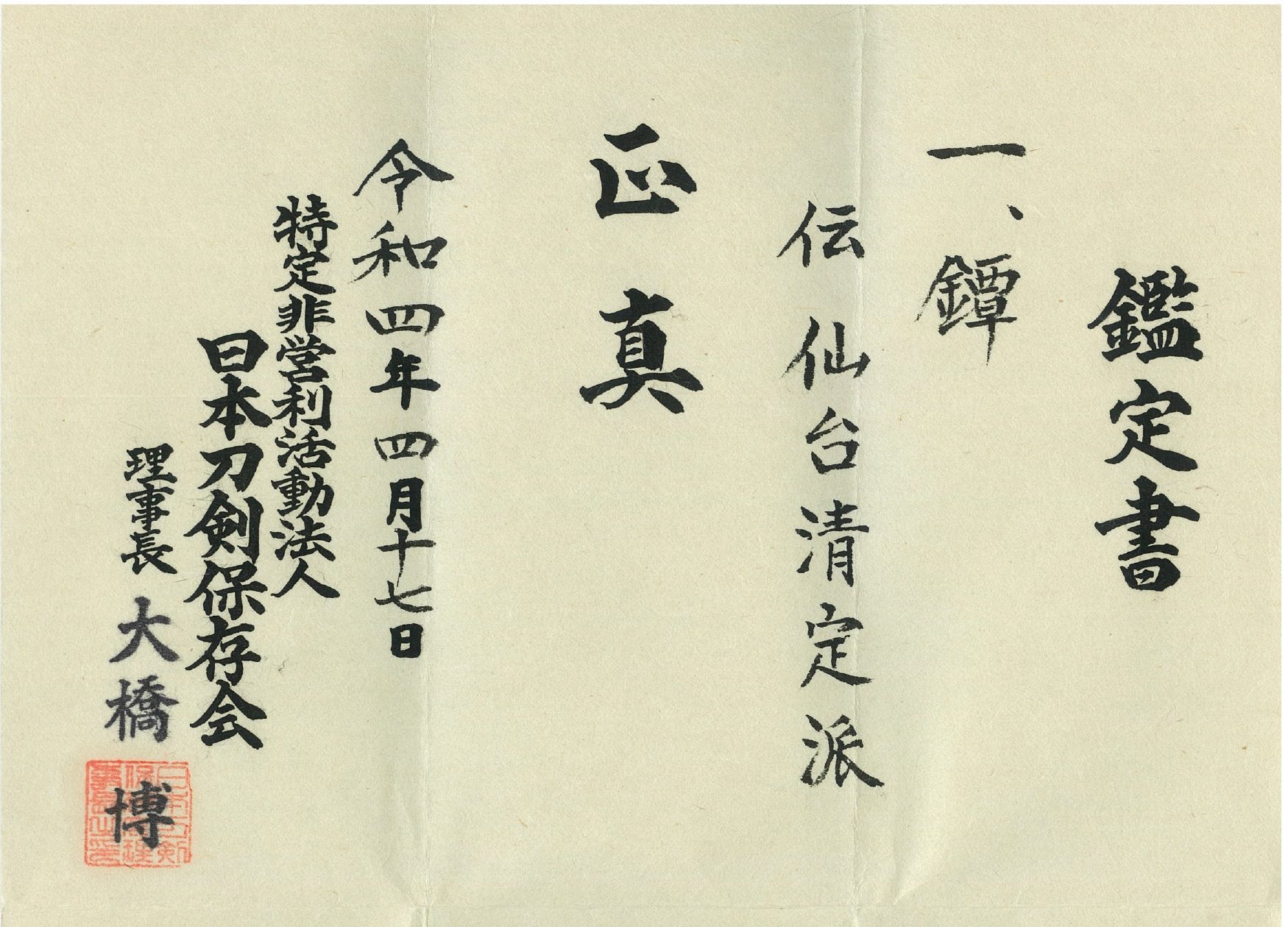
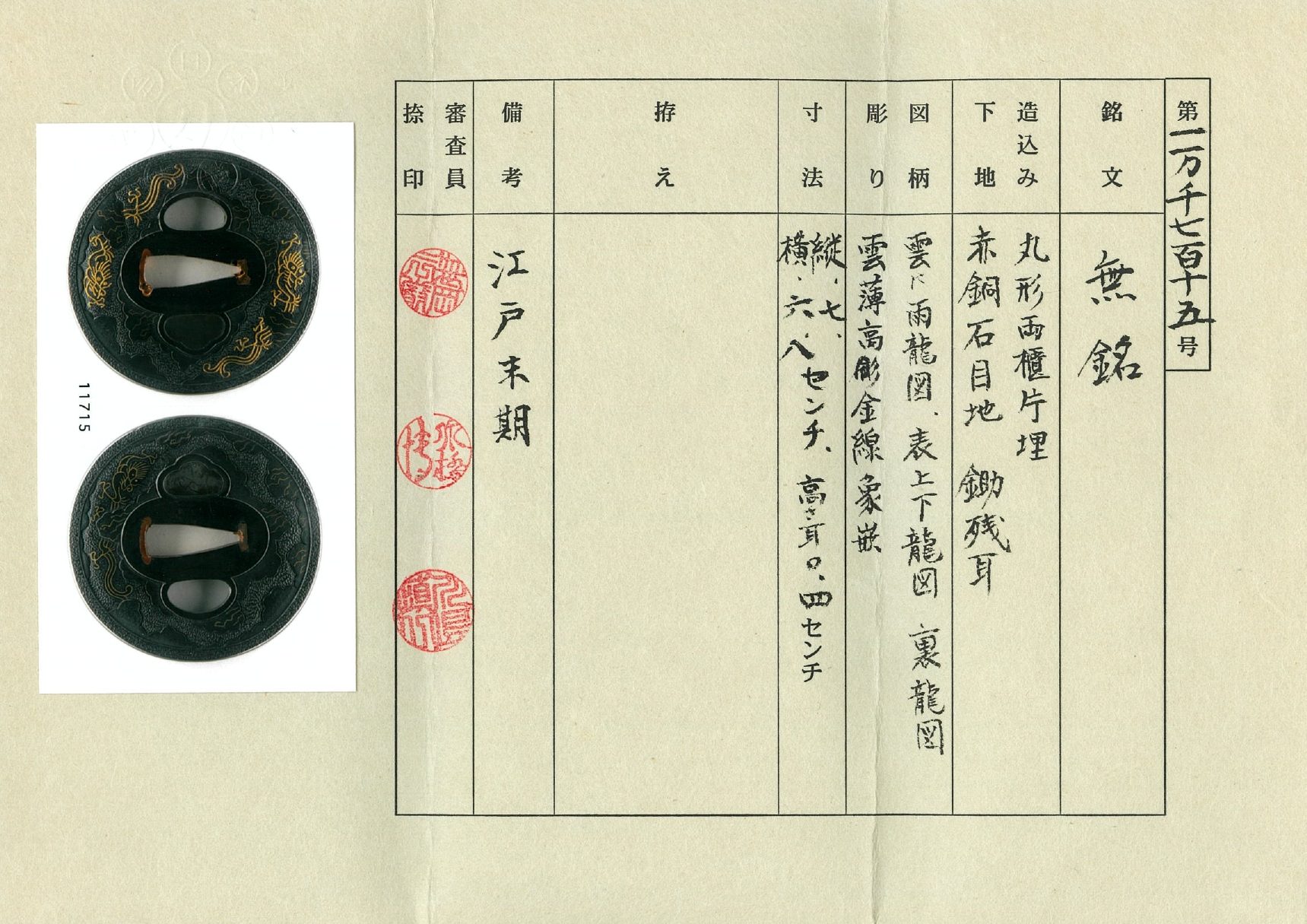
Title: Kiyosada-style, Kumo ni Ameryu Zu Description According to the certificate, this Tsuba’s maker is attributed to Kiyosada (清定). Kiyosada did well in Sendai (仙台) area in the late Edo period. He moved to Edo and learned under the Omori family. He was good at making Shakudou Tsubas with inlay decorations. About the design, the theme is the Kumo ni Ameryu Zu (雲に雨竜図). It is a combination of Ameryu (雨竜) and clouds. The Ameryu, also called the Amaryou, is a kind of dragon who controls the rain. It is believed that the Ameryu would make rain in the proof when God is blessed. A theory says an Ameryu is the young figure of a dragon. This creature has been thought to be a small spirit who lives in forests. As mentioned above, their appearance has a similarity to a dragon. That is why they are sometimes depicted with a charming look compared to other types of dragons. Moreover, snake worship was common in Japan because the serpent has a deep relationship with the water god faith. It might be the reason why Japanese people love the Ameryu pattern. Clouds bring rain and snow, and their movements significantly affect the day’s weather. Due to its supernatural power, a theory says that gods, spirits, and dragons dwell in the clouds. Also, as mentioned above, clouds are related to the Ameryu. Understandably, these motifs are designed together in works, as you see in this Tsuba. Initially, the dragon is an imaginary creature found in ancient traditions or myths. Furthermore, it is regarded as a symbolic beast of auspicious signs. Its body is likened to nine animals: antlers are deer, the head is a camel, eyes are demons, the neck is a snake, belly is the Mizuchi (蛟, a mythical animal in Japan that looks like a snake and has a horn and four legs), scales are fish, claws are falcons, palms are tigers, and ears are cows. It was thought that the dragon would reign at the top of all animals because of its odd-looking appearance. The dragon design is often seen in sword mountings. Dragons and Ameryu, we guess both motifs were highly favored among Samurais because of their auspicious images. *As this item is an antique, please check each photo and ensure its condition. What is Tsuba? Tsuba is the hand-guard of the Japanese sword. High-class Samurai wore his katana sword with its beautiful sword mountings such as Tsuba. Tsuba’s front design tends to be more decorative as this part was often seen by other Samurais when he was walking on the streets. Why is it that the sword mounting was important for Samurai? The sword mountings of the Japanese sword have many kinds of decorations such as handguards (Tsuba), sword hilt (Menuki), pommel (Fuchi Kashira). The Japanese sword worked as a weapon and as an object to show who he was. For example, it shows their personalities and beliefs. You could say that it is like decorations for smartphones today. We recommend you zoom in on the pictures of the sword fittings. When you do so, you can see the skill of Japanese metal engraving techniques. They are mainly made of iron and copper with inlays of gold, silver, and bronze. When it comes to handguard (Tsuba), each one has a different outline and weight. These sword fittings that have lived with Japanese swords of the same age might be worth as much as the Japanese swords. They are inconspicuous parts of the Japanese sword. Nevertheless, if you are knowledgeable or particular about it, you will become a connoisseur of the Samurai. Authentication Paper : NTHK Kanteisho Certificate NTHK, also known as NPO Nihon Touken Hozon Kai, is the oldest organization for sword authentication of Japanese swords in modern times. It was established in 1889 during the post-Samurai era. They authenticated the Tsuba on Apr 17th in the fourth year of Reiwa (2022). The purchaser will receive this original certificate as well. We can also translate what is written into English and make a PDF file for your record if you request. 【About us】 Samurai Museum is located in Tokyo, Japan, e
NihontoWatchOffered by Samurai Museum

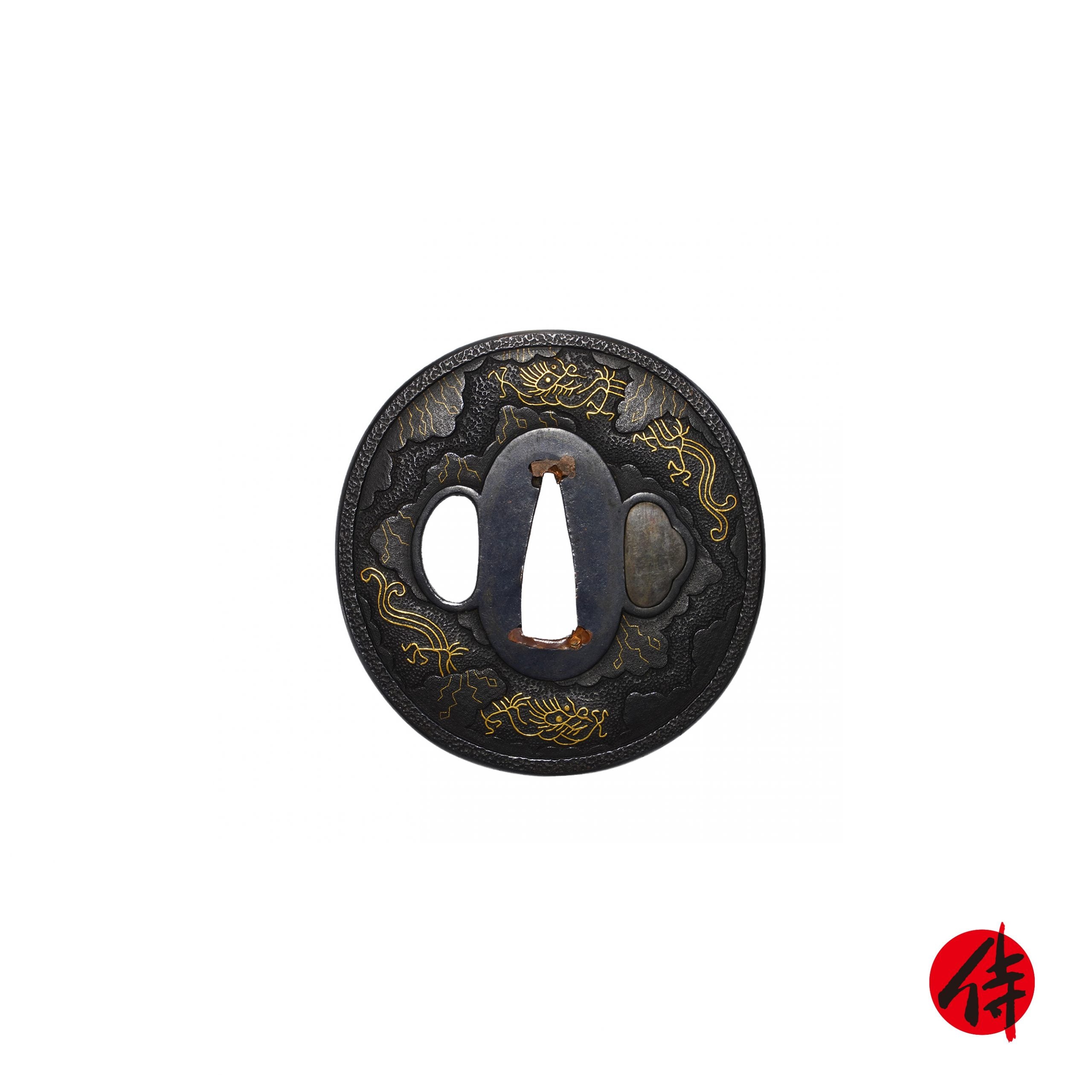
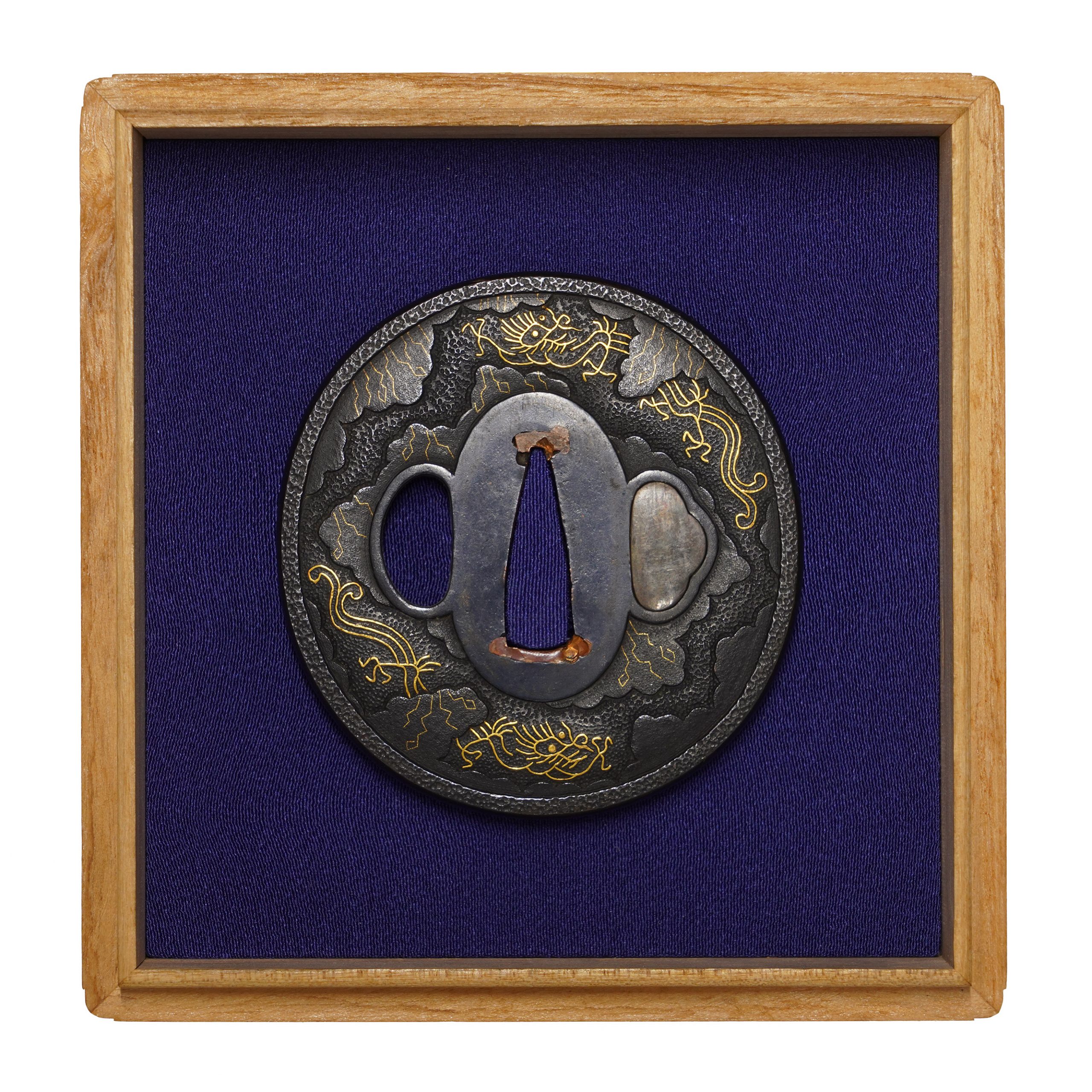
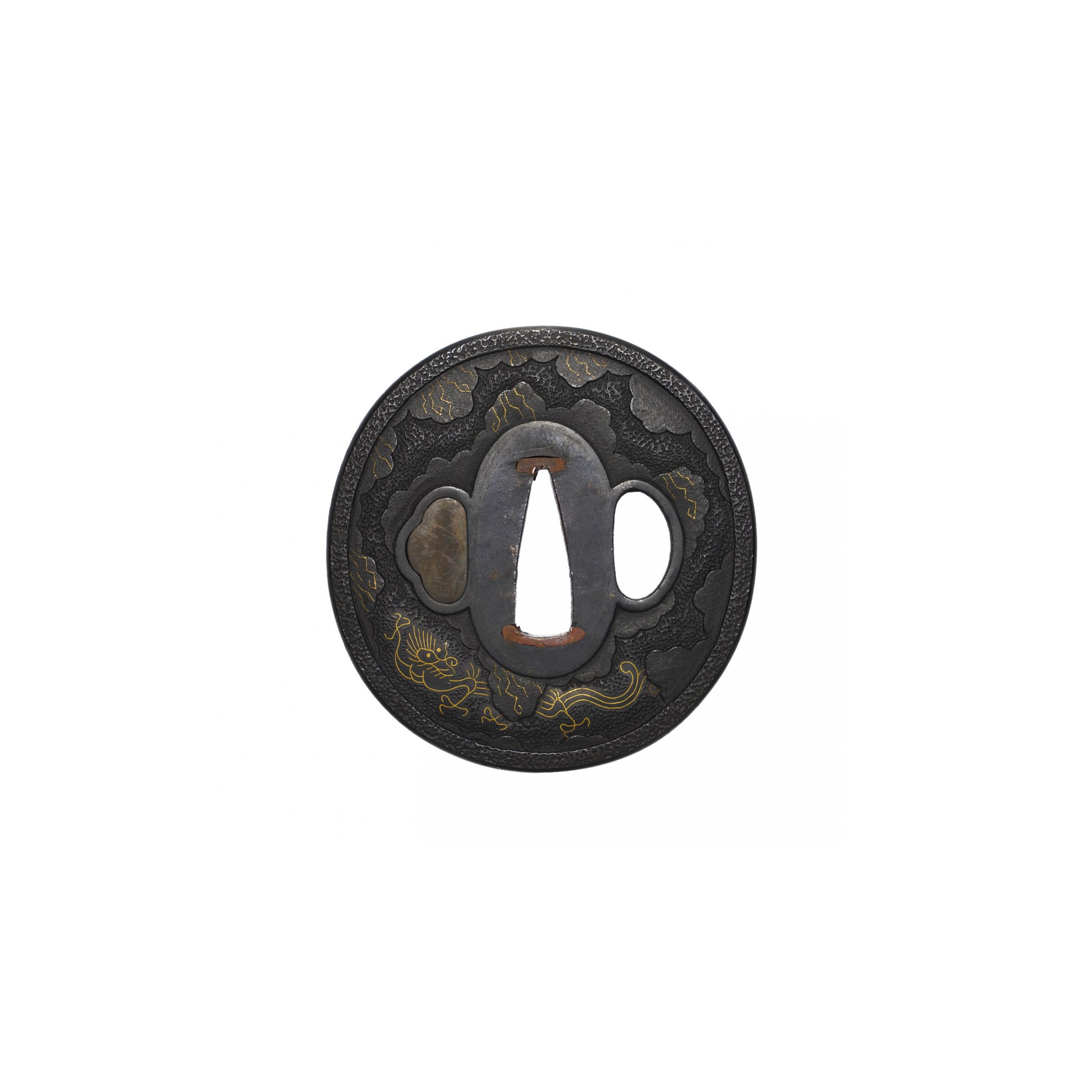
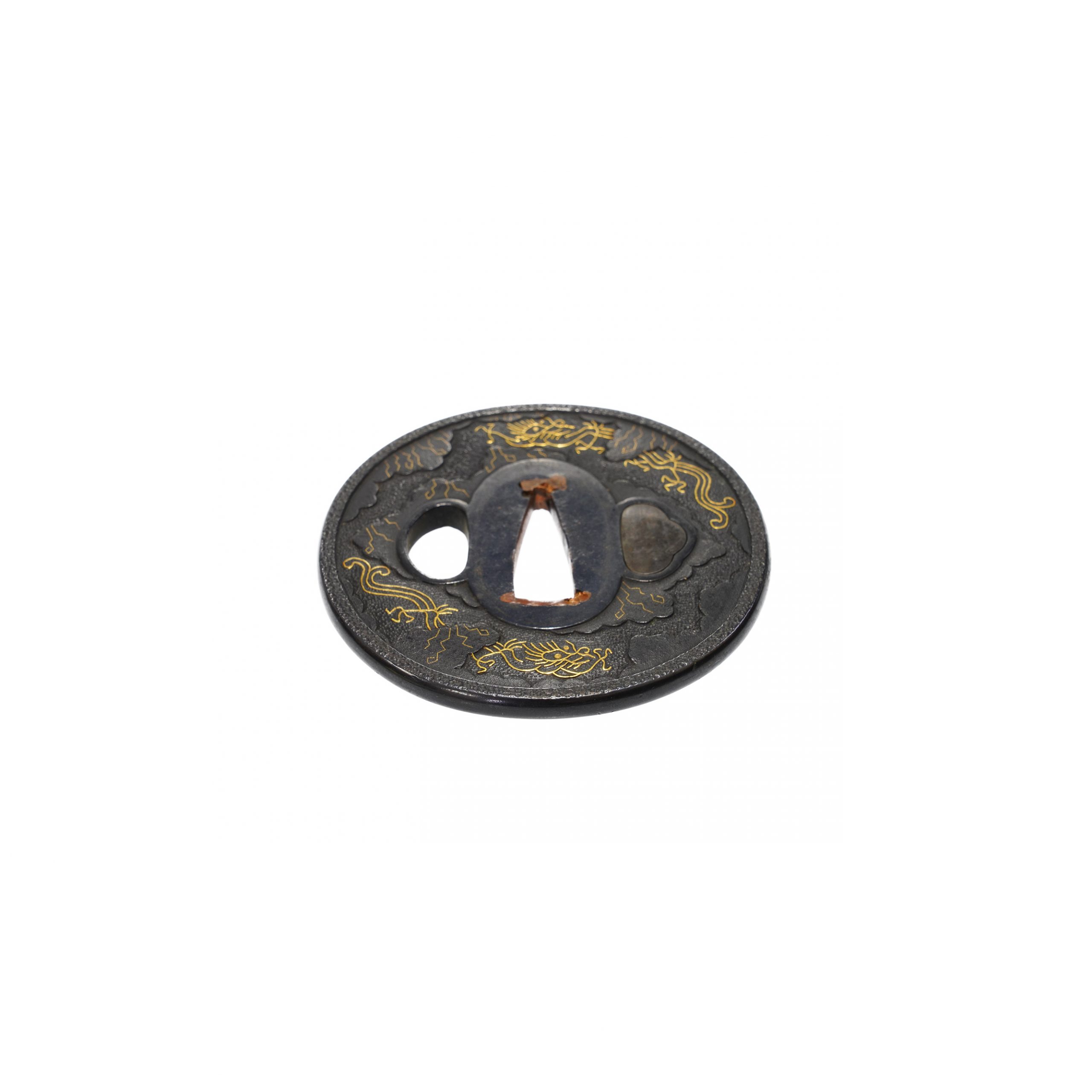
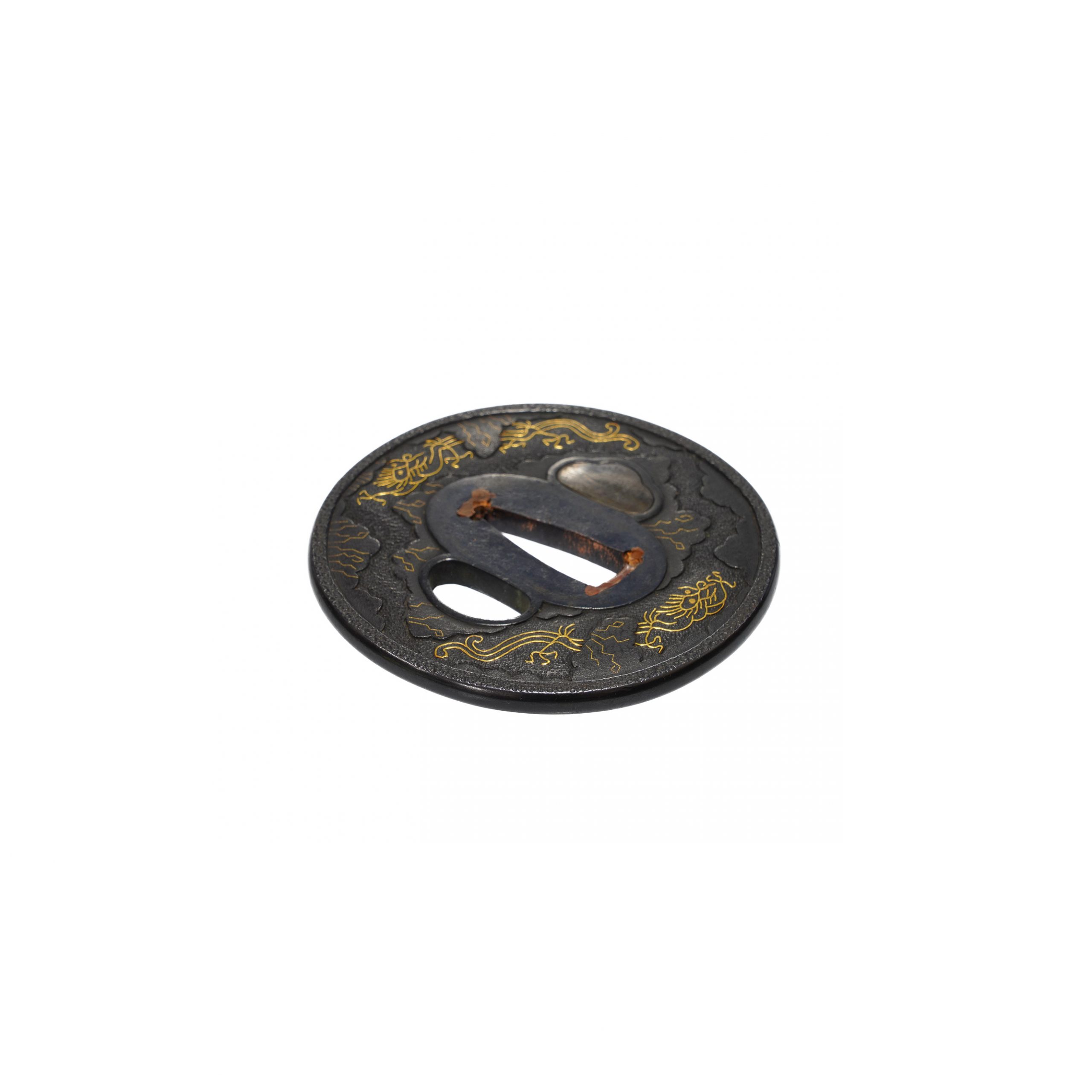
Kinko · Mutsu (Sendai) · mid Edo
1 piece on the market now
Kusakari Kiyosada the First, common name Hachisaburo, who took Kusakariya as his house name, was a metalwork artist retained by the Date family of the great Sendai domain. The setsumei record that he first studied under the Sendai-domain craftsman Masamura Shichiuemon, then went down to Edo and learned in the Omori house, and in the Tenmei years returned to Sendai to become a Date domain craftsman. In the Date domain the retained houses of Shibuya, Kusakari, Oguma, Saito, Masamura and Sukegawa were active, and above all the Shibuya and Kusakari houses developed the flat-inlay technique, which won the acclaim of the world. His own forte, which the records say he was best at above all, is the war-fan device inlaid in gold on a shakudo ishime ground: his inlay method outlines the design with a high-relief carved-in gold line, then fills the field flush, level with the ground, with geometric patterns such as the saaya fret, the tortoise-shell, the masu square and the hemp-leaf, all set in fine gold wire. His signature reads Sendai-ju Kiyosada, cut without a kao.
Where Kiyosada stands among comparable artisans: across all of nihontō, and within tradition, era, and period. The tiers (Foremost · Leading · Major · Notable) weigh official designations from the NBTHK and Japan's Agency for Cultural Affairs, together with historical honors of lasting repute such as the Sansaku and Meibutsu-chō.
Select a lens to see how it's measured.
Kinko · Mutsu (Sendai)
3 pieces on the market now
The Kusakari school (草苅) was one of several distinguished kinko lineages retained as official domain craftsmen (kakae-ko) by the Date family of Sendai, one of the great han of Mutsu Province. Alongside the Shibuya, Oguma, Saito, Masamura, and Sukegawa houses, the Kusakari artisans served as han-ko to the Date throughout the middle and late Edo period. "[[c:1]] The founding master, Kiyosada (清定, first generation), used Kusakariya as his house name. He apprenticed under Masamura Shichiemon, a craftsman in service to the Sendai domain, then travelled to Edo to study under the Omori family before returning to Sendai during the Tenmei era (1781-1789) to assume his position as domain artisan to the Date house. The Kusakari school's collective style is defined by a highly distinctive inlay method practiced on shakudo grounds. The canonical technique, described with near-formulaic consistency across the corpus, proceeds as follows: on an ishime-ji (stone-textured) ground, the outlines of the design are carved in high relief and inlaid with gold wire (kinsen-zogan); the interior is then polished out (togidashi) to lie nearly level with the ground plane, and filled with geometric patterns executed in hira-zogan.
The repertoire of interior patterns is itself a hallmark: kikko (tortoiseshell), sayagata (linked swastika fret), masugata (square diaper), asanoha (hemp leaf), ajiro (woven mat), shippo-tsunagi (linked seven-jewel), nami-chidori (waves with plovers), and soryu (paired dragons) recur across nearly every designated work. "[[c:2]] The standard ground is ishime-ji, though at least one rare example employs nanako-ji, suggesting a specially commissioned piece of exceptional care[[c:3]]. Gold fukurin rims, sometimes bearing flowing-water (ryusui) designs, and gold-lined hitsu-ana complete the refined presentation. The Kusakari school's significance rests in its mastery of a technically demanding inlay method that became synonymous with Sendai kinko craftsmanship. Kiyosada's works are praised across the setsumei for their "splendid command of technique"[[c:5]] and the "strong professional pride" they convey, with designated examples ranging from characteristic gunbai tsuba to rarer departures such as a raptor-and-cypress composition that combines katakiribori and kebori with the school's signature inlay manner[[c:4]]. The consistency of the NBTHK's assessments — describing the works as displaying "the maker's distinctive character together with his accurate and advanced technical skill"[[c:6]] — affirms the Kusakari tradition as a defining expression of domain metalwork in the service of one of Edo-period Japan's most powerful daimyo houses. Learn more →
| Smith | Era | Designated |
|---|---|---|
| Kiyosada清定 | mid Edo | 6 |
The NTHK’s principal certificate, issued for a fitting of considerable quality. It confirms a genuine signature, or, for an unsigned (mumei) work, records the judges’ attribution to a smith or school. The paper carries a detailed worksheet with a numerical point score.
The NTHK (Nihon Tōken Hozon Kai, the Society for the Preservation of the Japanese Sword) is the oldest of Japan’s sword-appraisal bodies, founded in 1910, decades before the NBTHK. After the death of its long-serving head it divided into two successor societies, the NTHK and the NTHK-NPO, both of which continue to hold shinsa. NTHK certificates are known for a detailed worksheet that records a numerical point score alongside the judges’ written opinion, and the society is especially respected for its attribution of unsigned (mumei) work.
Returns/exchanges limited to defects caused by shipping (except willful misconduct or gross negligence by the company); customers must contact within 72 hours of receiving the product.