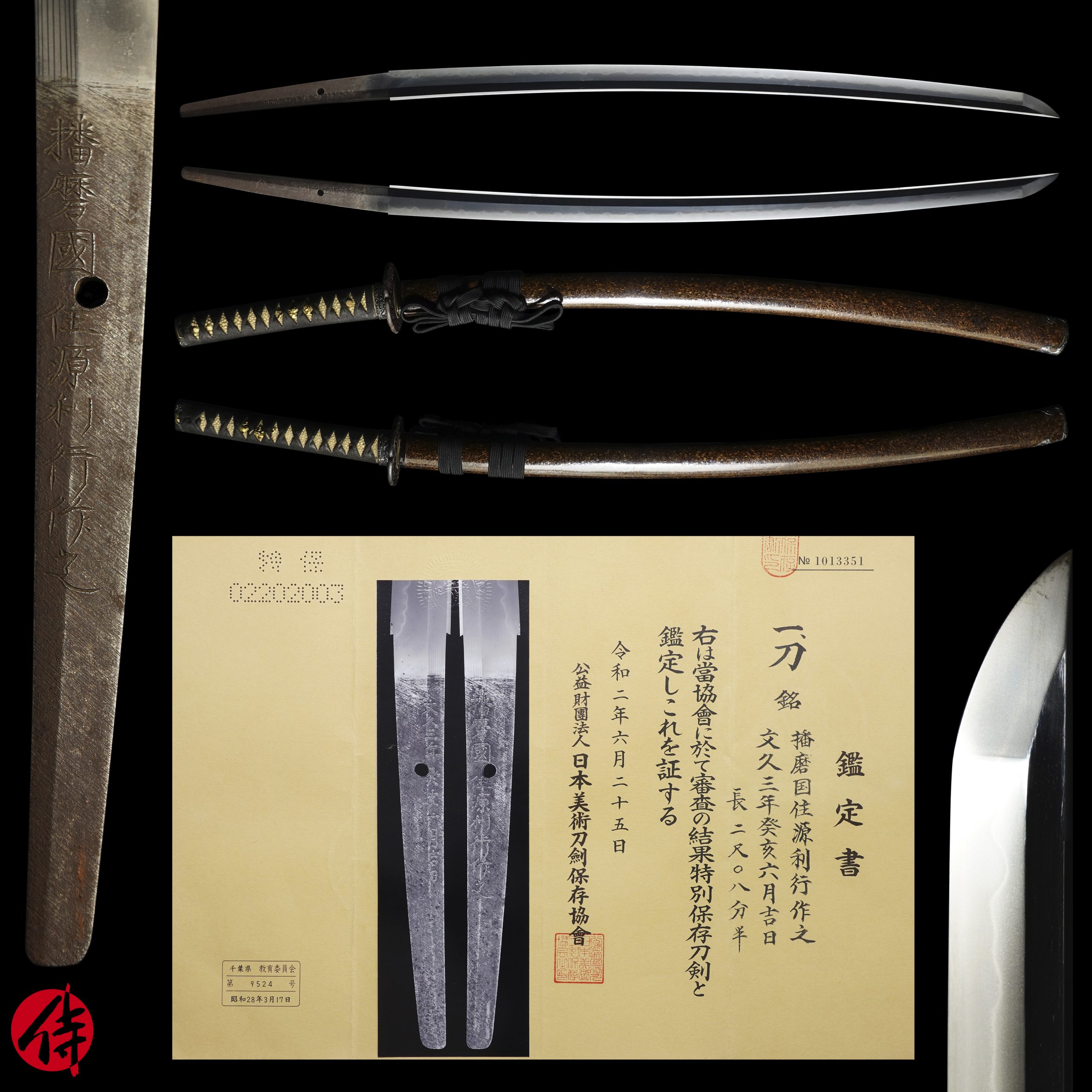
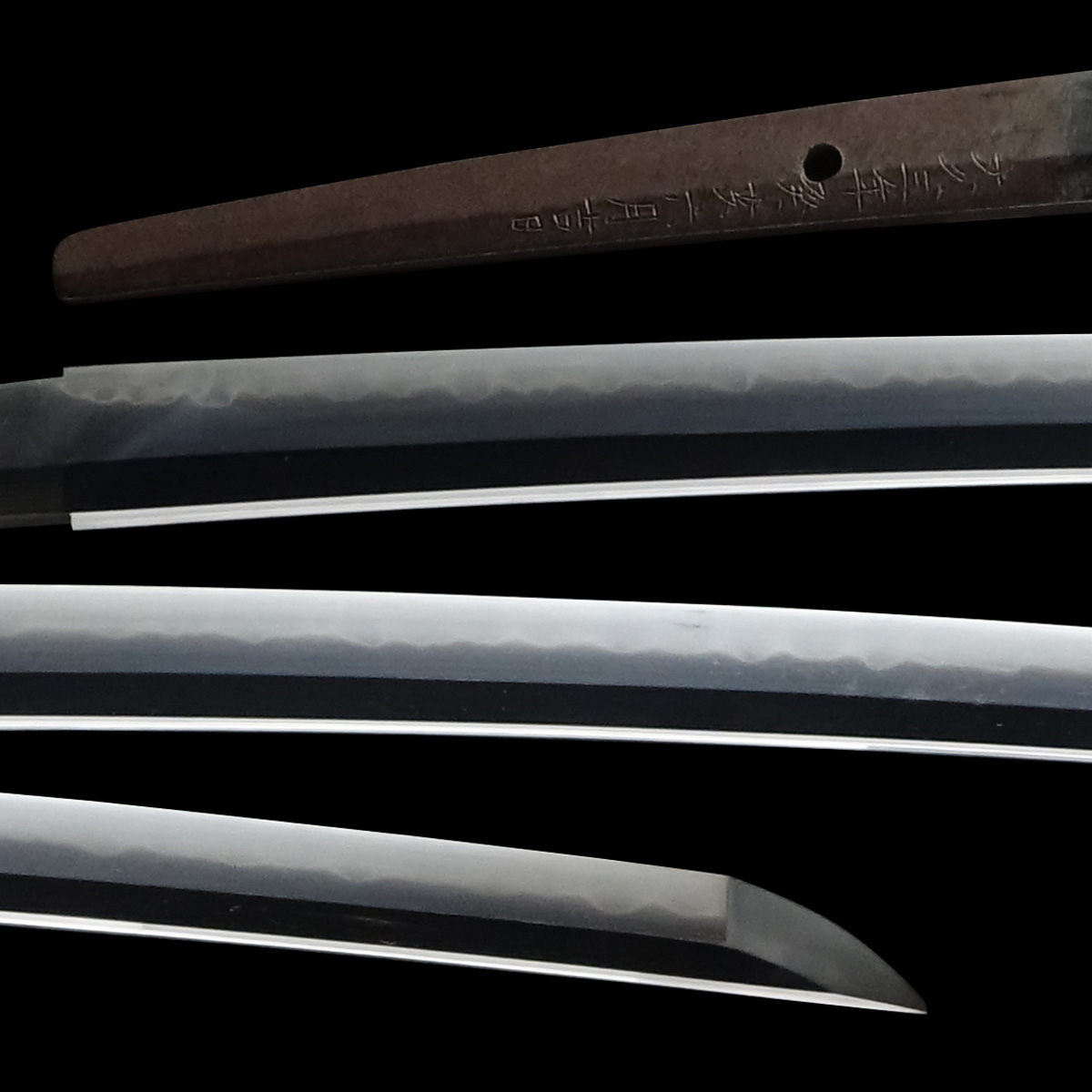
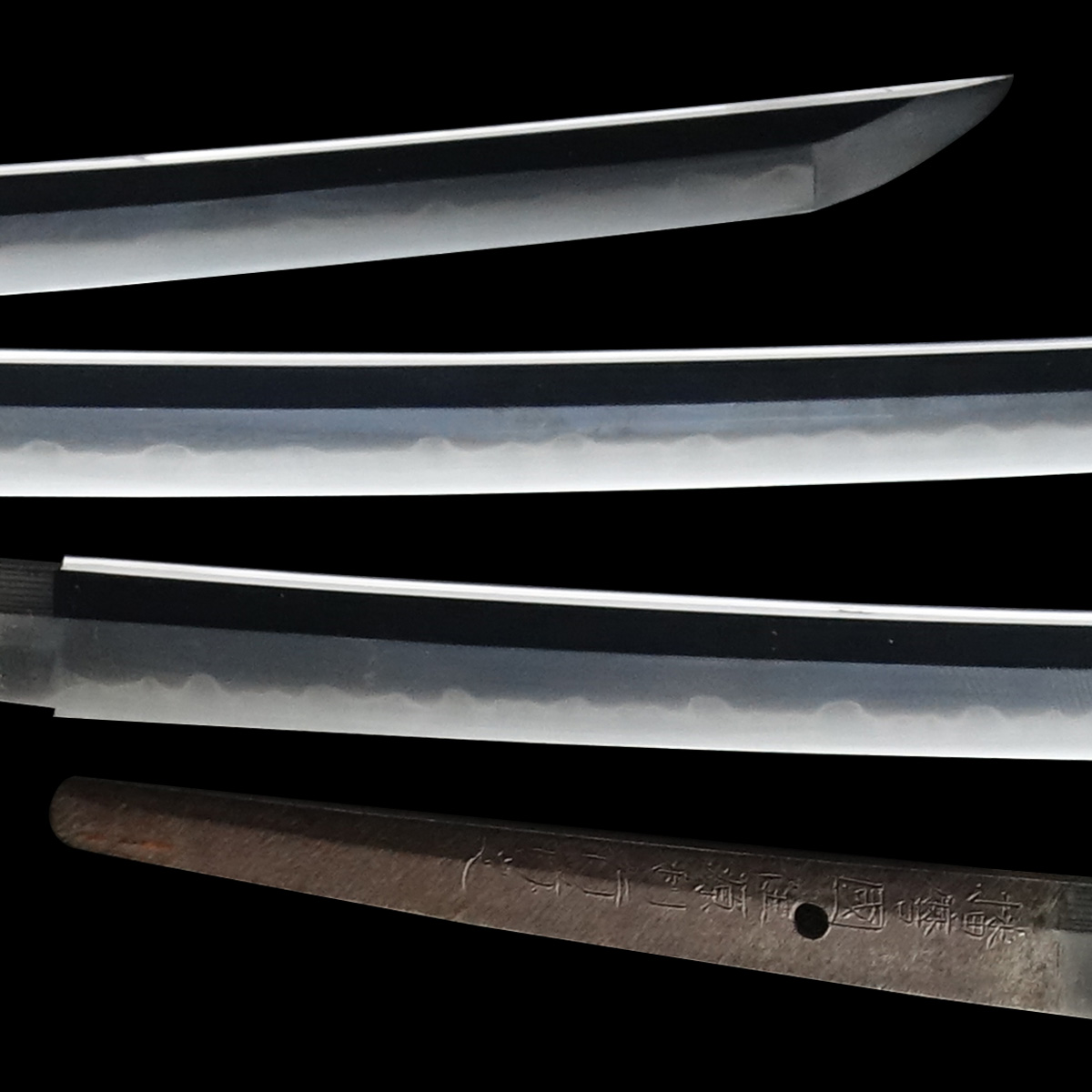
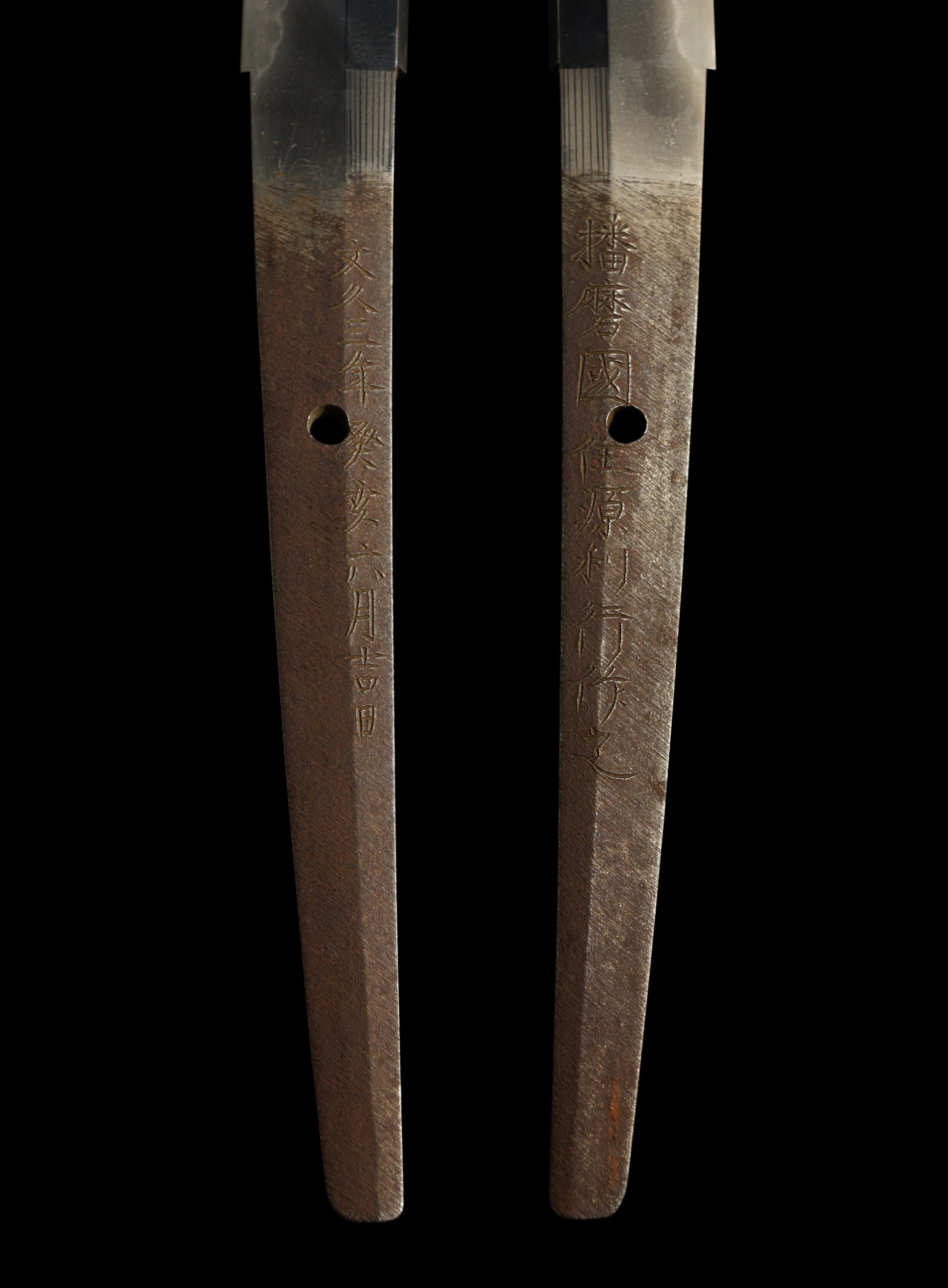
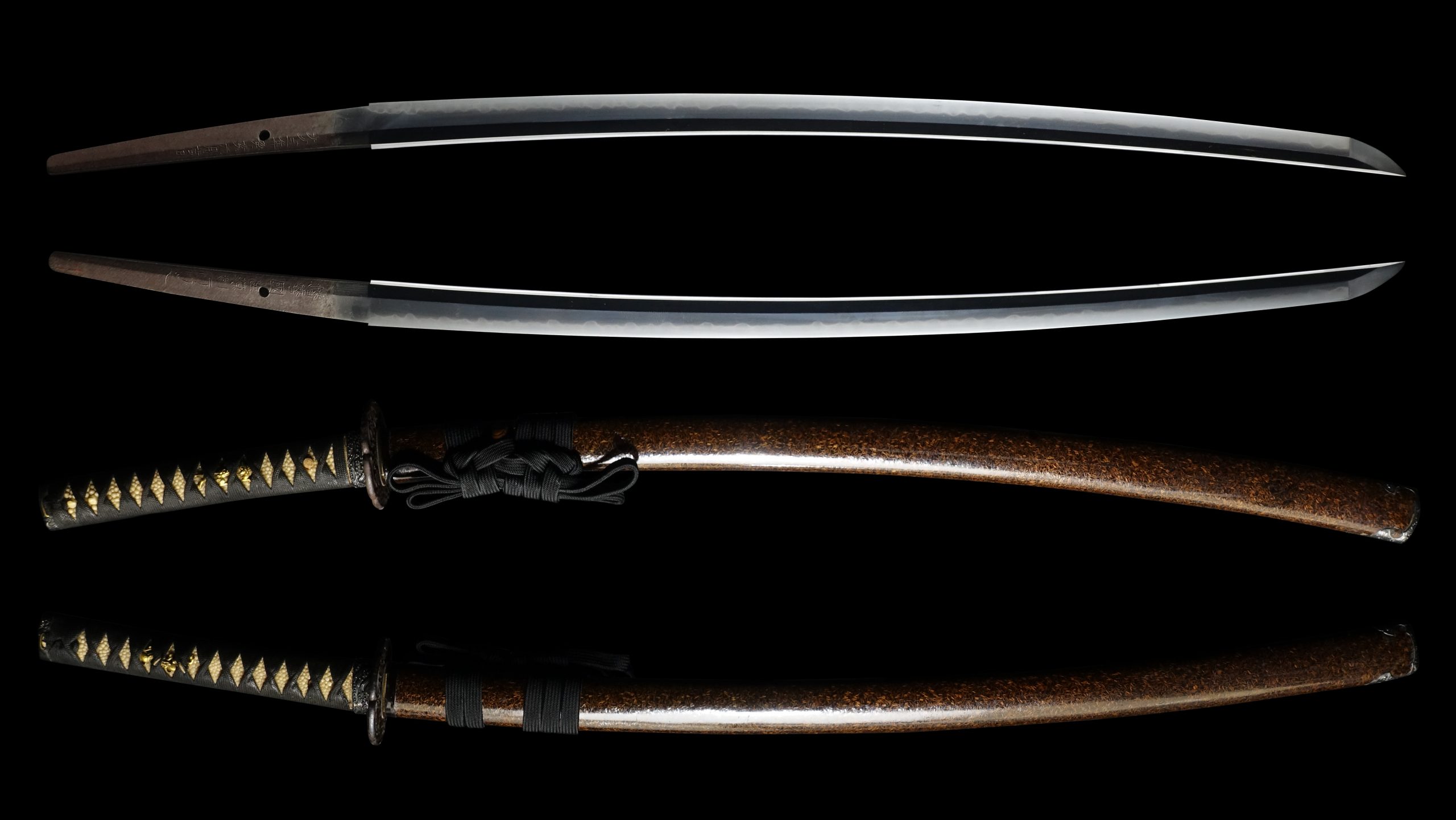
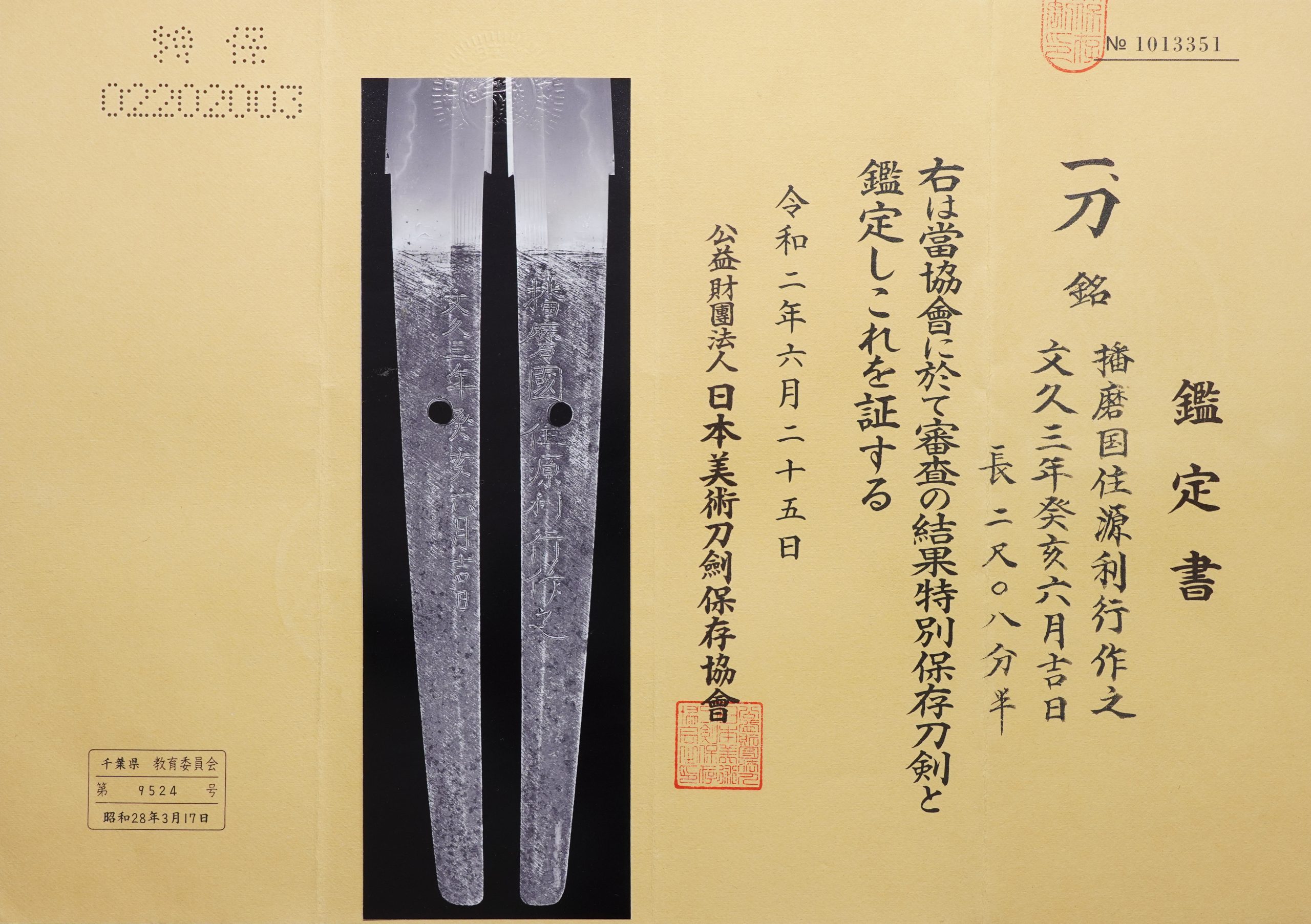
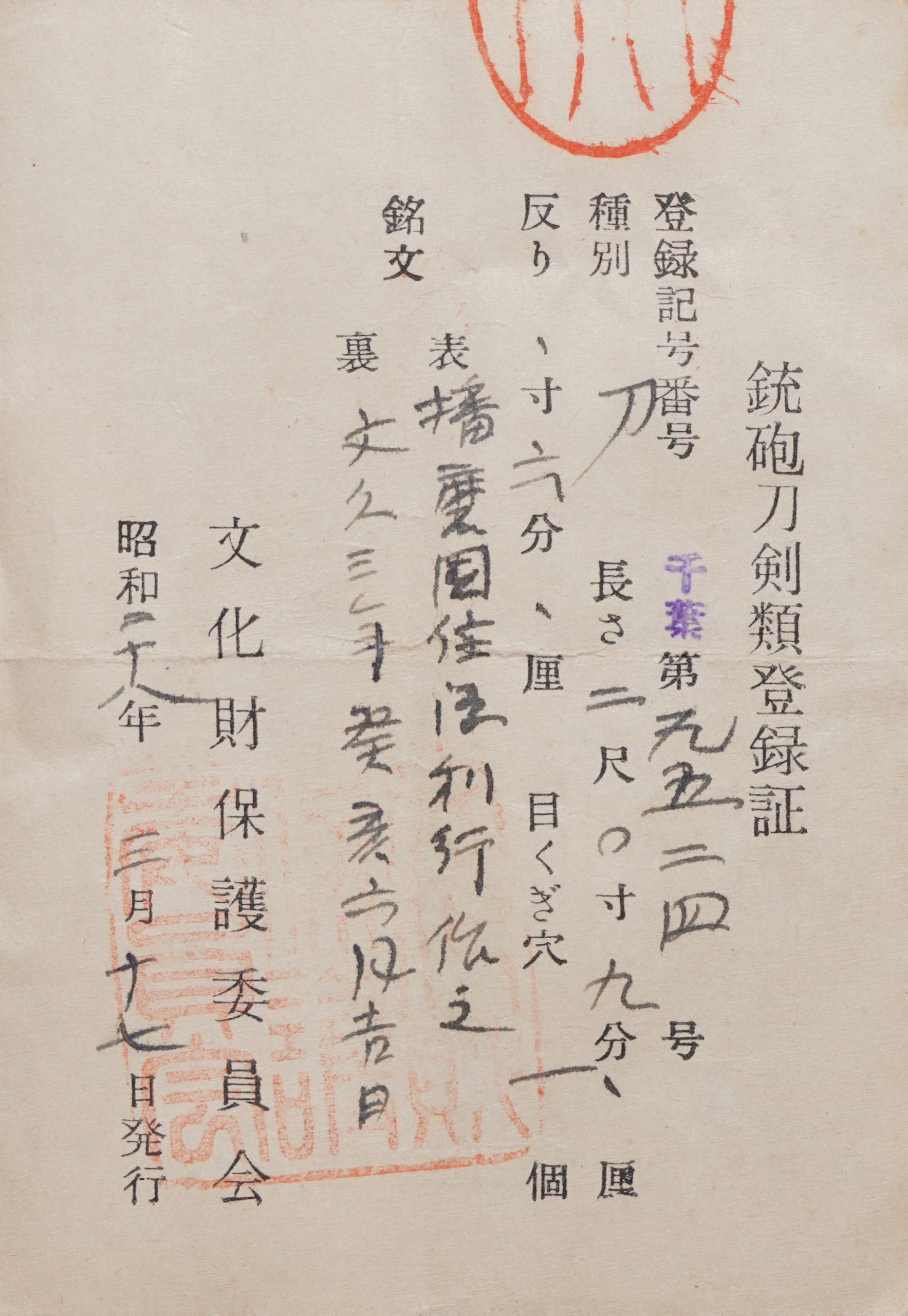
This blade was signed by Harima Koku Jyu Minamoto Toshiyuki(播磨国住源利行) in June, the third year of the Bunkyu era(1863: the end of the Edo period).
Harima Koku Jyu means that he lived in the Harima province when he forged this blade. Harima province is located in today’s Hyogo prefecture. Minamoto Toshiyuki(源利行) is his maker’s name while his real name was Kurokawa Taichiro(黒川太市郎).
This blade was forged when he was in his 30’s. He was active in sword-forging during the Bakumatsu era(the end of the Edo period).
In the 11th year of the Bunsei era(1828), Toshiyuki was born in Miki city, Banshu(Hyogo prefecture). His father was also a blacksmith who mainly made wooden planers while eager to master the sword-forging technique. Being inspired by his father, Toshiyuki also dreamt of being a skilled swordsmith. And eventually, Toshiyuki mastered outstanding workmanship in his career.
Toshiyuki became an Okakaekaji for the Akashi domain in Hyogo prefecture, where Himeji castle is located.
Okakaekaji is those who exclusively served a specific clan or domain during Samurai history. It was honorable for any swordsmith to gain this position. During the last Edo period, the Akashi domain was ruled by Matsudaira Yoshinori, the 9th head of the clan and a renowned feudal lord. Their headquarter was Himeji castle.
It is said that Yoshinori loved Toshiyuki’s work, and Toshiyuki was invited to his castle every month. And the vice head of the Akashi clan went to Toshiyuki’s workplace every year, and Yoshinori himself visited him. This fact tells us how skilled Toshiyuki’s craftsmanship was and was respected by the clan’s head.
After the new Meiji imperial government ousted the Tokugawa government in 1868, Toshiyuki moved to Edo city due to the relocation of his master. He tried to make ends meet by forging swords. However, it became difficult because of all the regulations implemented by the new government. So, he decided to make wooden planers and became famous for the sharpness of the tool.
There is no doubt that he was a highly skilled sword maker at the end of the Edo period. Toshiyuki died in the 39th year of the Meiji era(1906).
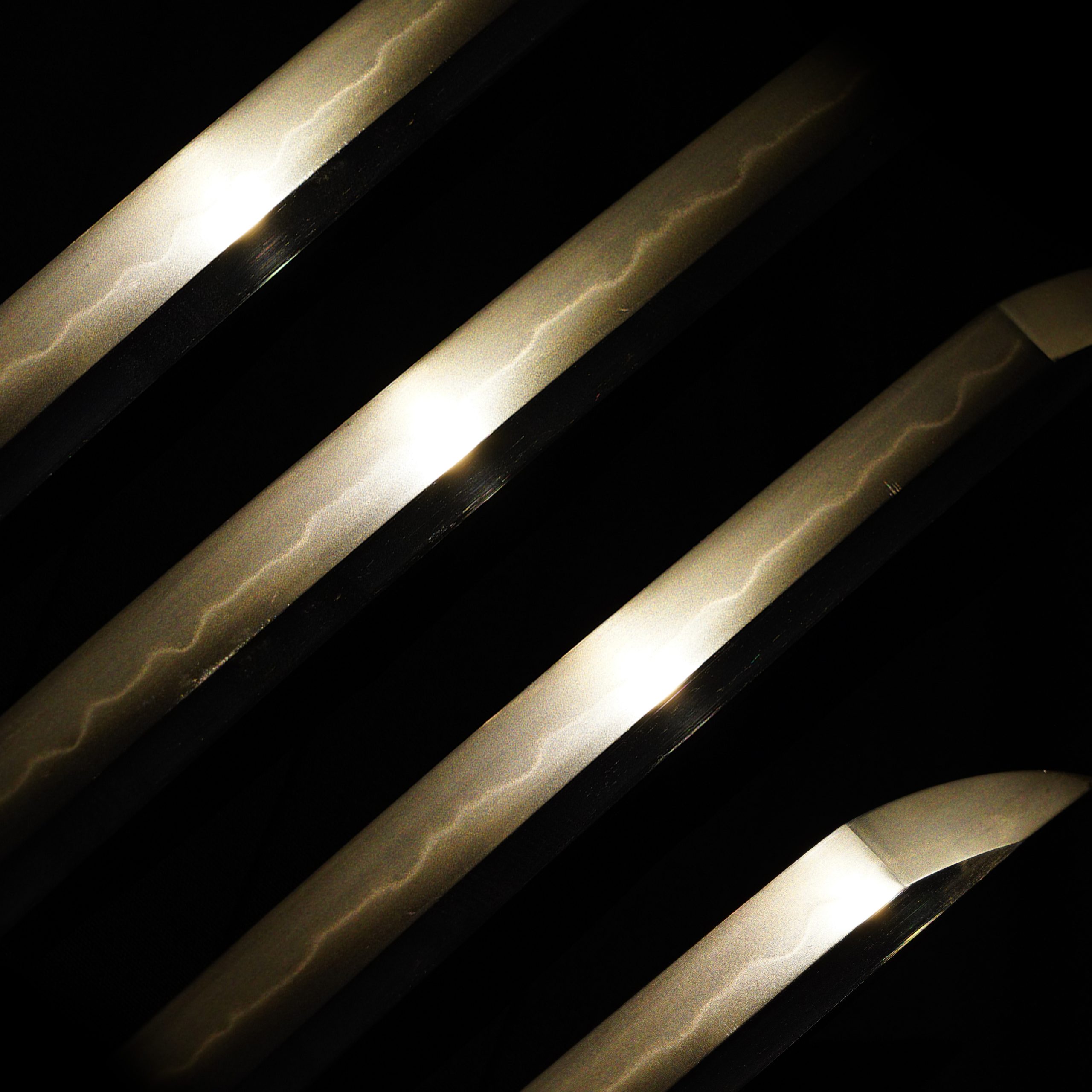
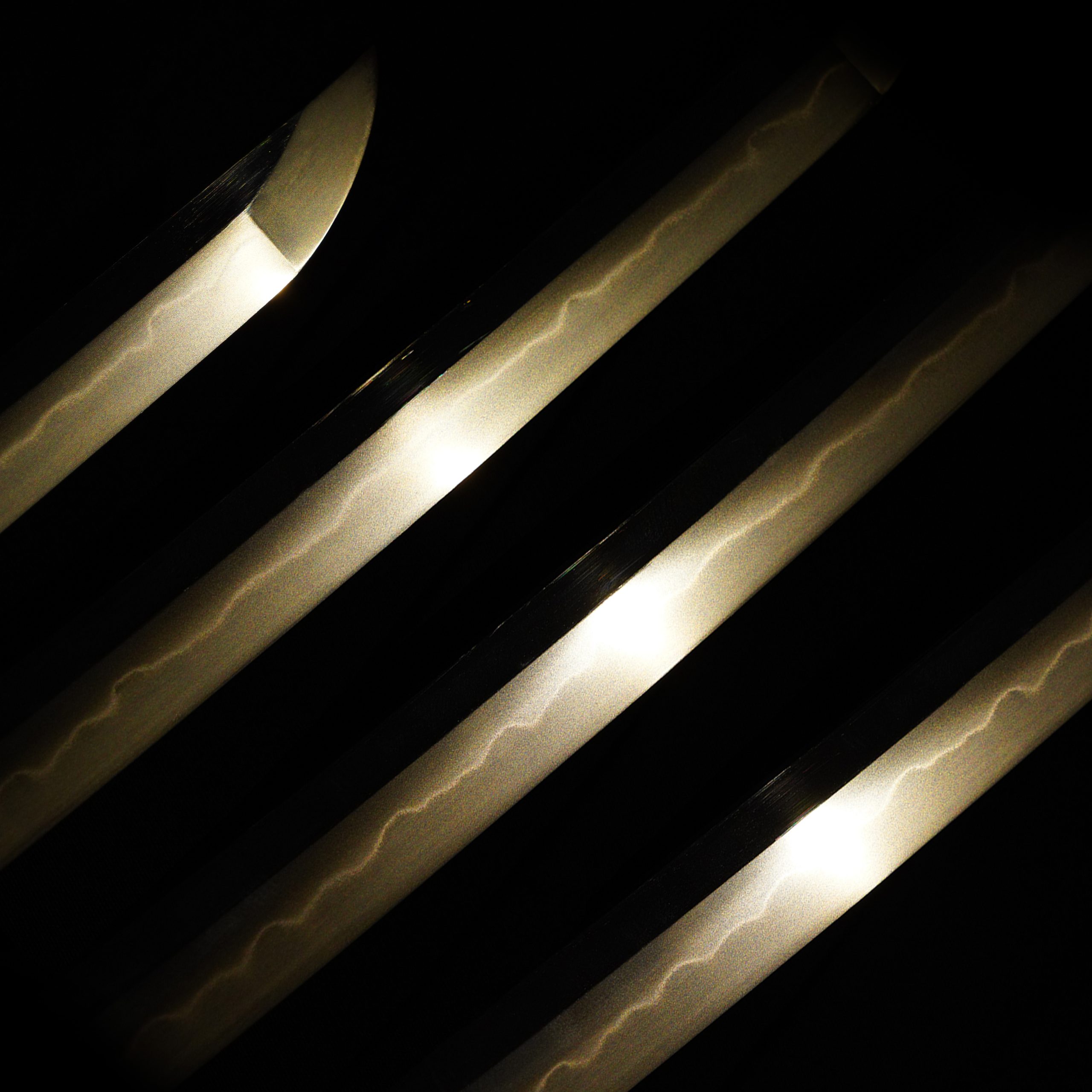
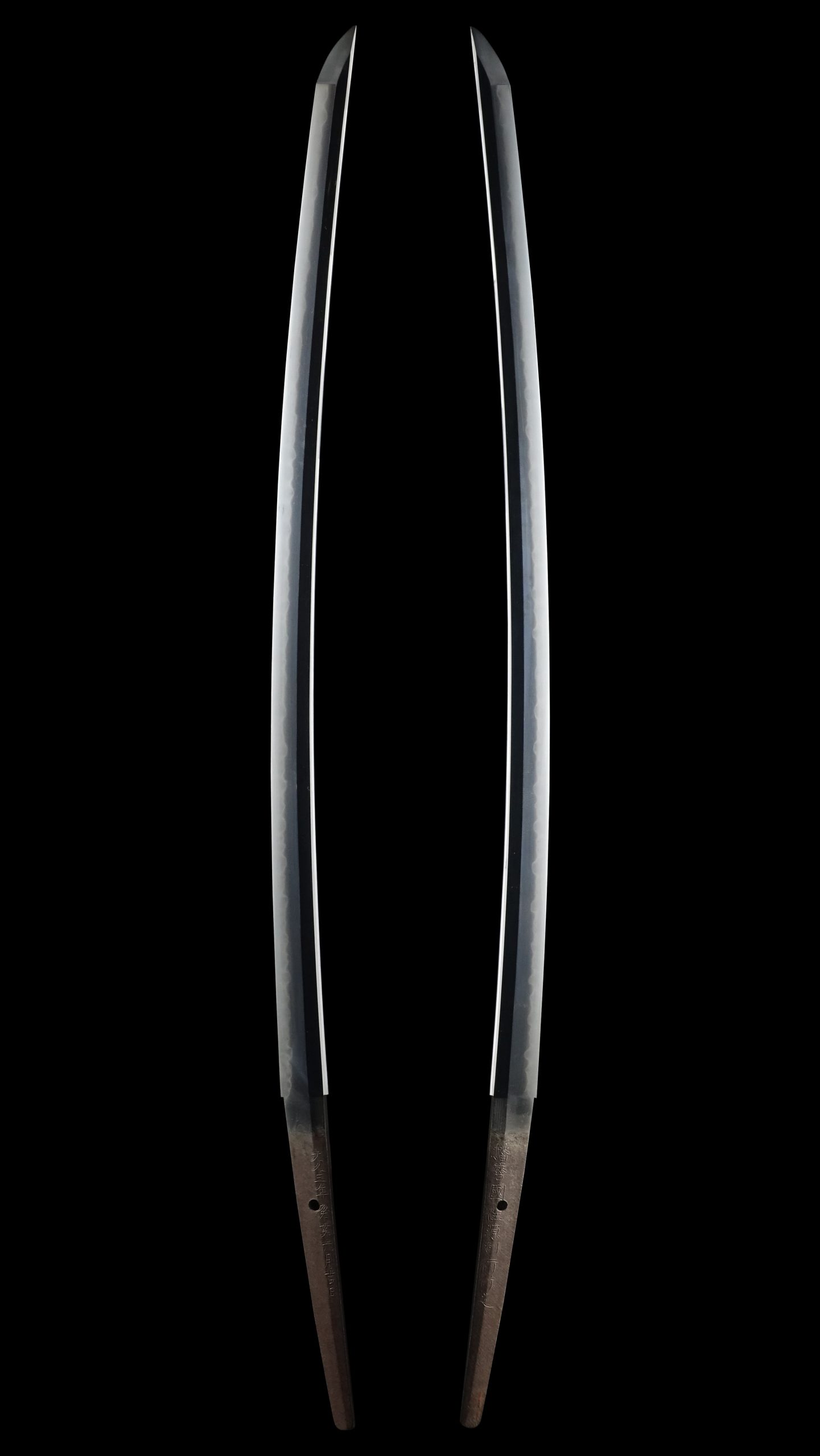
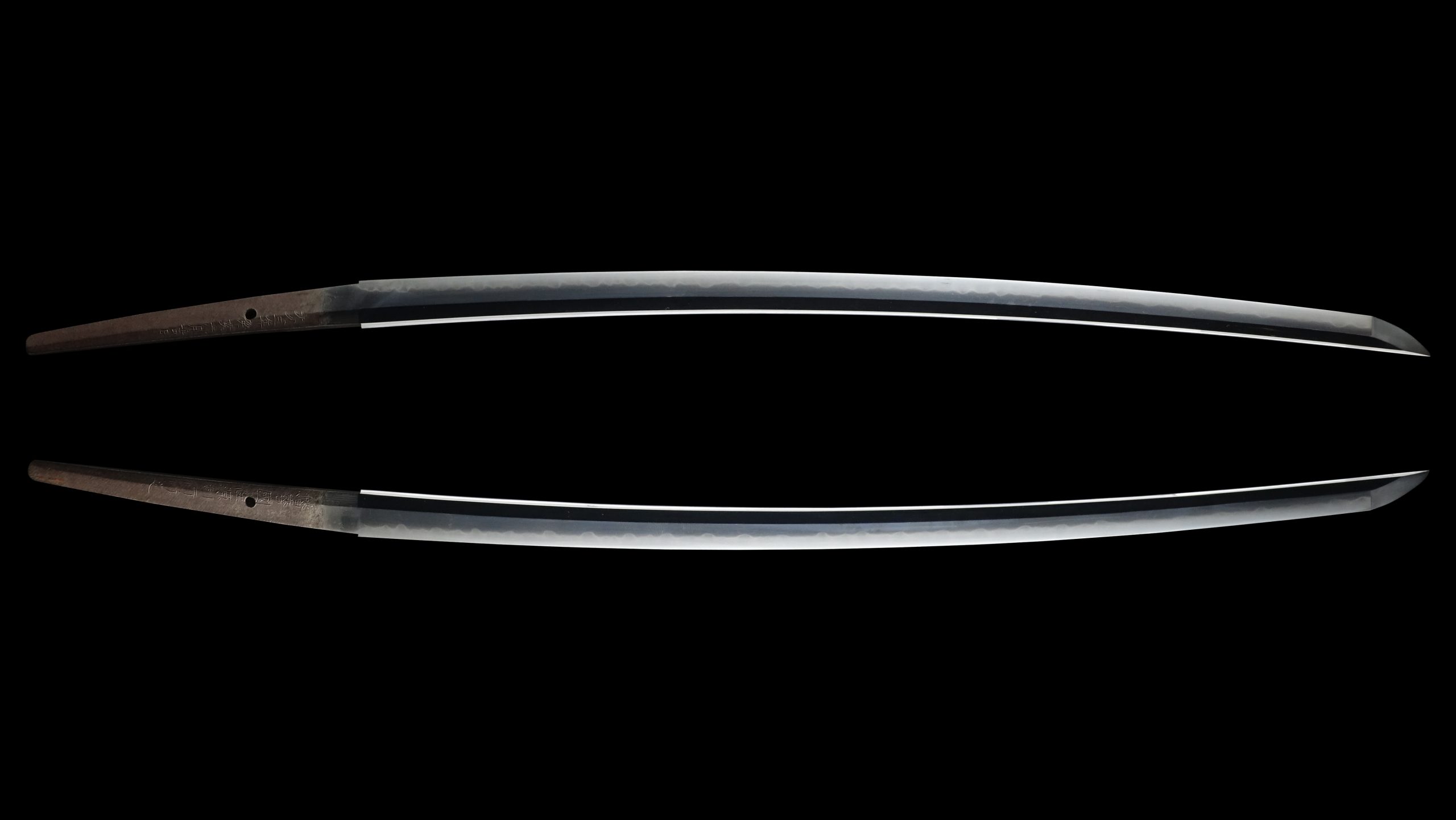
Since this blade was forged five years before the Edo period ended, it must have been ordered by a Samurai who served the Akashi clan. It has a beautiful tempering line(Hamon), and the overall condition of the blade is excellent.
This blade is appraised as a Tokubetsu Hozon Token(特別保存刀剣) issued by NBTHK(Nihon Bijutsu Touken Hozon Kyokai:日本美術刀剣保存協会).
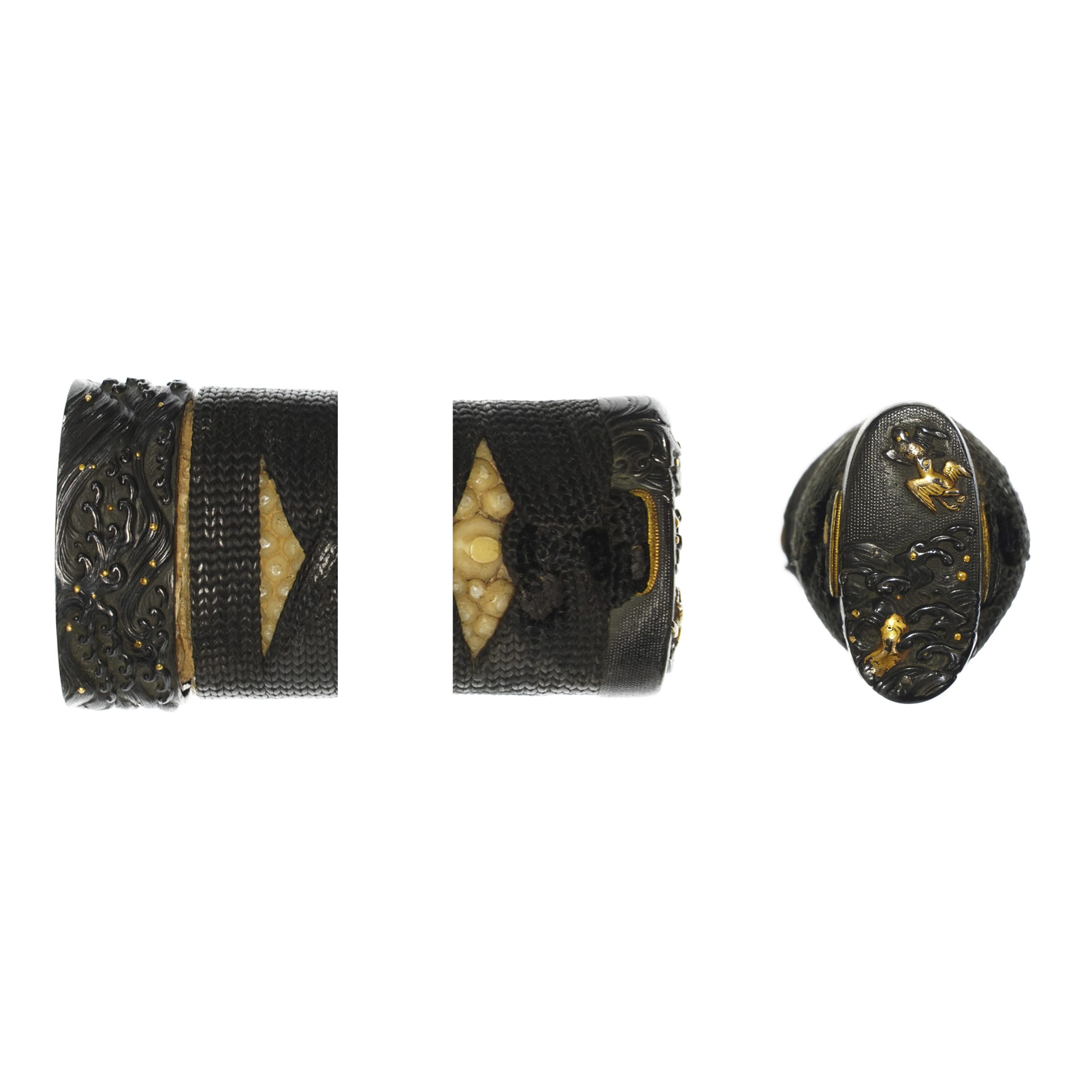
Fuchi-Kashira
This Fuchi Kashira is made from copper; it remains its nice black color. Tiny golden dots describe waterdrops. The surface of the Kashira part is decorated with small protrusions. It is made by hitting with the Nanako-Ji Tagane (魚子地鏨, chisel used for this technique). This decorative technique shows us the maker’s expert skill.
The motif of this Fuchi Kashira is the Nami Chidori (波千鳥) pattern. It is the combination of provers and waves. This design represents happy marriage and family safety. According to a theory, Japanese people have treated it as a good omen design since the Nara period (648-781). Waves are likened to the world, meaning it describes the determination: overcoming difficulties with a partner even if there are small or big waves (difficulties/ troubles). Also, the plover pattern is used as a prayer for victory or achievement of a goal.
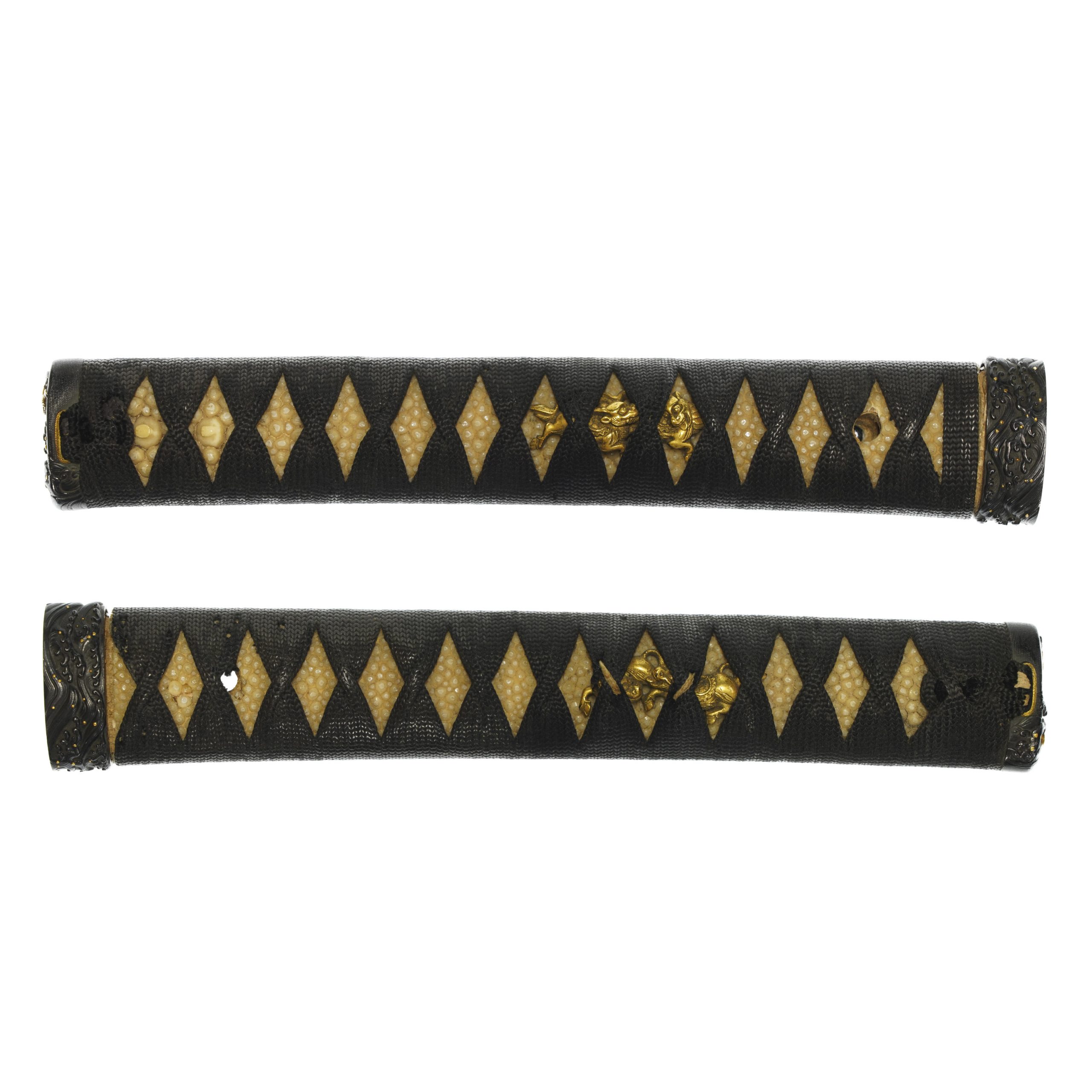
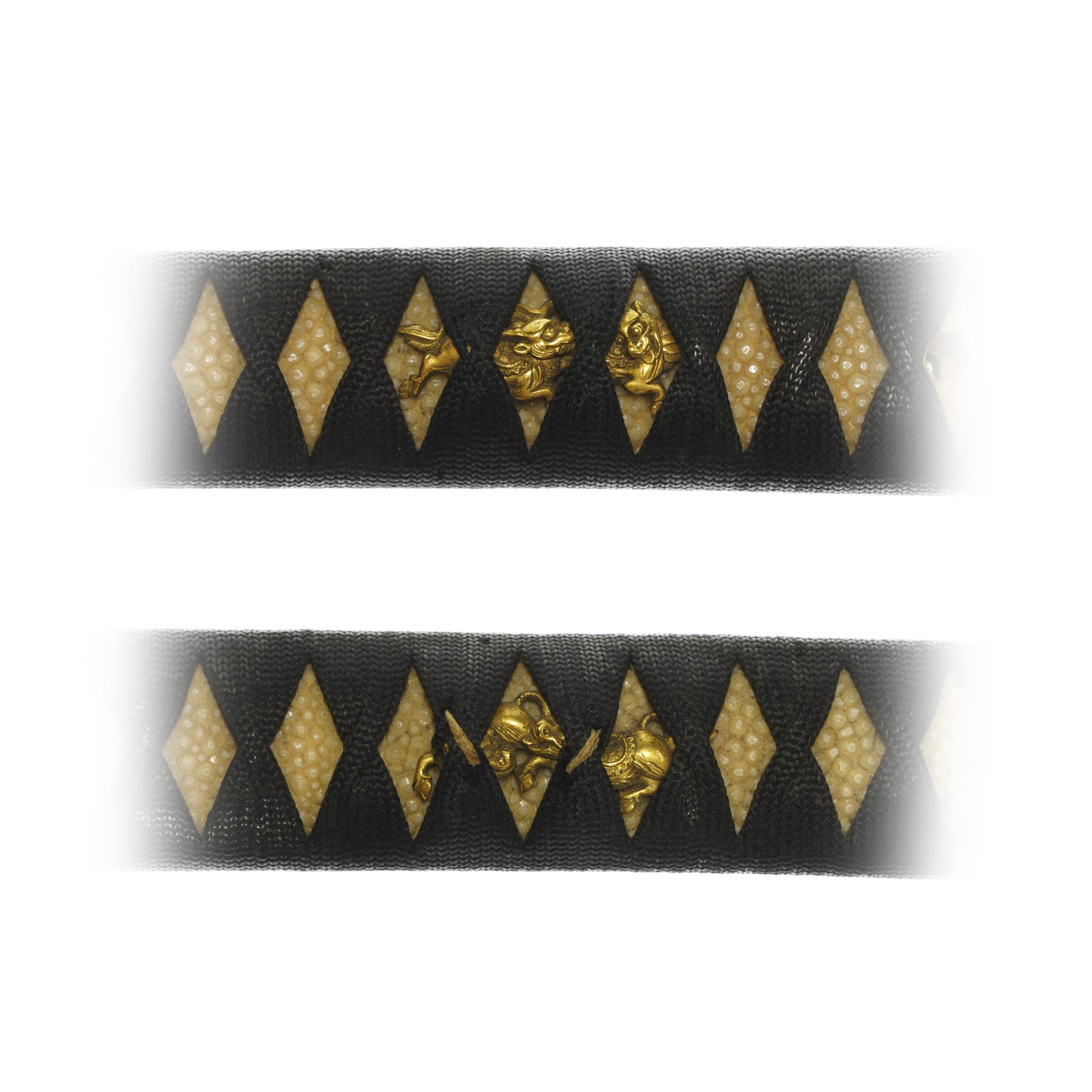
Tsuka and Menuki
The golden metal is applied to this Menuki, and it makes shiny appearances for the work. You would find two animals are running together. This Menuki’s motif might be the Kirin (麒麟, Qilin), one of the legendary beasts that appear in mythology. A theory says that this sacred animal would materialize when the king (or emperor) does virtuous politics for people. The Kirin’s appearance is similar to deer and has a horse-liked hoof, cow’s tail, and horn on the head. Same as other sacred beasts such as dragons or turtles, the Kirin has also been familiar to Japanese people as an auspicious pattern for a long time.
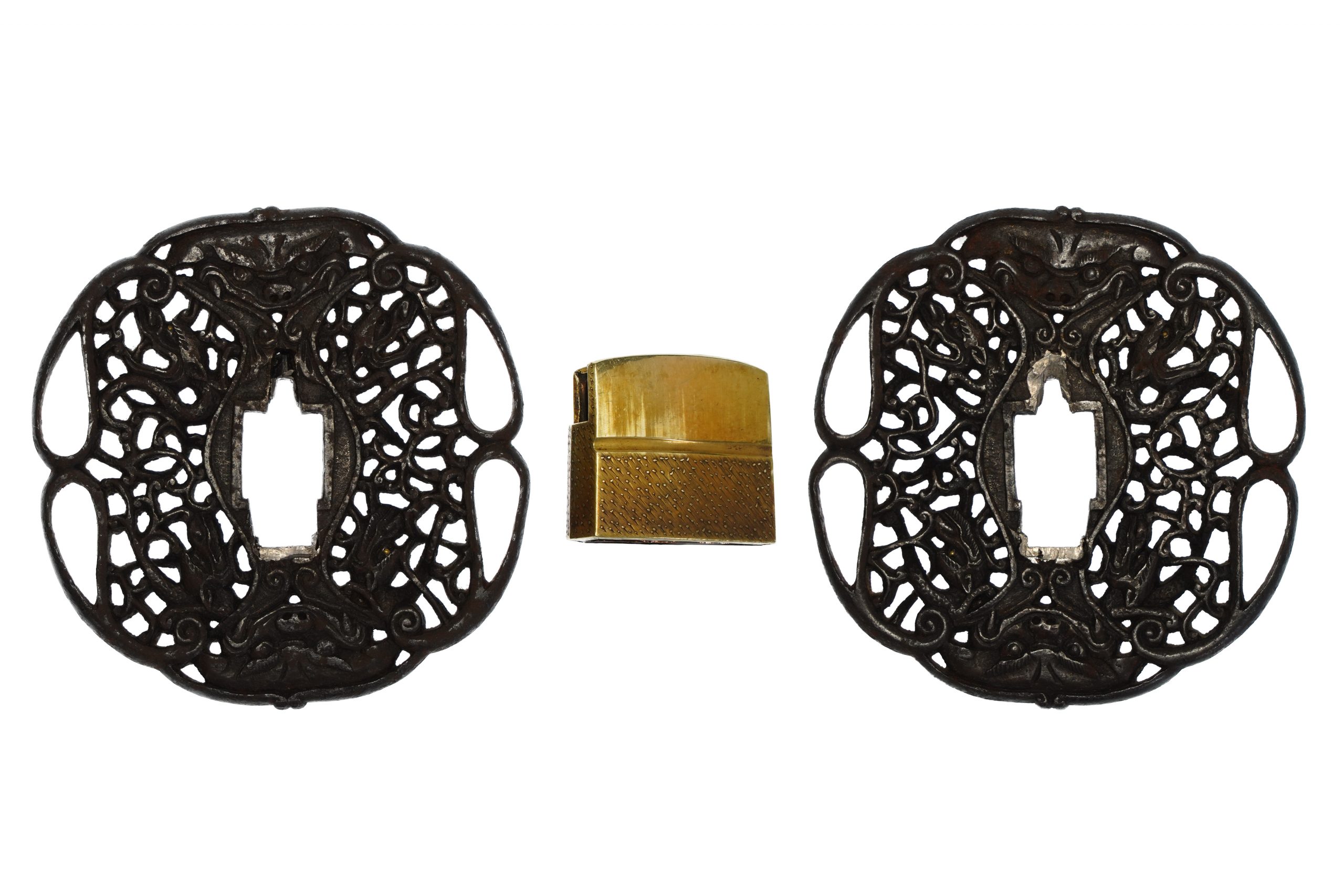
Tsuba and Habaki
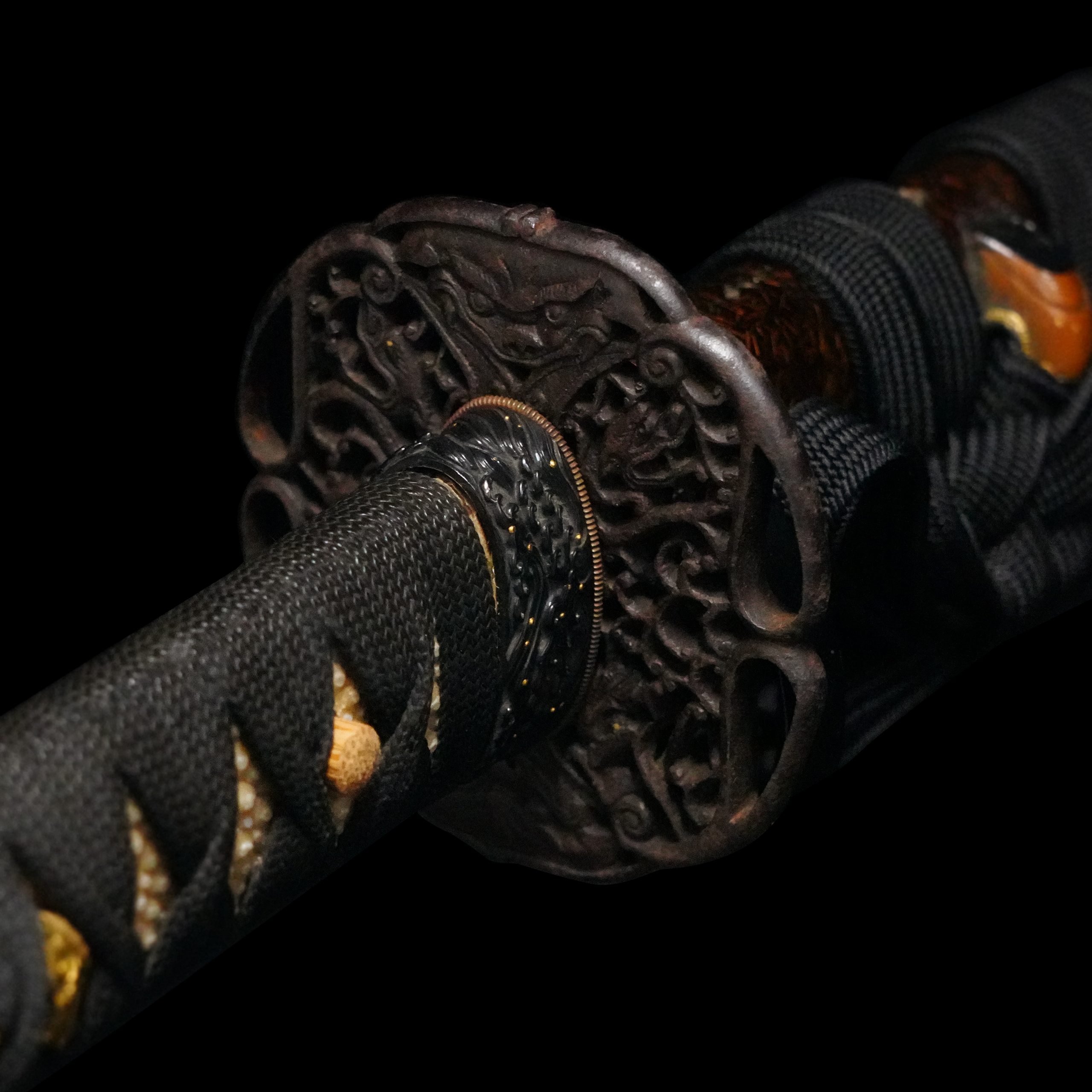
The Society for Preservation of Japanese Art Swords, known as NBTHK, recognized this Tsuba as Tokubetsu Kichou Kodougu. They authenticated the Tsuba on September 24th in the 42nd year of Showa (1967). This Tsuba is categorized as the Nanban (南蛮) Tsuba. This style’s Tsuba usually has a circle shape or the Mokkou shape. Dragons, foreign letters, or arabesque designs are often engraved and inlaid with gold or silver on the thin iron. Due to its design, the Nanban Tsuba has an exotic mood.
This Tsuba is made from iron and has a unique shape that looks like a combination of six petals. The faces of a kind of creature are designed at the upper and lower side. Thick eyebrows, big eyes, and fangs are characteristic. The faces of four beasts are placed around the Nakago Ana (茎穴, center hole); these are probably dragons. Initially, the dragon is an imaginary creature found in ancient traditions or myths. Furthermore, it is regarded as a symbolic beast of auspicious signs. Its body is likened to nine animals: antlers are deer, the head is a camel, eyes are demons, the neck is a snake, belly is Mizuchi (蛟, mythical animal in Japan which looks like a snake and have a horn and four legs), scales are fish, claws are falcons, palms are tigers, and ears are cows. It was thought that the dragon would reign at the top of all animals because of its odd-looking appearance.
Authentication Paper
They authenticated the blade on June 25th in the second year of Reiwa (2020). They appraised it as Tokubetsu Hozon Touken, the blade especially worth preserving for Japanese society.

 NihontoWatch