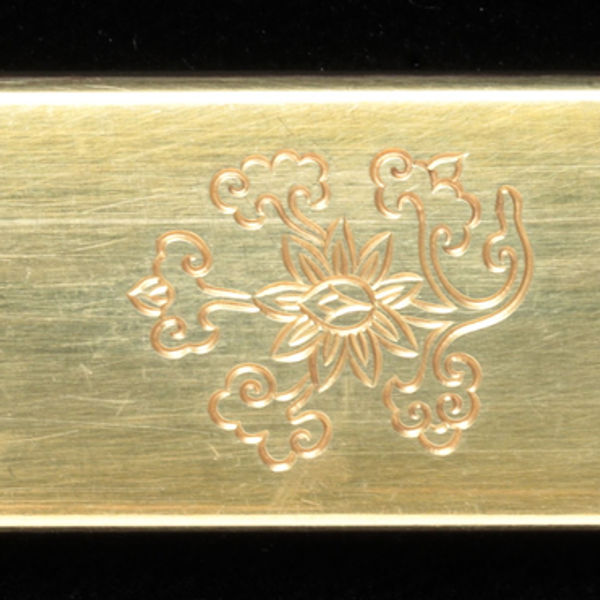
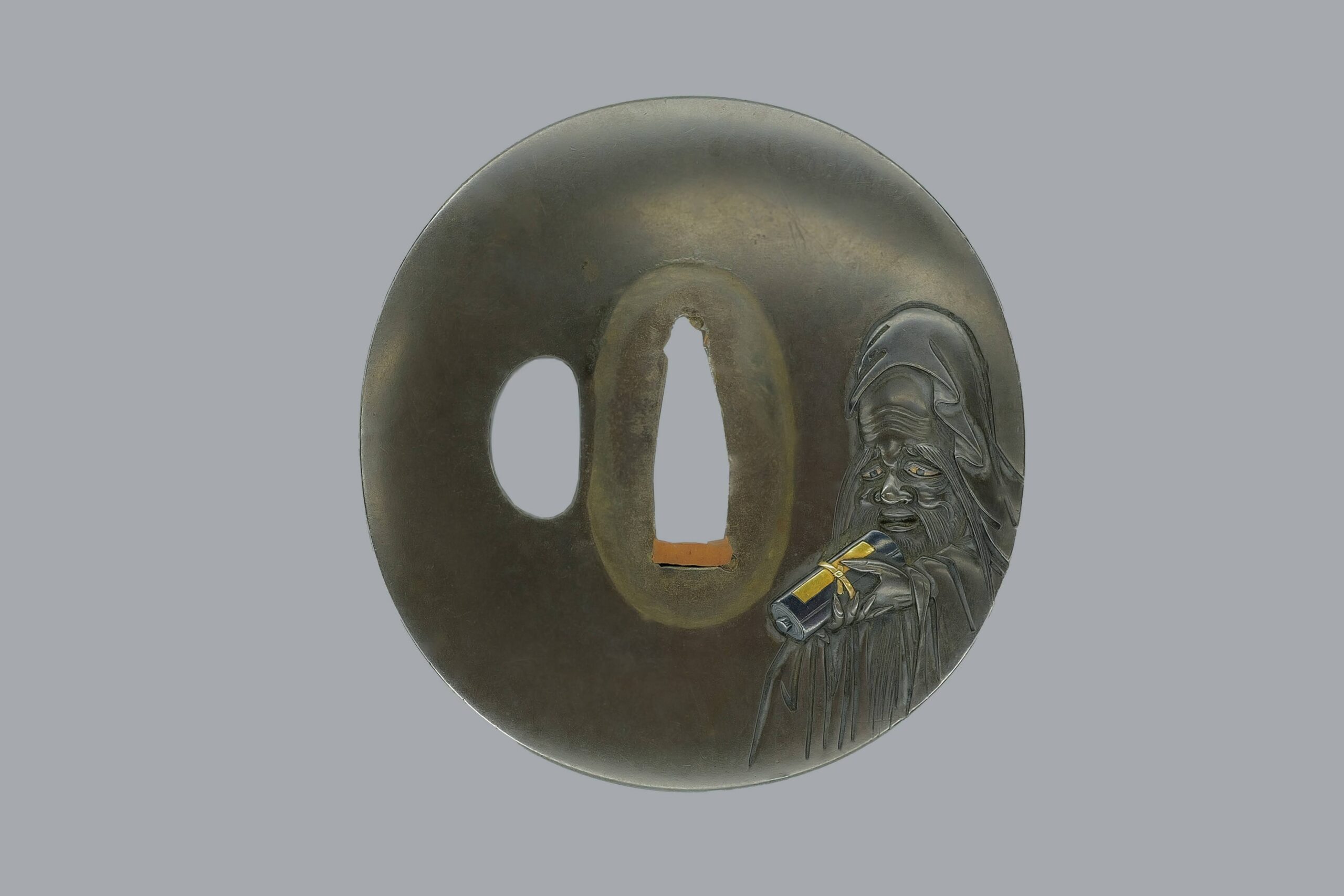
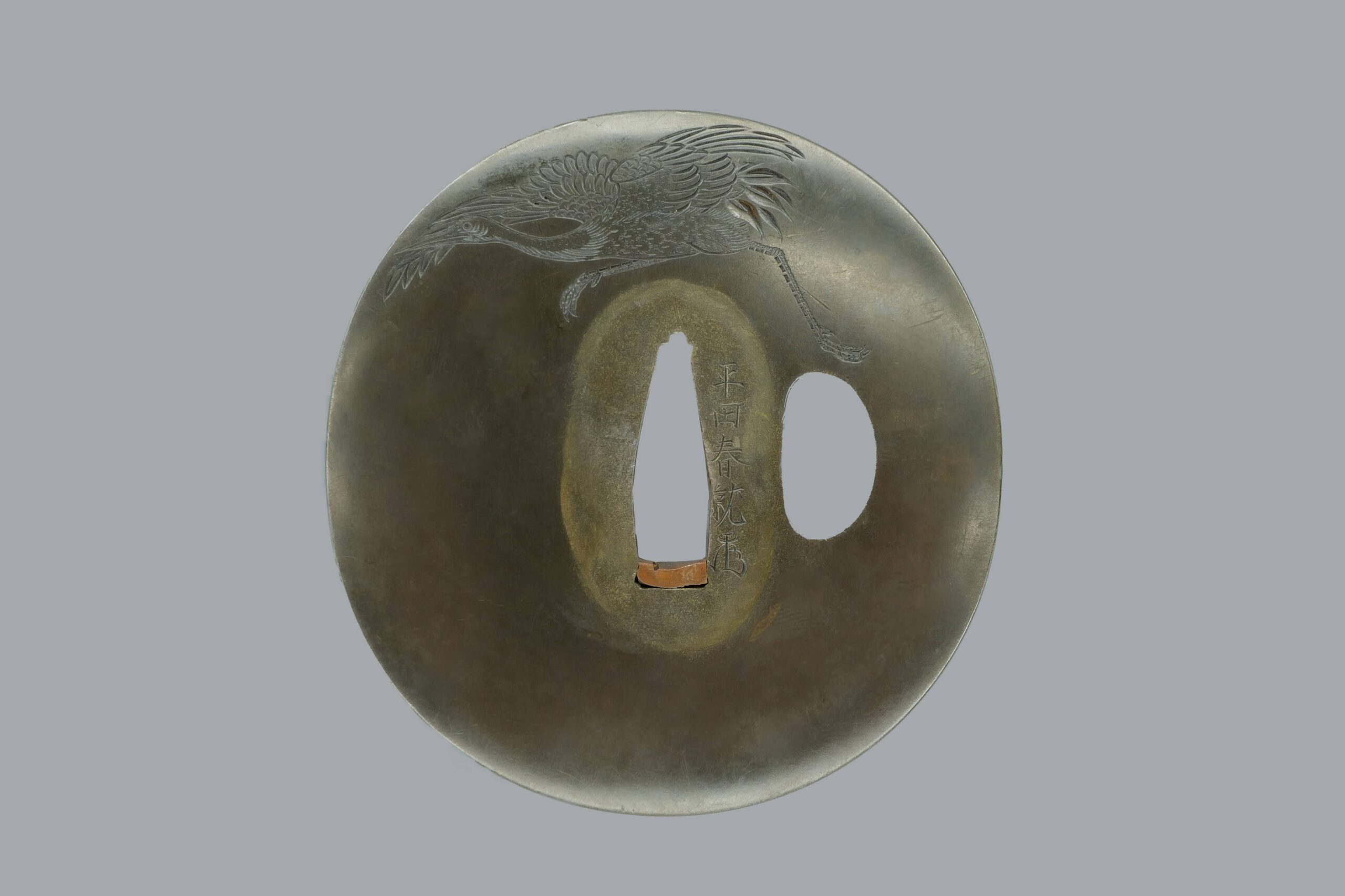
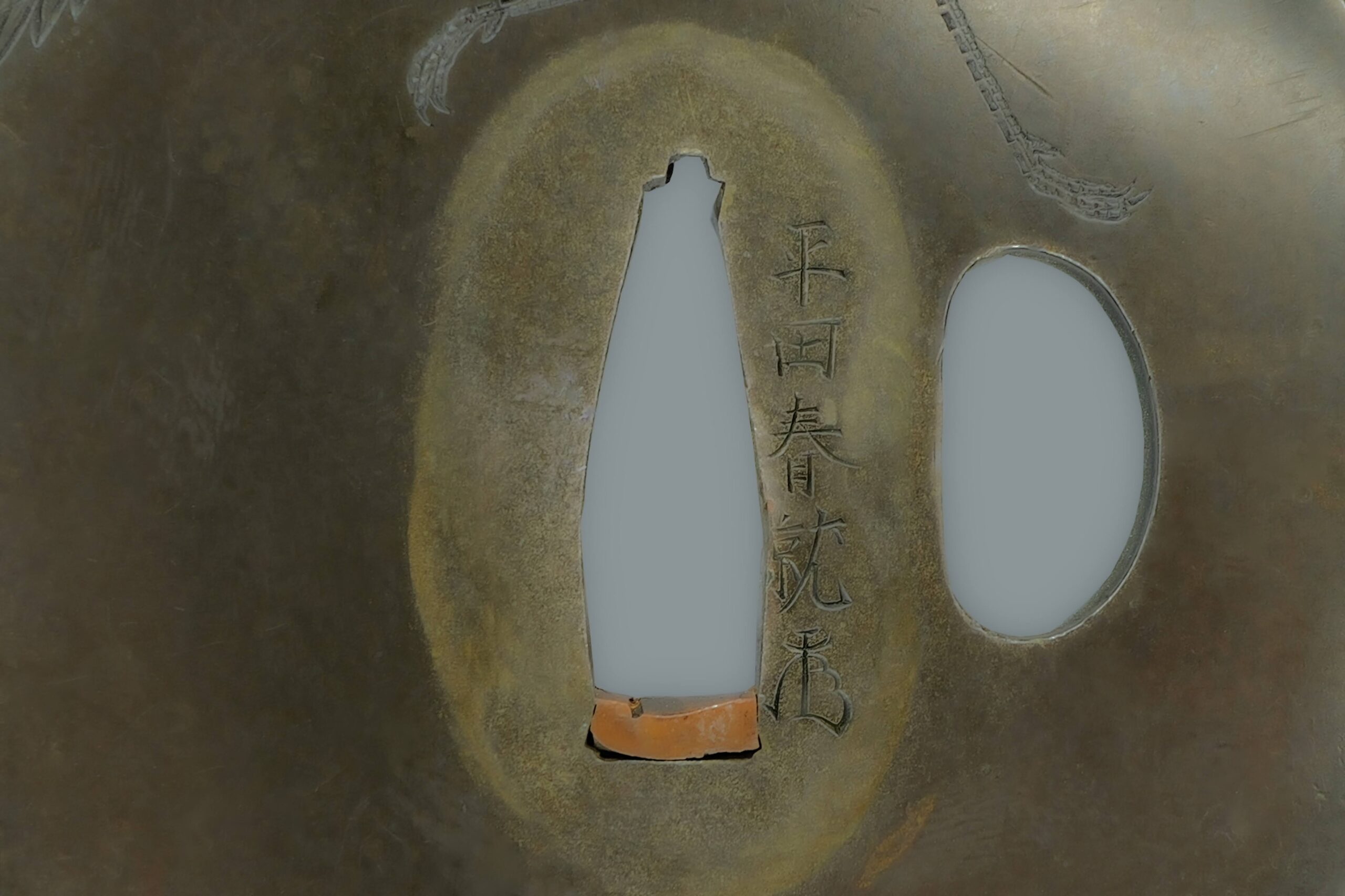
A fitting by Hirata Harunari depicting the god of longevity. The piece incorporates takabori inlaid metals on a polished shibuichi base. The reverse shows a crane remarkably executed with katakiribori and kebori. This work is an excellent example of Harunari's skill and the Hirata tradition.
 NihontoWatch
mei · Hirata · Late Edo (?–1840)
Hirata Harunari
Late Edo (?–1840)
Signed
Tokuho (NBTHK)
Kinko · Edo
3 pieces on the market now
Hirata Harunari was the eighth-generation master of the Hirata school, a lineage founded by Hirata Donin (also recorded as Hirata Michihito), who was celebrated for expressing the sumptuous beauty of Momoyama-period art in sword fittings through the medium of shippo (cloisonne enamel). As hereditary specialists in service to the Edo shogunate, the Hirata house transmitted its enameling techniques across successive generations. Harunari stands out as an especially accomplished artisan within that lineage: unlike other heads of the family, he did not confine himself to the hereditary shippo alone but also practiced chokin (metal carving), and for that reason left behind works employing a wide variety of methods. Following Harunari, the Hirata family continued to make full use of its inherited cloisonne expertise, undertaking the production of decorations and orders for the Meiji government.
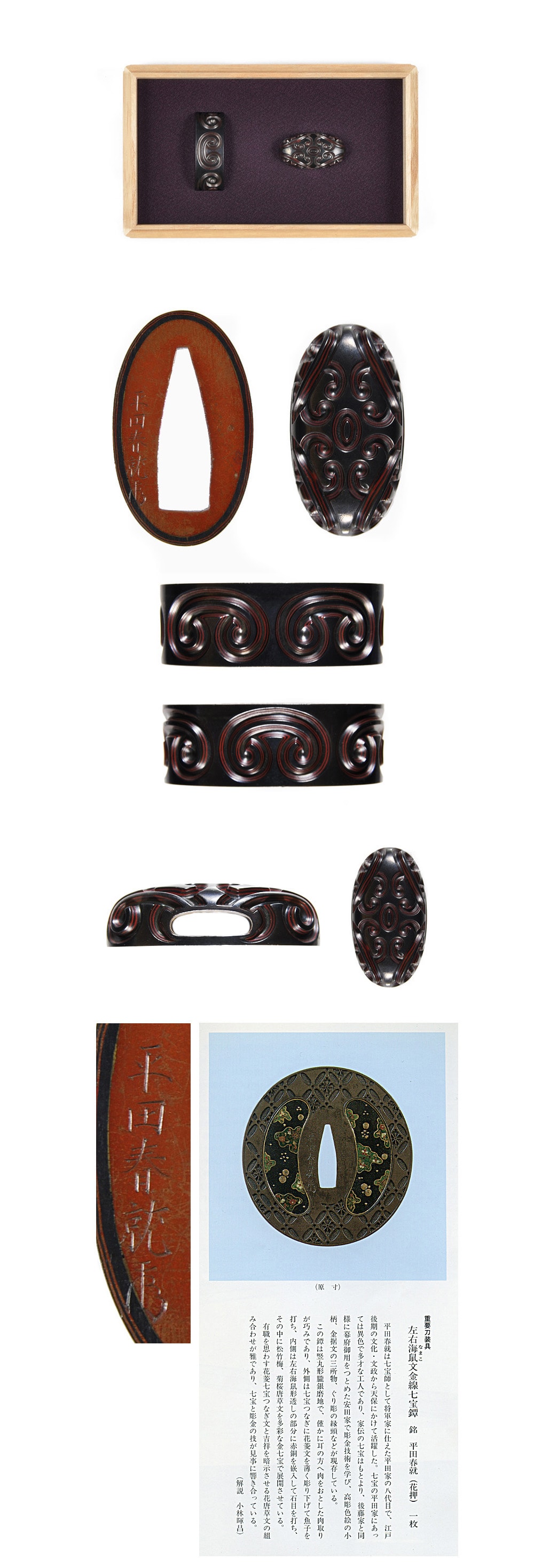
Harunari's shippo work employs predominantly gold cloisonne, yielding an elegant effect; many of his pieces are, in every respect, exceptionally beautiful. His gold-wire cloisonne inlays (kinsen shippo zogan) are arranged with remarkable effect, producing enamel tonalities that are highly transparent and clear -- a quality that distinguishes late-period Hirata work from the earlier manner, in which doro shippo was heaped up in thicker relief. In works combining cloisonne with carving, his takabori is executed through precise and accurate chisel handling, and a range of colored metals -- gold, silver, shibuichi, and suaka -- is employed so that even the finest details are rendered with exactitude[[c:1]]. Among his oeuvre there are also works that do not employ shippo at all, yet are executed with finely controlled workmanship -- neat, delicate, and painstakingly thorough.
The NBTHK has consistently recognized Harunari as a maker whose output gathers together the very essence of shippo inlay while simultaneously demonstrating crisp, masterful carving skill[[c:2]]. His pieces are described as exceptionally dignified in tone, and his best works stand as excellent demonstrations of the high technical level attained by this maker. That Harunari was thoroughly conversant with multiple techniques -- uniting the Hirata tradition of cloisonne with extremely meticulous metal-carving work -- places him in a singular position within the late Edo-period tosogu world, an artisan whose versatility elevated the hereditary art of his house to its fullest expression.
Where Harunari stands among comparable artisans: across all of nihontō, and within tradition, era, and period. The tiers (Foremost · Leading · Major · Notable) weigh official designations from the NBTHK and Japan's Agency for Cultural Affairs, together with historical honors of lasting repute such as the Sansaku and Meibutsu-chō.
Select a lens to see how it's measured.
Kinko · Musashi
8 pieces on the market now
The Edo Hirata school descends from Hirata Dōnin (平田道仁), the craftsman who expressed the sumptuous, luxurious beauty of Momoyama-period art in sword fittings through the technique of shippō (七宝, cloisonné enamel). Commonly known as Hikoshirō, Dōnin was a native of Kyoto, and his skills are traditionally said to have been learned from Korea. Cloisonné of that time accorded with contemporary taste and was employed for architectural metal fittings at sites such as Fushimi Castle and the Jurakudai, attracting great attention as a fresh form of decorative craft. Around the Keichō era (1596–1615) Dōnin entered the service of Tokugawa Ieyasu; he moved from Sunpu to Edo, and thereafter the Hirata family — distinct from the Higo Hirata line — served generation after generation as official retained artisans (kakae-kō) of the Tokugawa shogunate, granted a residence in Edo and a stipend of ten persons' rations. His eldest son and successor, the second-generation Shūichi (就一), had an audience with Tokugawa Iemitsu in Shōhō 3 (1646) and was maintained as a bakufu craftsman specializing in mounting ornaments. The school's defining art is cloisonné applied to sword fittings, above all gold-wire cloisonné inlay (kin-sen shippō zōgan) and the distinctive Hirata manner of flush enamel inlay (shippō suemon-zōgan), set against grounds of polished or stone-textured shakudō, iron, and brass. Mount Fuji was the subject at which the first and second generations most excelled — the summit crowned in pure-white enamel snow, the long foothills shimmering in pale blue, with gold inlay for rocks symbolizing wealth — alongside lotus blossoms on the water, willows with small birds, snow-capped mountain ranges, rain dragons (uryū), and floral arabesques.
The palette centers on a richly opalescent, milky-toned enamel inherited from Dōnin, joined by emerald-like transparent green and fresh hues of vermilion, yellow, and blue. " Successive heirs used Hikoshirō as their common name, and signed works from the first through the fourth generations are exceedingly few. From around the fifth-generation Jūmon (就門), a small number of works without cloisonné appear; the eighth-generation Harunari (春就), unlike other heads of the house, also studied chōkin (metal carving) under the Yasuda family, likewise shogunal purveyors, producing yōbori menuki and takabori iroe work on nanako-ji, a manner transmitted in turn to the ninth-generation Shūshō (就将). The cloisonné techniques were guarded as an isshi sōden — a secret, single-heir transmission — down into the Meiji era, when the family applied its hereditary art to the manufacture of the decorations and orders of the Japanese state, beginning with the Order of the Golden Kite (Kinshi Kunshō). Patronage remained at the highest level throughout: the tenth-generation Hikoshirō Haruyuki (春行) fulfilled a shogunal commission ordered in Genji 1 (1864) and completed in Keiō 1 (1865) that was transmitted within the Tokugawa house; a ceremonial aikuchi mounting with fittings by Harunari passed down as an heirloom of the Kishū Tokugawa family; and Shūshō worked on commission from the Lord of Nagashima. The school's influence extended beyond the main line — Nakamura Haruhiro, retained craftsman of the Daishōji Maeda house, became a pupil of Harunari and was permitted to use the Hirata surname. Dōnin's Momoyama-period masterpieces, with their antique elegance and dignified restraint, are esteemed as revealing "the very essence of Japanese cloisonné art,"[[c:1]] and celebrated examples were treasured in collections such as that of Ryūshidō, Mitsumura Toshimo — securing the Edo Hirata line's place as the fountainhead of cloisonné in the tosogu canon. Learn more →
| Smith | Era | Designated |
|---|---|---|
| Donin道仁 | — | 31 |
| Harunari春就 | — | 6 |
| Haruyoshi春美 | — | 0 |
| Shigekata重賢 | 1670 | 1 |
| Harumasa春正 | — | 0 |
A Hozon-certified blade judged to show notably superior workmanship and a better state of preservation. The bar is higher: re-tempered blades and most unsigned Muromachi/Edo works are excluded.
The NBTHK (Nihon Bijutsu Tōken Hozon Kyōkai, the Society for the Preservation of Japanese Art Swords) is a public-interest incorporated foundation founded in 1948 and supervised by Japan’s Agency for Cultural Affairs (Bunkachō); it is based at the Japanese Sword Museum in Tokyo. Its expert panels physically examine each submitted work (shinsa) and issue a certificate (kanteishō) ranking it by artistic and historical merit. NBTHK papers are the most widely recognized standard of authentication for Japanese swords and fittings.
NBTHK official siteReturns accepted within 7 days of receipt (JP terms; EN page states 3 days). Customer must contact within the window and return at own cost. Refund after items confirmed in original condition; repair fees charged if damage occurs.
¥1,500,000
A fitting by Hirata Harunari depicting the god of longevity. The piece incorporates takabori inlaid metals on a polished shibuichi base. The reverse shows a crane remarkably executed with katakiribori and kebori. This work is an excellent example of Harunari's skill and the Hirata tradition.
NihontoWatchmei · Hirata · Late Edo (?–1840)
Hirata Harunari
Late Edo (?–1840)
Signed
Tokuho (NBTHK)
Kinko · Edo
3 pieces on the market now
Hirata Harunari was the eighth-generation master of the Hirata school, a lineage founded by Hirata Donin (also recorded as Hirata Michihito), who was celebrated for expressing the sumptuous beauty of Momoyama-period art in sword fittings through the medium of shippo (cloisonne enamel). As hereditary specialists in service to the Edo shogunate, the Hirata house transmitted its enameling techniques across successive generations. Harunari stands out as an especially accomplished artisan within that lineage: unlike other heads of the family, he did not confine himself to the hereditary shippo alone but also practiced chokin (metal carving), and for that reason left behind works employing a wide variety of methods. Following Harunari, the Hirata family continued to make full use of its inherited cloisonne expertise, undertaking the production of decorations and orders for the Meiji government.
Harunari's shippo work employs predominantly gold cloisonne, yielding an elegant effect; many of his pieces are, in every respect, exceptionally beautiful. His gold-wire cloisonne inlays (kinsen shippo zogan) are arranged with remarkable effect, producing enamel tonalities that are highly transparent and clear -- a quality that distinguishes late-period Hirata work from the earlier manner, in which doro shippo was heaped up in thicker relief. In works combining cloisonne with carving, his takabori is executed through precise and accurate chisel handling, and a range of colored metals -- gold, silver, shibuichi, and suaka -- is employed so that even the finest details are rendered with exactitude[[c:1]]. Among his oeuvre there are also works that do not employ shippo at all, yet are executed with finely controlled workmanship -- neat, delicate, and painstakingly thorough.
The NBTHK has consistently recognized Harunari as a maker whose output gathers together the very essence of shippo inlay while simultaneously demonstrating crisp, masterful carving skill[[c:2]]. His pieces are described as exceptionally dignified in tone, and his best works stand as excellent demonstrations of the high technical level attained by this maker. That Harunari was thoroughly conversant with multiple techniques -- uniting the Hirata tradition of cloisonne with extremely meticulous metal-carving work -- places him in a singular position within the late Edo-period tosogu world, an artisan whose versatility elevated the hereditary art of his house to its fullest expression.
Where Harunari stands among comparable artisans: across all of nihontō, and within tradition, era, and period. The tiers (Foremost · Leading · Major · Notable) weigh official designations from the NBTHK and Japan's Agency for Cultural Affairs, together with historical honors of lasting repute such as the Sansaku and Meibutsu-chō.
Select a lens to see how it's measured.
Kinko · Musashi
8 pieces on the market now
The Edo Hirata school descends from Hirata Dōnin (平田道仁), the craftsman who expressed the sumptuous, luxurious beauty of Momoyama-period art in sword fittings through the technique of shippō (七宝, cloisonné enamel). Commonly known as Hikoshirō, Dōnin was a native of Kyoto, and his skills are traditionally said to have been learned from Korea. Cloisonné of that time accorded with contemporary taste and was employed for architectural metal fittings at sites such as Fushimi Castle and the Jurakudai, attracting great attention as a fresh form of decorative craft. Around the Keichō era (1596–1615) Dōnin entered the service of Tokugawa Ieyasu; he moved from Sunpu to Edo, and thereafter the Hirata family — distinct from the Higo Hirata line — served generation after generation as official retained artisans (kakae-kō) of the Tokugawa shogunate, granted a residence in Edo and a stipend of ten persons' rations. His eldest son and successor, the second-generation Shūichi (就一), had an audience with Tokugawa Iemitsu in Shōhō 3 (1646) and was maintained as a bakufu craftsman specializing in mounting ornaments. The school's defining art is cloisonné applied to sword fittings, above all gold-wire cloisonné inlay (kin-sen shippō zōgan) and the distinctive Hirata manner of flush enamel inlay (shippō suemon-zōgan), set against grounds of polished or stone-textured shakudō, iron, and brass. Mount Fuji was the subject at which the first and second generations most excelled — the summit crowned in pure-white enamel snow, the long foothills shimmering in pale blue, with gold inlay for rocks symbolizing wealth — alongside lotus blossoms on the water, willows with small birds, snow-capped mountain ranges, rain dragons (uryū), and floral arabesques.
The palette centers on a richly opalescent, milky-toned enamel inherited from Dōnin, joined by emerald-like transparent green and fresh hues of vermilion, yellow, and blue. " Successive heirs used Hikoshirō as their common name, and signed works from the first through the fourth generations are exceedingly few. From around the fifth-generation Jūmon (就門), a small number of works without cloisonné appear; the eighth-generation Harunari (春就), unlike other heads of the house, also studied chōkin (metal carving) under the Yasuda family, likewise shogunal purveyors, producing yōbori menuki and takabori iroe work on nanako-ji, a manner transmitted in turn to the ninth-generation Shūshō (就将). The cloisonné techniques were guarded as an isshi sōden — a secret, single-heir transmission — down into the Meiji era, when the family applied its hereditary art to the manufacture of the decorations and orders of the Japanese state, beginning with the Order of the Golden Kite (Kinshi Kunshō). Patronage remained at the highest level throughout: the tenth-generation Hikoshirō Haruyuki (春行) fulfilled a shogunal commission ordered in Genji 1 (1864) and completed in Keiō 1 (1865) that was transmitted within the Tokugawa house; a ceremonial aikuchi mounting with fittings by Harunari passed down as an heirloom of the Kishū Tokugawa family; and Shūshō worked on commission from the Lord of Nagashima. The school's influence extended beyond the main line — Nakamura Haruhiro, retained craftsman of the Daishōji Maeda house, became a pupil of Harunari and was permitted to use the Hirata surname. Dōnin's Momoyama-period masterpieces, with their antique elegance and dignified restraint, are esteemed as revealing "the very essence of Japanese cloisonné art,"[[c:1]] and celebrated examples were treasured in collections such as that of Ryūshidō, Mitsumura Toshimo — securing the Edo Hirata line's place as the fountainhead of cloisonné in the tosogu canon. Learn more →
| Smith | Era | Designated |
|---|---|---|
| Donin道仁 | — | 31 |
| Harunari春就 | — | 6 |
| Haruyoshi春美 | — | 0 |
| Shigekata重賢 | 1670 | 1 |
| Harumasa春正 | — | 0 |
A Hozon-certified blade judged to show notably superior workmanship and a better state of preservation. The bar is higher: re-tempered blades and most unsigned Muromachi/Edo works are excluded.
The NBTHK (Nihon Bijutsu Tōken Hozon Kyōkai, the Society for the Preservation of Japanese Art Swords) is a public-interest incorporated foundation founded in 1948 and supervised by Japan’s Agency for Cultural Affairs (Bunkachō); it is based at the Japanese Sword Museum in Tokyo. Its expert panels physically examine each submitted work (shinsa) and issue a certificate (kanteishō) ranking it by artistic and historical merit. NBTHK papers are the most widely recognized standard of authentication for Japanese swords and fittings.
NBTHK official siteReturns accepted within 7 days of receipt (JP terms; EN page states 3 days). Customer must contact within the window and return at own cost. Refund after items confirmed in original condition; repair fees charged if damage occurs.
¥1,500,000