Hirata Donin, commonly known by the name Hikoshiro, was a Kyoto-born craftsman who founded the Hirata lineage of shippo (cloisonne enamel) specialists during the period. Tradition holds that he learned his cloisonne techniques from Korea, and in his later years he was summoned by Tokugawa Ieyasu, entering the shogun's service around the Keicho era (1596--1615). He relocated from Sunpu to , where the Hirata family was granted a residence and received a stipend of ten retainers' rations. Thereafter, successive generations served as official artisans retained by the Tokugawa bakufu, each head heir adopting the common name Hikoshiro. The family's cloisonne methods were transmitted as an isshi soden---a closely guarded, single-heir tradition---down into the Meiji period, at which point the lineage applied its hereditary techniques to the manufacture of government orders and decorations of the Japanese state, including the Order of the Golden Kite.
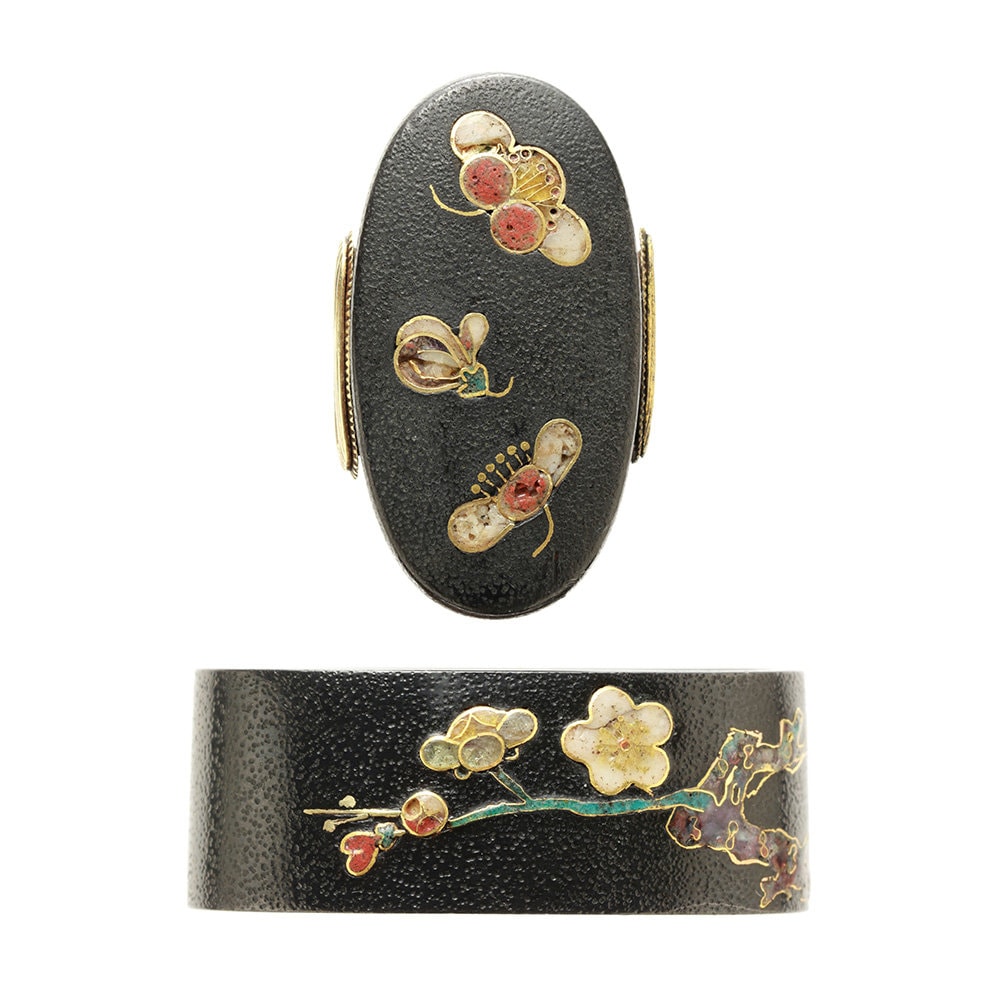
Among metalworkers who expressed the sumptuous, luxuriant beauty of art in sword fittings, Donin is a figure whose importance cannot be overlooked. His primary medium was shippo- (cloisonne inlay), executed through gold-wire cloisons---termed -sen shippo---fused with richly saturated enamels onto grounds, most frequently the jet-black (polished ground). His favored subject was Mount , which he rendered repeatedly with striking variation: compositions expressing the four seasons, depictions of dawn, midday, and evening light on the mountain, and arrangements pairing the peak with auspicious motifs such as deer or gold-and-silver ornament at its base. Beyond the theme, he produced outstandingly decorative works featuring (assorted treasures), bird-and-flower patterns, and boldly scaled kaburaya (whistling arrow) designs. His technique also encompassed (high-relief carving), - (flush inlay), and polychrome metalwork incorporating gold, silver, and inset jewel-like elements of red and deep indigo. A rare signed bearing the inscription "Hirata Hikoshi " demonstrates that his gold - and rounded, abundantly modeled contours were consistent across both his cloisonne and non-cloisonne productions.
The 's evaluations consistently characterize Donin's works as possessing an antique elegance and dignified restraint that clearly distinguishes them from later cloisonne production. His coloring is described as achieving a uniquely deep luster and an appealing savor, with hues of the doro-shippo (mud cloisonne) praised for their profound beauty. Pieces are recognized for their calm composition and pronounced sense of jidai-shoku (period character), which conceals a profound beauty beneath the surface opulence. The identifies his workmanship as consistently superb, noting that his elevated technical ability is fully displayed in every detail and that his cloisonne inlay work constitutes Donin's special forte. Among the corpus of Mount , which was initially thought to number only five or six examples but has since been shown to exceed a dozen, the finest are without exception described as beautifully made---works that capture with gravitas Japan's very emblem and embody the innovative spirit of the age.