 NihontoWatchNihontoWatch
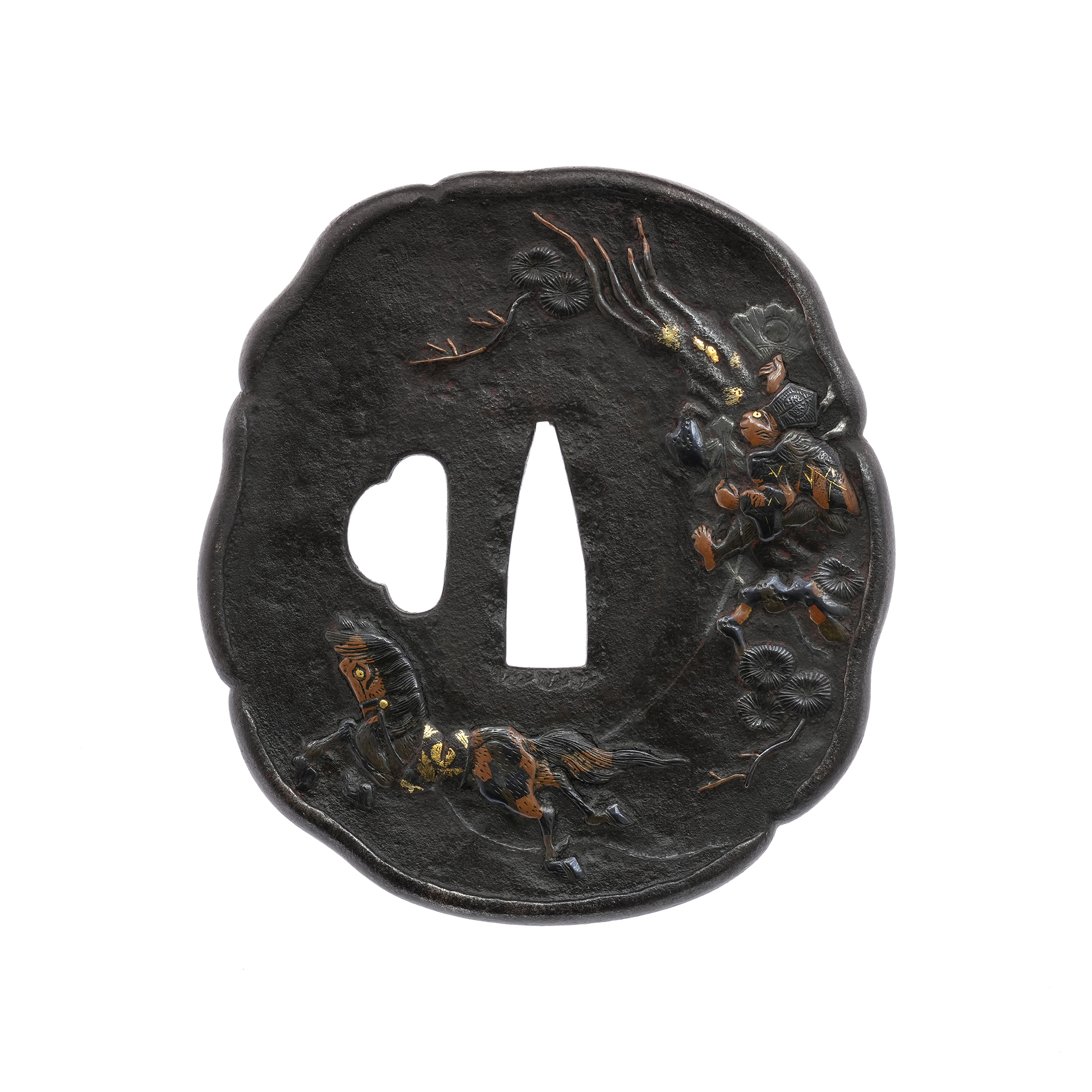
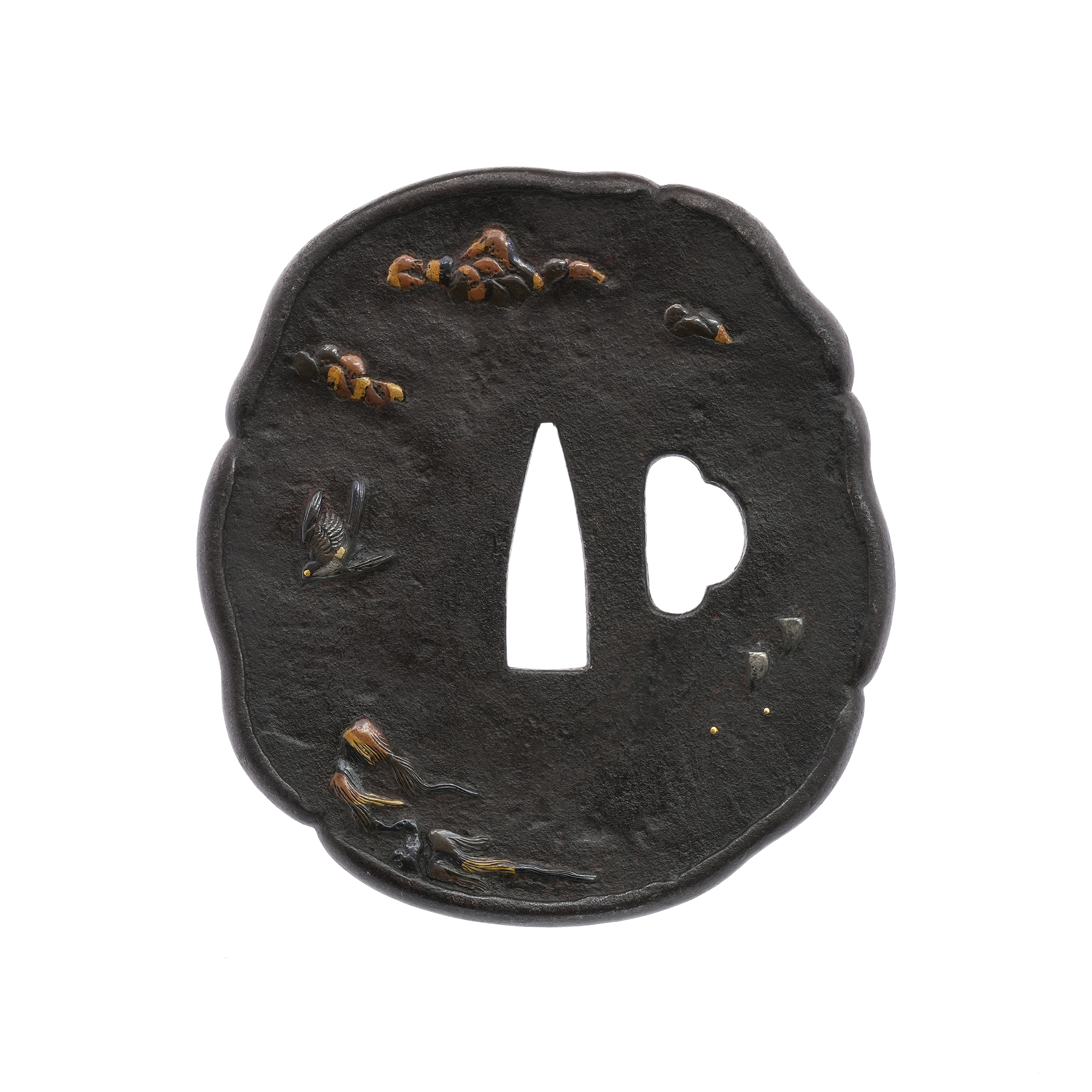
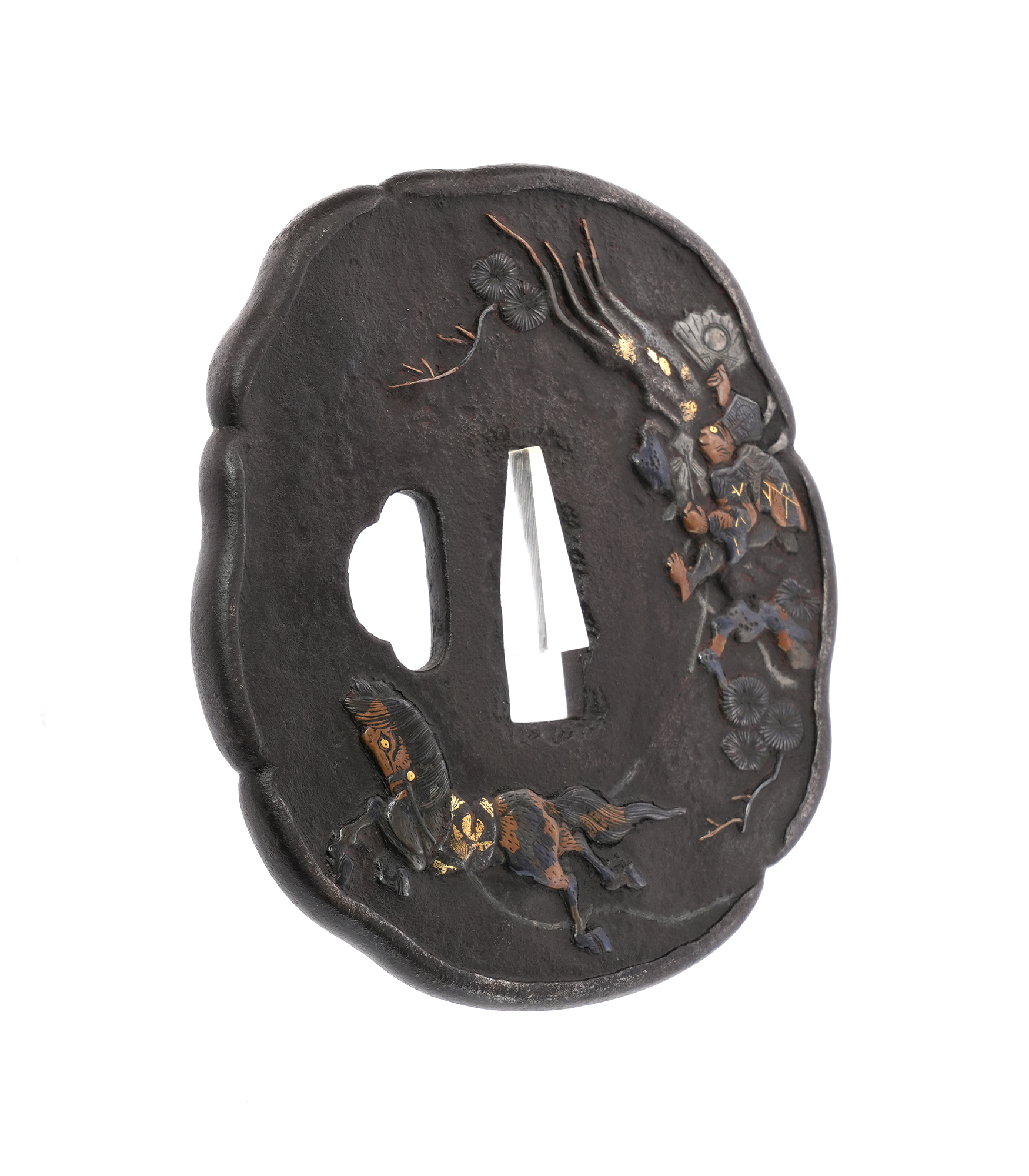
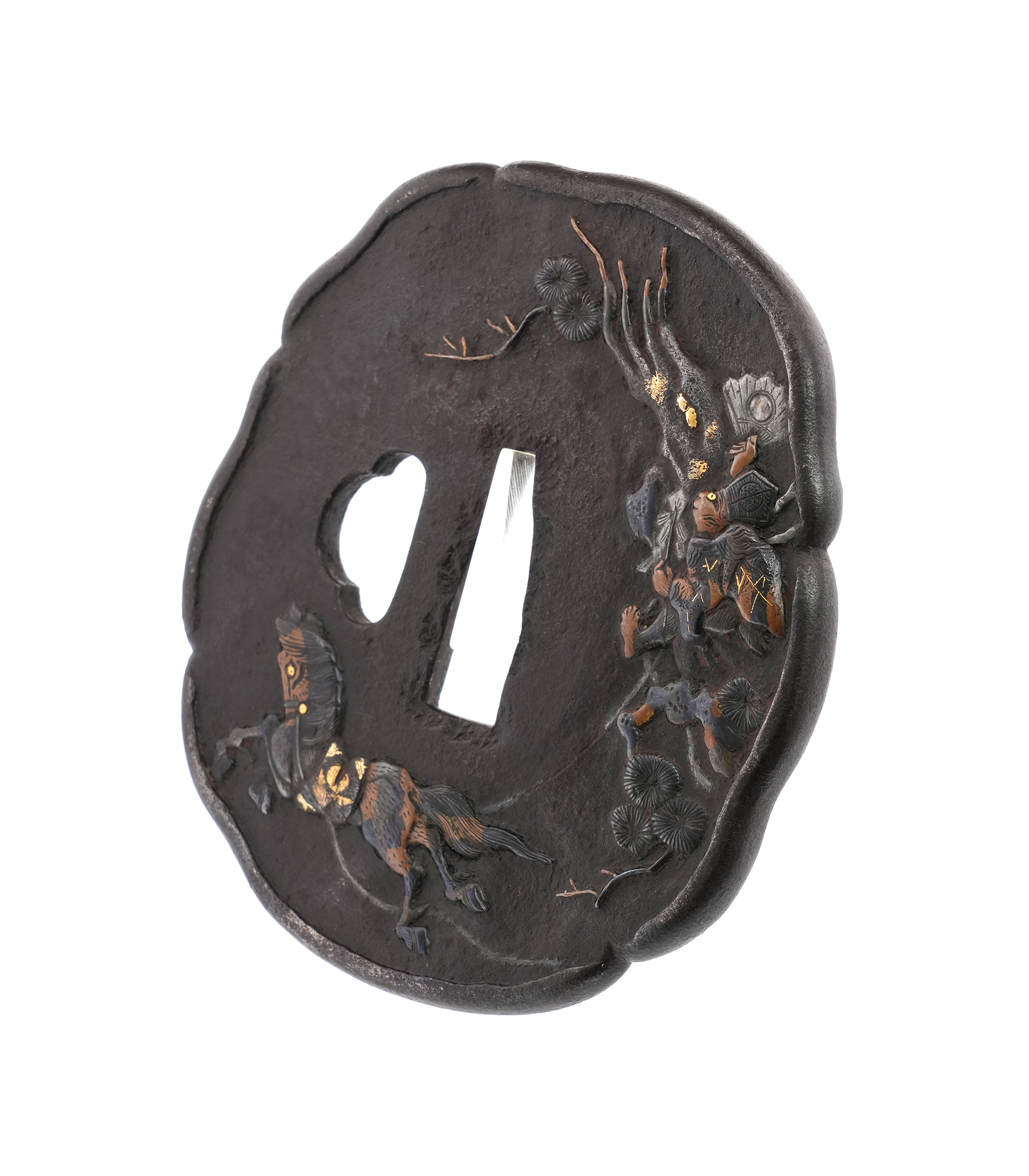
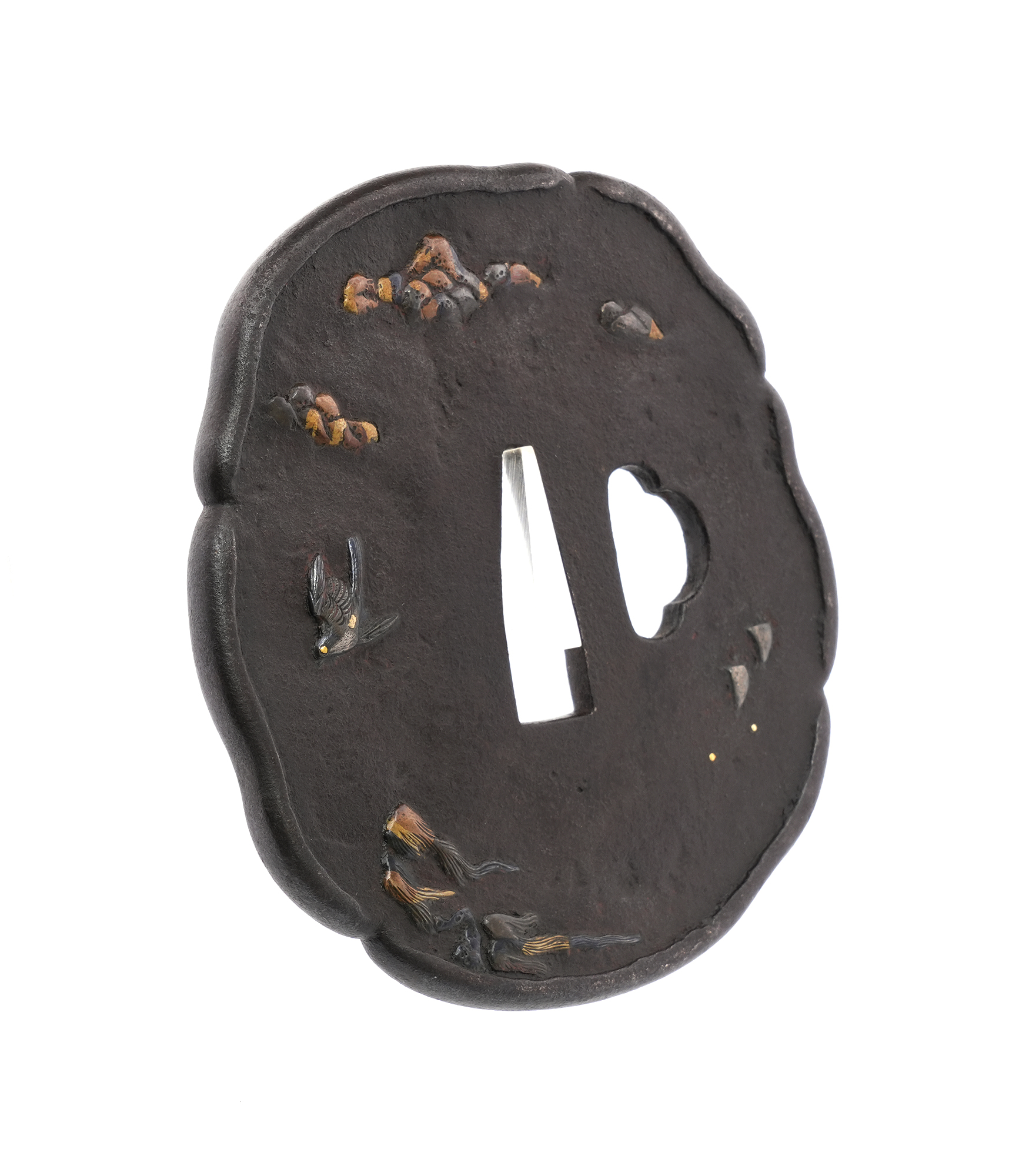
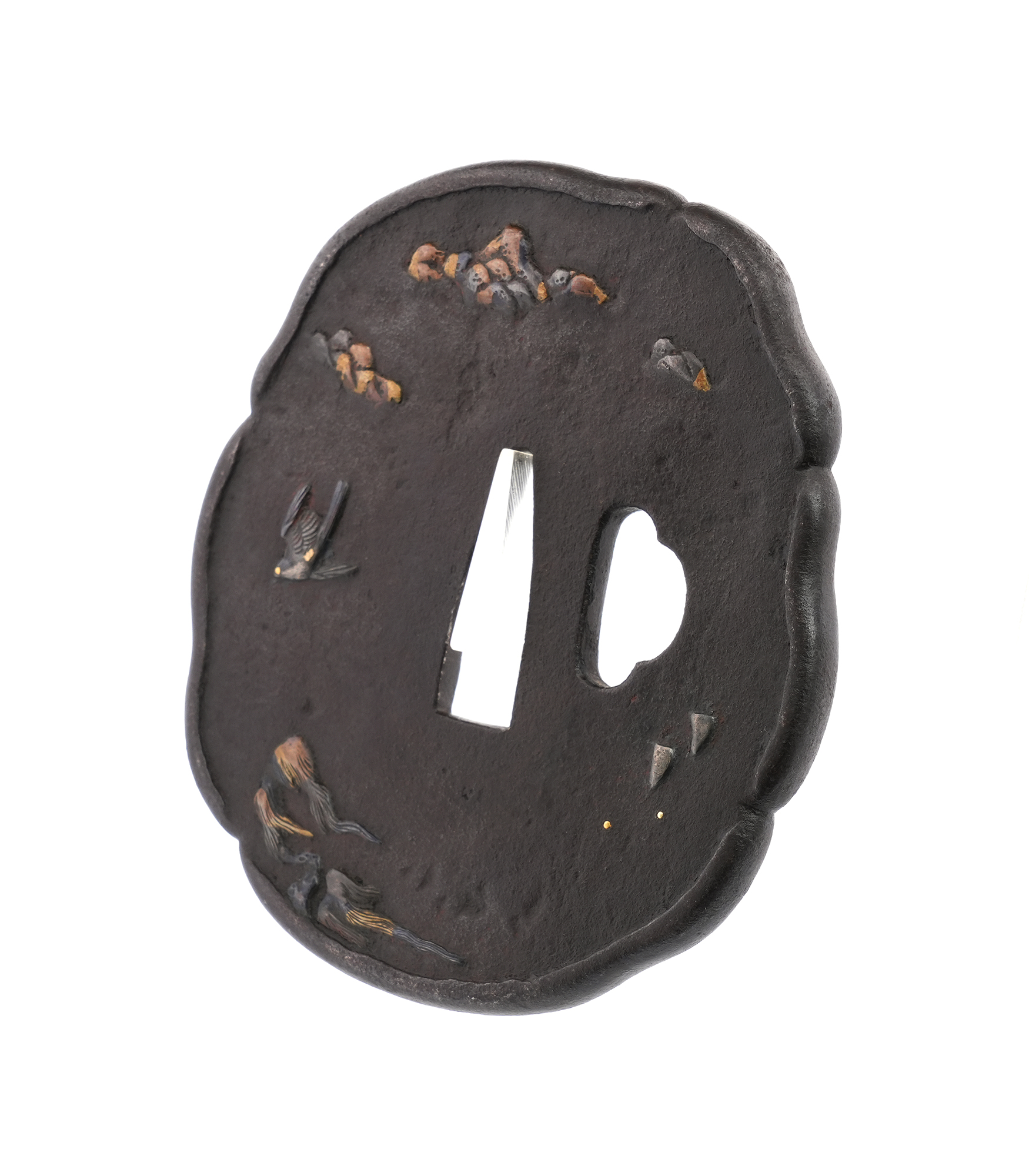
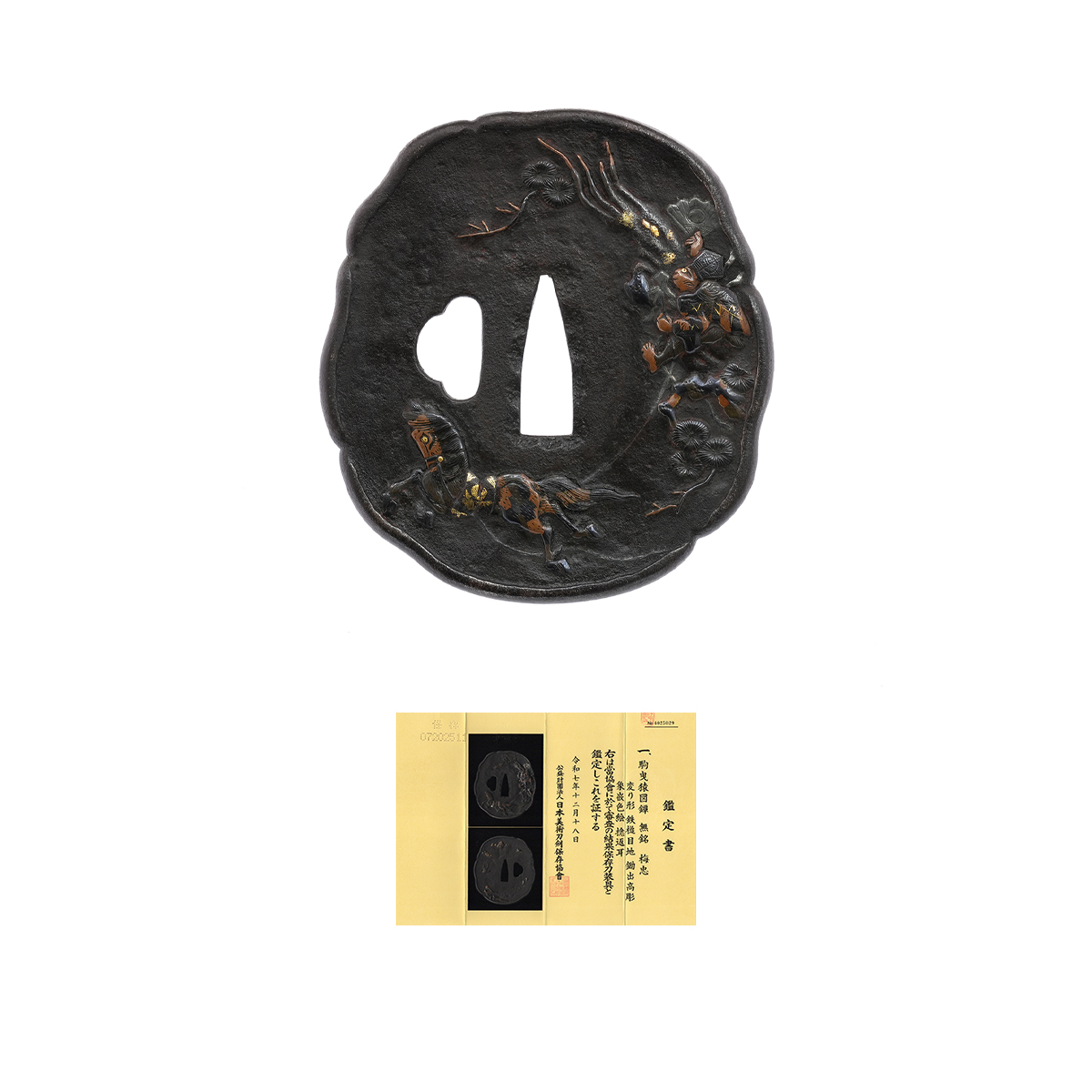
This work is an iron-base kawarigata tsuba with a komahiki-zaru design, kiwame as Umetada. It uses a large kawarigata iron base, and skillfully depicts a scene possessing both auspiciousness and narrative quality on the obverse and reverse. The jitetsu is well-forged and presents a calm iron texture that has aged over time. The outer shape is composed of a free-flowing kawarigata that does not fit into a standard form, and the free sense of modeling and pictorial design characteristic of the Umetada school are well expressed. On the obverse, a monkey wearing an eboshi and clothing is depicted, and its figure holding a fan in its right hand and leading a horse with its left hand is vividly drawn using takabori. The horse is expressed with a powerful physique, and combined with the monkey's gestures, it gives rich movement to the composition. Kin-zogan and iroe are applied to key points, adding an elegant splendor through the contrast with the calm iron base. On the reverse, a flying bird is arranged, and above it, scenery thought to be a mountain range is depicted. It skillfully composes a vast landscape within the limited surface of the tsuba, and while corresponding with the komahiki-zaru design on the obverse, it creates an atmosphere as if one is looking at a single picture scroll. The komahiki-zaru is an auspicious design that has been cherished since ancient times, and the figure of a monkey leading a horse embodies wishes for peace and prosperity. This work is a piece where the free and lively sense of design unique to the Umetada school and the koga iron texture are wonderfully harmonized, and combined with the large kawarigata tsukurikomi, it is an excellent piece rich in highlights that conveys the charm of metalwork art from the Momoyama to the early Edo period to the present day.
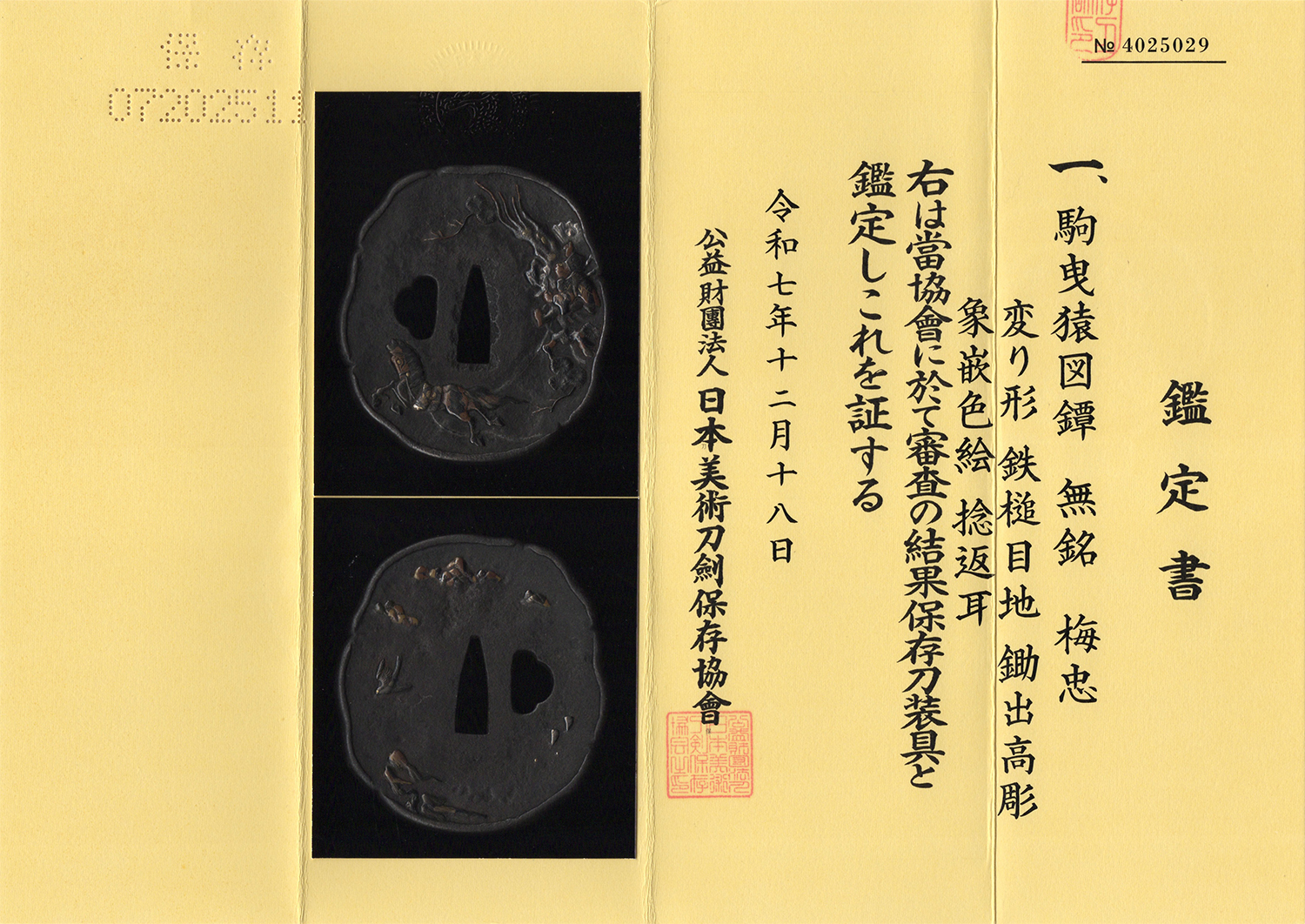
Certificate reading — 無銘(梅忠)
NihontoWatchOffered by Toushin

Machine translation of the shop's Japanese ·
Machine translation from the shop's Japanese · may contain errors ·
Shinto · Kyoto
45 pieces on the market now
The Umetada school is one of the most distinguished metalworking lineages of the Momoyama period, rooted in Nishijin, Kyoto, and claiming descent from the legendary Sanjo Munechika. The house served the Ashikaga shogunal family over successive generations, establishing deep foundations in the full range of sword-related arts -- swordmaking, blade carving (toshin-bori), the production of steel and fittings, the shortening of blades, the insertion of inlaid signature attributions (zogan-mei), and the making of mountings. " Myoju taught both Hizen Tadayoshi and Higo no Kami Teruhiro, and accepted commissions from the Toyotomi and Tokugawa houses as well as many daimyo families. An earlier stratum of production, appraised as Ko-Umetada, dates from the close of the Muromachi period and demonstrates that the group's technical foundations were firmly established before Myoju's maturity. The near-contemporary Mitsutada, though absent from formal genealogies, is conjectured to have been of senior standing within the circle; his works, executed on brass with an archaic dekoboko-ji ground, display "an even more classically archaic elegance" than Myoju's. Shigeyoshi, active from the Kan'ei through Genroku eras, carried the tradition forward into the mid-Edo period. The Umetada school's collective technical identity divides into two principal modes: iron works and soft-metal (irogane) works. In the iron mode, Myoju expressed geometric patterns -- sayagata, raimon, kasumi-kaminari-mon, and rinzu-mon -- by means of gold nunome-zogan, complemented by celebrated openwork including wheel and double-tomoe sukashi tsuba.
The nejikaeshi-mimi (twisted turned-back rim) and gold rim inlay are techniques "at which he particularly excelled," while the iron itself is invariably "carefully selected" and displays excellent quality. In the irogane mode -- employing shakudo, suaka, brass, and other alloys as ground material -- the school developed a distinctive form of hira-zogan (flat inlay) that retains only slight relief, deploying colored metals in novel combinations. " Ground textures including hammered tsuchime-ji, polished migaki-ji, and file-finished surfaces are deployed with meticulous care to heighten the pictorial effect. Mitsutada's work on brass with its uneven, raised-and-recessed ground and enrichment through gold and silver nunome-zogan represents a more archaic variant of this aesthetic. Shigeyoshi synthesized the inherited hira-zogan tradition with textile-derived designs of linked shippo, karakusa arabesque, and sayagata patterns -- reflecting his Nishijin milieu, the heart of Kyoto's silk-weaving district -- while deploying suemon-zogan, sukidashi-bori, and kin-iroe across shakudo grounds in both polished and stone-textured finishes. The Umetada school's historical significance is singular: the pictorial manner of design, the hira-zogan technique, and the use of non-iron metals as the ground material "all find their earliest beginning with Myoju" -- he stands as the originator of an entire aesthetic vocabulary in kinko. The NBTHK consistently describes Myoju's work as possessing "the vitality that preserves the very momentum of brushwork," with a "strong connection with Hon'ami Koetsu and Tawaraya Sotatsu" that places him among the foremost artistic figures of the Momoyama age. " Solid-gold tsuba, frequently melted down during periods of upheaval, are recognized as extremely rare survivals of exceptional documentary and artistic value. Learn more →
| Smith | Era | Designated |
|---|---|---|
| Myoju明寿 | 1590-1631 | 45 |
| Muneyoshi宗吉 | 1596-1615 | 4 |
| Naritsugu就次 | — | 0 |
| Umetada Mitsushige光重 | 1700-1750 | 0 |
| Kaji’emon加治右衛門 | — | 0 |
Certifies a genuine fitting worth preserving: a correct signature, or, if unsigned, an identifiable era and school, with recognized artistic and craft value.
The NBTHK (Nihon Bijutsu Tōken Hozon Kyōkai, the Society for the Preservation of Japanese Art Swords) is a public-interest incorporated foundation founded in 1948 and supervised by Japan’s Agency for Cultural Affairs (Bunkachō); it is based at the Japanese Sword Museum in Tokyo. Its expert panels physically examine each submitted work (shinsa) and issue a certificate (kanteishō) ranking it by artistic and historical merit. NBTHK papers are the most widely recognized standard of authentication for Japanese swords and fittings.
NBTHK official siteAs a rule we do not accept returns, except when we have sent a different item from the one ordered or when there is a significant discrepancy between the description and the item. If you wish to return an item, please contact us within 3 days of its arrival and then send it back.
¥398,200