 NihontoWatchNihontoWatch
Perhaps because there are examples of the Hyonen motif by Eijo and Kenjo of the Goto family, these menuki have been given a kiwame to Ko-Goto. They are certainly similar, but this theme is famous and there are a fair number of examples in machibori as well. Although the jigane is dark, it is a shakudo with a slight reddish tint. The carving is superb, and the design of a warrior riding atop the plump form of a catfish is full of charm. Would it be off the mark to call it a Chinese version of a rodeo (as Hyonen originates from a Chinese legend)? As with other works, the treatment of the catfish's whiskers might be the particular highlight. It is skillful indeed; to carve thin, undulating, curved whiskers without any sense of incongruity, while ensuring they do not break, requires great thought. The attribution to Ko-Goto likely stems from this form and the manner of the carving. The construction uses a slightly thin jigane that has been carefully worked with uchidashi and possesses kukuri. The uchidashi is quite strong, with tagane marks visible everywhere on the urayuki, allowing one to fully enjoy the skill of the embossing. The ashi have broken off and are missing, but their shape can be minutely inferred from the surrounding chikane. They appear to have been neat rectangles, from which a period of the early Edo period or later can be inferred. The iroe on the surface has peeled away, but traces can be seen on the sides, suggesting the iroe extended right to the susogiwa. At this point, one must abandon the Ko-Goto attribution to the Momoyama period or earlier. The overall form is not rugby-ball shaped but rather free and unconventional. And despite originating from a legend, the appearance of a human figure... it is a parade of kiwadokoro that almost confirms a date of the early Edo period or later. However, based on the uchidashi technique and the construction of the jibata, one can say it does not go as late as the mid-Edo period. These menuki seem somewhat elusive and hard to grasp, but since that is the original meaning of the motif itself, one could say they are menuki that capture the very essence of the subject (a bit of irony).
NihontoWatchOffered by Asahi Token

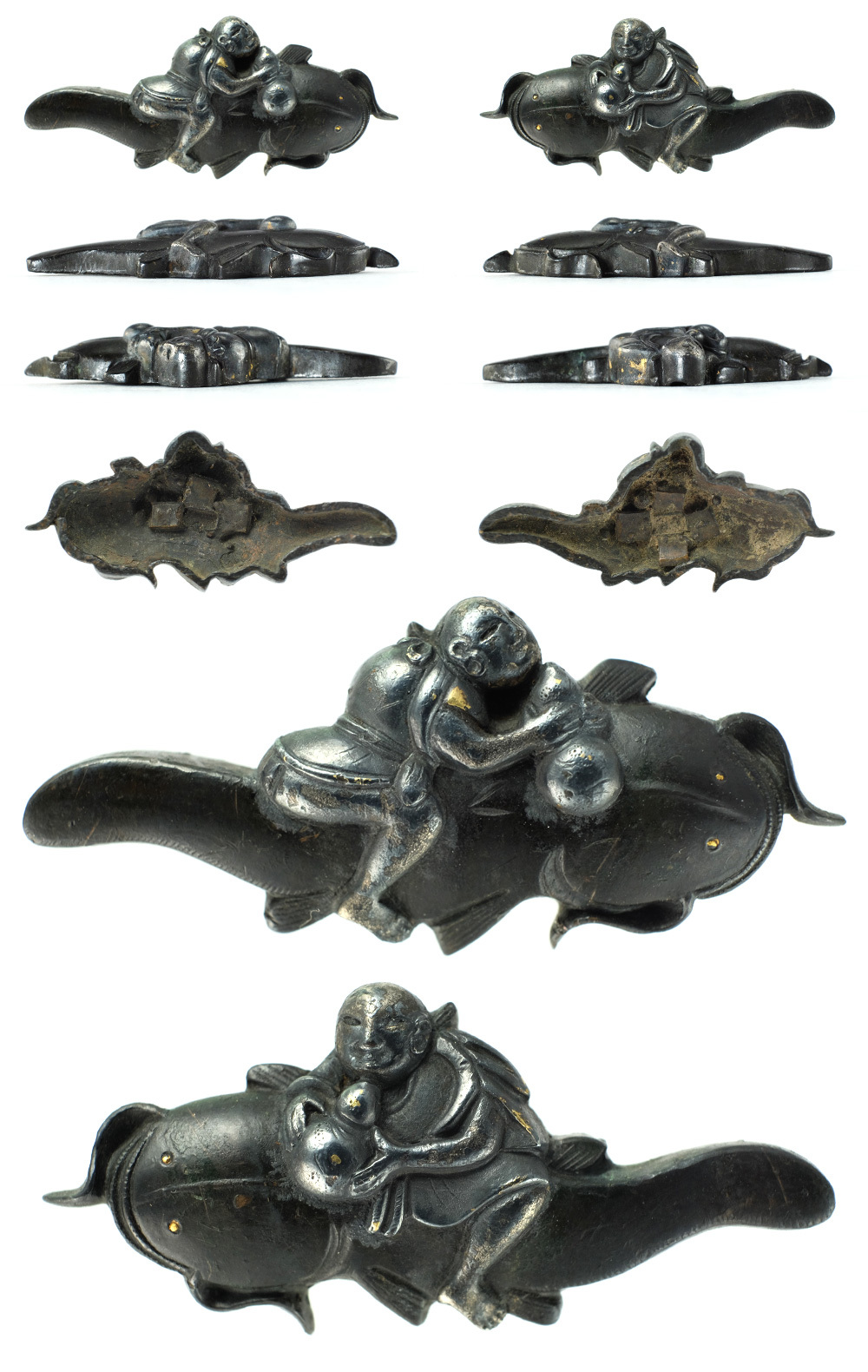
Ko-Goto School
Pre-Edo
Unsigned
Hozon (NBTHK)
Machine translation of the shop's Japanese ·
Machine translation from the shop's Japanese · may contain errors ·
Iebori · Kyoto
The term Ko-Gotō refers to works of the Gotō family from the time of the first master, Yūjō, in the Muromachi period, through approximately the fifth master, Tokujō, in the Momoyama period, for which it is not possible to determine the individual artist's personal name. These unsigned pieces represent the formative period of the Gotō house—the official metalworkers to the Ashikaga and later Tokugawa shogunates—and embody the foundational aesthetic principles that would define the school's centuries-long dominance of elite tōsōgu production. The designation encompasses works that display characteristic Gotō workmanship but differ in certain technical details from the securely attributed output of named masters such as Jōshin (third generation), making individual attribution impossible while affirming the broader family tradition. Ko-Gotō works demonstrate a consistent technical repertoire that became the hallmark of the school's approach: compositions are typically executed on shakudō nanako-ji grounds—jet-black surfaces meticulously worked with dense fish-roe texturing—and feature motifs rendered in takabori (high relief) with pronounced three-dimensional modeling. The decoration frequently employs gold uttori iroe, a subdued polychrome metal finishing technique that imparts a softened, lustrous glow to raised elements, often complemented by gold and silver zōgan (inlay) for accent details such as dewdrops or small ornamental flourishes. Subjects drawn from nature predominate: seaweed and shells, pine and wisteria, melons and loquats, chrysanthemums, holly, and aquatic motifs including catfish amid waves. Narrative and symbolic themes also appear—Idaten pursuing a demon, paired sheep, horse tack, and the Zen-inspired gourd-and-catfish pairing famously depicted by Josetsu.
These motifs are arranged with compositional ingenuity, balancing sumptuous surface treatment with dignified restraint, and the carving technique consistently displays the forceful yet refined hand characteristic of the Gotō lineage. The scale of Ko-Gotō kōgai tends toward the imposing—frequently exceeding twenty-two centimeters in length with substantial nikuoki (volume and thickness)—reflecting their primary use on uchigatana during the Muromachi period. The artistic significance of Ko-Gotō work lies in its establishment of the aesthetic standards and technical vocabulary that subsequent generations of the Gotō house would elaborate and refine. The antique patina (koshoku) often present on surviving examples—where the gold uttori has naturally flaked or mellowed over centuries—imparts a depth and evocative character prized by connoisseurs as evidence of age and authenticity. While later Gotō masters would produce signed works with increasingly pictorial and decorative tendencies, Ko-Gotō pieces retain a pattern-like quality tempered by emerging pictorial treatments, representing a transitional aesthetic between earlier ornamental abstraction and the fully realized e-fū (pictorial style) of later periods. The use of apotropaic motifs such as holly—believed to ward off evil spirits—reflects the cultural context of these works as protective talismans as well as objects of refined craftsmanship. As a category, Ko-Gotō serves both a practical taxonomic function within tōsōgu connoisseurship and a conceptual one, preserving the recognition of works whose high quality and characteristic execution confirm Gotō family authorship even when the passage of centuries has obscured the individual hand responsible. Learn more →
Certifies a genuine fitting worth preserving: a correct signature, or, if unsigned, an identifiable era and school, with recognized artistic and craft value.
The NBTHK (Nihon Bijutsu Tōken Hozon Kyōkai, the Society for the Preservation of Japanese Art Swords) is a public-interest incorporated foundation founded in 1948 and supervised by Japan’s Agency for Cultural Affairs (Bunkachō); it is based at the Japanese Sword Museum in Tokyo. Its expert panels physically examine each submitted work (shinsa) and issue a certificate (kanteishō) ranking it by artistic and historical merit. NBTHK papers are the most widely recognized standard of authentication for Japanese swords and fittings.
NBTHK official siteReturns are accepted within 7 days of the item's arrival, provided its condition has not changed since the time of sale. Once the return is confirmed, the payment is promptly refunded to your designated account.
¥110,000