During the Nanbokucho era, Bitchu Aoe smiths such as Tsuginao and Tsugiyoshi left behind not only tachi in suguha, but also wide sunobi tanto and hira-zukuri ko-wakizashi with clear so-called saka-choji midareba, where the heads of the choji midare are fired pointing toward the nakago-saki. Intense battles between the Northern Court in Kyoto supported by Ashikaga Takauji and the Southern Court in Yamato Yoshino led by Emperor Go-Daigo were unfolding across various provinces, and it is said that among the busho of that time, when odachi and o-nagamaki were moriyuki, the basara style of preferring the grand and eccentric became popular. Hira-zukuri wakizashi in saka-choji style likely embodied the temperament of such an era.
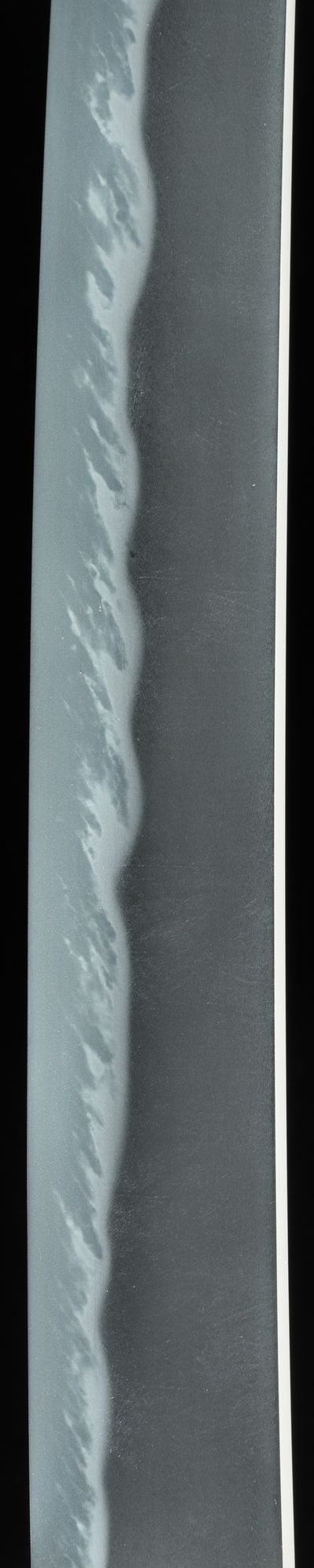
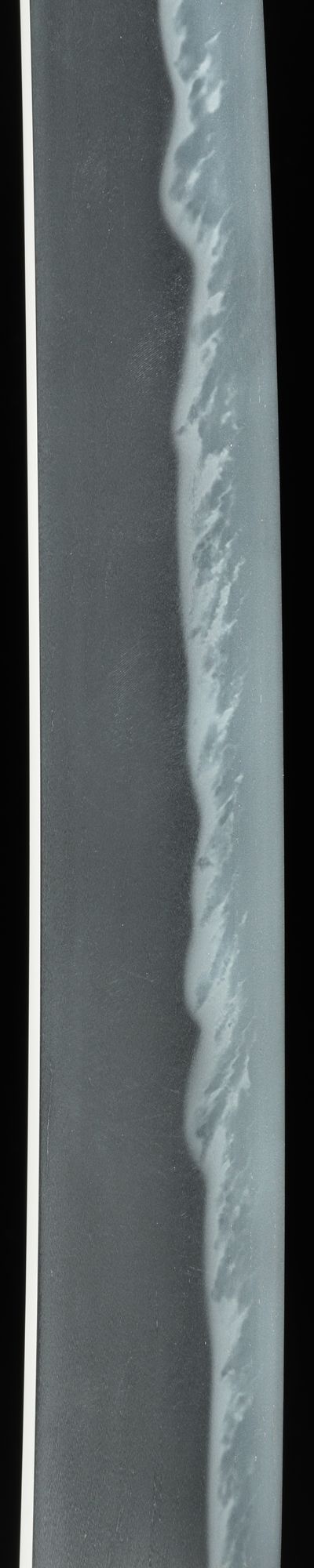
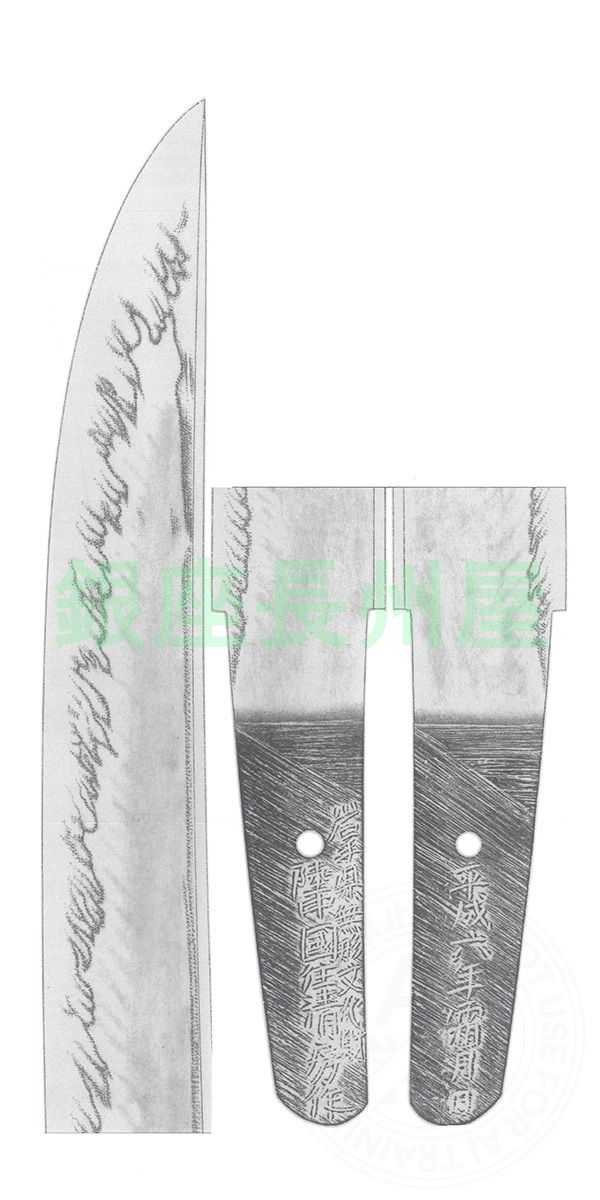
The wakizashi in the title is a masterpiece modeled after the saka-choji of the Bitchu Aoe smiths, and the creator is the swordsmith Yamaguchi Kiyofusa (note), a holder of Iwate Prefecture Intangible Cultural Property. While the mihaba is extremely wide, the kasane is thin, resulting in a gokai sugata that seems ready to overwhelm a basara daimyo. As for the jigane, the ko-mokume hada is densely standing out, and fine jinie boils up to create a beautiful texture like early frost, accompanied by a clear dark band near the ha, with a vivid utsuri like a shadow of the yakiba standing across the entire hiraji. The hamon is a saka-choji midare with high-fired choji and complexly arranged ko-choji, where the ashi point toward the kissaki direction, the nioiguchi is somewhat tight with bright konie, and yo float within the clear hachu, moving dynamically like flames. The boshi is intensely midare-komi, mixed with shimaba, returning long and yaki-sage along the mune. On the nakago, which shines in a silver-white color just as it was at the time of production, the mei characters are vivid with thick chisel strokes. This is a kaishin no hitokuchi by the swordsmith Kiyofusa, who repeated trial and error based on the teachings of his master, Sumitani Masamine.
Note... Master Kiyofusa was born in Showa 7 in Morioka City. He studied under the Living National Treasure swordsmith Sumitani Masamine.
He was designated Mukansa in Showa 61, and an Iwate Prefecture Intangible Cultural Property in Heisei 5.
Machine translation from the shop's Japanese · may contain errors ·
During the Nanbokucho era, Bitchu Aoe smiths such as Tsuginao and Tsugiyoshi left behind not only tachi in suguha, but also wide sunobi tanto and hira-zukuri ko-wakizashi with clear so-called saka-choji midareba, where the heads of the choji midare are fired pointing toward the nakago-saki. Intense battles between the Northern Court in Kyoto supported by Ashikaga Takauji and the Southern Court in Yamato Yoshino led by Emperor Go-Daigo were unfolding across various provinces, and it is said that among the busho of that time, when odachi and o-nagamaki were moriyuki, the basara style of preferring the grand and eccentric became popular. Hira-zukuri wakizashi in saka-choji style likely embodied the temperament of such an era.
The wakizashi in the title is a masterpiece modeled after the saka-choji of the Bitchu Aoe smiths, and the creator is the swordsmith Yamaguchi Kiyofusa (note), a holder of Iwate Prefecture Intangible Cultural Property. While the mihaba is extremely wide, the kasane is thin, resulting in a gokai sugata that seems ready to overwhelm a basara daimyo. As for the jigane, the ko-mokume hada is densely standing out, and fine jinie boils up to create a beautiful texture like early frost, accompanied by a clear dark band near the ha, with a vivid utsuri like a shadow of the yakiba standing across the entire hiraji. The hamon is a saka-choji midare with high-fired choji and complexly arranged ko-choji, where the ashi point toward the kissaki direction, the nioiguchi is somewhat tight with bright konie, and yo float within the clear hachu, moving dynamically like flames. The boshi is intensely midare-komi, mixed with shimaba, returning long and yaki-sage along the mune. On the nakago, which shines in a silver-white color just as it was at the time of production, the mei characters are vivid with thick chisel strokes. This is a kaishin no hitokuchi by the swordsmith Kiyofusa, who repeated trial and error based on the teachings of his master, Sumitani Masamine.
Note... Master Kiyofusa was born in Showa 7 in Morioka City. He studied under the Living National Treasure swordsmith Sumitani Masamine.
He was designated Mukansa in Showa 61, and an Iwate Prefecture Intangible Cultural Property in Heisei 5.
The twentieth century nearly killed the craft twice: wartime distortion, then the occupation ban. The NBTHK’s founding in 1948 and licensed forging from 1953 rebuilt the sword as an art, crowned by Living National Treasures and the mukansa rank.
We could not find an authenticity certificate on the seller’s listing. Japanese swords and fittings are normally papered by the NBTHK (or the NTHK). Without one, the attribution is the seller’s own assessment and has not been independently verified — treat it with caution and ask the dealer about certification before buying.
If, due to our fault, the item differs significantly from its proper condition, the item may be returned. Cooling-off is within one week of the item's arrival.





 NihontoWatch