 NihontoWatchNihontoWatch
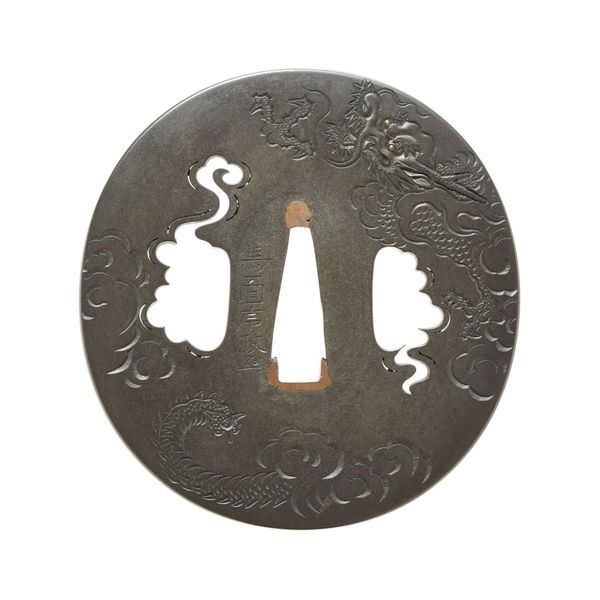
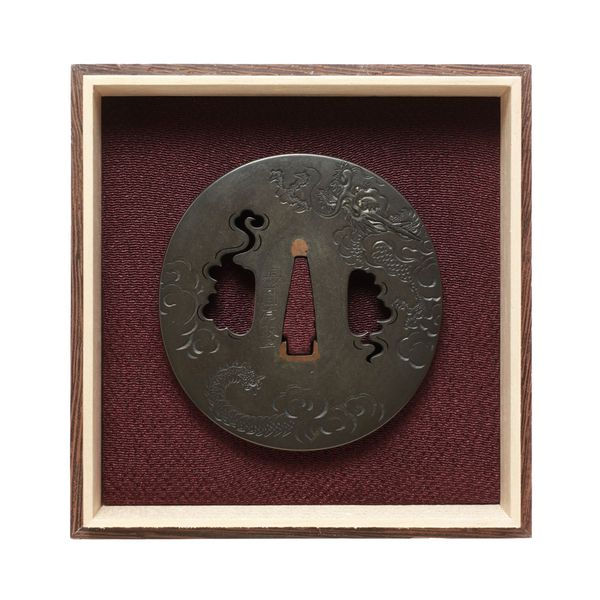
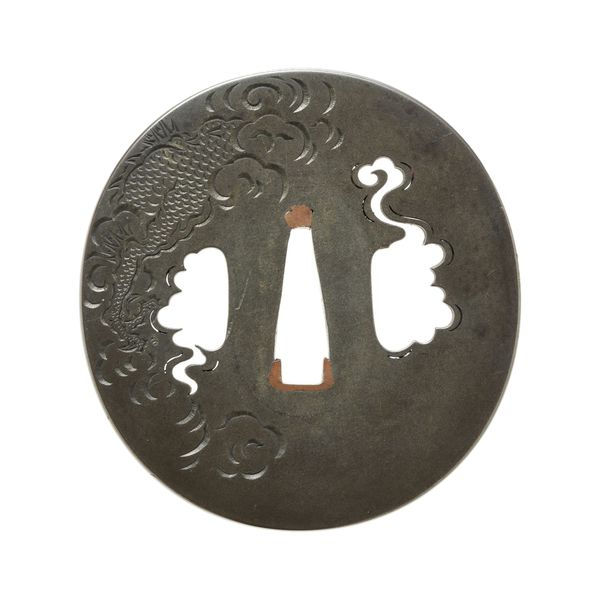
The origins of the Bamen clan go back to the Sengoku period, and they were a family involved in armor production in Echizen Province. There is a theory that they were a lineage of Bamen-shi who specialized in the bamen used for protecting the face, specifically for the horse armor that was popular during the Sengoku period. The unique surname Bamen was bestowed upon them by the Honda family, the lords of the domain. Many works by Tsugumasa are iron tsuba with designs such as horses rendered in negative ito-sukashi. This work is a rare example in shibuichi-ji, which eloquently tells of the fact that he was a pupil of Kikuchi Tsugukatsu. The shibuichi migaki-ji is formed into a gentle goishi-gata, and by making full use of katakiri-bori and shishiai-bori, it vividly depicts a dragon flying through the air accompanied by clouds. He likely sublimated anything he thought was good into his work; it is a masterpiece that crystallizes his skill and sensibility, such as the katakiri-bori with minute movements of the tagane, the sankaku-tagane carved into the horns and face, and the extremely fine ito-sukashi following the shape of the zuiun-shaped hitsu-ana. Even the carved edges of the hitsu-ana are beautiful.
NihontoWatchBamen Tsunemasa馬面序政
Offered by Choshuya

Translated from the shop's Japanese ·
Rows still in Japanese are as written by the shop
Machine translation from the shop's Japanese · may contain errors ·
Katchushi · Echizen
4 pieces on the market now
Katchushi · Echizen
4 pieces on the market now
| Smith | Era | Designated |
|---|---|---|
| Bamen Tsunemasa馬面序政 | — | 0 |
A Hozon-certified fitting of notably superior craftsmanship and condition, often with signature or workmanship of high reference value.
The NBTHK (Nihon Bijutsu Tōken Hozon Kyōkai, the Society for the Preservation of Japanese Art Swords) is a public-interest incorporated foundation founded in 1948 and supervised by Japan’s Agency for Cultural Affairs (Bunkachō); it is based at the Japanese Sword Museum in Tokyo. Its expert panels physically examine each submitted work (shinsa) and issue a certificate (kanteishō) ranking it by artistic and historical merit. NBTHK papers are the most widely recognized standard of authentication for Japanese swords and fittings.
NBTHK official siteIf, due to our fault, the item differs significantly from its proper condition, the item may be returned. Cooling-off is within one week of the item's arrival.