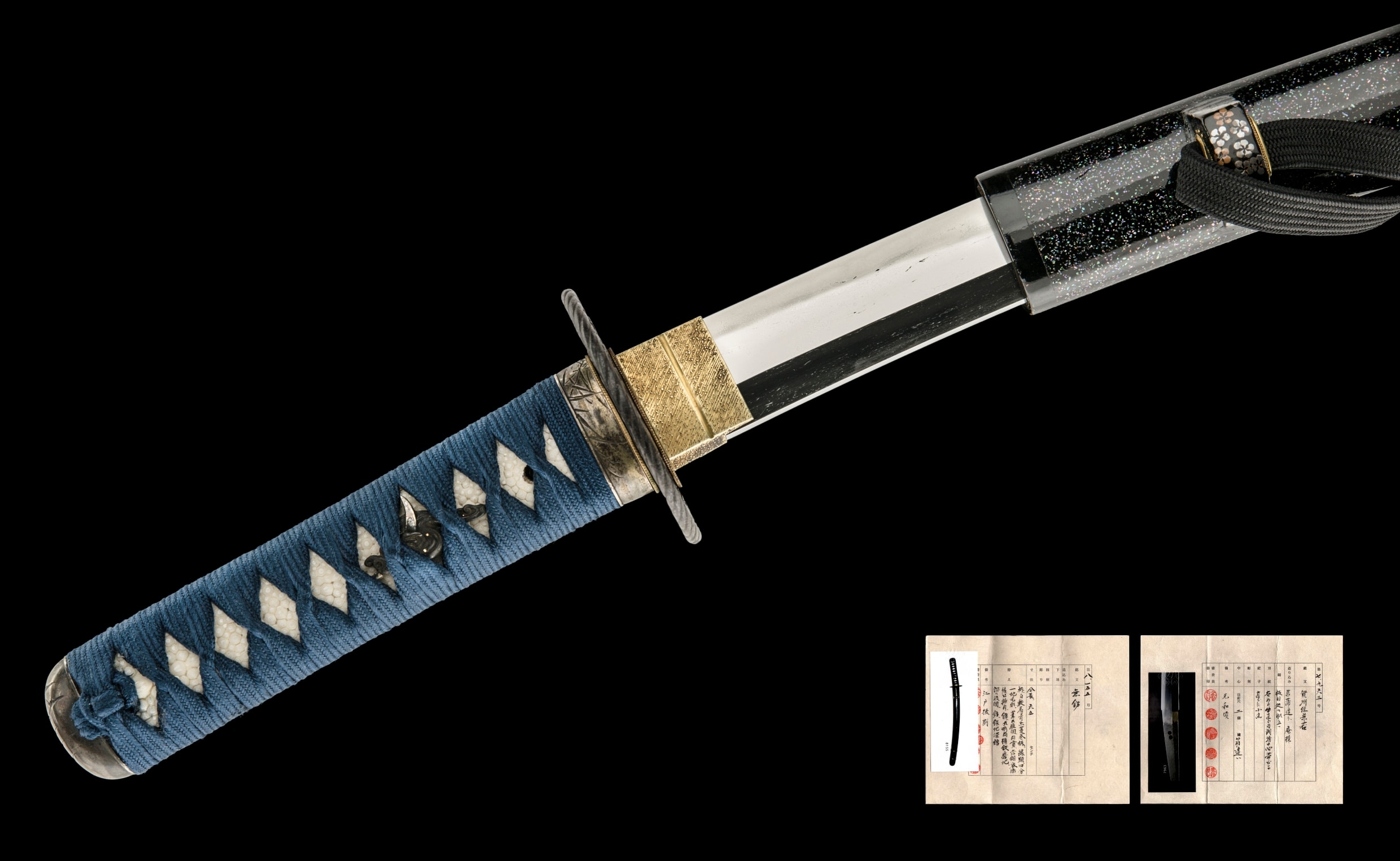
Edo was the sword’s age of connoisseurship: the Hon’ami appraisers, the shogunal register of famous blades of 1719, and a thriving literature turned the sword into an object of study even as it ceased to be drawn in war.
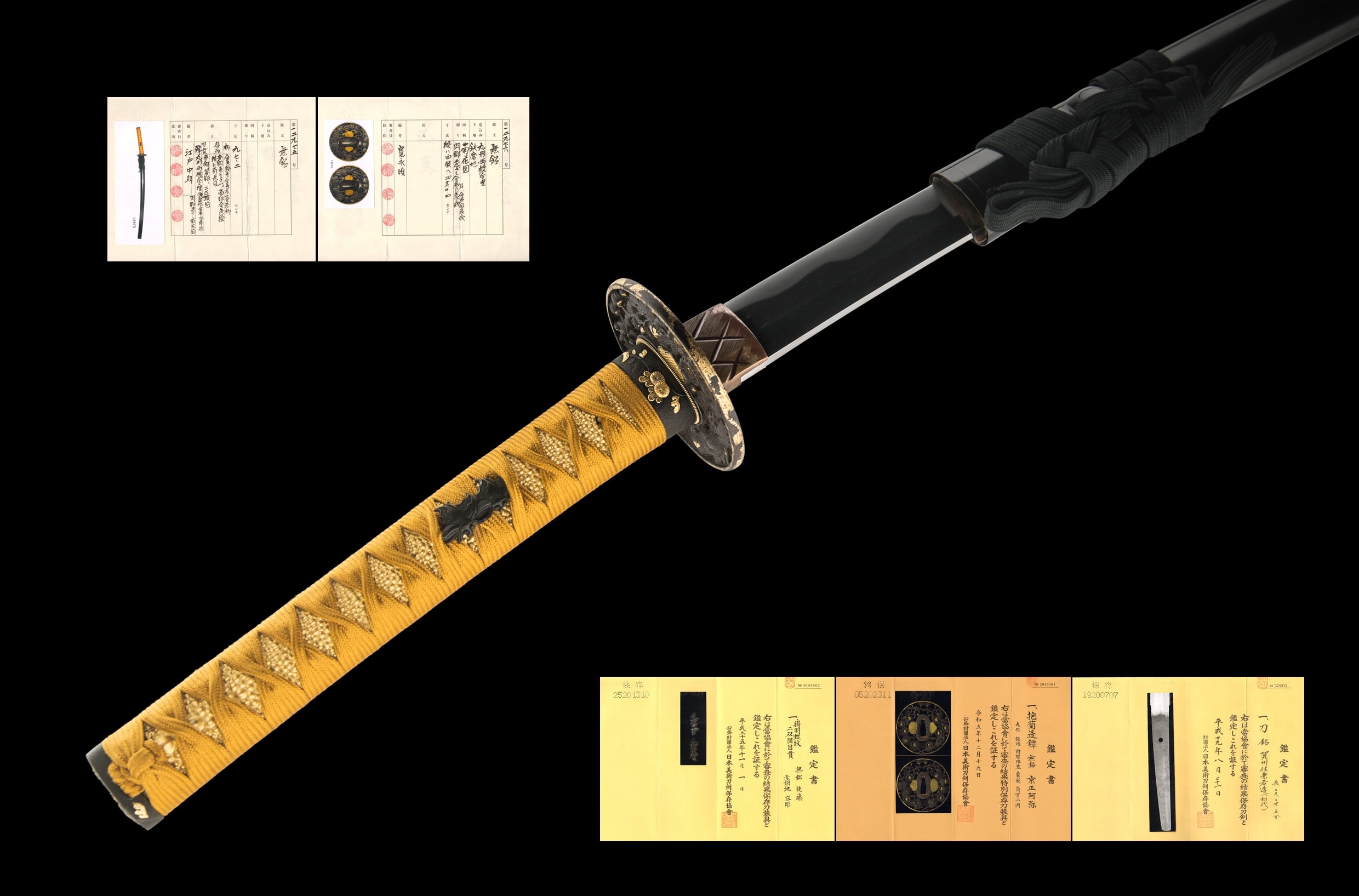
This is an o-suriage mumei katana attributed to Jinroku Kanewaka, the founder of the Kaga Shinto school. Originally around 84.8 cm, it features a high sori and moderate kasane, with a slightly extended chukissaki, reminiscent of a Nanbokucho period odachi. While an earlier appraisal by Uchiyama Tadamori in 1891 attributed it to Naoe Kanetoshi, modern appraisal identifies the fresh jihada and box-shaped hamon as characteristic of the first generation Kanewaka.
 NihontoWatch
suriage-mumei · Edo
Kashu (Kaga) Kanewaka, of Mino-Seki origin · Kaga · around 1596-1619
Fujishiro Jo-jo saku · Tōken Taikan top 17%
A katana dated Genna 5 (1619), eighth month, carries the firm signature Kashū-jū Kanewaka tsukuru and stands as the documentary cornerstone of the line: the published sources call it "a superior piece that clearly shows a Shizu-style approach, and valuable as reference material"[[c:1]]. This is the first-generation Kanewaka, the founder of the Kaga (Kanazawa) Shintō house that bears his name. He styled himself Tsujimura Jinroku and later Shirōemon-no-jō; descended from the Seki smiths of Mino, he moved to Kaga and was retained there, and his extant first-generation work begins with dated pieces of Keichō 12 (1607). Around Genna 5 he received the court title Etchū no Kami and changed his name to Takahira, so the bulk of his earlier blades are signed in the six characters Kashū-jū Kanewaka saku, and the later ones Etchū no Kami Fujiwara Takahira. He is the root of the Kaga Shintō tradition.
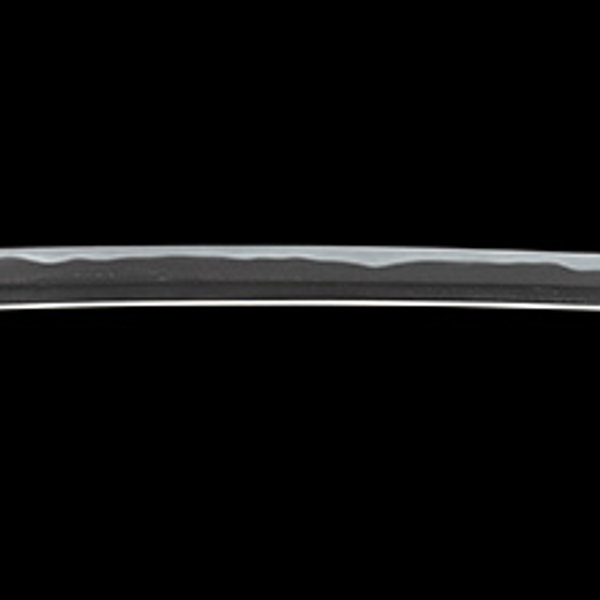
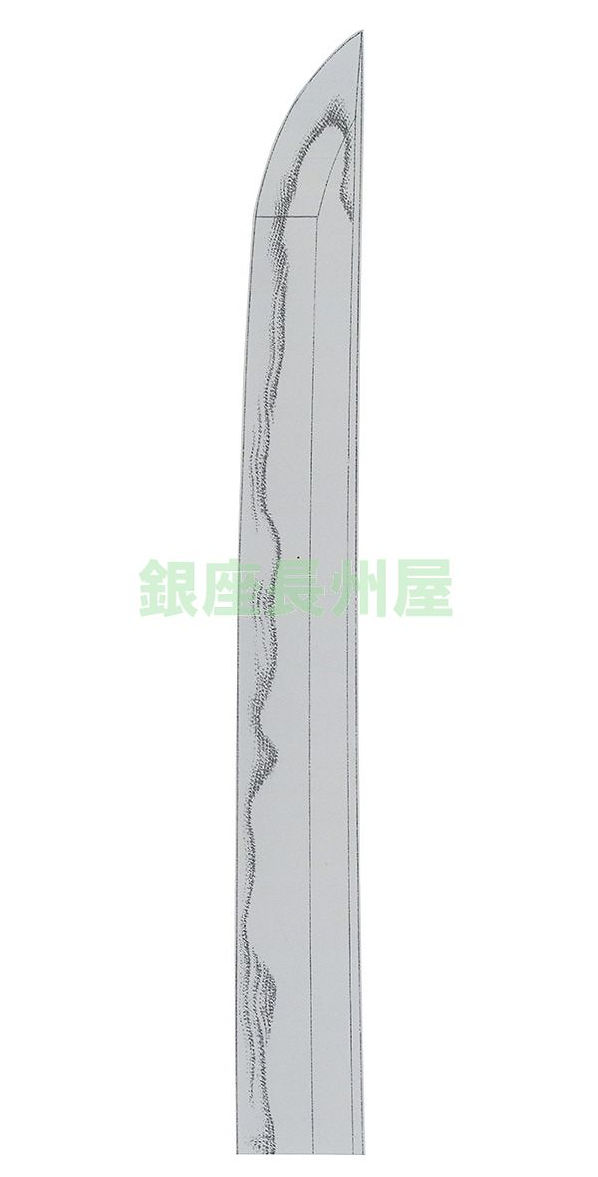
His hand is read first by its strong Mino character. Over an itame that flows and stands, masame-leaning in places, with chikei entering and ji-nie adhering, he tempers a shallow notare mixed with gunome and small gunome, pointed togari-ba and a box-leaning element. The nioiguchi runs tight and bright, ko-nie adhering well and at times gathering into coarse nie, with sunagashi and kinsuji drawn frequently through the line. The published sources read this directly as a Shizu, indeed a Naoe-Shizu, manner carried out of Mino into Kaga. On his finest signed katana the judges find that "the ji and ha clearly display Kanewaka's distinctive characteristics, the nie adheres well, and the blade conveys a spirited, forceful presence"[[c:2]].
The jigane is the constant of his work. It is an itame that flows toward the edge and the back, standing a little, masame-inclined in stretches, with chikei and ji-nie, the steel at times dark-toned yet clear. Over that jigane the temper carries the box-leaning quality that became the family tell: a hako-gakatta element worked into the notare and gunome. On the first generation it stays soft and nie-collapsing rather than crisply drawn; the published sources note that a clearly defined hako-ba is comparatively uncommon in his own hand and grows sharp only from the second and third generations. The bōshi runs in notare-komi to a ko-maru, sometimes pointed and brushed, and several blades carry twin grooves cut through to a kaki-nagashi finish, while one bears a grass-style kurikara with bonji and gomabashi.
Within the first generation the published sources draw a careful internal distinction. The rare blades signed in the bare two characters Kanewaka are read as the oldest in tone: of one such katana the judges write that "among the two-character Kanewaka, this example is the most archaic even within the first generation"[[c:3]], and that the other early pieces accord with it. These archaic works show an itame leaning to masame, somewhat rough and zanguri, the temper a ko-nie construction with the nioiguchi tightening, small gunome running linked, togari-ba, kuichigai-ba and sunagashi. He worked across every form, and the published sources observe of one of his katana that "extant works by the first-generation Kanewaka are extremely few in every form, katana, wakizashi and tantō alike"[[c:4]], which makes each surviving piece of evident value. He also left a ken, the double-edged form notoriously difficult to make well, which the judges single out as exceptionally well executed and important as documentary material.
What sets the first-generation Kanewaka apart, within the Kaga school he founded and against the wider field of Keichō Shintō, is exactly what the judges name in his own blades. His is the Mino-Shizu manner brought to Kaga, the flowing itame, the notare with gunome and togari-ba, the sunagashi and kinsuji, the soft box-leaning temper that has not yet hardened into the sharp hako-ba of his successors. One wakizashi is described as recalling in certain respects the tradition associated with Muramasa, in the matching of its temper on both faces, a resemblance the published sources offer as colour rather than attribution. He stands before the maturing of the Kaga line, the founding hand from which Matasuke and the later Shirōemon descend.
For the collector he is a scarce founding name of the Kaga Shintō tradition. Fujishiro grades the first generation Jō-jō saku. He has no National Treasures and no Important Cultural Properties; his record runs instead through the prewar Jūyō Bijutsuhin and the modern Jūyō tier, with several signed and dated katana, a wakizashi, a tantō and the ken among them. His blades are preserved in long-held private collections grounded in their own provenance, one Jūyō Bijutsuhin katana recorded from the Ueno Kahei collection. Because so few first-generation works survive in any form, a signed Kanewaka of the shodai comes to light only seldom, and a privately held example is a notable thing for a collector to encounter, a dated document of how Kaga Shintō began.
Where Kanewaka stands among comparable artisans: across all of nihontō, and within tradition, era, and period. The tiers (Foremost · Leading · Major · Notable) weigh official designations from the NBTHK and Japan's Agency for Cultural Affairs, together with historical honors of lasting repute such as the Sansaku and Meibutsu-chō.
Select a lens to see how it's measured.
Years he was demonstrably active, proven by signed-and-dated blades
Shinto · Kaga
3 pieces on the market now
Among the shintō workshops of the northern provinces, the Kanewaka line of Kaga (Kashū) traces its root to Mino. The setsumei record that the first-generation smith was a son of Shihōsuke Kanewaka of Seki and that, though he stood in the lineage of the Seki smiths, he forged his blades in Kaga. " The second generation, Matasuke, was the third son of the first, born in Keichō 17 (1612), active from Kan'ei through Enpō, and dead in Enpō 5 (1677) at sixty-six. The third, his legitimate heir, took the name Shirōemon and worked from Kanbun through Shōtoku, with dated pieces from Enpō 5 to Hōei 4 (1677 to 1707); a fourth, the Tsujiura Shirōemon of the same name, assisted his father as a substitute smith and inherited the name after Matasuke's death. The cutting-test katana signed Tsujimura Etchū no Kami Fujiwara Takahira[[c:2]] ties the workshop to the Maeda domain's swords, its blade tested five times and the result inlaid in kinzōgan. The shared hand is grounded in Mino forging carried north. The jigane across these blades is itame mixed with masame and mokume, often with standing grain (hada-dachi), abundant ji-nie, fine chikei, and a steel of slightly blackish yet clear tone, a cast the setsumei call a trait of the northern provinces (Hokukoku-mono). The temper is built on ko-notare mixed with gunome and pointed togariba, frequently assuming a boxed (hako-ba) character, with deep nioi, well-adhering nie, conspicuous sunagashi, kinsuji, and at times tobiyaki; the bōshi runs sugu with ko-maru or enters midare-komi, often with hakikake and a yakitsume-leaning point, a Yamato-tradition close noted on the masame-forged third-generation work.
To read the hand, the setsumei point to Mino Shizu and Naoe Shizu affinity, the wanare-based mixture of gunome and togari, and the box-shaped temper. Generations are told apart by that box: in the first generation it tends toward nie-kuzure, flavorful and not sharply drawn, and a defined hako-ba is comparatively uncommon; from the second and third it grows more crisply outlined. The third generation also worked saka-chōji-midare (reverse chōji), and in such pieces the fourth produced utsuri effects that could be taken for the Ishidō school. The kantei points the setsumei fix upon are the standing, blackish itame-masame ground, the boxed notare with sunagashi and kinsuji, and the Shizu-derived midare leaning. " Named works carry the lineage: a Genna 5 ken, whose date proves the title came later; the Kashū Fujiwara Yukimitsu tachi dated Bunmei 17 (1485) marks the older Muromachi Kashū ground from which such northern work descends; and a katana with kenuki-gata tachi koshirae in ashide maki-e shows the dress that accompanied the line. The setsumei place one blade in the Imperial Collection, attributed to the fourth-generation Tsujiura Shirōemon, and record provenance in Kaga and Ishikawa hands. Across the generations the verdict is consistent: each smith was skilled in his own right, the forging at times exceeding ordinary Kashū work, and the dated inscriptions stand as documentary anchors for early Kaga shintō. Learn more →
| Smith | Era | Designated |
|---|---|---|
| Kanewaka兼若 | 1596-1619 | 10 |
| Kanewaka兼若 | 1673-1681 | 4 |
| Kanewaka兼若 | 1624-1644 | 2 |
| Takahira高平 | 1673-1681 | 1 |
| Yukimitsu行光 | 1469-1487 | 1 |
The Edo period (1615 to 1868)
Edo was the sword’s age of connoisseurship: the Hon’ami appraisers, the shogunal register of famous blades of 1719, and a thriving literature turned the sword into an object of study even as it ceased to be drawn in war.
We could not find an authenticity certificate on the seller’s listing. Japanese swords and fittings are normally papered by the NBTHK (or the NTHK). Without one, the attribution is the seller’s own assessment and has not been independently verified — treat it with caution and ask the dealer about certification before buying.
If, due to our fault, the item differs significantly from its proper condition, the item may be returned. Cooling-off is within one week of the item's arrival.
This is an o-suriage mumei katana attributed to Jinroku Kanewaka, the founder of the Kaga Shinto school. Originally around 84.8 cm, it features a high sori and moderate kasane, with a slightly extended chukissaki, reminiscent of a Nanbokucho period odachi. While an earlier appraisal by Uchiyama Tadamori in 1891 attributed it to Naoe Kanetoshi, modern appraisal identifies the fresh jihada and box-shaped hamon as characteristic of the first generation Kanewaka.
NihontoWatchsuriage-mumei · Edo
Kashu (Kaga) Kanewaka, of Mino-Seki origin · Kaga · around 1596-1619
Fujishiro Jo-jo saku · Tōken Taikan top 17%
A katana dated Genna 5 (1619), eighth month, carries the firm signature Kashū-jū Kanewaka tsukuru and stands as the documentary cornerstone of the line: the published sources call it "a superior piece that clearly shows a Shizu-style approach, and valuable as reference material"[[c:1]]. This is the first-generation Kanewaka, the founder of the Kaga (Kanazawa) Shintō house that bears his name. He styled himself Tsujimura Jinroku and later Shirōemon-no-jō; descended from the Seki smiths of Mino, he moved to Kaga and was retained there, and his extant first-generation work begins with dated pieces of Keichō 12 (1607). Around Genna 5 he received the court title Etchū no Kami and changed his name to Takahira, so the bulk of his earlier blades are signed in the six characters Kashū-jū Kanewaka saku, and the later ones Etchū no Kami Fujiwara Takahira. He is the root of the Kaga Shintō tradition.
His hand is read first by its strong Mino character. Over an itame that flows and stands, masame-leaning in places, with chikei entering and ji-nie adhering, he tempers a shallow notare mixed with gunome and small gunome, pointed togari-ba and a box-leaning element. The nioiguchi runs tight and bright, ko-nie adhering well and at times gathering into coarse nie, with sunagashi and kinsuji drawn frequently through the line. The published sources read this directly as a Shizu, indeed a Naoe-Shizu, manner carried out of Mino into Kaga. On his finest signed katana the judges find that "the ji and ha clearly display Kanewaka's distinctive characteristics, the nie adheres well, and the blade conveys a spirited, forceful presence"[[c:2]].
The jigane is the constant of his work. It is an itame that flows toward the edge and the back, standing a little, masame-inclined in stretches, with chikei and ji-nie, the steel at times dark-toned yet clear. Over that jigane the temper carries the box-leaning quality that became the family tell: a hako-gakatta element worked into the notare and gunome. On the first generation it stays soft and nie-collapsing rather than crisply drawn; the published sources note that a clearly defined hako-ba is comparatively uncommon in his own hand and grows sharp only from the second and third generations. The bōshi runs in notare-komi to a ko-maru, sometimes pointed and brushed, and several blades carry twin grooves cut through to a kaki-nagashi finish, while one bears a grass-style kurikara with bonji and gomabashi.
Within the first generation the published sources draw a careful internal distinction. The rare blades signed in the bare two characters Kanewaka are read as the oldest in tone: of one such katana the judges write that "among the two-character Kanewaka, this example is the most archaic even within the first generation"[[c:3]], and that the other early pieces accord with it. These archaic works show an itame leaning to masame, somewhat rough and zanguri, the temper a ko-nie construction with the nioiguchi tightening, small gunome running linked, togari-ba, kuichigai-ba and sunagashi. He worked across every form, and the published sources observe of one of his katana that "extant works by the first-generation Kanewaka are extremely few in every form, katana, wakizashi and tantō alike"[[c:4]], which makes each surviving piece of evident value. He also left a ken, the double-edged form notoriously difficult to make well, which the judges single out as exceptionally well executed and important as documentary material.
What sets the first-generation Kanewaka apart, within the Kaga school he founded and against the wider field of Keichō Shintō, is exactly what the judges name in his own blades. His is the Mino-Shizu manner brought to Kaga, the flowing itame, the notare with gunome and togari-ba, the sunagashi and kinsuji, the soft box-leaning temper that has not yet hardened into the sharp hako-ba of his successors. One wakizashi is described as recalling in certain respects the tradition associated with Muramasa, in the matching of its temper on both faces, a resemblance the published sources offer as colour rather than attribution. He stands before the maturing of the Kaga line, the founding hand from which Matasuke and the later Shirōemon descend.
For the collector he is a scarce founding name of the Kaga Shintō tradition. Fujishiro grades the first generation Jō-jō saku. He has no National Treasures and no Important Cultural Properties; his record runs instead through the prewar Jūyō Bijutsuhin and the modern Jūyō tier, with several signed and dated katana, a wakizashi, a tantō and the ken among them. His blades are preserved in long-held private collections grounded in their own provenance, one Jūyō Bijutsuhin katana recorded from the Ueno Kahei collection. Because so few first-generation works survive in any form, a signed Kanewaka of the shodai comes to light only seldom, and a privately held example is a notable thing for a collector to encounter, a dated document of how Kaga Shintō began.
Where Kanewaka stands among comparable artisans: across all of nihontō, and within tradition, era, and period. The tiers (Foremost · Leading · Major · Notable) weigh official designations from the NBTHK and Japan's Agency for Cultural Affairs, together with historical honors of lasting repute such as the Sansaku and Meibutsu-chō.
Select a lens to see how it's measured.
Years he was demonstrably active, proven by signed-and-dated blades
Shinto · Kaga
3 pieces on the market now
Among the shintō workshops of the northern provinces, the Kanewaka line of Kaga (Kashū) traces its root to Mino. The setsumei record that the first-generation smith was a son of Shihōsuke Kanewaka of Seki and that, though he stood in the lineage of the Seki smiths, he forged his blades in Kaga. " The second generation, Matasuke, was the third son of the first, born in Keichō 17 (1612), active from Kan'ei through Enpō, and dead in Enpō 5 (1677) at sixty-six. The third, his legitimate heir, took the name Shirōemon and worked from Kanbun through Shōtoku, with dated pieces from Enpō 5 to Hōei 4 (1677 to 1707); a fourth, the Tsujiura Shirōemon of the same name, assisted his father as a substitute smith and inherited the name after Matasuke's death. The cutting-test katana signed Tsujimura Etchū no Kami Fujiwara Takahira[[c:2]] ties the workshop to the Maeda domain's swords, its blade tested five times and the result inlaid in kinzōgan. The shared hand is grounded in Mino forging carried north. The jigane across these blades is itame mixed with masame and mokume, often with standing grain (hada-dachi), abundant ji-nie, fine chikei, and a steel of slightly blackish yet clear tone, a cast the setsumei call a trait of the northern provinces (Hokukoku-mono). The temper is built on ko-notare mixed with gunome and pointed togariba, frequently assuming a boxed (hako-ba) character, with deep nioi, well-adhering nie, conspicuous sunagashi, kinsuji, and at times tobiyaki; the bōshi runs sugu with ko-maru or enters midare-komi, often with hakikake and a yakitsume-leaning point, a Yamato-tradition close noted on the masame-forged third-generation work.
To read the hand, the setsumei point to Mino Shizu and Naoe Shizu affinity, the wanare-based mixture of gunome and togari, and the box-shaped temper. Generations are told apart by that box: in the first generation it tends toward nie-kuzure, flavorful and not sharply drawn, and a defined hako-ba is comparatively uncommon; from the second and third it grows more crisply outlined. The third generation also worked saka-chōji-midare (reverse chōji), and in such pieces the fourth produced utsuri effects that could be taken for the Ishidō school. The kantei points the setsumei fix upon are the standing, blackish itame-masame ground, the boxed notare with sunagashi and kinsuji, and the Shizu-derived midare leaning. " Named works carry the lineage: a Genna 5 ken, whose date proves the title came later; the Kashū Fujiwara Yukimitsu tachi dated Bunmei 17 (1485) marks the older Muromachi Kashū ground from which such northern work descends; and a katana with kenuki-gata tachi koshirae in ashide maki-e shows the dress that accompanied the line. The setsumei place one blade in the Imperial Collection, attributed to the fourth-generation Tsujiura Shirōemon, and record provenance in Kaga and Ishikawa hands. Across the generations the verdict is consistent: each smith was skilled in his own right, the forging at times exceeding ordinary Kashū work, and the dated inscriptions stand as documentary anchors for early Kaga shintō. Learn more →
| Smith | Era | Designated |
|---|---|---|
| Kanewaka兼若 | 1596-1619 | 10 |
| Kanewaka兼若 | 1673-1681 | 4 |
| Kanewaka兼若 | 1624-1644 | 2 |
| Takahira高平 | 1673-1681 | 1 |
| Yukimitsu行光 | 1469-1487 | 1 |
The Edo period (1615 to 1868)
Edo was the sword’s age of connoisseurship: the Hon’ami appraisers, the shogunal register of famous blades of 1719, and a thriving literature turned the sword into an object of study even as it ceased to be drawn in war.
We could not find an authenticity certificate on the seller’s listing. Japanese swords and fittings are normally papered by the NBTHK (or the NTHK). Without one, the attribution is the seller’s own assessment and has not been independently verified — treat it with caution and ask the dealer about certification before buying.
If, due to our fault, the item differs significantly from its proper condition, the item may be returned. Cooling-off is within one week of the item's arrival.