 NihontoWatchNihontoWatch
Edo fraaie periode Gesigneerde Fuchi (TSU-JINPO) van shakudo en een kashira van Buffelhoorn met de Nara/Kamakura herten en landschap, in goud high-lights goede conditie 3.9 x 2.3cm.
NihontoWatchOffered by Japanszwaard
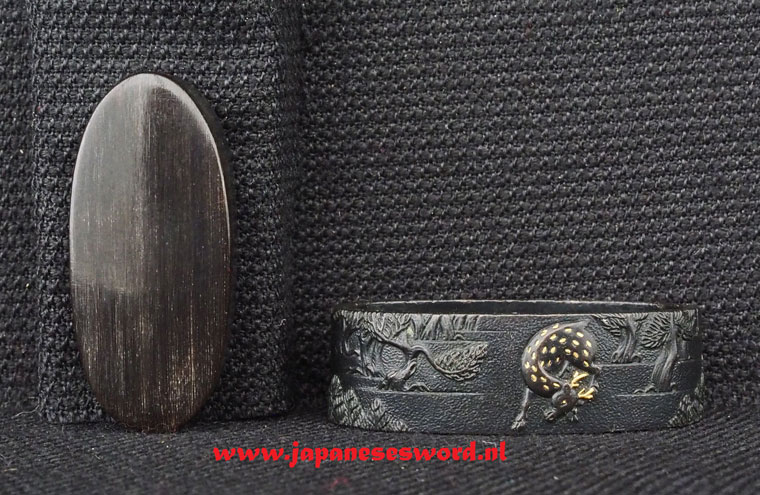
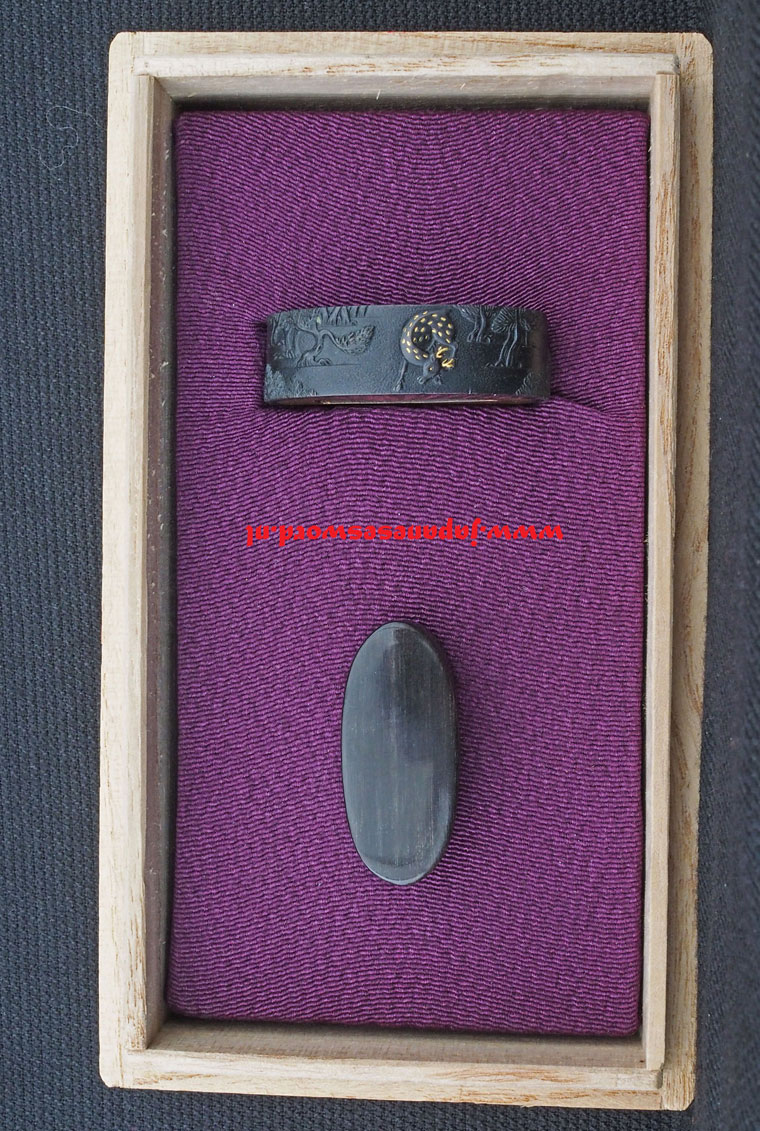
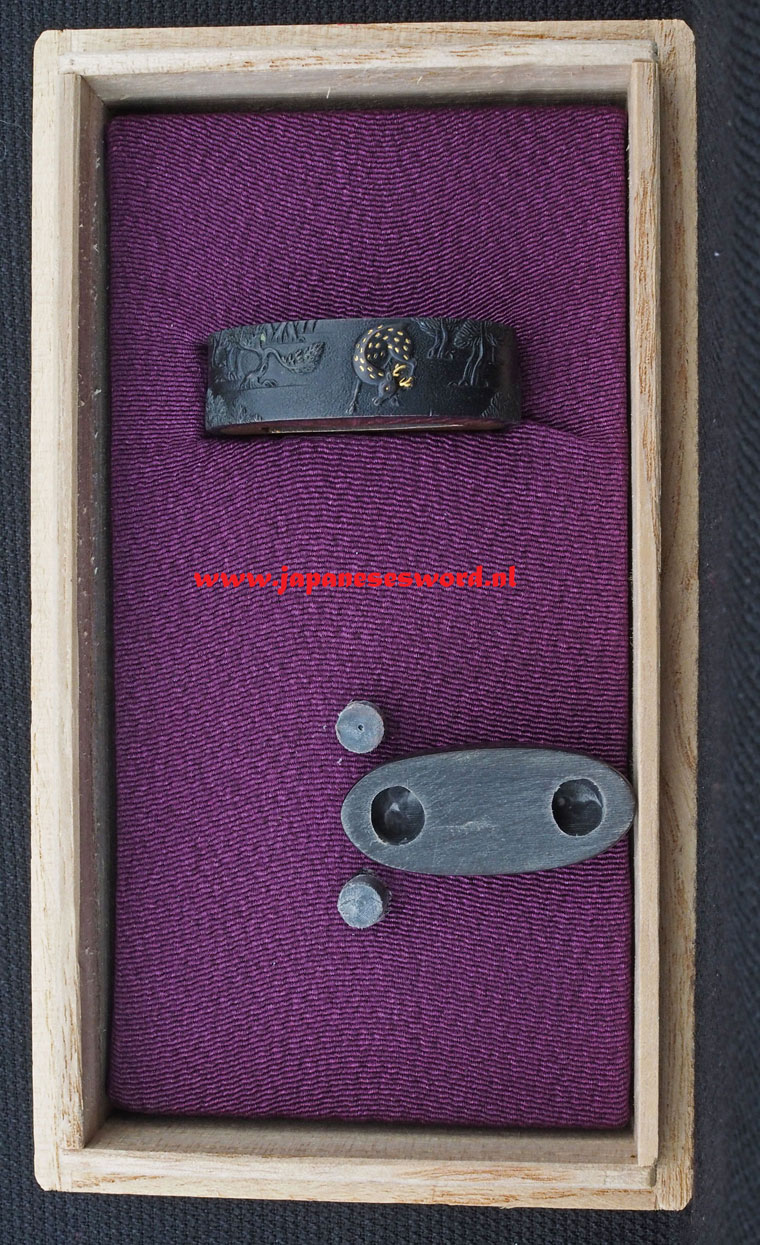
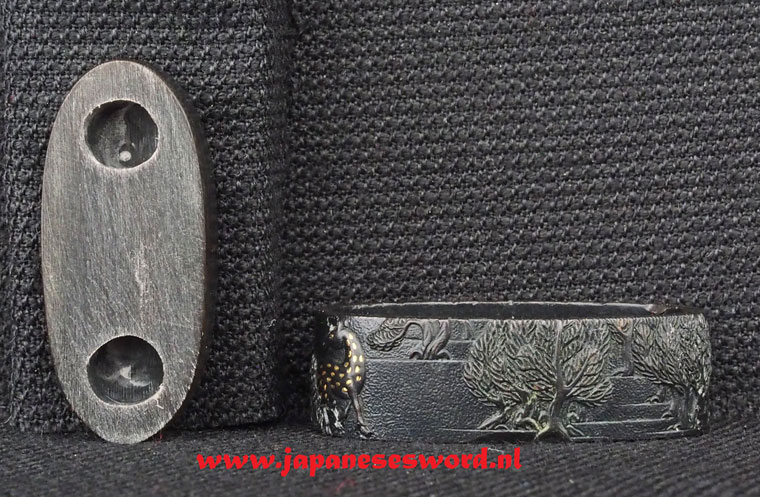
Edo
Signed
Kinko
Tsu Jinpo, whose personal name was Otsu Hachizaemon, is traditionally recorded as a student of Nomura Masamichi. He lived in the vicinity of the Ginza district in Edo and is said to have died in Horeki 12 (1762). One source places his lifespan from Kyoho 7 (1722) to Horeki 12, while another records his death at age forty-two in Horeki 11 (1761). He is also known by the signature readings Tsujinobu and Tsushinpo. Among his extant oeuvre, fuchi-kashira predominate, followed in number by tsuba and kozuka, and the NBTHK consistently identifies his fuchi-kashira as the body of work most worthy of attention.
Jinpo's works are characterized above all by an unwavering commitment to strict realism. The NBTHK repeatedly observes that "many of his works pursue strict realism" and that "among his carvings there are pieces that startle the viewer[[c:1]]." His favored subjects include birds of prey perched on oak trees, lilies, and shrimp, all rendered in shakudo nanako-ji with takabori and iroe. The oak-and-raptor compositions are described as possessing "an extremely forceful impact," with the bird "seeming at any moment about to launch into flight." His lily subjects employ sue-mon (applied motifs) in gold and suaka with refined polychrome metalwork. The carving manner is consistently praised as "keen and incisive," powerful yet naturalistic, imbued with a shasei (sketch-from-life) spirit. On occasion, his work recalls the dignity of early Goto masterworks, as in a rare mitokoromono set where, "along with a Goto-like dignity of style, one can also discern a power and freshness distinctive to Tsushinpo."
The NBTHK assessment of Jinpo is anchored in two recurring themes: forceful realism and mastery of living subjects. The Kano Natsuo Chokin-dan is cited approvingly for its observation that his "crests and patterns stand out with brilliant clarity[[c:2]]." His shrimp are rendered with such vitality that the movement of the legs is described as "superb," displaying "the artist's true strengths to the fullest." Whether depicting the coiled tension of a raptor or the delicate unfurling of a lily bud, Jinpo's work is consistently elevated by the NBTHK as representing an exceptionally high technical level within the mid-Edo metalworking tradition, combining the controlled grandeur of the Goto inheritance with a distinctive, uncompromising naturalism entirely his own.
Where Tsu Jinpo stands among comparable artisans: across all of nihontō, and within tradition, era, and period. The tiers (Foremost · Leading · Major · Notable) weigh official designations from the NBTHK and Japan's Agency for Cultural Affairs, together with historical honors of lasting repute such as the Sansaku and Meibutsu-chō.
Select a lens to see how it's measured.
Kinko
5 pieces on the market now
The Nomura school (野村) is a lineage of kinko (金工) metalworkers based in Edo, active from the mid-Edo period. The school's eponymous tradition is anchored by Nomura Masahide (野村正秀), recorded in the NBTHK setsumei as "a highly skilled artist of the Edo Nomura school," and by Nomura Masamichi (野村正道), also known as Nomura Shodo, who served as the principal teacher of the school's most prolific designated member, Tsu Jinpo (津尋甫). Jinpo, whose personal name was Otsu Hachizaemon[[c:1]], is documented as having lived in the vicinity of Ginza in Edo and as having been active from Kyoho 7 (1722) until his death in Horeki 12 (1762). The teacher-pupil axis from Masamichi to Jinpo constitutes the core documented lineage of the school, situating it firmly within the broader Edo-period kinko milieu. The collective style of the Nomura school is defined by a rigorous commitment to realism and by a distinctive technical vocabulary rooted in shakudo (赤銅) nanako-ji (魚子地) grounds worked in takabori (高彫, high relief). This combination of deep-black shakudo surface with precisely punched nanako and boldly sculptural relief carving is the school's signature idiom, recurring across virtually every designated work. Motifs are drawn overwhelmingly from the natural world: raptors poised on oak trees (kashiwa, 柏), lilies (yuri, 百合), shrimp (ebi, 海老), and small birds amid branches.
" Polychrome enrichment through iroe (色絵) and kin-iroe (金色絵), as well as applied motifs in gold and suaka (素銅), lends chromatic depth to the relief compositions. Several works also demonstrate the influence of the Goto house tradition, exhibiting what the setsumei describe as "Goto-like dignity of style" alongside "a power and freshness distinctive to" the Nomura lineage. " Fuchi-kashira (縁頭) constitute the predominant format, followed by tsuba, kozuka, and mitokoromono (三所物) sets. The Nomura school occupies a distinctive position within the Edo-period kinko canon as a lineage that channeled the formal discipline of the Goto tradition into an intensely naturalistic mode of expression. While the school drew on Goto prototypes, particularly in nanako technique and in certain mitokoromono compositions modeled after "early Goto masterworks," the Nomura idiom is distinguished by a sculptural forcefulness and a commitment to observed nature that the setsumei consistently single out. Among Jinpo's fuchi-kashira, designs of raptors alighting upon oak branches are described as possessing "an extremely forceful impact," with "masterpieces" among them, while his lily subjects are noted as a particular strength. The school's legacy, as attested across the designated corpus, resides in this synthesis of technical rigor, vivid realism, and the bold relief carving that constitutes its most recognizable hallmark. Learn more →
| Smith | Era | Designated |
|---|---|---|
| Tsu Jinpo津尋甫 | — | 7 |
| Masayoshi正芳 | — | 0 |
| Masahide正英 | — | 0 |
| Masatsugu正次 | — | 0 |
| Masamichi正道 | — | 0 |
Swords only: if a sword does not match the description, the buyer must report it by e-mail within 48 hours of receipt, after which the sale is final. Returns only after agreement, safely packed and in exactly the condition delivered; the refund is the purchase price minus shipping/transport and bank costs, and return shipping and its risk are for the buyer. Consignment items carry no guarantee and cannot be returned.