Muromachi turned sword making into an industry: the uchigatana rose with massed infantry warfare, Osafune and Seki produced bundle swords beside custom orders, and the Ming trade carried Japanese blades abroad by the tens of thousands.
 NihontoWatchNihontoWatch
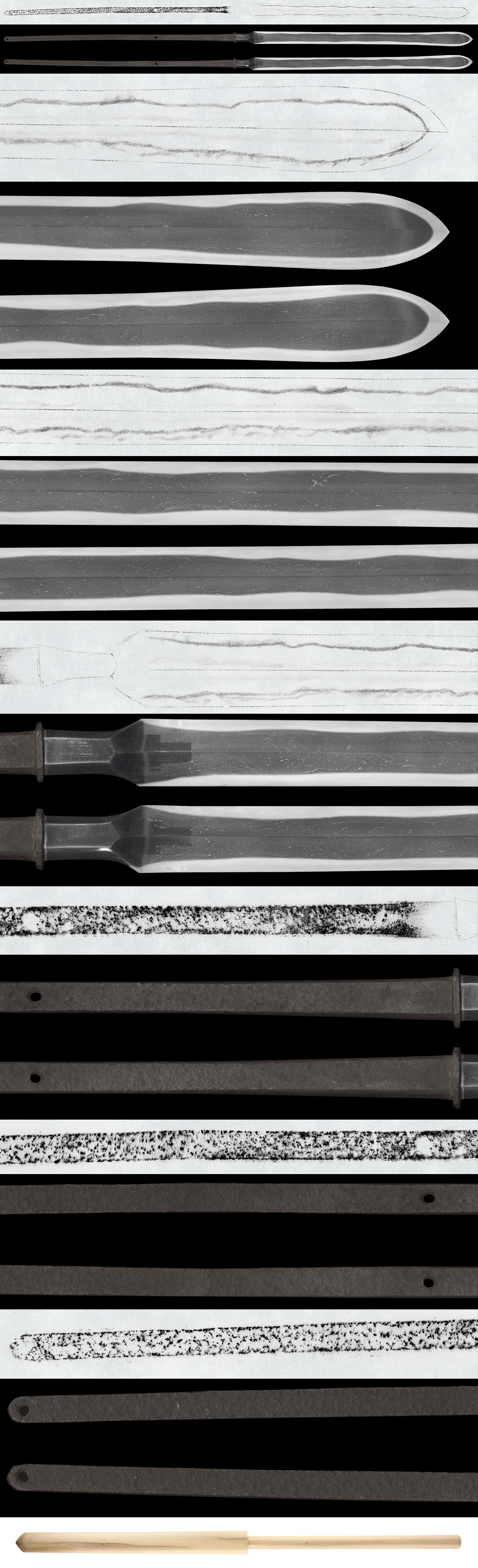
At our company, we classify the work of swordsmiths as Saijo-saku, Jojo-saku, Jo-saku, or Futsu-saku. The workmanship of this piece is ranked as Jo-saku for a mumei sword. Taihai: A long yari with a nagasa of 45cm. It has sufficient length. Jitetsu: Itame-hada that is well-forged, and the hadame can be clearly seen. Hamon: Suguha with active ko-ashi. Features: This piece has a well-forged jitetsu, good polish, and good workmanship, but there are small hakobore and kitae-ware in places. I believe it was made around the end of the Muromachi period. *International shipping costs separate
Auction status: live on sword-auction.com.
NihontoWatchOffered by Aoi Art

The dealer notes doubts about the signature. Please judge it as an unsigned piece. — Hoshi



Machine translation of the shop's Japanese ·
Machine translation from the shop's Japanese · may contain errors ·
The Muromachi period (1392 to 1573)
Muromachi turned sword making into an industry: the uchigatana rose with massed infantry warfare, Osafune and Seki produced bundle swords beside custom orders, and the Ming trade carried Japanese blades abroad by the tens of thousands.
We could not find an authenticity certificate on the seller’s listing. Japanese swords and fittings are normally papered by the NBTHK (or the NTHK). Without one, the attribution is the seller’s own assessment and has not been independently verified — treat it with caution and ask the dealer about certification before buying.
If you wish to return an item, please notify us within 3 days of receipt. After this period we cannot accept cancellations. Please ship the return to us within 5 business days. Cancellation is conditional on the item being kept in the same condition as at the time of sale, so please handle it with care.