After the Ōnin War broke the Ashikaga order, a century of Sengoku warfare armed nearly every province in Japan. The era rewards a discriminating eye: routine work exists in quantity, and beside it stand custom blades of the first rank.
 NihontoWatchNihontoWatch
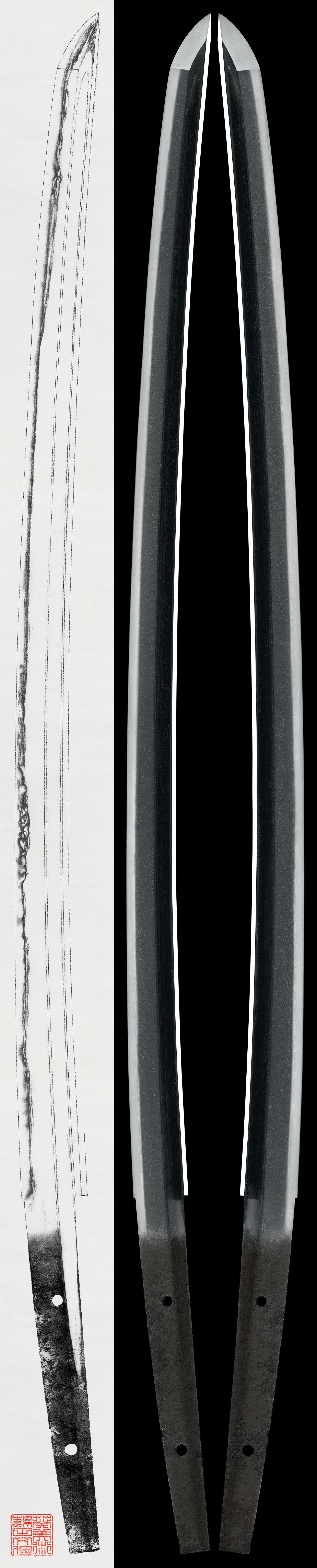
Katana in Shirasaya (NBTHK Hozon Token) (Consignment Sale) (We divide 4 sections for each sword as Saijyo Saku, Jyojyo Saku, Jyo Saku and Regular Saku). This blade is ranked as Jyo Saku among works attributed to the Kanabo School. Shape: A well-proportioned katana that has undergone suriage (shortening) and machi-okuri (relocation of the notches). The blade has relatively deep curvature and an elongated kissaki. Bo-hi grooves are carved on both sides of the blade. Jigane: Beautifully refined and well-forged ko-itame hada with clearly visible grain patterns. Hamon: Suguha mixed with ko-gunome, featuring ashi activity. The boshi displays midarekomi. Features: The Kanabo School was a group of Japanese swordsmiths based in Nara (Nanto), Yamato Province, who were active from the late Muromachi period (Sengoku period) through the Edo period (Shinto period). This particular katana displays the distinctive hamon of the Kanabo School, featuring ko-gunome-midare with abundant ko-ashi activity. The blade also has an elongated boshi, further enhancing its distinctive appearance. Historical Background: Practicality and Excellent Cutting Ability: The Kanabo School specialized in swords designed for actual combat, emphasizing strength, durability, and excellent cutting performance rather than decorative appearance. During the late Koto period, their swords were highly regarded as Wazamono, known for their exceptional sharpness and cutting ability. Outstanding Production of Yari and Naginata: In addition to tachi and uchigatana, the Kanabo School was particularly skilled in producing naginata and yari. Among their notable works were jumonji-yari (cross-shaped spears), including those associated with Kakuzenbo In'ei, the founder of the Hozoin-ryu school of spear fighting. Representative swordsmiths of the school include Nanto Ju Kanabo Hyoe no Jo Masatsugu, Masanaga, and Masasada. Their works are characterized by wide mihaba, thick kasane, and robust construction, reflecting their emphasis on strength and practical use. The jigane often displays flowing itame or mokume hada mixed with masame, producing a prominent grain pattern. Many examples also feature abundant ji-nie, contributing to the distinctive appearance of the steel. NBTHK Hozon Token (Certificate awaiting issuance).
Kanefusa金房
Offered by Aoi Art



Machine translation of the shop's Japanese ·
Settsu · around 1684-1688
1 piece on the market now
The Muromachi period (1392 to 1573)
After the Ōnin War broke the Ashikaga order, a century of Sengoku warfare armed nearly every province in Japan. The era rewards a discriminating eye: routine work exists in quantity, and beside it stand custom blades of the first rank.
Certifies a genuine blade worth preserving: a signature confirmed correct, or, if unsigned, an era, province, and school that the NBTHK can reliably identify.
The NBTHK (Nihon Bijutsu Tōken Hozon Kyōkai, the Society for the Preservation of Japanese Art Swords) is a public-interest incorporated foundation founded in 1948 and supervised by Japan’s Agency for Cultural Affairs (Bunkachō); it is based at the Japanese Sword Museum in Tokyo. Its expert panels physically examine each submitted work (shinsa) and issue a certificate (kanteishō) ranking it by artistic and historical merit. NBTHK papers are the most widely recognized standard of authentication for Japanese swords and fittings.
NBTHK official siteIf you wish to return an item, please notify us within 3 days of receipt. After this period we cannot accept cancellations. Please ship the return to us within 5 business days. Cancellation is conditional on the item being kept in the same condition as at the time of sale, so please handle it with care.
Auction status: live on sword-auction.com.