 NihontoWatchNihontoWatch
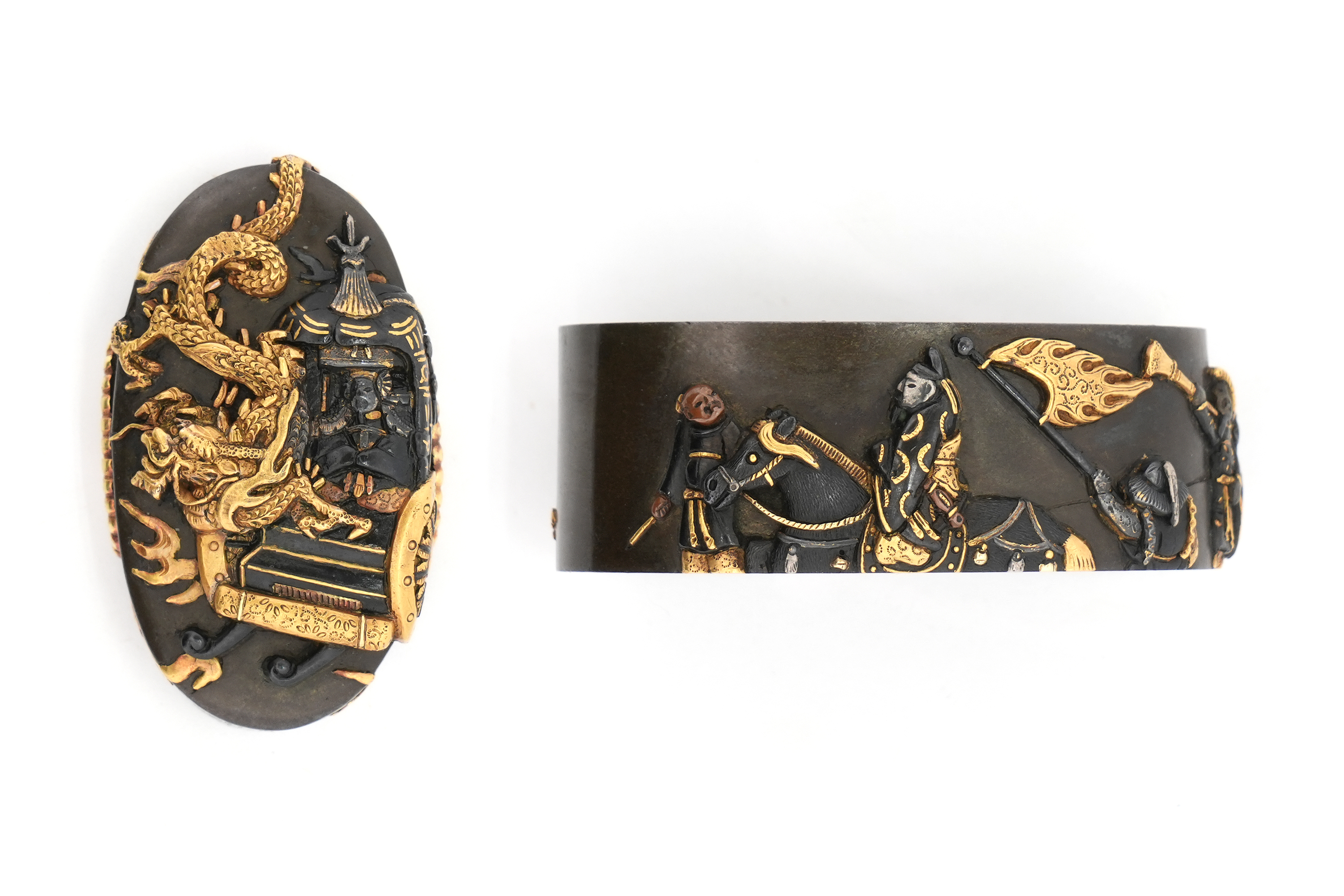
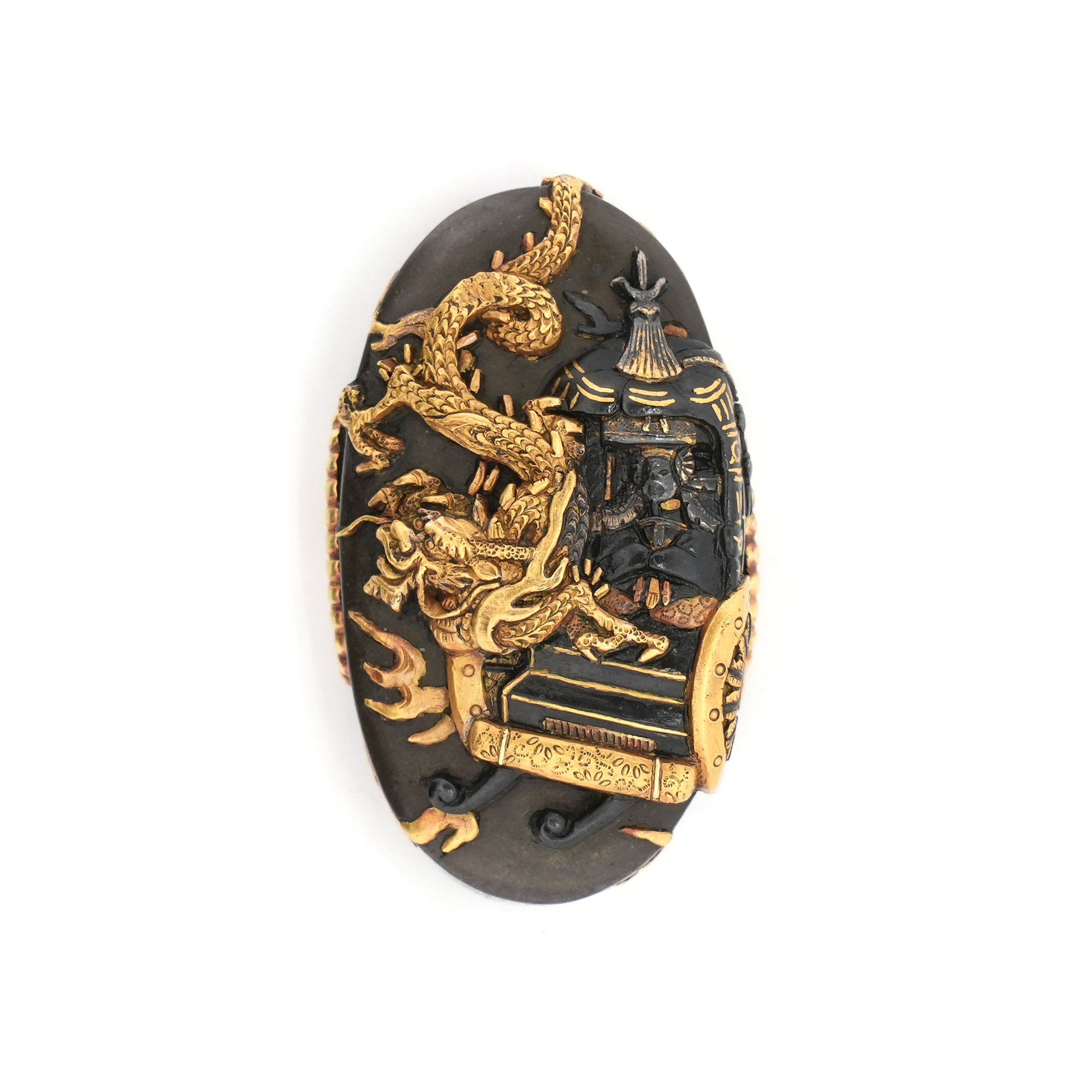
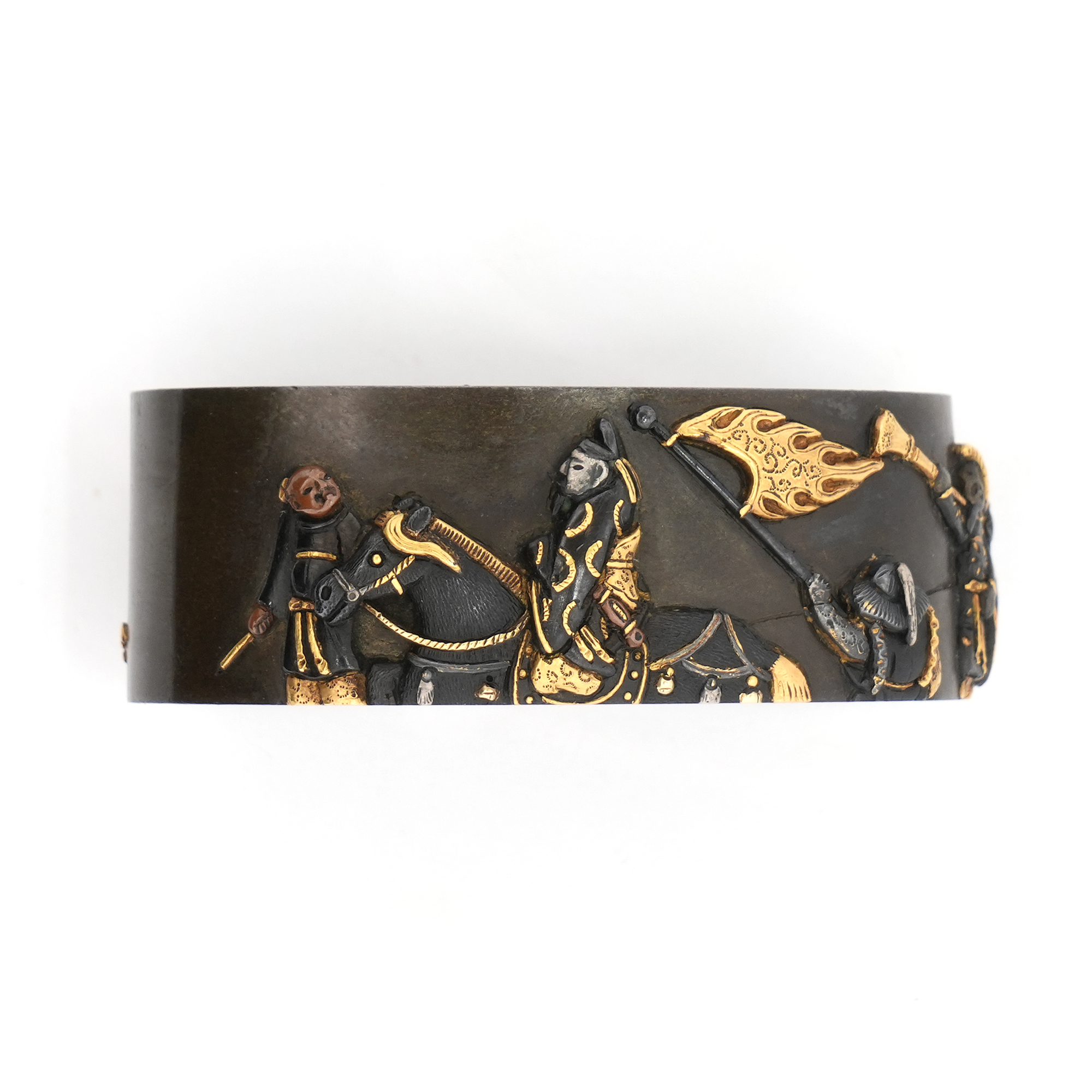
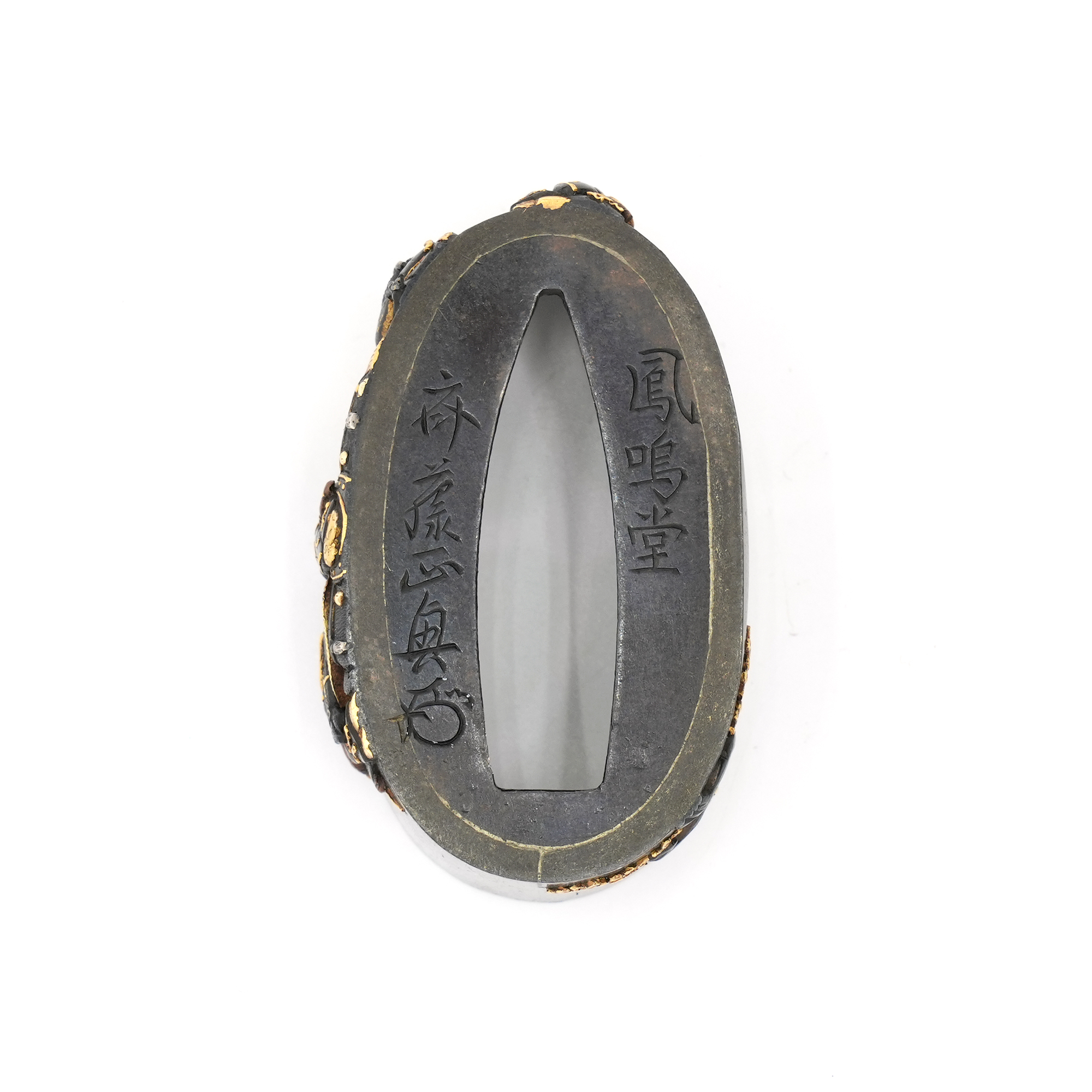
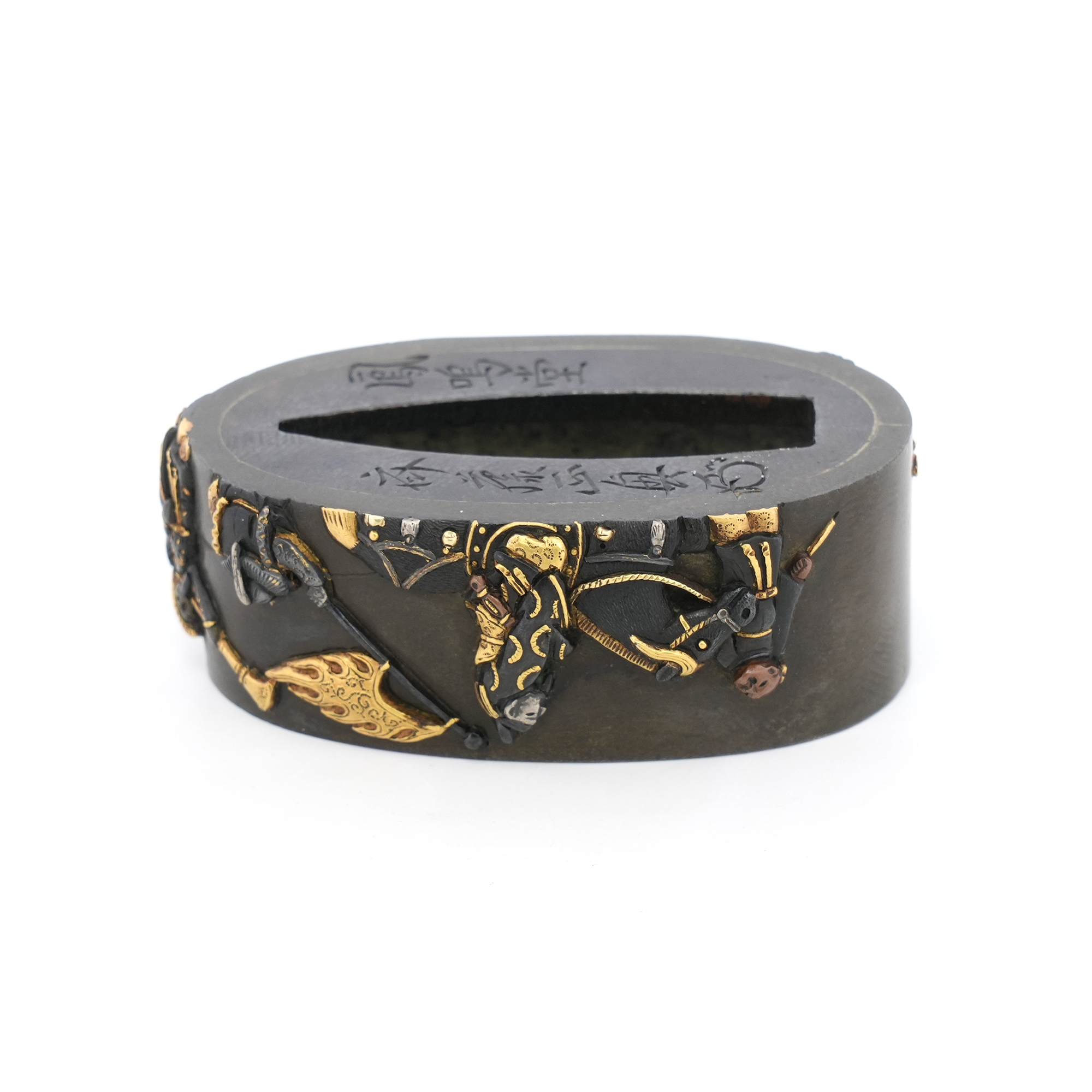
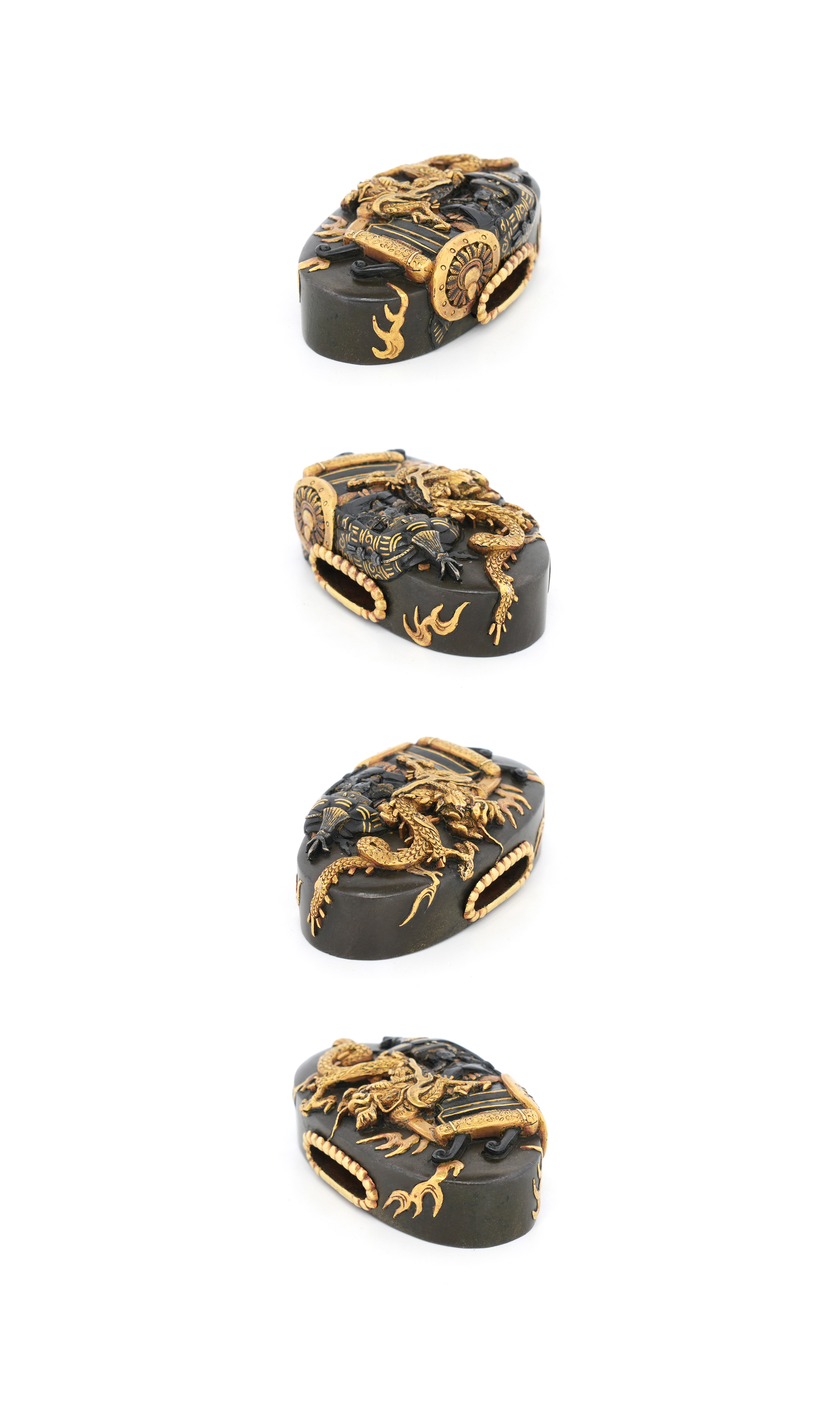
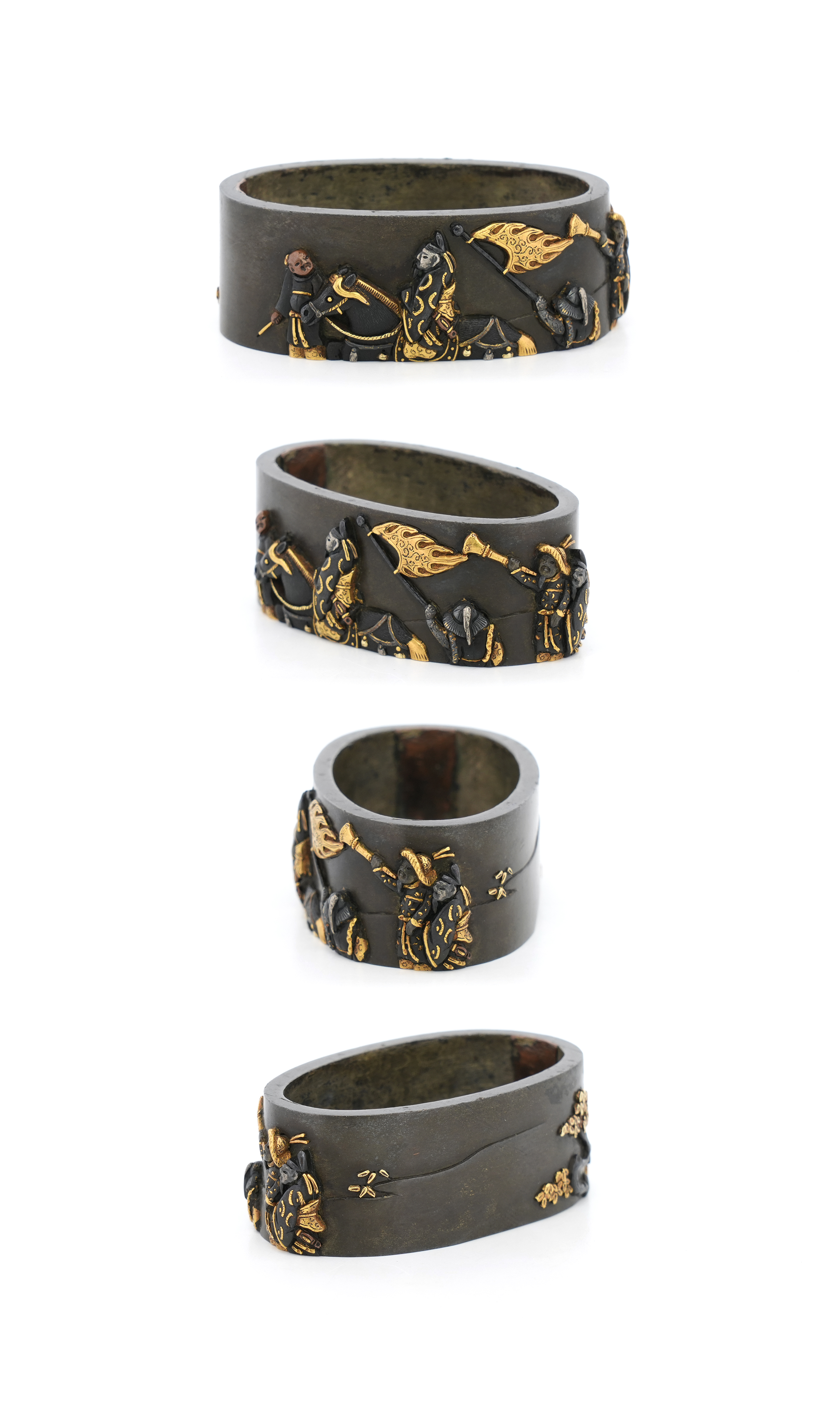
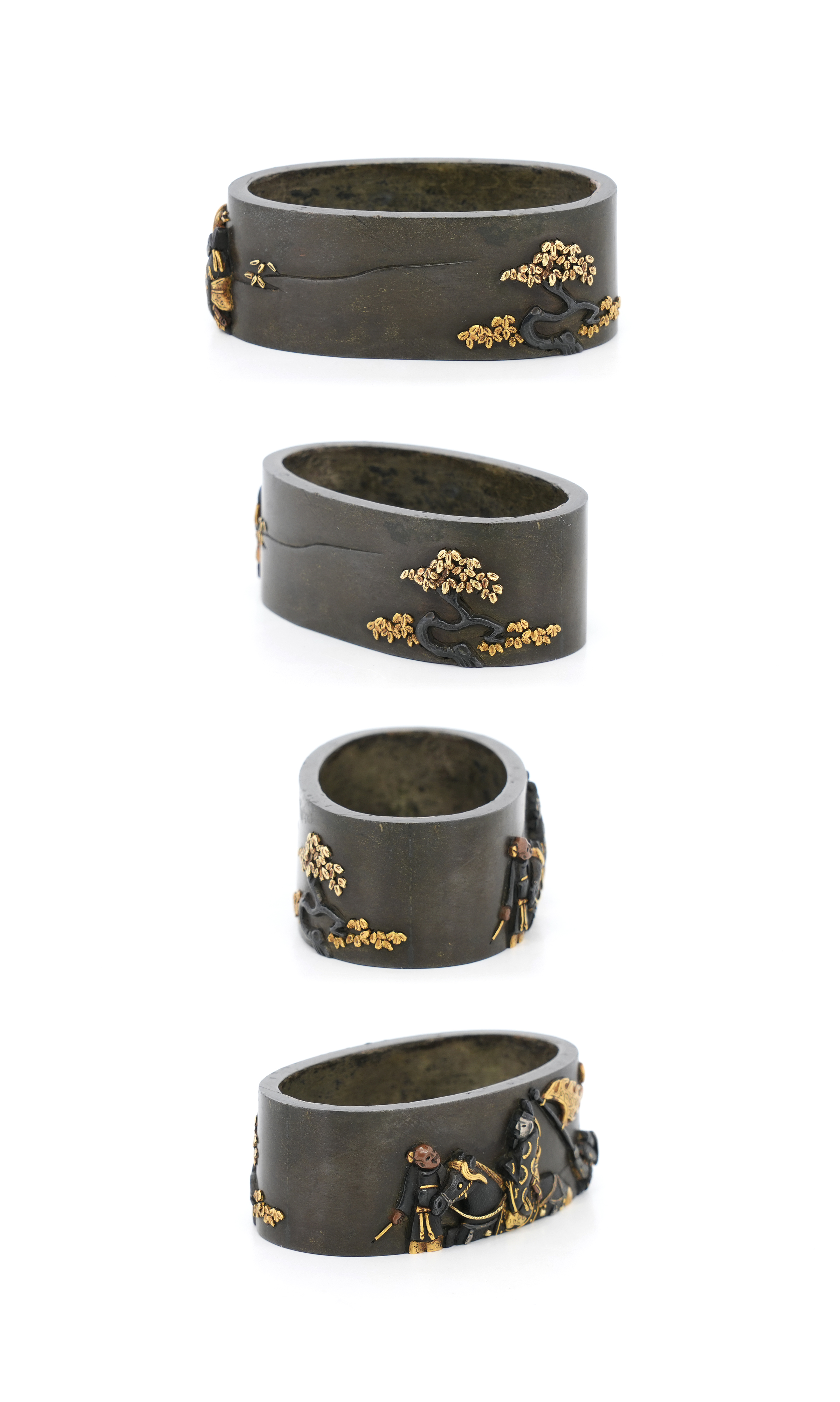
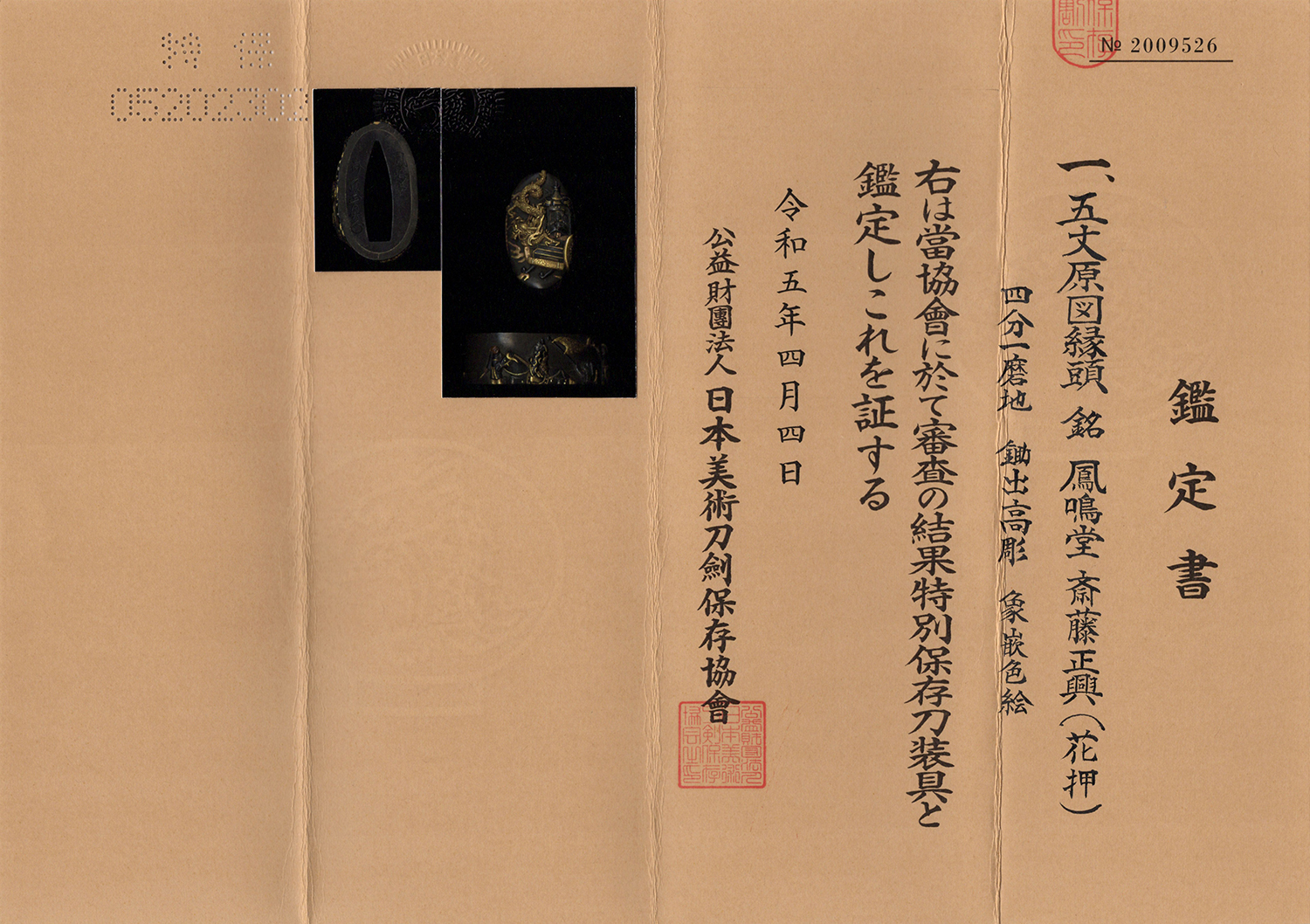
Homeido Saito Masaoki learned metal carving as a student of Ichinomiya Nagatsune and was a metal artist active in Kyoto during the mid-Edo period; he is the same person as Yoshioki. He signed his works with names such as "Homeido Masaoki (kao)", "Saito Masaoki (kao)", and "Homeido Masaoki (kao)". Using themes from Japanese and Chinese historical figures and legends, he layered thick sukidashi takabori and varied zogan iroe on a shibuichi ground to three-dimensionally depict the most dramatic scenes of a story. This piece features a dignified mei of "Homeido Saito Masaoki (kao)" cut into the ceiling of the fuchi, and it has been appraised as a Tokubetsu Hozon Tosogu by the Nihon Bijutsu Token Hozon Kyokai. The composition, which fits figures, horses, military banners, a dragon, and a carriage into a small curved surface without flaw, and the skill in precisely using the colour tones of gold, silver, shakudo, and suaka, fully demonstrate Masaoki's accomplished range of work. The subject is the Battle of Wuzhang Plains, the final northern expedition of the Three Kingdoms period in China, where Zhuge Liang Kongming, the chancellor of Shu, confronted Sima Yi Zhongda of Wei. It is said that in Jianxing 12 (234), during a long standoff, Kongming died of illness, but the Shu army kept his death secret and retreated in an orderly fashion; Sima Yi, who had turned to pursue them, saw the figure of Kongming appear on a carriage, doubted he was alive, and fearing him, withdrew his army. The phrase "The dead Kongming drives away the living Zhongda," born from this anecdote, is widely known as a story showing that Kongming's strategy and prestige overwhelmed the enemy general even after his death, and this piece unfolds that tense moment continuously across the fuchi and kashira. On the kashira, centered on the figure of Kongming sitting in a solemn carriage, a dragon is carved in high relief, winding its body significantly as it circles the entire surface. The concept of layering the existence of Kongming, who was also called the Hidden Dragon, onto the figure of the dragon further enhances the symbolism of the subject. By arranging the dragon's long torso to draw a large arc from above and directing its head toward the front of the carriage, a continuous swirling motion is created across the entire rounded surface of the kashira. The scales are carved with relief one by one, and the horns, whiskers, claws, and even the eyes are intricately carved. Because details such as Kongming's crown and facial features, the wheels, the railings, and the edges of the curtains are meticulously crafted, it is a dramatic composition where the gold-shining dragon strongly catches the eye from the front, and as the angle is changed, the figure of Kongming sitting quietly appears from within. The fuchi depicts the scene where Sima Yi's army advances while raising military banners, lining up the warrior on horseback, the soldiers supporting the banners, and the figures following the cavalry across the horizontal surface. The chisel is used finely for the horse's mane and coat, the bit and reins, the patterns on the clothing, and even the flame-shaped borders of the military banners. By mixing shakudo, suaka, and silver for the figures' faces, hands, and costumes, and placing rich gold in key areas of the military banners, horse tack, and armor, the figures are made to stand out clearly against the calm shibuichi migaki-ji. While layering multiple figures and horses within a narrow width, it does not feel cramped; the modeling, which expresses the tension and momentum of the military column through the movement of the figures and horses aligned in the direction of travel and the military banners fluttering in the wind, reveals the artist's skill in condensing a story into a single scene. The ground is, as noted in the appraisal certificate, shibuichi migaki-ji, with figures and the dragon raised thickly from the ground through sukidashi takabori, and the respective materials and distances are depicted through zogan iroe. The black-tinged clothing and horse bodies, the silver-shining facial features, the warm suaka-colored skin, and the gold brilliance placed throughout are layered in multiple levels; one can enjoy the precision of the chisel up close, and the dignified screen composition based on black and gold from a distance. It should also be noted that the decoration extends not only to the main figures but also to the parts visible when attached to the tsuka, such as by circling the area around the shitodome of the kashira with a rope-like gold pattern and adding a flame-like design to the sides. This piece, which clearly depicts the popular Three Kingdoms subject of Wuzhang Plains—Kongming and the dragon on the kashira, and Sima Yi's party retreating in surprise on the fuchi—and allows one to read the development of the story while turning the front and back, is excellent in all aspects: the carving technique as a figure metal artist, the splendor that exhausts the use of colored metals, and the concept of condensing historical legends into one's hand. It is a masterpiece that combines power and dignity, with a genuine mei and a Tokubetsu Hozon Tosogu appraisal certificate, and its content, which well retains the main carvings and iroe, has high value for collection; it is recommended not only for those who like the Three Kingdoms and warrior prints, but also for those who want to fully appreciate the precise figure expression of mid-Edo period machi-bori metal artists.
Offered by Toushin

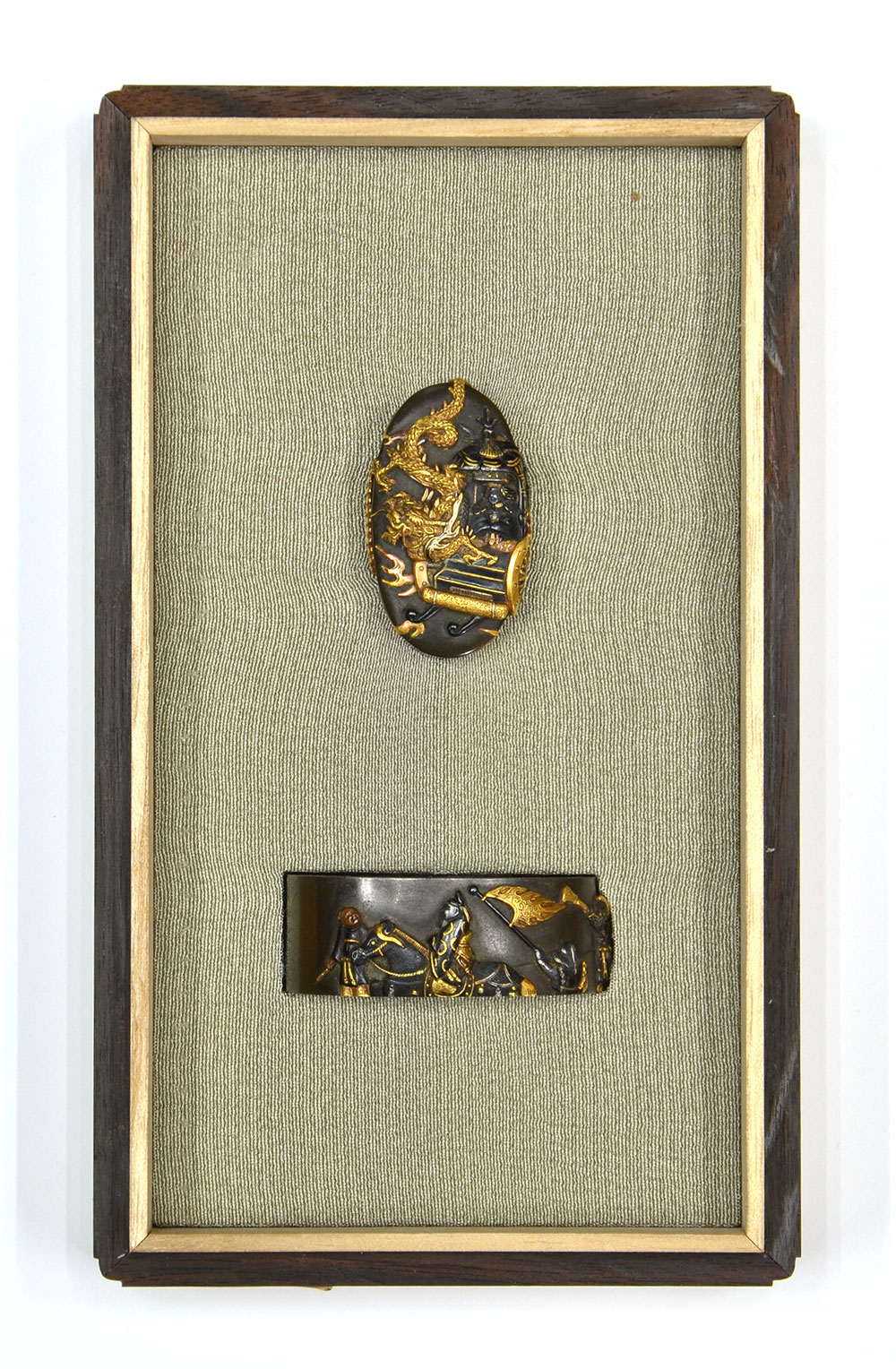
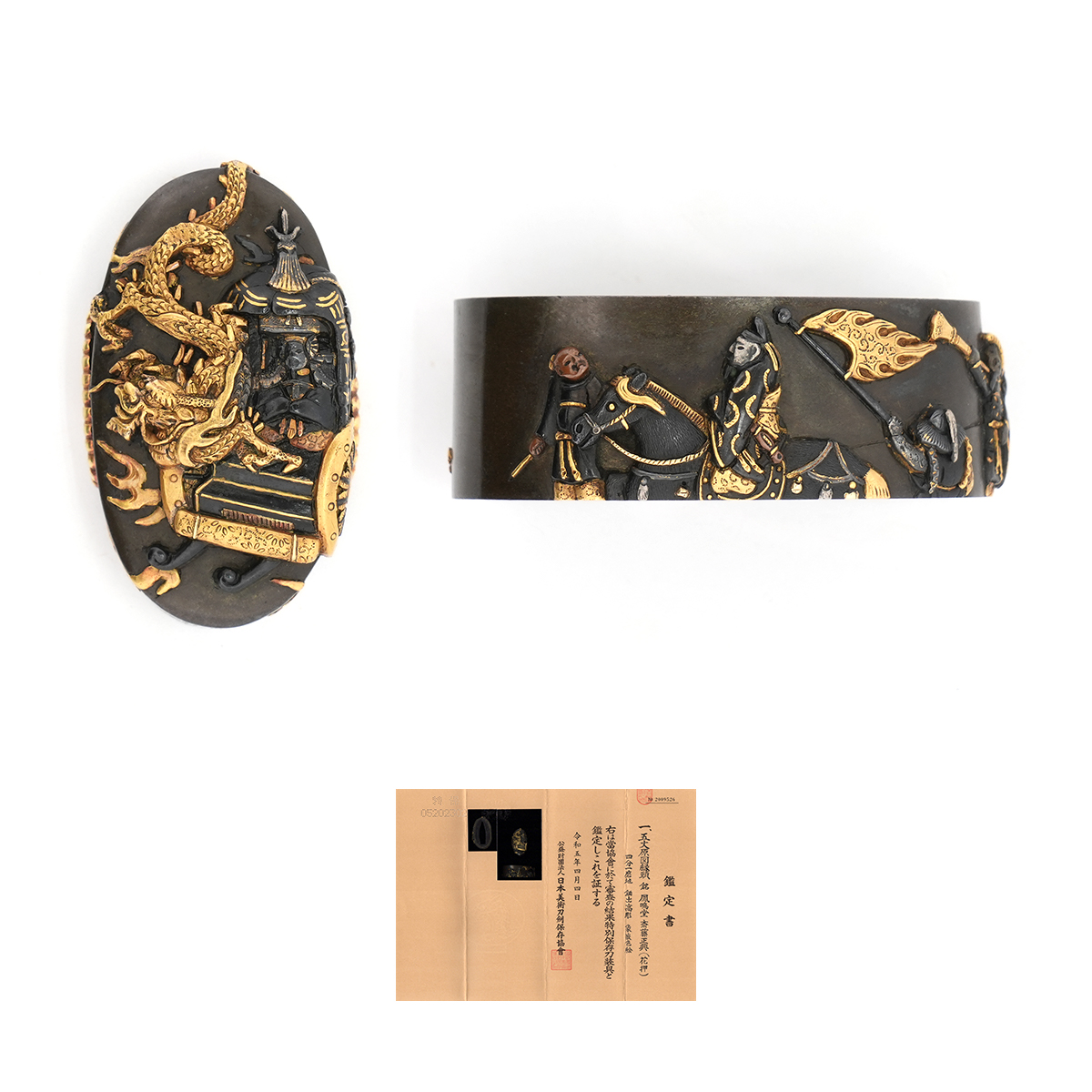
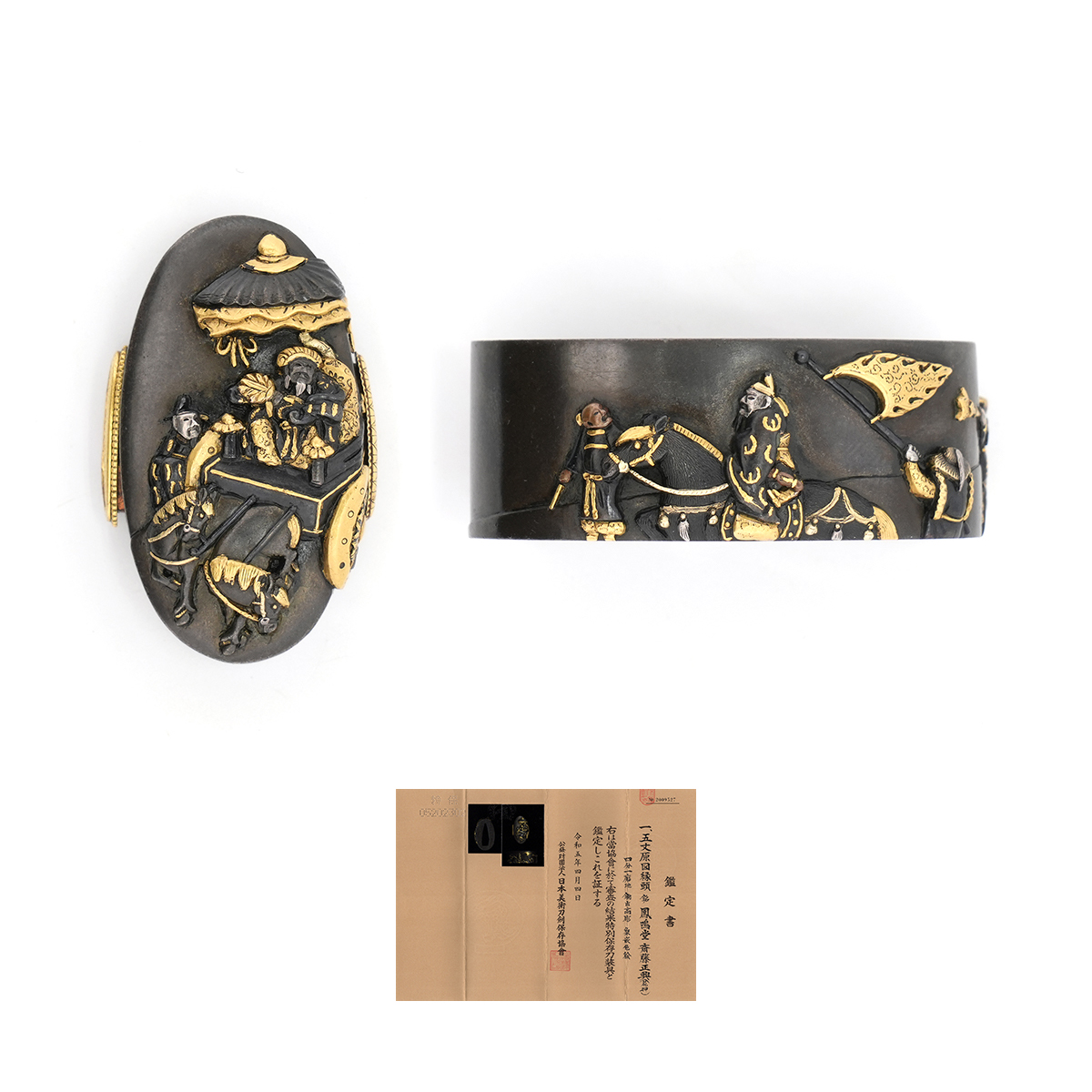
Edo
Kyoto
Signed
Tokuho (NBTHK)
Machine translation of the shop's Japanese ·
Machine translation from the shop's Japanese · may contain errors ·
A Hozon-certified fitting of notably superior craftsmanship and condition, often with signature or workmanship of high reference value.
The NBTHK (Nihon Bijutsu Tōken Hozon Kyōkai, the Society for the Preservation of Japanese Art Swords) is a public-interest incorporated foundation founded in 1948 and supervised by Japan’s Agency for Cultural Affairs (Bunkachō); it is based at the Japanese Sword Museum in Tokyo. Its expert panels physically examine each submitted work (shinsa) and issue a certificate (kanteishō) ranking it by artistic and historical merit. NBTHK papers are the most widely recognized standard of authentication for Japanese swords and fittings.
NBTHK official siteAs a rule we do not accept returns, except when we have sent a different item from the one ordered or when there is a significant discrepancy between the description and the item. If you wish to return an item, please contact us within 3 days of its arrival and then send it back.
¥770,000