 NihontoWatchNihontoWatch
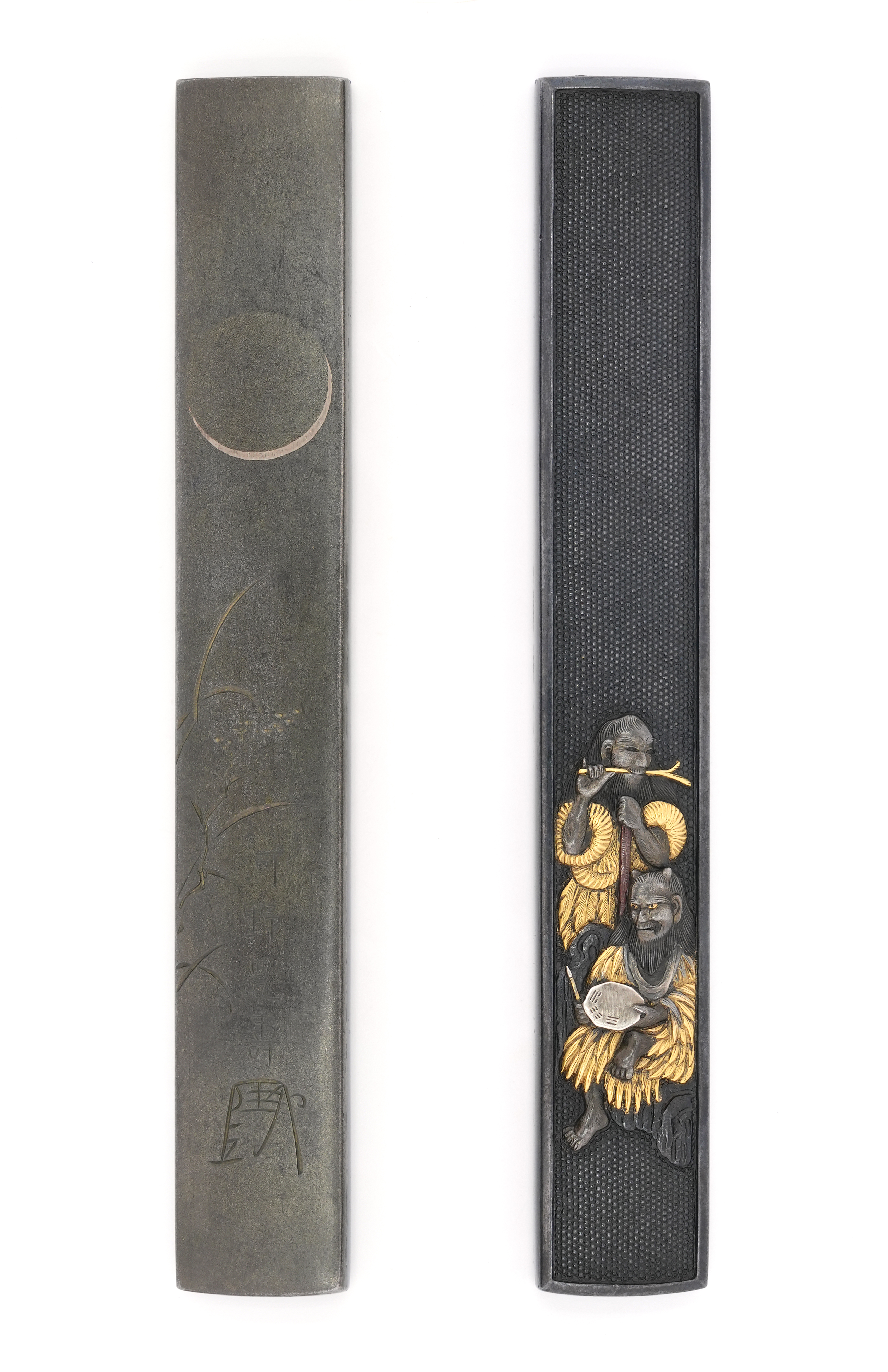
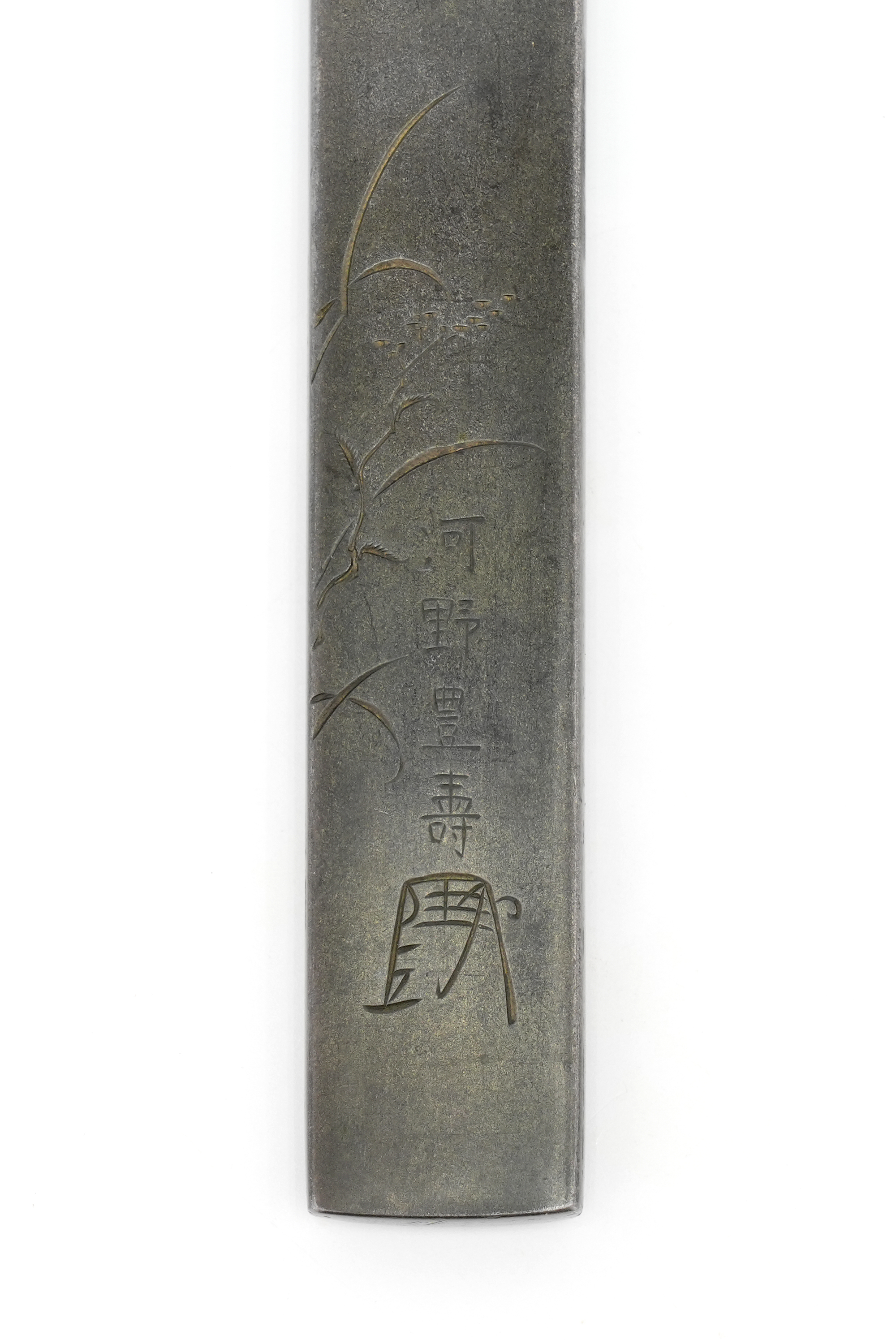
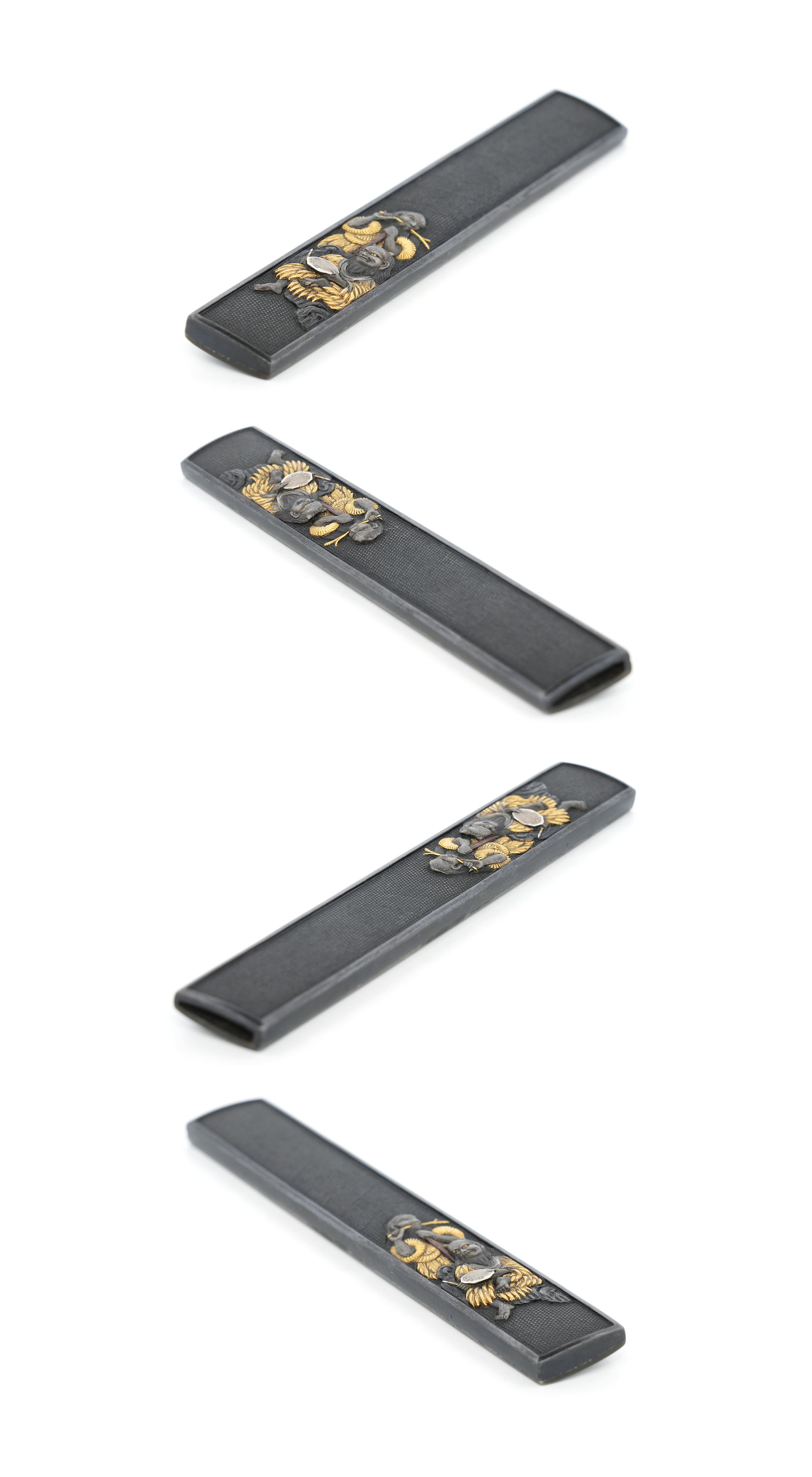
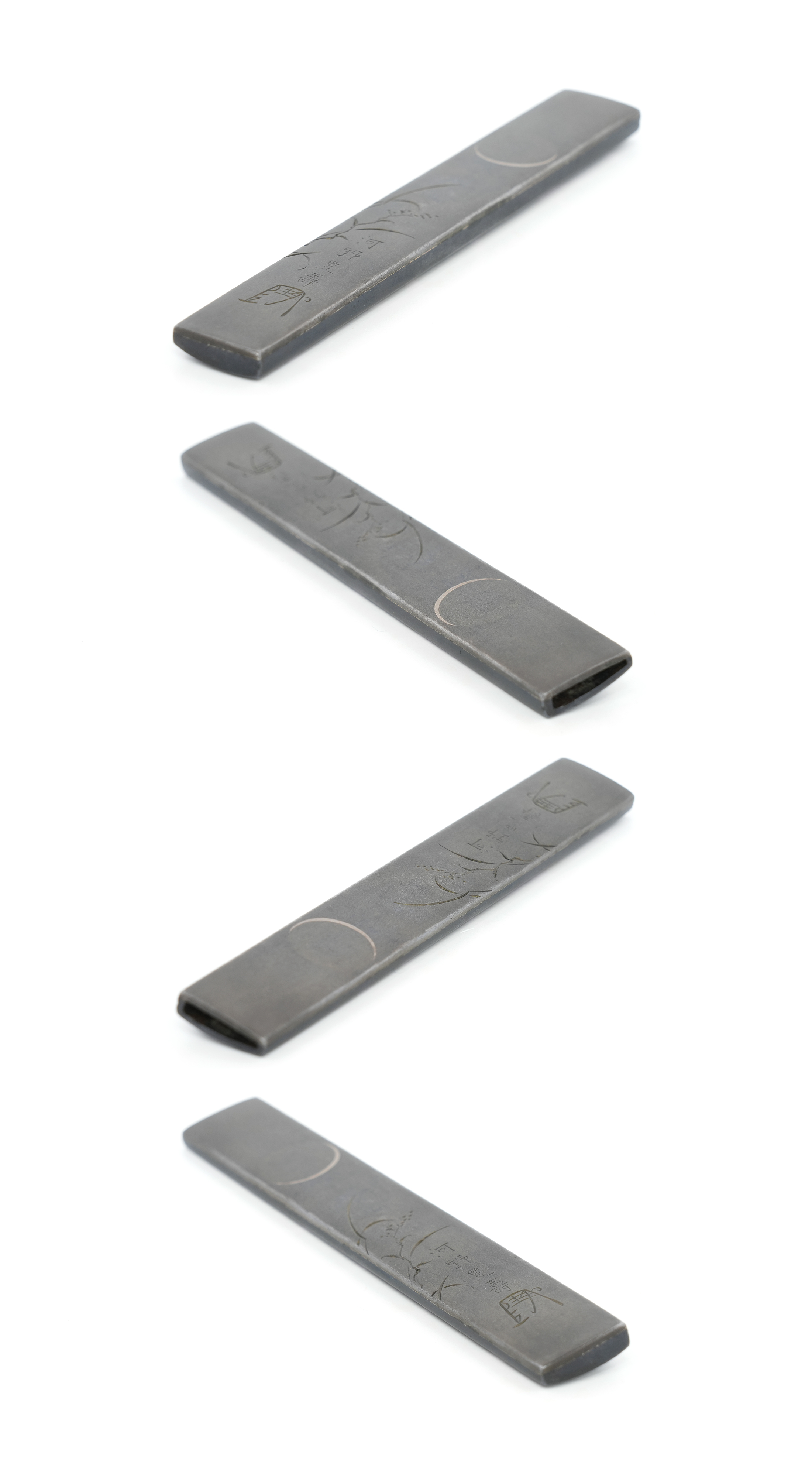
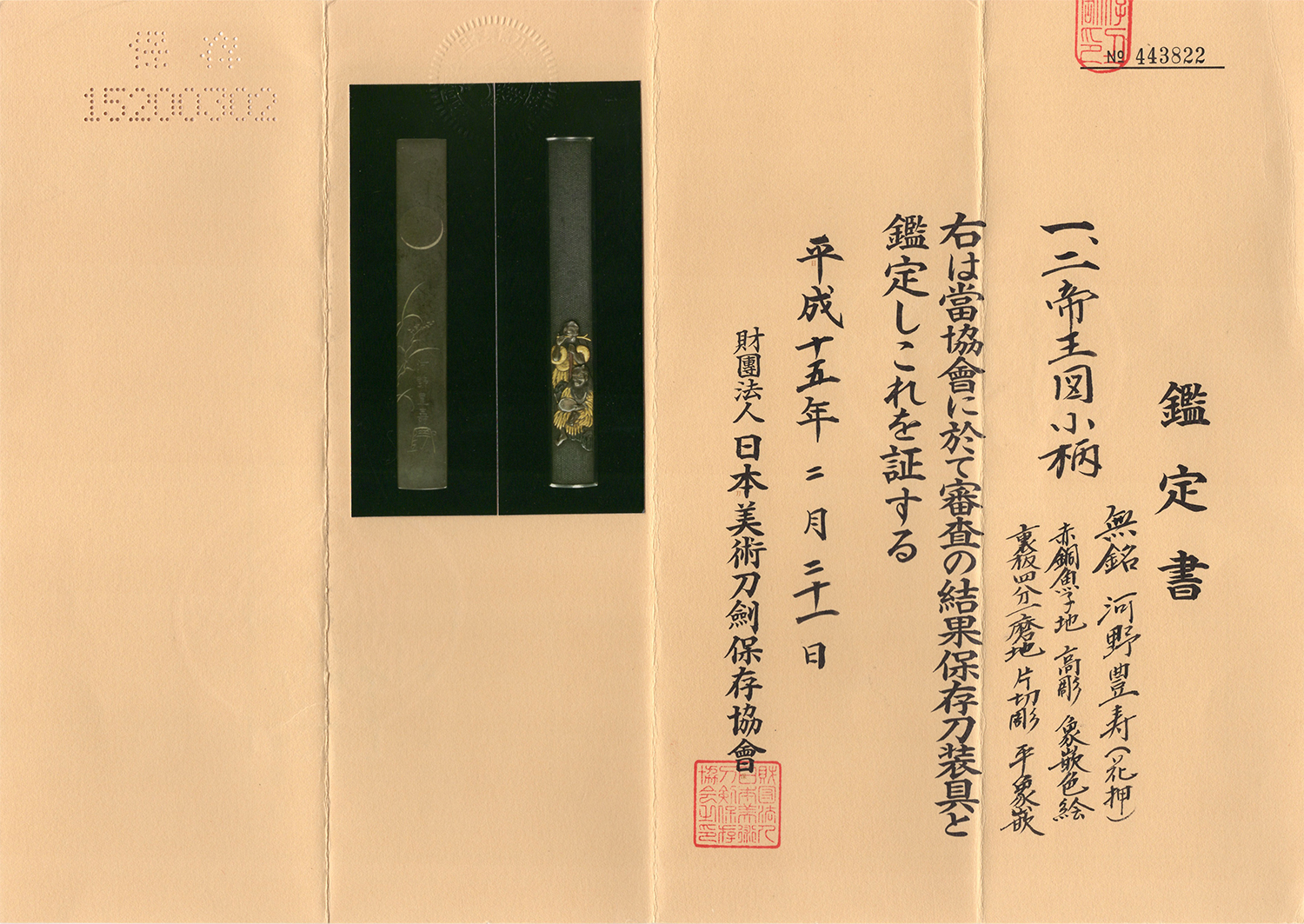
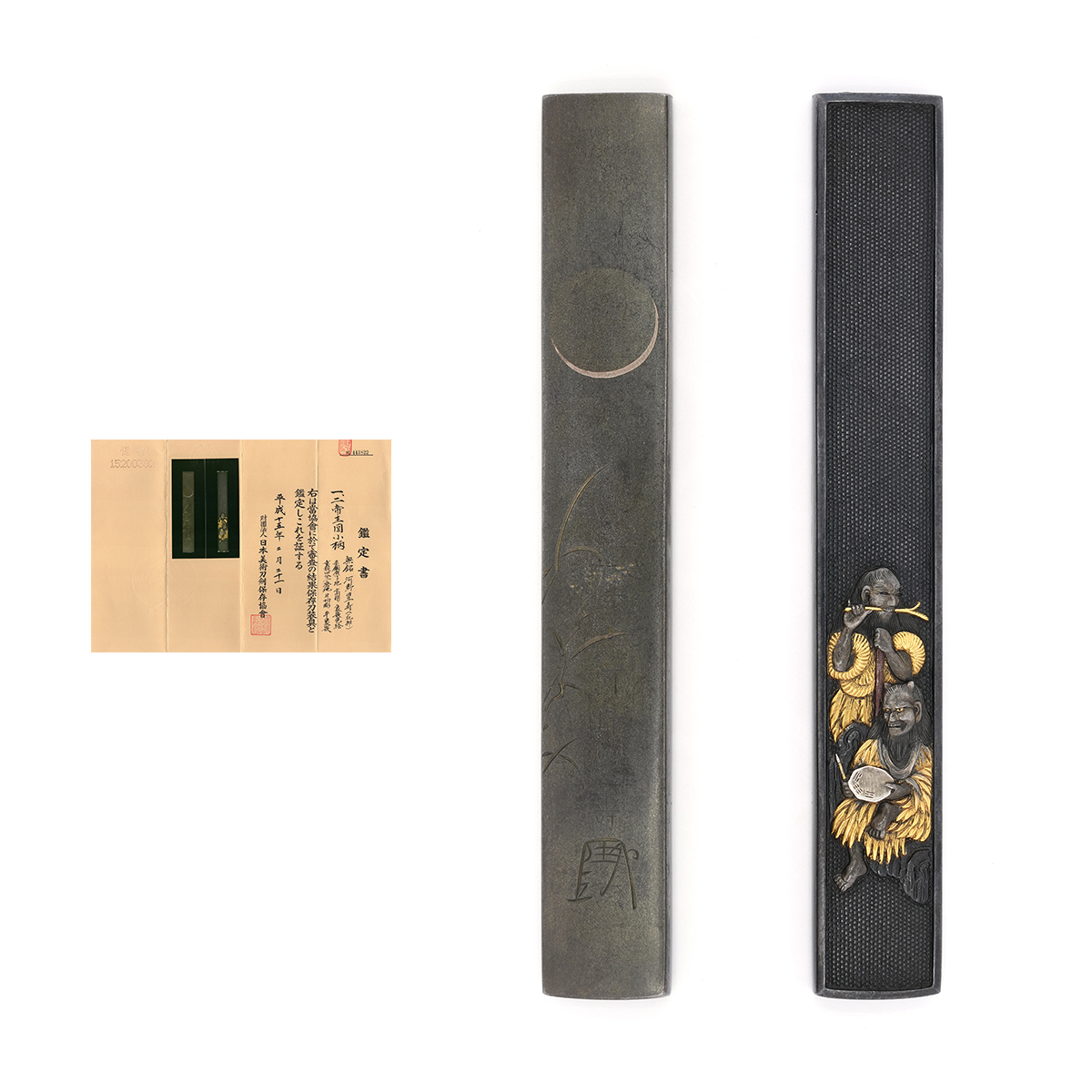
Kono Toyohisa was a tosogu metalworker active in Echizen-no-kuni during the late Edo period. Examples of his work bearing the date Keio 2 (1866) have been confirmed, and he left behind excellent works featuring Japanese and Chinese figures, skillfully combining iroe of gold, silver, and suaka against a base of shibuichi and shakudo. His kogai and fuchi-gashira depicting figures such as Seiobo and dancers are even housed in overseas museums, and his work is characterized by takabori iroe that captures the facial expressions and gestures of figures in detail, katakiri-bori, and a composition that makes effective use of negative space. This piece bears the mei "Kono Toyohisa" and a kao; it is a signed work that allows one to fully appreciate Toyohisa's skill and compositional ability, as he depicts two emperors on a stage of finely detailed shakudo nanako-ji, bringing together the rich colors of the front and the quiet moonlit scene of the back into a single work. This is a kogai that depicts two ancient Chinese emperors using shibuichi, suaka, and gold against the deep black stage of a shakudo nanako-ji. The figure in the upper section, who carries grass to his mouth and holds a suaka whip, is understood to be Shennong, who is said to have tasted a hundred herbs to learn their medicinal properties, while the figure in the lower section, who carries a board inscribed with the bagua and a brush, is understood to be Fuxi, who is said to have created the bagua. The two figures, who observed all things and brought wisdom to people's lives, are vividly contained within the limited space of the kogai. The Shennong in the upper section stands upright, carrying grass to his mouth and holding the legendary red whip in his other hand; the soft color of the shibuichi used for his face and limbs contrasts well with his gold clothing. The Fuxi in the lower section is seated on a rock, holding a brush in his right hand and an octagonal board carved with the bagua in his left; the modeling of his head, which suggests horns, and his eyes, accented with gold, tighten his expression. As one moves their eyes from the upper figure to the lower figure, the two figures and the tools they hold connect as a single story. The shakudo nanako-ji spreading out behind the figures is painstakingly hammered with fine grains, and while the gold of the clothing shines richly, a large black negative space is left, giving both the seated figure on the rocks and the standing figure a sense of expansive air. The use of different colored metals—shibuichi for the faces and limbs, suaka for the whip, and gold for the clothing and eyes—is a work with highlights in both design and technique, allowing one to enjoy the detailed chisel work when viewed up close, and making the outlines of the two emperors stand out vividly when viewed from a distance. The back plate is a shibuichi migaki-ji that carves a moonlit scene with a different atmosphere from the front. At first, it appears that only the crescent moon of silver zogan is shining, but when one looks closely, one notices that shibuichi of a slightly different tone has been inlaid in a circular shape, quietly representing the entire lunar disk. Below this, grass, which appears to be susuki, is lightly arranged in katakiri-bori. This composition responds to the colorful figure scene on the front with the quietness of moonlight and grass on the back, and with the addition of the Kono Toyohisa mei and kao, it further deepens the pleasure of turning it over in one's hands. On the front, one can enjoy the ancient wisdom that supported human activity, and on the back, the lingering sentiment of the night sky and wild grasses. From the gold clothing and silver bagua board visible from the front, to the shibuichi zogan of the lunar disk that is only understood when changing the angle, this is a piece where discoveries accumulate each time it is appreciated. It is reassuring that a Hozon Tosogu Kanteisho is included, and it is an item I would recommend to those who want to enjoy the charm of different base metals—shakudo nanako-ji and shibuichi migaki-ji—in a single kogai, and to those seeking a work with an ingenious design among those depicting historical figures. *Due to a mistake by the Nihon Bijutsu Token Hozon Kyokai, although it is signed, the certificate states "Mumei Kono Toyohisa (kao)". I am currently applying for a change (rewrite) of the certificate's contents.
Offered by Toushin

Kaga-kinko Kono Toyotoshi
Edo
Echizen
Signed
Hozon (NBTHK)
Machine translation of the shop's Japanese ·
Machine translation from the shop's Japanese · may contain errors ·
Kinko · Kaga
1 piece on the market now
Kinko · Kaga
16 pieces on the market now
The Kaga metalworking tradition (加賀金工) encompasses the broader community of artisans who practiced their craft under the patronage of the Maeda lords of Kaga Province, centered on Kanazawa. '" Craftsmen's families such as Kuwamura, Tsuji, Katsuki, and Koichi are said to have migrated from Kyoto to Kaga around the Kan'ei and Joo eras, where they prospered. " Named masters include Suzuki Kahei Yoshinori[[c:1]], whose signed tsuba adorns a koshirae transmitted as the possession of Maeda Yoshiyasu, fourteenth lord of the house, and Yamao Haruri (山尾春理), whose signed fuchi demonstrate the tradition's continuation into the Bakumatsu period. The collective idiom of Kaga metalwork is defined by its mastery of hira-zogan — flat inlay deploying a rich palette of colored metals against polished grounds. " The technique is said to have originated when the flat-inlay methods of stirrup-makers (abumi-shi, 鐙工) were adapted for tsuba and sword fittings. Particular refinement is achieved through manipulation of gold alloy proportions: one tsuba uses "several kinds of gold — created by altering the proportions of the alloy — imparting an even deeper tonal richness," while another distinguishes three tonal gradations within gold alone.
Alongside hira-zogan, kebori (毛彫, hairline engraving) is a constant companion technique, and the corpus extends to takabori with kin-gin iroe on shakudo nanako-ji grounds. Motifs range from literary subjects — Genji monogatari scenes rendered on bamboo blinds, folding screens, and fan panels — to naturalistic compositions of autumn grasses, massed butterflies, dianthus with brushwood fences, and heraldic programs such as the Hakutaku (白澤) guardian creature of Maeda family tradition. Works on suaka ground are noted as "comparatively rare," presenting "an archaic flavor," while polished shakudo grounds yield jet-black fields against which colored metals achieve maximum brilliance. The Kaga tradition occupies a singular position in the tosogu canon as the premier regional school of flat inlay. " Several designated works are identified as presentation pieces conceived for the highest levels of daimyo patronage. Learn more →
| Smith | Era | Designated |
|---|---|---|
| Ujitada氏忠 | — | 0 |
| Kiyonaga清永 | — | 0 |
| Katsuhisa克久 | — | 0 |
| Genroku源六 | — | 0 |
| Katsuhisa克久 | — | 0 |
Certifies a genuine fitting worth preserving: a correct signature, or, if unsigned, an identifiable era and school, with recognized artistic and craft value.
The NBTHK (Nihon Bijutsu Tōken Hozon Kyōkai, the Society for the Preservation of Japanese Art Swords) is a public-interest incorporated foundation founded in 1948 and supervised by Japan’s Agency for Cultural Affairs (Bunkachō); it is based at the Japanese Sword Museum in Tokyo. Its expert panels physically examine each submitted work (shinsa) and issue a certificate (kanteishō) ranking it by artistic and historical merit. NBTHK papers are the most widely recognized standard of authentication for Japanese swords and fittings.
NBTHK official siteAs a rule we do not accept returns, except when we have sent a different item from the one ordered or when there is a significant discrepancy between the description and the item. If you wish to return an item, please contact us within 3 days of its arrival and then send it back.
¥1,320,000