Shinto Yamashiro, early Edo, Wazamono, with koshirae
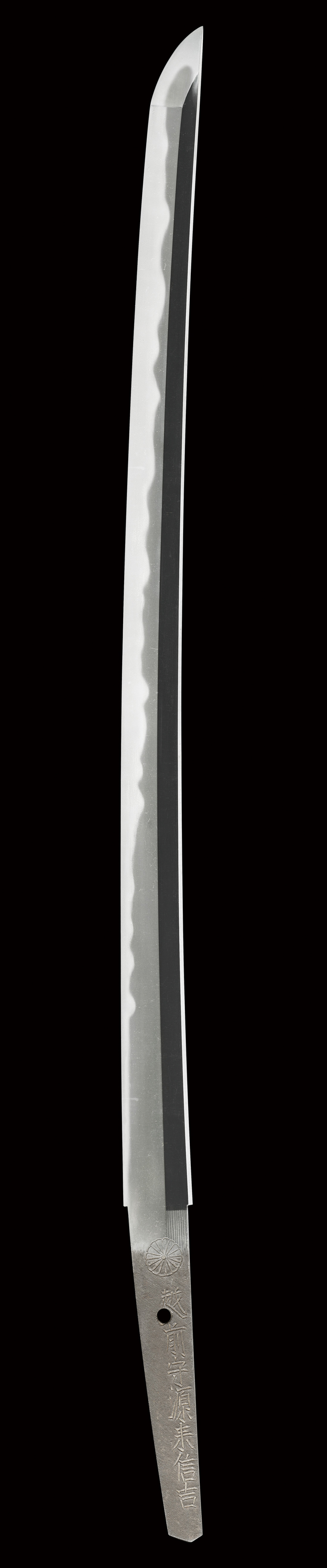
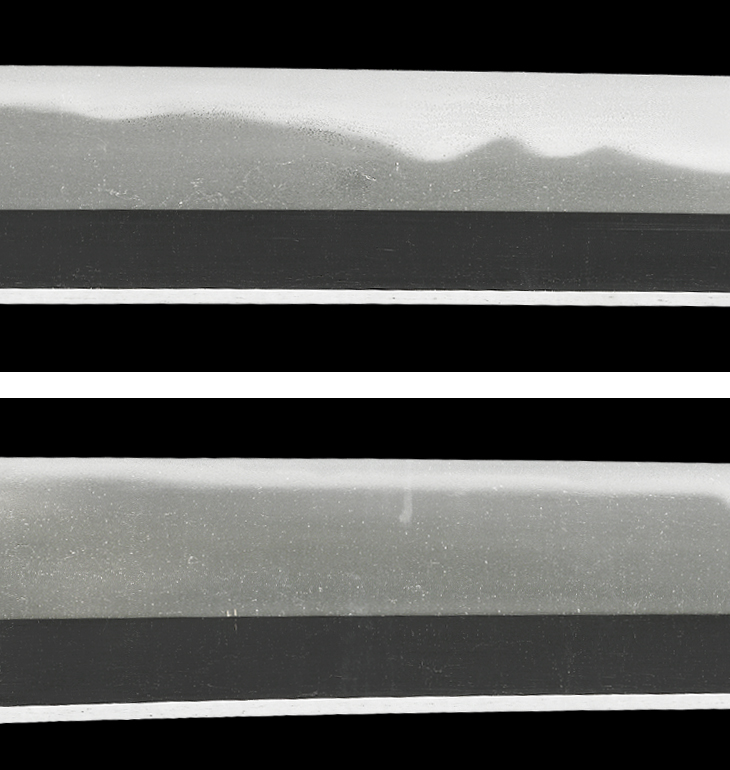
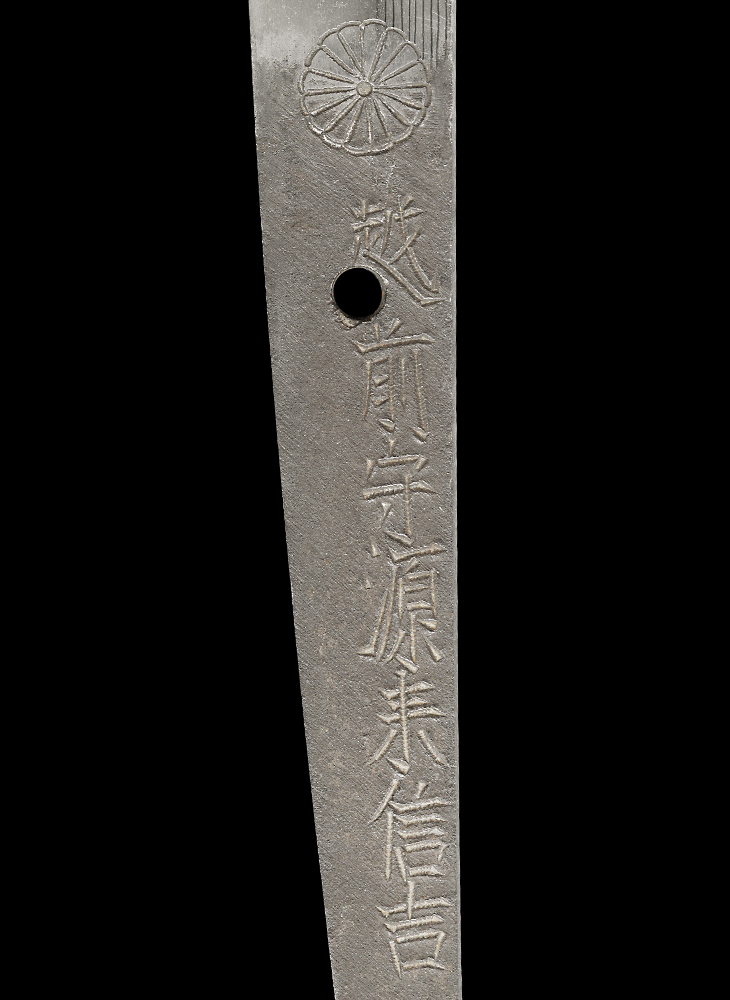
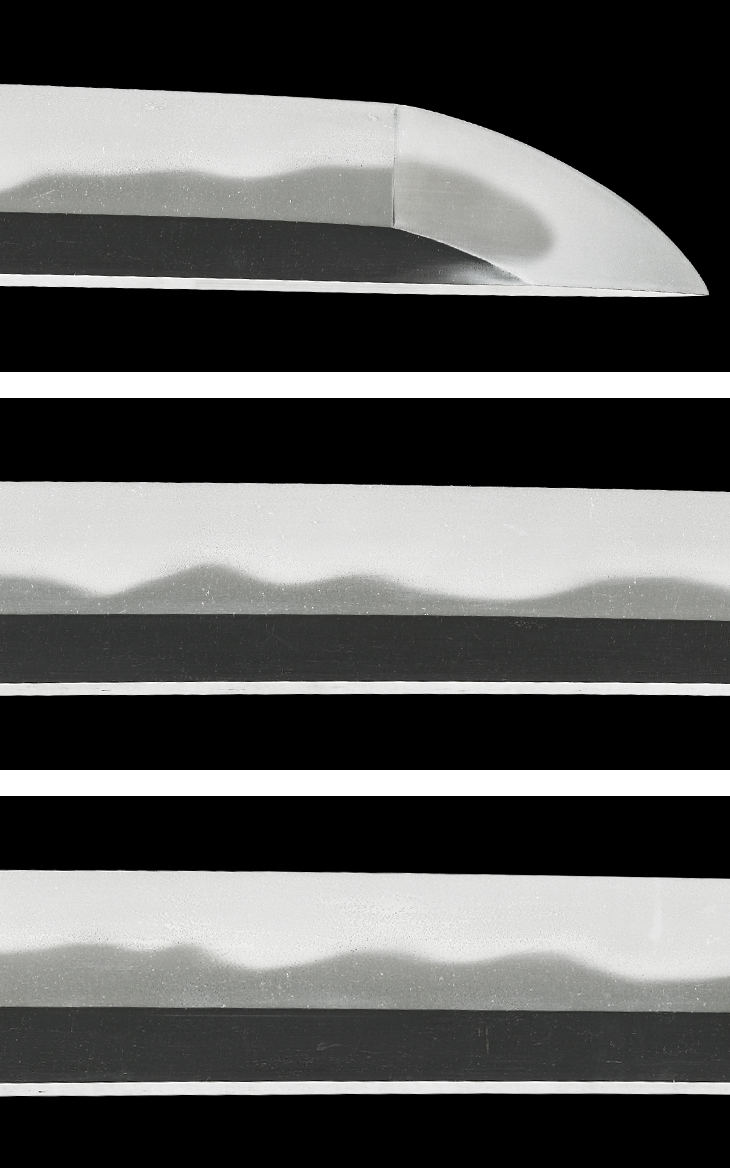
Shinogi-zukuri, shinogi is standard, iori-mune is low, chu-kissaki. Kitae: the skin is a densely packed ko-itame that tends to be slightly sunken, with areas that stand out in a flowing pattern, and the ji-tetsu is generally refined with ji-nie. Hamon: starting from a sugu-notare style yaki-dashi, it becomes a gunome-midare; the ha-buchi is particularly thickly covered in nie and nioi, with intense kinsuji and sunagashi in places, appearing as nie-sake and nie-kuzure. Boshi: sugu style with nie, returning in a ko-maru fashion. Nakago is ubu, tip is iriyama-gata, yasurime is kesho-sujikai. Copper habaki. Recently polished. In shirasaya.
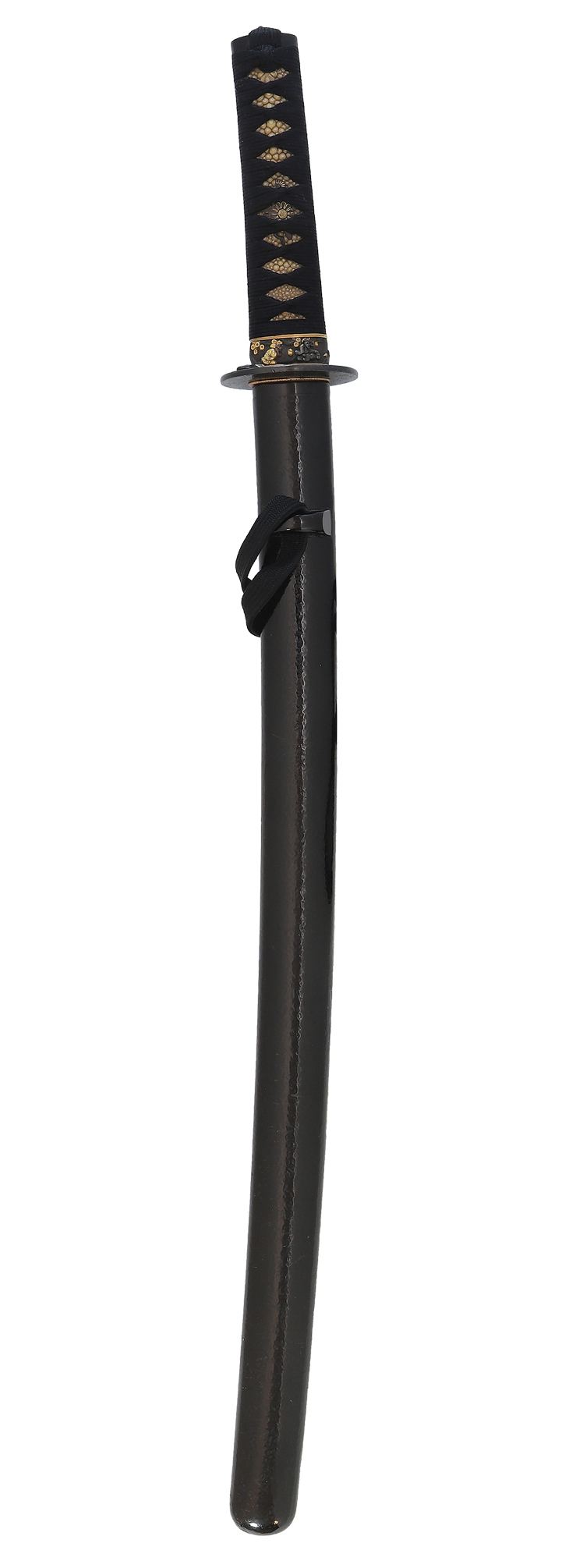
With wakizashi koshirae (total length 74.5, late Edo, saya: black ro-ishime-ji, sageo: black, tsuka: oya-same with black tsuka-maki, fuchi: shakudo nanako-ji takabori iroe with figures under a pine tree, kashira: horn, tsuba: shakudo kenma-ji, takabori iroe, kebori, figures under the moon).
The Nobuyoshi school is said to have belonged to the Kyoto Mishina school, used the Takai surname, and lived in Heianjo. With the first generation Shinano no Kami Nobuyoshi as the head, the school included Echizen no Kami, Awa no Kami, Sagami no Kami, and Kawachi no Kami Nobuyoshi; they later moved to Settsu and devoted themselves to the development of the Osaka Mishina school.
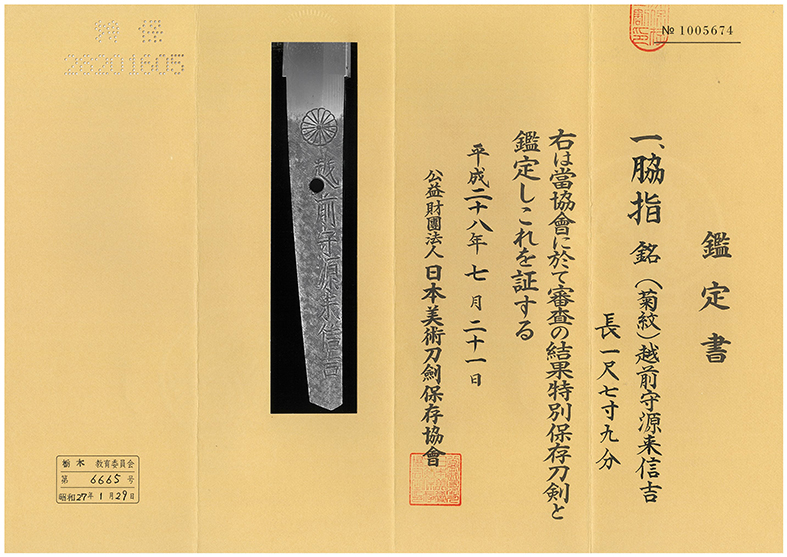
Echizen no Kami Nobuyoshi was the third son of the first generation Shinano no Kami Nobuyoshi and was one of those who moved to Settsu, being a swordsmith active around the Kanbun, Enpo, and Genroku eras. This smith, who is considered a master, was particularly skilled at works aiming for the style of Shinkai and Sukehiro, and he is the only one in the school to have several blades designated as Juyo Token.
This work has a nagasa of over 1 shaku 7 sun 9 bu, a grand wakizashi with solid mihaba and kasane; the skin is a densely packed ko-itame that tends to be slightly sunken, with areas that stand out in a flowing pattern; it features a gunome-midare hamon starting from a sugu-notare style yaki-dashi, and the ha-buchi is particularly thickly covered in nie and nioi, with intense kinsuji and sunagashi in places, exhibiting nie-sake and nie-kuzure.
The condition of the ji and ha as well as the polish are good; the brightness and clarity of the ha-buchi truly bring Shinkai to mind, and it bears the kiku-mon characteristic of the Mishina school.
A fine work by Takai Echizen no Kami Nobuyoshi, who is considered the most skilled among the various generations of Nobuyoshi, accompanied by period koshirae.
Machine translation from the shop's Japanese · may contain errors ·
Shinto Yamashiro, early Edo, Wazamono, with koshirae
Shinogi-zukuri, shinogi is standard, iori-mune is low, chu-kissaki. Kitae: the skin is a densely packed ko-itame that tends to be slightly sunken, with areas that stand out in a flowing pattern, and the ji-tetsu is generally refined with ji-nie. Hamon: starting from a sugu-notare style yaki-dashi, it becomes a gunome-midare; the ha-buchi is particularly thickly covered in nie and nioi, with intense kinsuji and sunagashi in places, appearing as nie-sake and nie-kuzure. Boshi: sugu style with nie, returning in a ko-maru fashion. Nakago is ubu, tip is iriyama-gata, yasurime is kesho-sujikai. Copper habaki. Recently polished. In shirasaya.
With wakizashi koshirae (total length 74.5, late Edo, saya: black ro-ishime-ji, sageo: black, tsuka: oya-same with black tsuka-maki, fuchi: shakudo nanako-ji takabori iroe with figures under a pine tree, kashira: horn, tsuba: shakudo kenma-ji, takabori iroe, kebori, figures under the moon).
The Nobuyoshi school is said to have belonged to the Kyoto Mishina school, used the Takai surname, and lived in Heianjo. With the first generation Shinano no Kami Nobuyoshi as the head, the school included Echizen no Kami, Awa no Kami, Sagami no Kami, and Kawachi no Kami Nobuyoshi; they later moved to Settsu and devoted themselves to the development of the Osaka Mishina school.
Echizen no Kami Nobuyoshi was the third son of the first generation Shinano no Kami Nobuyoshi and was one of those who moved to Settsu, being a swordsmith active around the Kanbun, Enpo, and Genroku eras. This smith, who is considered a master, was particularly skilled at works aiming for the style of Shinkai and Sukehiro, and he is the only one in the school to have several blades designated as Juyo Token.
This work has a nagasa of over 1 shaku 7 sun 9 bu, a grand wakizashi with solid mihaba and kasane; the skin is a densely packed ko-itame that tends to be slightly sunken, with areas that stand out in a flowing pattern; it features a gunome-midare hamon starting from a sugu-notare style yaki-dashi, and the ha-buchi is particularly thickly covered in nie and nioi, with intense kinsuji and sunagashi in places, exhibiting nie-sake and nie-kuzure.
The condition of the ji and ha as well as the polish are good; the brightness and clarity of the ha-buchi truly bring Shinkai to mind, and it bears the kiku-mon characteristic of the Mishina school.
A fine work by Takai Echizen no Kami Nobuyoshi, who is considered the most skilled among the various generations of Nobuyoshi, accompanied by period koshirae.
About the maker
Nobuyoshi
信吉
Yamashiro · around 1673-1695
Fujishiro Chu-jo saku · Tōken Taikan top 37%
5 pieces on the market now
›
Historical importance
Where Nobuyoshi stands among comparable artisans: across all of nihontō, and within tradition, era, and period. The tiers (Foremost · Leading · Major · Notable) weigh official designations from the NBTHK and Japan's Agency for Cultural Affairs, together with historical honors of lasting repute such as the Sansaku and Meibutsu-chō.
Under the Tokugawa peace the daishō became a regulated uniform, and demand gathered in the castle towns, above all Edo itself. The craft split two ways: brilliant display work for connoisseurs, and tested blades whose cutting results were sometimes inlaid in gold.
A Hozon-certified blade judged to show notably superior workmanship and a better state of preservation. The bar is higher: re-tempered blades and most unsigned Muromachi/Edo works are excluded.
About the NBTHK›
The NBTHK (Nihon Bijutsu Tōken Hozon Kyōkai, the Society for the Preservation of Japanese Art Swords) is a public-interest incorporated foundation founded in 1948 and supervised by Japan’s Agency for Cultural Affairs (Bunkachō); it is based at the Japanese Sword Museum in Tokyo. Its expert panels physically examine each submitted work (shinsa) and issue a certificate (kanteishō) ranking it by artistic and historical merit. NBTHK papers are the most widely recognized standard of authentication for Japanese swords and fittings.
For one-of-a-kind items such as swords, sword fittings and antiques, other customers may be waiting for the item, so please contact us about a return within 3 days of its arrival and ship it back within 8 days. Refunds are made on the day the returned item arrives.

 NihontoWatch