Shinto, Yamashiro. Early Edo period.
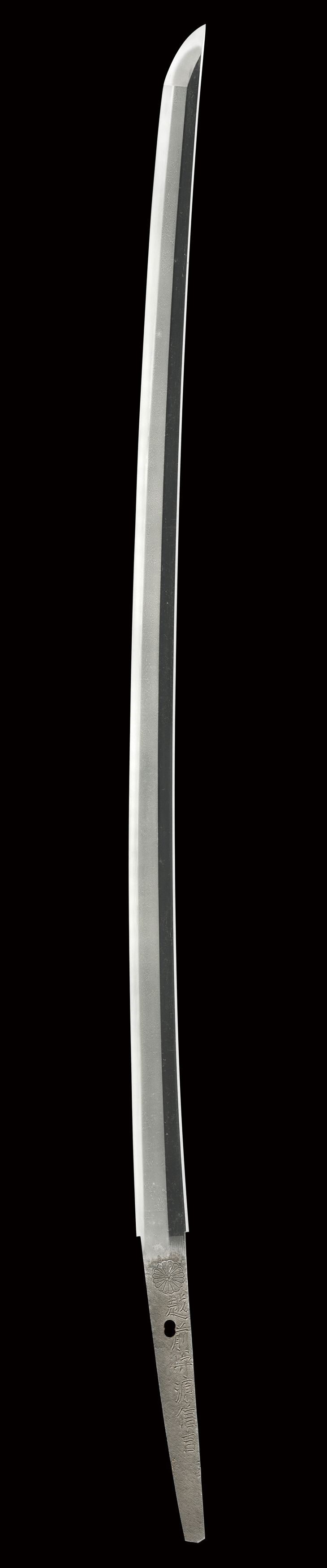
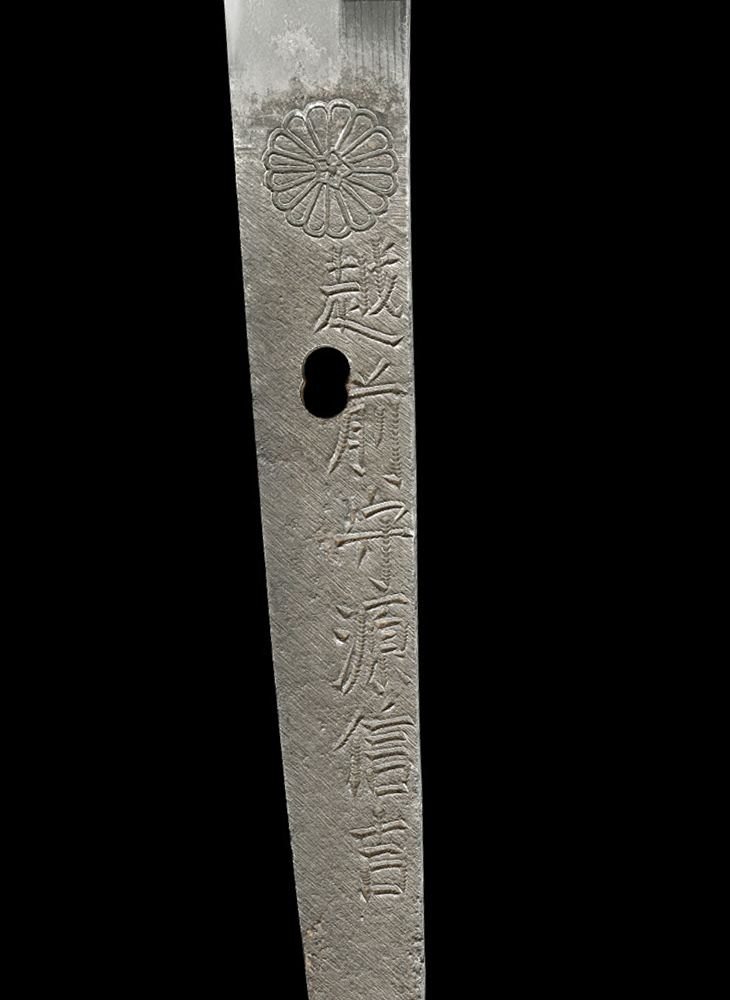
Shinogi-zukuri, shinogi is jinjo, iori-mune is low, chu-kissaki. Kitae is itame with mokume and nagare-hada, the hada is prominent, ji-nie attaches thickly, chikei enters, the jigane is good. Hamon is sugu-cho, the habuchi has ko-nie and is somewhat tight, fine hotsure occurs, within the ha there are ko-ashi and yo, kinsuji and sunagashi occur. Boshi is sugu-cho with nie, the saki is hakikake and returns. Nakago is ubu, saki is iriyamagata, yasurime is kesho osugichigai. Copper with gold-plated niju-habaki. Period polish. In shirasaya.
The Nobuyoshi school is said to have belonged to the students of the Kyo Mishina smiths; with the first generation Shinano no Kami Nobuyoshi as the head, they all took the surname Takai and forged swords in Kyoto. Within the school, there were the younger brother of the first generation, Awa no Kami Nobuyoshi, and his son, Echizen no Kami Nobuyoshi, among others; they later moved to Settsu and also devoted themselves to the development of the Osaka Mishina school.
The smith of this work, Echizen no Kami Nobuyoshi, was the third son of the first generation Shinano no Kami Nobuyoshi, one of those who moved to Settsu, and was a tosyo active from around Kanbun to Genroku. Initially he was Echizen no Daijo, later changing to Echizen no Kami, and in his later years he entered the priesthood and signed with the mei Tomonobu. On the nakago, there are also cases where a "Kiku-mon" or "Kiku-mon Ichi" is added.
This work has a nagasa of 2 shaku 3 sun, a sori that is somewhat shallow, and is a healthy jito blade; the sugu-cho ha has a tasteful deki with fine variations in the habuchi.
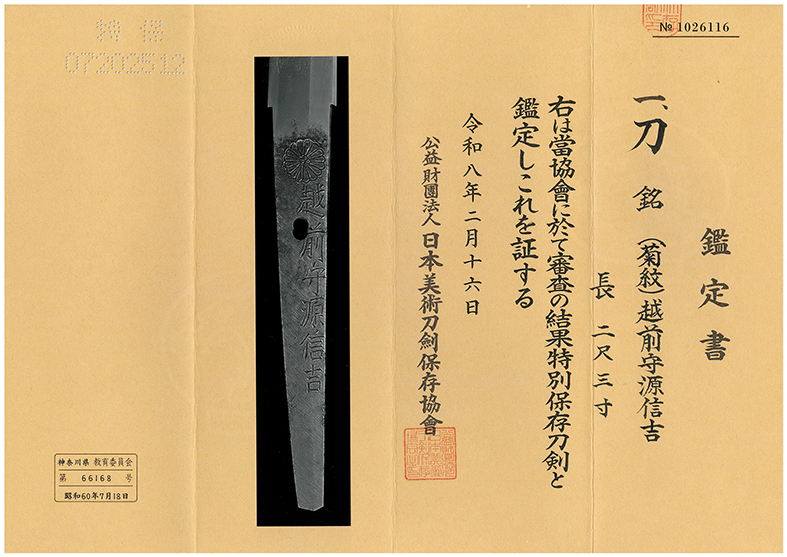
There are no large flaws, it has Tokubetsu Hozon papers, includes the Kiku-mon, and is a sincere Echizen no Kami Nobuyoshi.
Machine translation from the shop's Japanese · may contain errors ·
Shinto, Yamashiro. Early Edo period.
Shinogi-zukuri, shinogi is jinjo, iori-mune is low, chu-kissaki. Kitae is itame with mokume and nagare-hada, the hada is prominent, ji-nie attaches thickly, chikei enters, the jigane is good. Hamon is sugu-cho, the habuchi has ko-nie and is somewhat tight, fine hotsure occurs, within the ha there are ko-ashi and yo, kinsuji and sunagashi occur. Boshi is sugu-cho with nie, the saki is hakikake and returns. Nakago is ubu, saki is iriyamagata, yasurime is kesho osugichigai. Copper with gold-plated niju-habaki. Period polish. In shirasaya.
The Nobuyoshi school is said to have belonged to the students of the Kyo Mishina smiths; with the first generation Shinano no Kami Nobuyoshi as the head, they all took the surname Takai and forged swords in Kyoto. Within the school, there were the younger brother of the first generation, Awa no Kami Nobuyoshi, and his son, Echizen no Kami Nobuyoshi, among others; they later moved to Settsu and also devoted themselves to the development of the Osaka Mishina school.
The smith of this work, Echizen no Kami Nobuyoshi, was the third son of the first generation Shinano no Kami Nobuyoshi, one of those who moved to Settsu, and was a tosyo active from around Kanbun to Genroku. Initially he was Echizen no Daijo, later changing to Echizen no Kami, and in his later years he entered the priesthood and signed with the mei Tomonobu. On the nakago, there are also cases where a "Kiku-mon" or "Kiku-mon Ichi" is added.
This work has a nagasa of 2 shaku 3 sun, a sori that is somewhat shallow, and is a healthy jito blade; the sugu-cho ha has a tasteful deki with fine variations in the habuchi.
There are no large flaws, it has Tokubetsu Hozon papers, includes the Kiku-mon, and is a sincere Echizen no Kami Nobuyoshi.
About the maker
Nobuyoshi
信吉
Yamashiro · around 1673-1695
Fujishiro Chu-jo saku · Tōken Taikan top 37%
5 pieces on the market now
›
Historical importance
Where Nobuyoshi stands among comparable artisans: across all of nihontō, and within tradition, era, and period. The tiers (Foremost · Leading · Major · Notable) weigh official designations from the NBTHK and Japan's Agency for Cultural Affairs, together with historical honors of lasting repute such as the Sansaku and Meibutsu-chō.
Under the Tokugawa peace the daishō became a regulated uniform, and demand gathered in the castle towns, above all Edo itself. The craft split two ways: brilliant display work for connoisseurs, and tested blades whose cutting results were sometimes inlaid in gold.
A Hozon-certified blade judged to show notably superior workmanship and a better state of preservation. The bar is higher: re-tempered blades and most unsigned Muromachi/Edo works are excluded.
About the NBTHK›
The NBTHK (Nihon Bijutsu Tōken Hozon Kyōkai, the Society for the Preservation of Japanese Art Swords) is a public-interest incorporated foundation founded in 1948 and supervised by Japan’s Agency for Cultural Affairs (Bunkachō); it is based at the Japanese Sword Museum in Tokyo. Its expert panels physically examine each submitted work (shinsa) and issue a certificate (kanteishō) ranking it by artistic and historical merit. NBTHK papers are the most widely recognized standard of authentication for Japanese swords and fittings.
For one-of-a-kind items such as swords, sword fittings and antiques, other customers may be waiting for the item, so please contact us about a return within 3 days of its arrival and ship it back within 8 days. Refunds are made on the day the returned item arrives.

 NihontoWatch