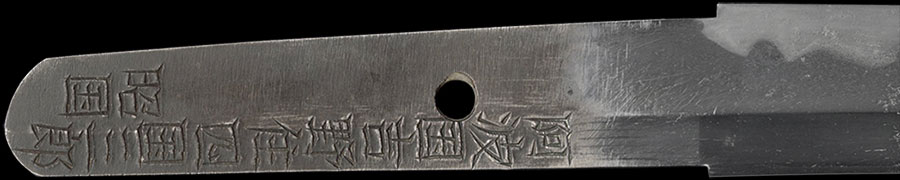
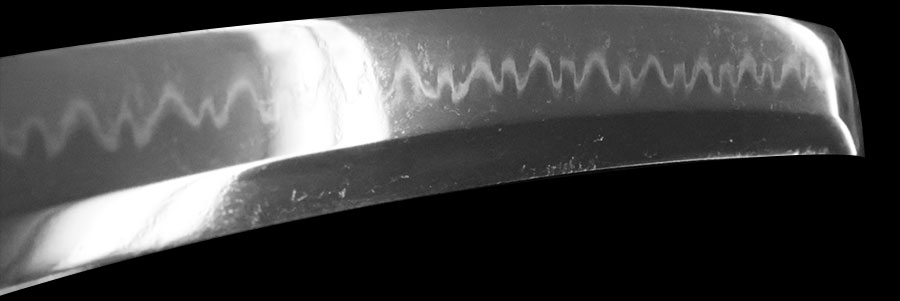
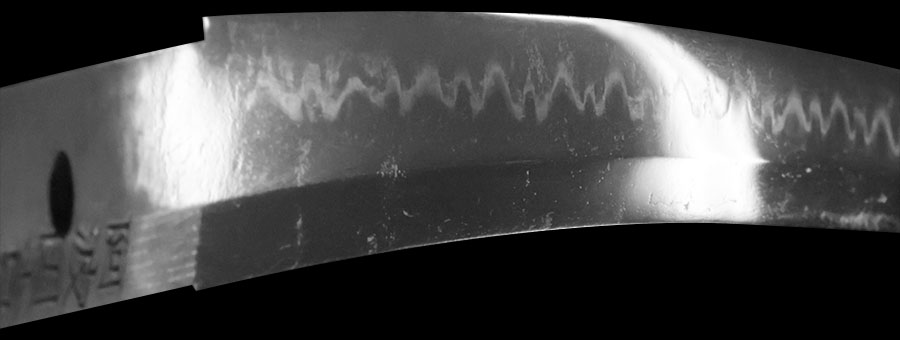
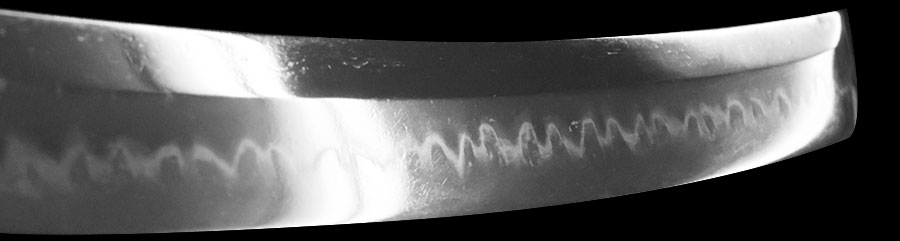
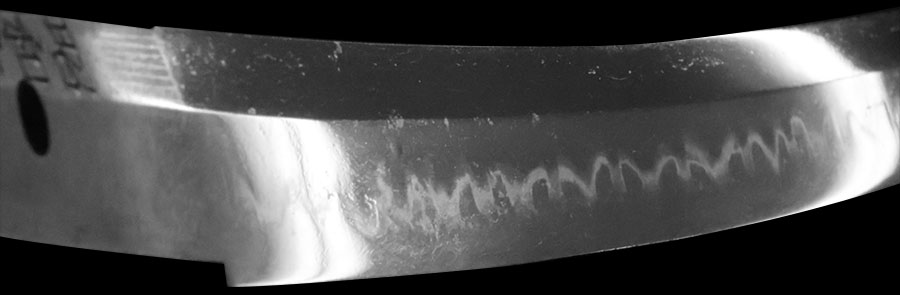
It has appeared, it has appeared; the pride of Tokushima Prefecture, the Yoshino River, is one of Japan's three great wild rivers and is called Shikoku Saburo. A precious wakizashi has appeared, crafted by the swordsmith Awa no Kuni Yoshino-ju Shikoku Saburo Akikuni, who took the alias Shikoku Saburo from the largest river in Shikoku that supplies water to all prefectures—including irrigation for Ehime, Kochi, Tokushima, and Kagawa—and flows into the Pacific Ocean; this work is a masterpiece modeled after Echigo no Kami Kanesada, who is said to be the hero of Osaka Shinto. The swordsmith Akikuni, real name Kondo Tsutomu, was a student of the Living National Treasure Miyairi Akihira and was a master craftsman selected before the war to receive the honor of being an appointed Army swordsmith. This wakizashi is a precious piece made in Showa 15 in what is now Yoshino, Awa City, which spreads across the Yoshino River basin in northeastern Tokushima Prefecture, at a time before the war when almost no wakizashi were produced by contemporary swordsmiths. This wakizashi copies the master of Osaka Shinto, Echigo no Kami Kanesada, showing a grand wakizashi sugata with a difference between the moto-mihaba and saki-mihaba and little sori; the jigane is forged in itame hada showing bright, good jigane with plenty of ji-nie, and the hamon is a spirited gunome midare in nioi-deki with plenty of ko-nie, mixed with yahazu-style ha, making it a well-made work. This time, we received this wakizashi which had been cherished in an old family, with the request to pass it on cheaply to someone who likes such things as they have grown old themselves; therefore, we are offering this famous wakizashi by Shikoku Saburo Akikuni at a super-bargain price. Please by all means enjoy it.
Machine translation from the shop's Japanese · may contain errors ·
It has appeared, it has appeared; the pride of Tokushima Prefecture, the Yoshino River, is one of Japan's three great wild rivers and is called Shikoku Saburo. A precious wakizashi has appeared, crafted by the swordsmith Awa no Kuni Yoshino-ju Shikoku Saburo Akikuni, who took the alias Shikoku Saburo from the largest river in Shikoku that supplies water to all prefectures—including irrigation for Ehime, Kochi, Tokushima, and Kagawa—and flows into the Pacific Ocean; this work is a masterpiece modeled after Echigo no Kami Kanesada, who is said to be the hero of Osaka Shinto. The swordsmith Akikuni, real name Kondo Tsutomu, was a student of the Living National Treasure Miyairi Akihira and was a master craftsman selected before the war to receive the honor of being an appointed Army swordsmith. This wakizashi is a precious piece made in Showa 15 in what is now Yoshino, Awa City, which spreads across the Yoshino River basin in northeastern Tokushima Prefecture, at a time before the war when almost no wakizashi were produced by contemporary swordsmiths. This wakizashi copies the master of Osaka Shinto, Echigo no Kami Kanesada, showing a grand wakizashi sugata with a difference between the moto-mihaba and saki-mihaba and little sori; the jigane is forged in itame hada showing bright, good jigane with plenty of ji-nie, and the hamon is a spirited gunome midare in nioi-deki with plenty of ko-nie, mixed with yahazu-style ha, making it a well-made work. This time, we received this wakizashi which had been cherished in an old family, with the request to pass it on cheaply to someone who likes such things as they have grown old themselves; therefore, we are offering this famous wakizashi by Shikoku Saburo Akikuni at a super-bargain price. Please by all means enjoy it.
The twentieth century nearly killed the craft twice: wartime distortion, then the occupation ban. The NBTHK’s founding in 1948 and licensed forging from 1953 rebuilt the sword as an art, crowned by Living National Treasures and the mukansa rank.
We could not find an authenticity certificate on the seller’s listing. Japanese swords and fittings are normally papered by the NBTHK (or the NTHK). Without one, the attribution is the seller’s own assessment and has not been independently verified — treat it with caution and ask the dealer about certification before buying.
For returns due to customer circumstances, the cost is the customer's responsibility. For returns due to our mis-shipment or a defective item, we bear the cost.










 NihontoWatch