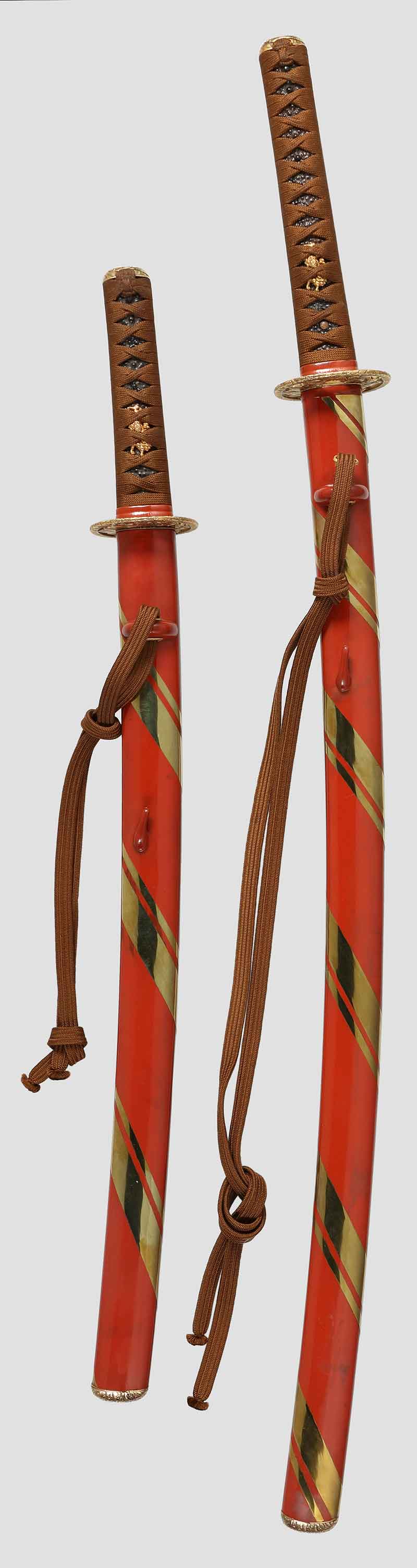
This work is a modern copy produced based on the Important Cultural Property "Shunuri Kin Hirumaki Daisho Koshirae" (owned by the Tokyo National Museum), which is attributed to have been used by Toyotomi Hideyoshi.
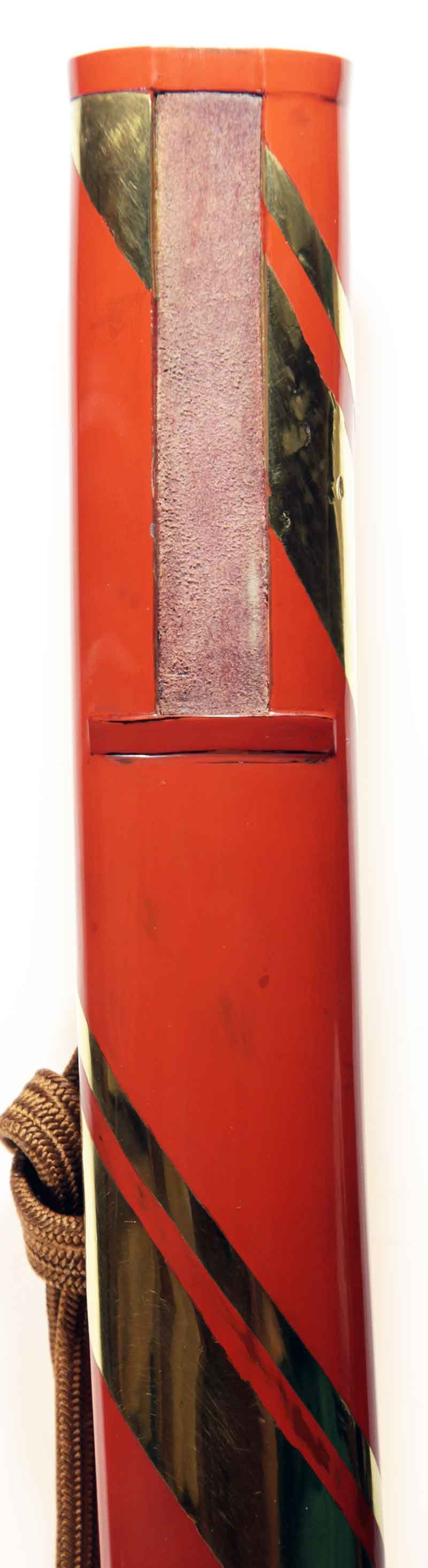
The original is a work from the Momoyama era, and it is said that after the death of Toyotomi Hideyoshi, the blades and koshirae were given to Mizoguchi Hidekatsu, the lord of Shibata Castle in Echigo Province, while the solid gold kiri-mon sukashi daisho tsuba were given to the Asano family. The saya are finished in hirumaki, where two strips of thin gold plate are wound spirally over red urushi lacquer, and the use of solid gold fittings for the tsukagashira and kojiri well demonstrates the magnificent decorative style of the Momoyama era. The original tsuba were solid gold kiri-mon sukashi tsuba, but because they were given to the Asano family, iron tsuba are currently attached.
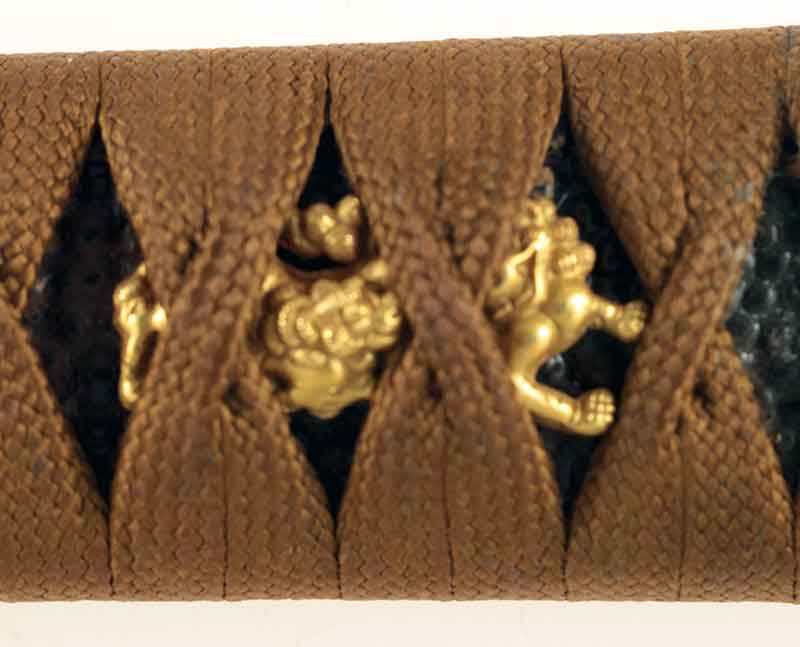
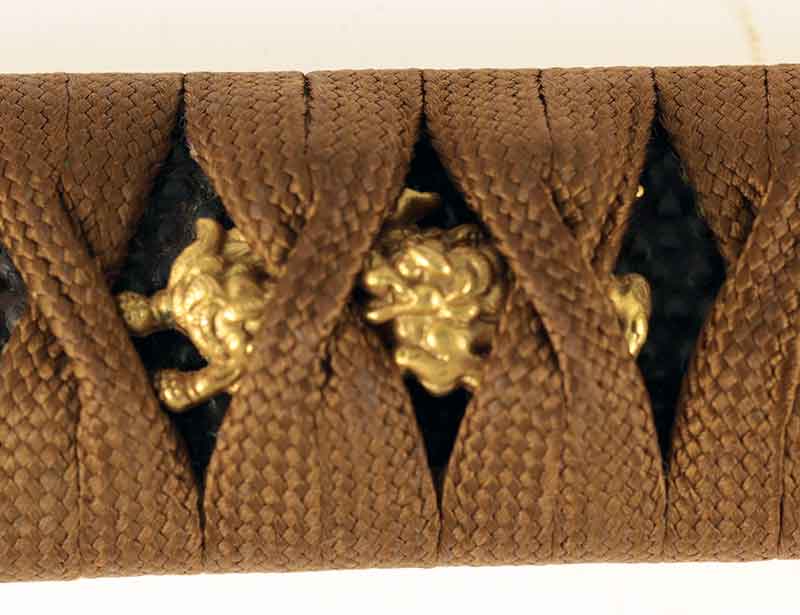
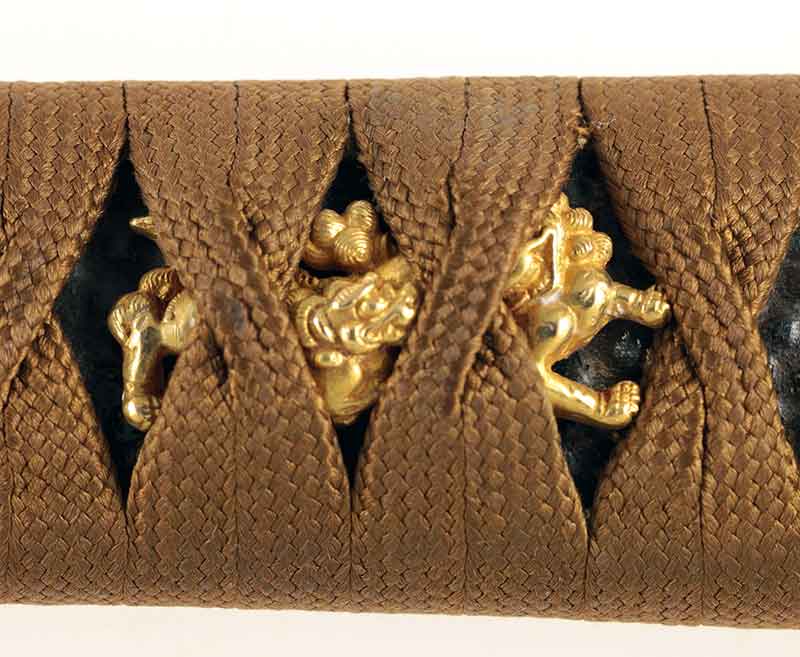
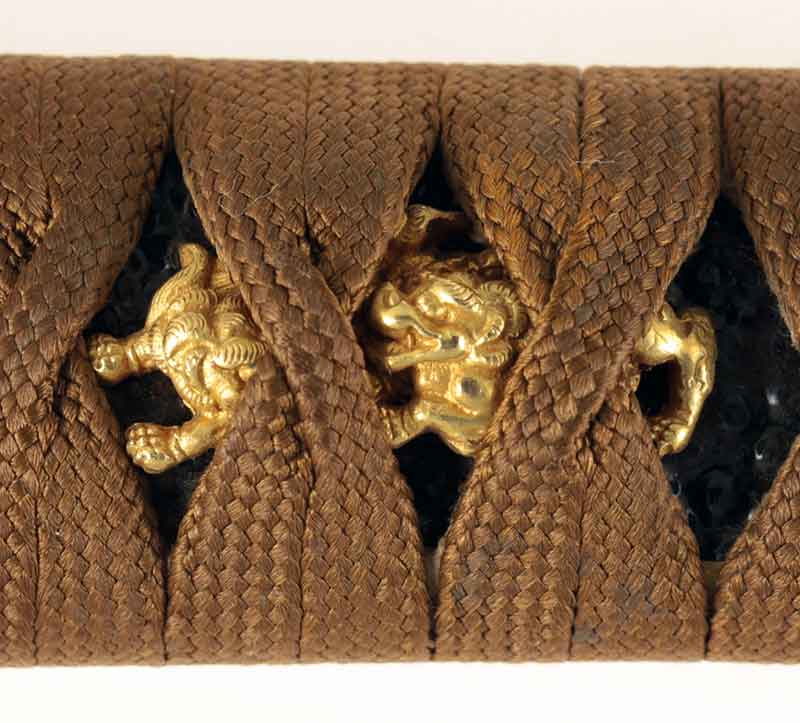
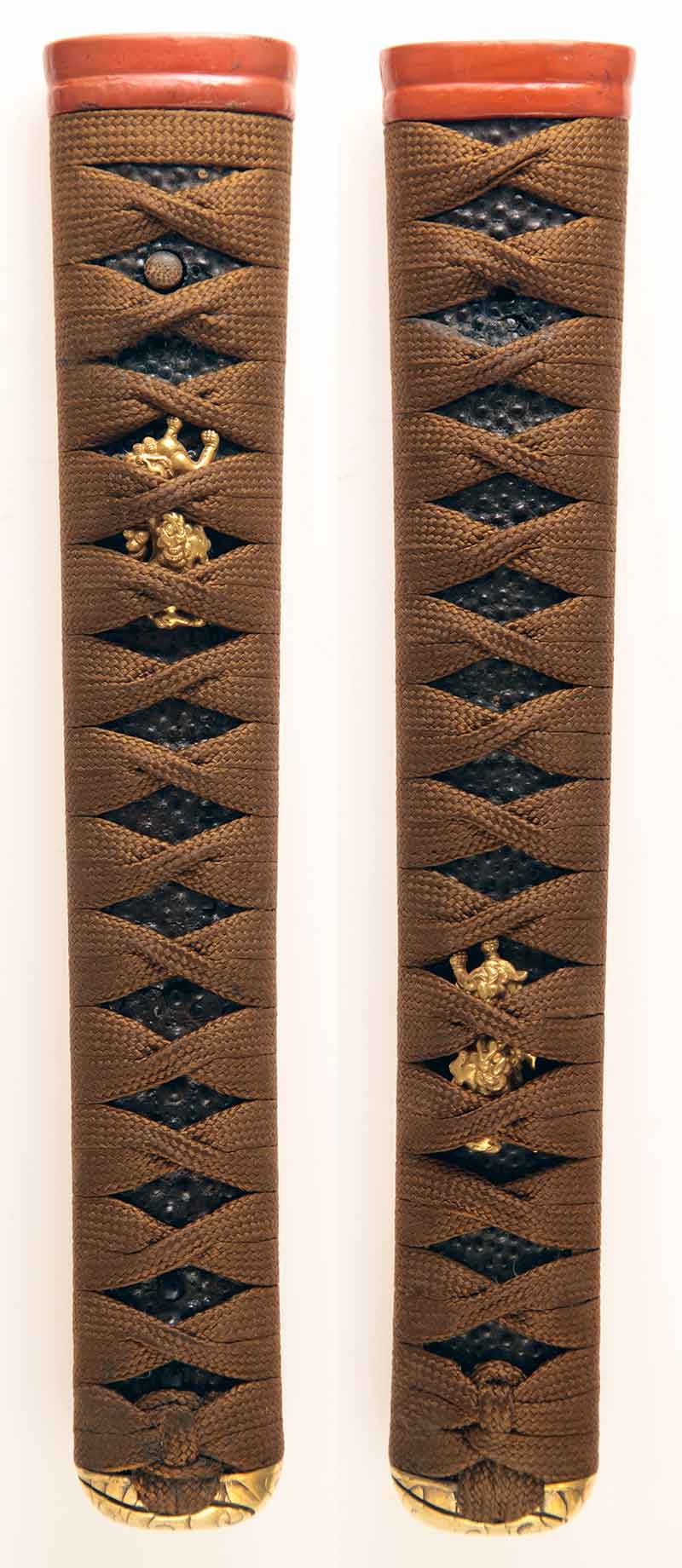
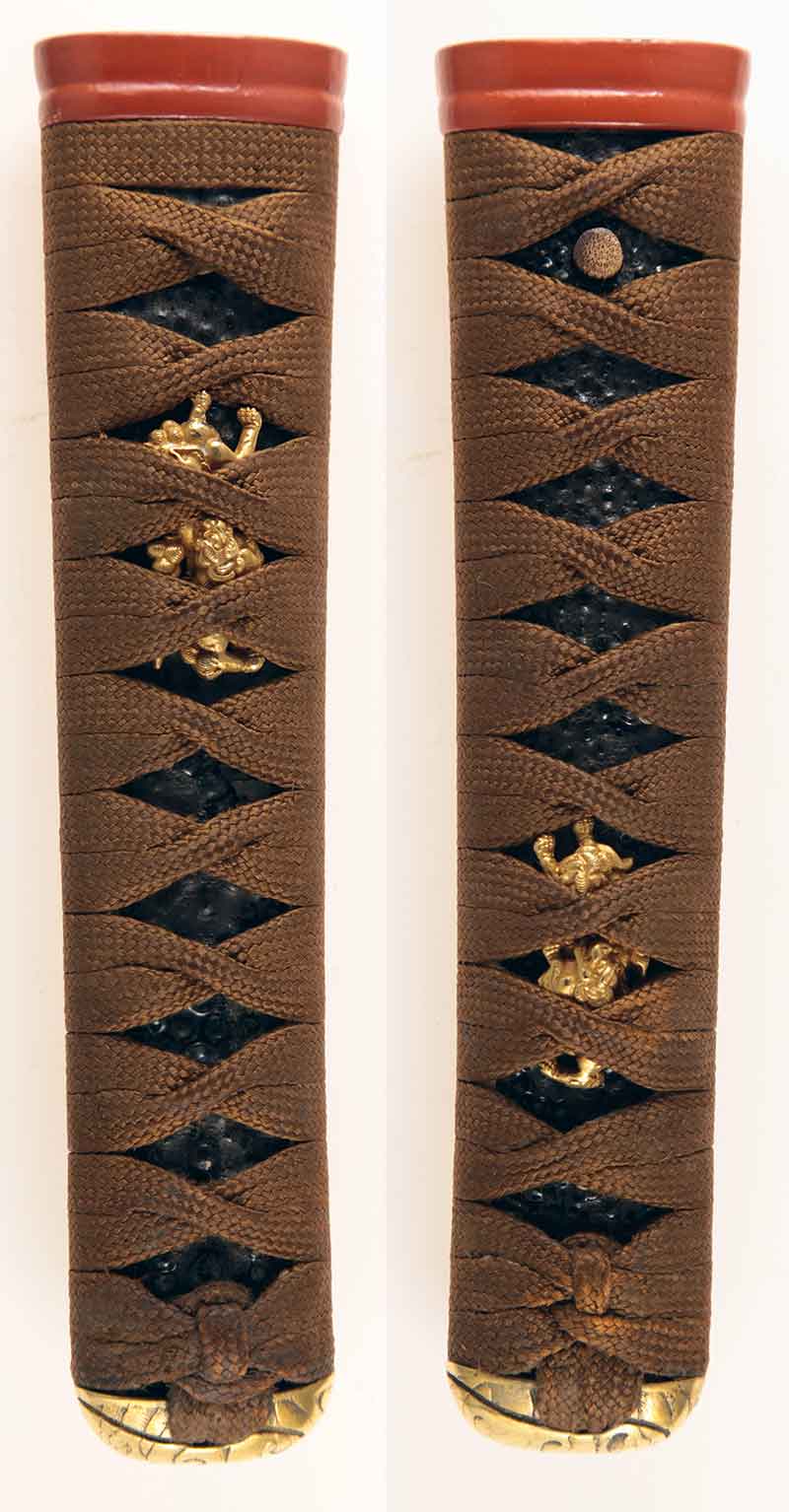
The tsukamaki is a later replacement, but it is said to have originally been kuro-ito morotsumemaki, and the menuki are arranged with the positions of the omote and ura reversed compared to general koshirae, similar to Owari koshirae. Furthermore, a characteristic point is that the kaerizuno, while standing up, is not diagonal to the saya but is attached in parallel. The style of using small solid gold tsukagashira without the wrap going over them (makigake) has elements that lead to the Higo koshirae of later generations.
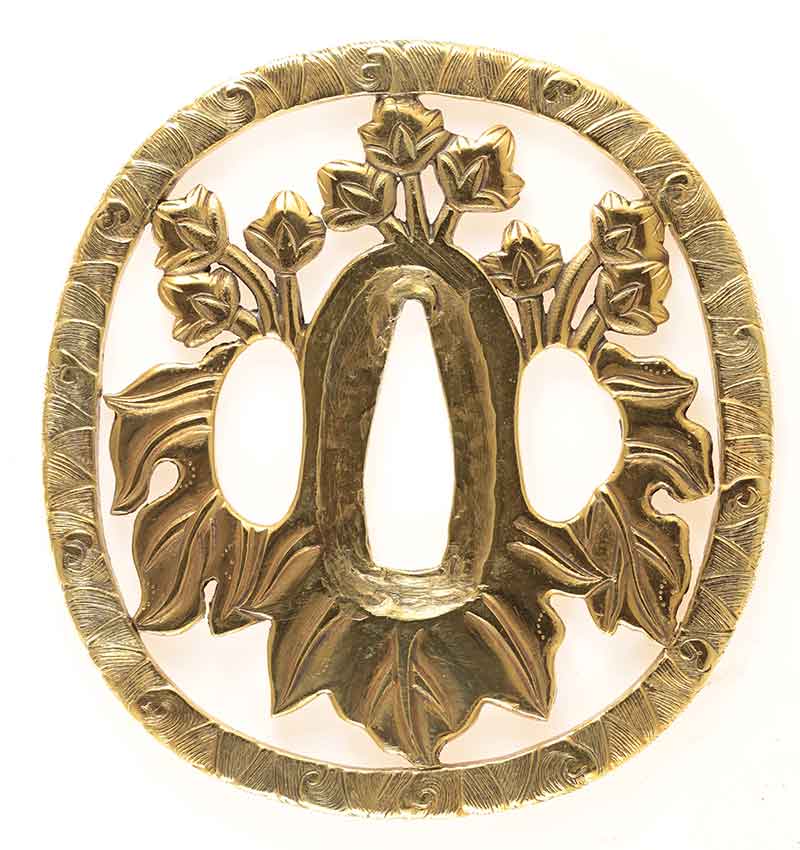
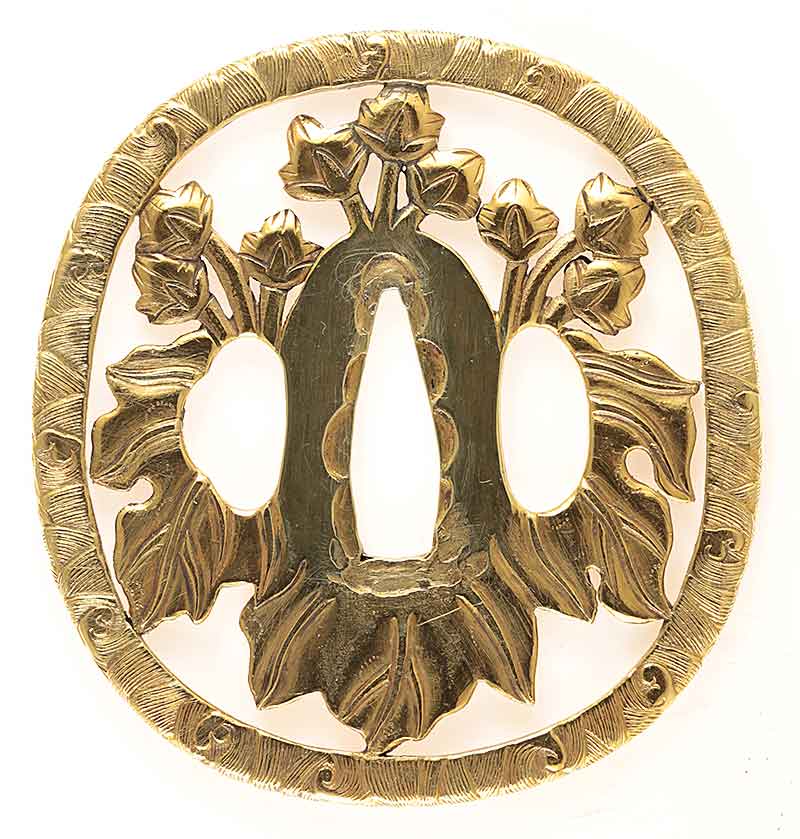
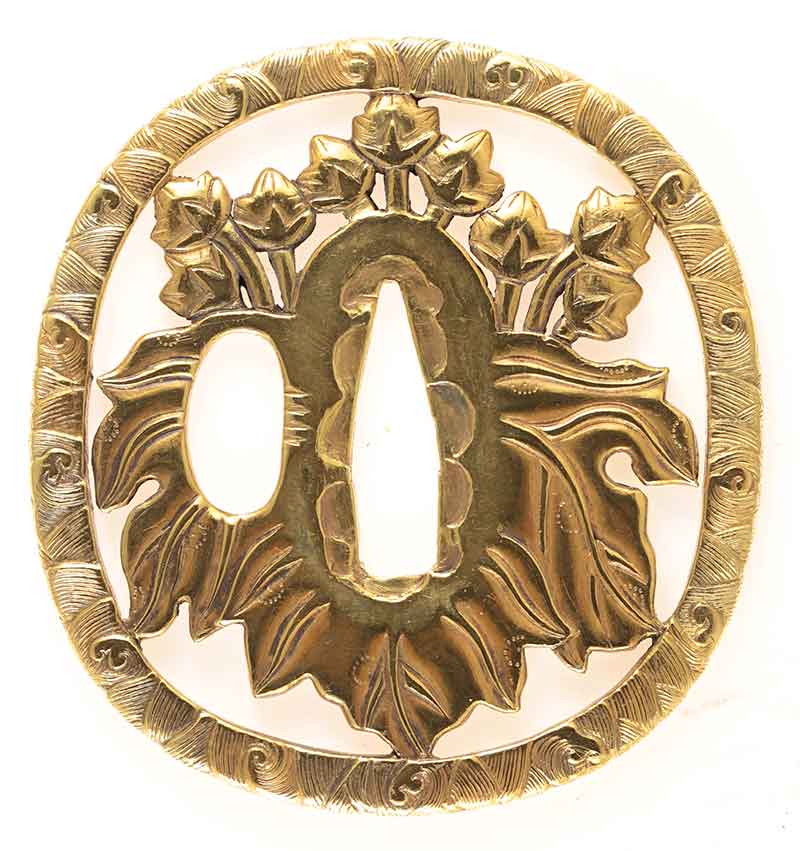
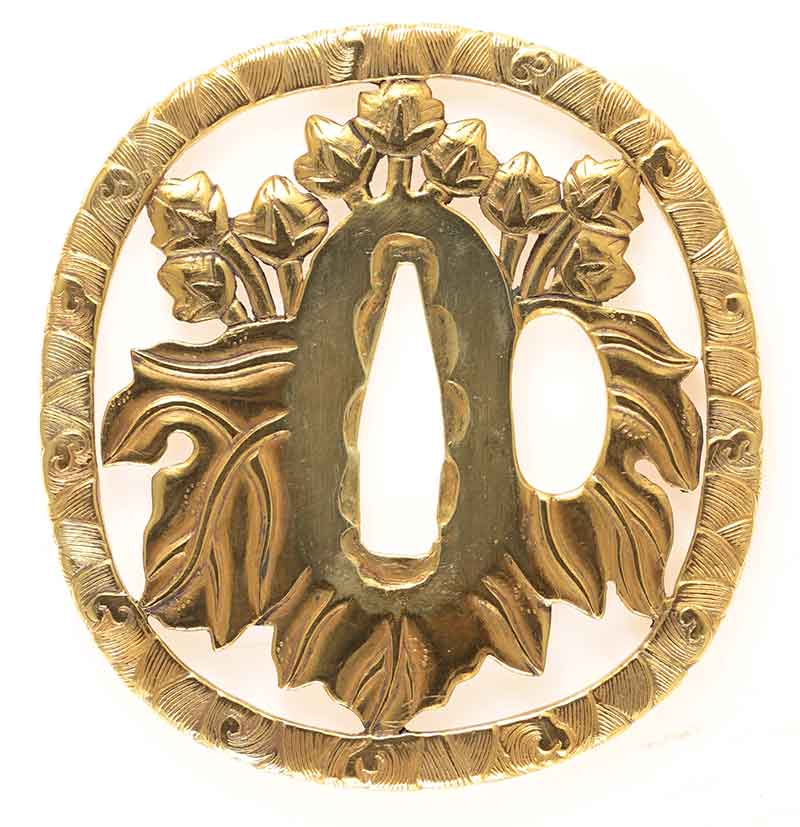
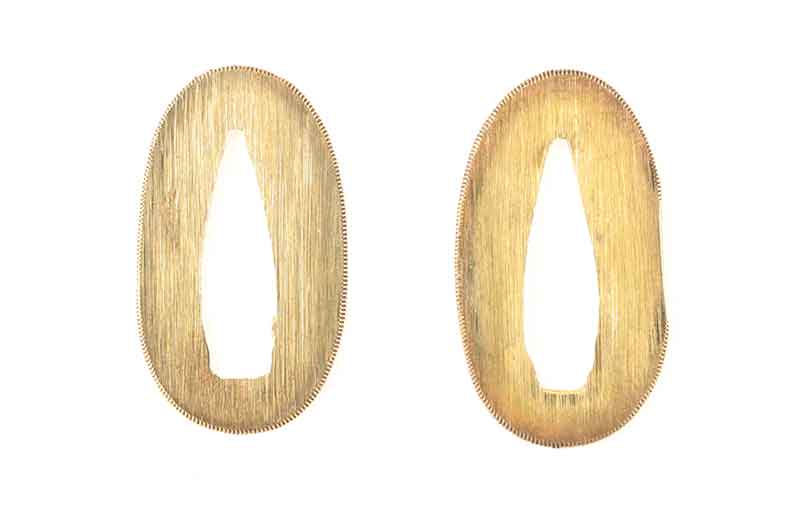
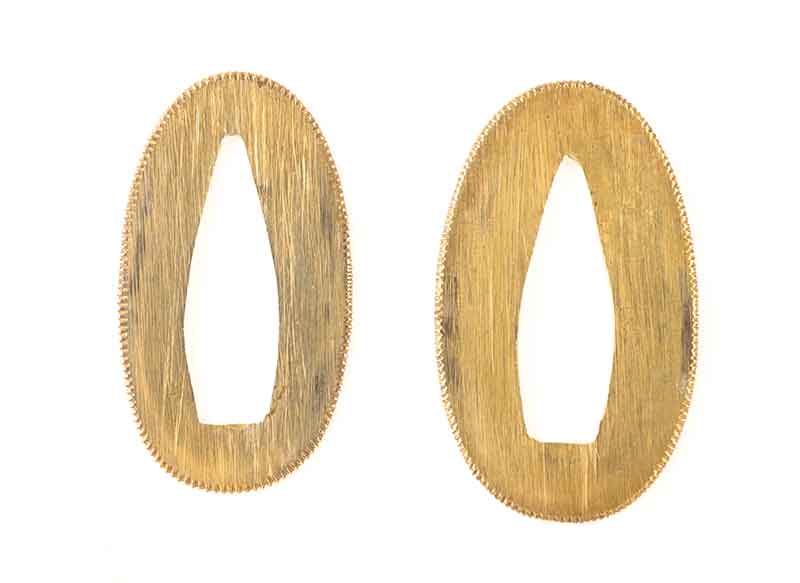
This work copies the design of the original and also reproduces the Important Art Object "Kiri-mon Daisho Tsuba" (gold openwork) passed down in the Asano family using solid gold. The original daisho tsuba passed down in the Asano family are luxurious items with kiri-mon carved in openwork on a solid gold ground and wave patterns hand-carved on the mimi, and are thought to be works of the Goto family from the Momoyama era. In this work, the daisho koshirae and daisho tsuba, which are currently passed down separately, are reproduced as a single set, creating a tailoring that evokes the appearance of the time they were used by Toyotomi Hideyoshi.
Starting with 147g for the large tsuba and 135g for the small tsuba, all fittings including the fuchi-kashira, menuki, kojiri, and seppa are manufactured in solid gold, with the total weight reaching an estimated 396 grams. The gold content is stated to be 73.8% (equivalent to approximately 17.7 karat gold), possessing a quality close to 18 karat gold. Unlike gold plating or kin-kise, it is a tailoring that luxuriously uses solid gold.
The vivid color contrast of red, gold, and black, created by applying kin-hirumaki to red urushi-nuri saya and arranging black thread tsukamaki, symbolizes the gorgeous and flamboyant Momoyama culture, and is a magnificent daisho koshirae that conveys the aesthetic sense of the ruler Toyotomi Hideyoshi to the present day. It is regrettable that the kozuka of the small wakizashi koshirae is missing.
Solid Gold Fitting Weight Details
Gold Content 73.8% (equivalent to approximately 17.7 karat gold)
Menuki: 1 pair (2 pieces) 11g = 11g
Seppa: 4 pieces 28g = 28g
Kojiri: approx. 9g x 2 = 18g
Fuchi: approx. 13g x 2 = 26g
Kashira: approx. 8g x 2 = 16g
Tsuba: (Dai) 147g = 147g
(Sho) 135g = 135g
Gold shitodome and hirumaki parts: 15g = 15g
Total = 396g
* The kozuka of the small wakizashi koshirae is missing.
That’s real money, and we couldn’t find current papers for this piece. Before you buy, ask the dealer whether it has been, or can be, submitted to shinsa. — HoshiAsk me first
Machine translation from the shop's Japanese · may contain errors ·
This work is a modern copy produced based on the Important Cultural Property "Shunuri Kin Hirumaki Daisho Koshirae" (owned by the Tokyo National Museum), which is attributed to have been used by Toyotomi Hideyoshi.
The original is a work from the Momoyama era, and it is said that after the death of Toyotomi Hideyoshi, the blades and koshirae were given to Mizoguchi Hidekatsu, the lord of Shibata Castle in Echigo Province, while the solid gold kiri-mon sukashi daisho tsuba were given to the Asano family. The saya are finished in hirumaki, where two strips of thin gold plate are wound spirally over red urushi lacquer, and the use of solid gold fittings for the tsukagashira and kojiri well demonstrates the magnificent decorative style of the Momoyama era. The original tsuba were solid gold kiri-mon sukashi tsuba, but because they were given to the Asano family, iron tsuba are currently attached.
The tsukamaki is a later replacement, but it is said to have originally been kuro-ito morotsumemaki, and the menuki are arranged with the positions of the omote and ura reversed compared to general koshirae, similar to Owari koshirae. Furthermore, a characteristic point is that the kaerizuno, while standing up, is not diagonal to the saya but is attached in parallel. The style of using small solid gold tsukagashira without the wrap going over them (makigake) has elements that lead to the Higo koshirae of later generations.
This work copies the design of the original and also reproduces the Important Art Object "Kiri-mon Daisho Tsuba" (gold openwork) passed down in the Asano family using solid gold. The original daisho tsuba passed down in the Asano family are luxurious items with kiri-mon carved in openwork on a solid gold ground and wave patterns hand-carved on the mimi, and are thought to be works of the Goto family from the Momoyama era. In this work, the daisho koshirae and daisho tsuba, which are currently passed down separately, are reproduced as a single set, creating a tailoring that evokes the appearance of the time they were used by Toyotomi Hideyoshi.
Starting with 147g for the large tsuba and 135g for the small tsuba, all fittings including the fuchi-kashira, menuki, kojiri, and seppa are manufactured in solid gold, with the total weight reaching an estimated 396 grams. The gold content is stated to be 73.8% (equivalent to approximately 17.7 karat gold), possessing a quality close to 18 karat gold. Unlike gold plating or kin-kise, it is a tailoring that luxuriously uses solid gold.
The vivid color contrast of red, gold, and black, created by applying kin-hirumaki to red urushi-nuri saya and arranging black thread tsukamaki, symbolizes the gorgeous and flamboyant Momoyama culture, and is a magnificent daisho koshirae that conveys the aesthetic sense of the ruler Toyotomi Hideyoshi to the present day. It is regrettable that the kozuka of the small wakizashi koshirae is missing.
Solid Gold Fitting Weight Details
Gold Content 73.8% (equivalent to approximately 17.7 karat gold)
Menuki: 1 pair (2 pieces) 11g = 11g
Seppa: 4 pieces 28g = 28g
Kojiri: approx. 9g x 2 = 18g
Fuchi: approx. 13g x 2 = 26g
Kashira: approx. 8g x 2 = 16g
Tsuba: (Dai) 147g = 147g
(Sho) 135g = 135g
Gold shitodome and hirumaki parts: 15g = 15g
Total = 396g
* The kozuka of the small wakizashi koshirae is missing.
Historical context
The Edo period (1615 to 1868)
›
Under the Tokugawa peace the daishō became a regulated uniform, and demand gathered in the castle towns, above all Edo itself. The craft split two ways: brilliant display work for connoisseurs, and tested blades whose cutting results were sometimes inlaid in gold.
We could not find an authenticity certificate on the seller’s listing. Japanese swords and fittings are normally papered by the NBTHK (or the NTHK). Without one, the attribution is the seller’s own assessment and has not been independently verified — treat it with caution and ask the dealer about certification before buying.
Please exercise cooling-off within 8 days of the item's arrival.
(1) We cannot accept items that have been altered or worked on in any way (e.g. test cutting, polishing or other work, display at viewing meetings, photography, taking oshigata rubbings, use for appreciation, copying of books).
(2) Return shipping is at the customer's expense.
(3) Costs other than the item price (bank transfer fees, cash-on-delivery fees, installment fees, etc.) cannot be refunded.
(4) For cash-on-delivery and similar payments, the refund is made after the payment has reached us.
(5) We cannot accept a return when a trade-in item is involved.
(6) Items delivered overseas cannot be returned or refunded (because of the time involved and, for swords, the surrender of the registration certificate and other circumstances).


 NihontoWatch