Two courts, sixty years of war, and the most dramatic silhouettes in the sword’s history: broad blades, extended points, true ōdachi later cut down into the majestic katana collectors prize. The Sōshū manner was the style of the age.
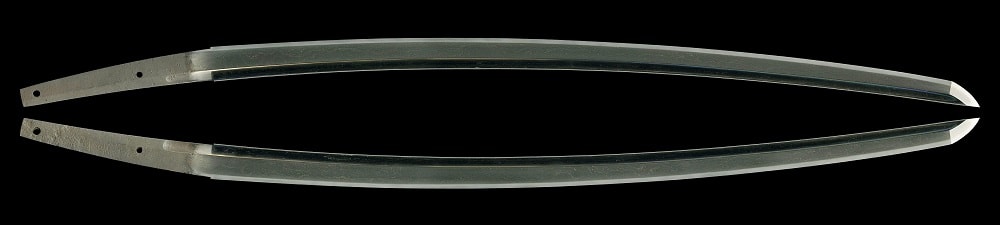
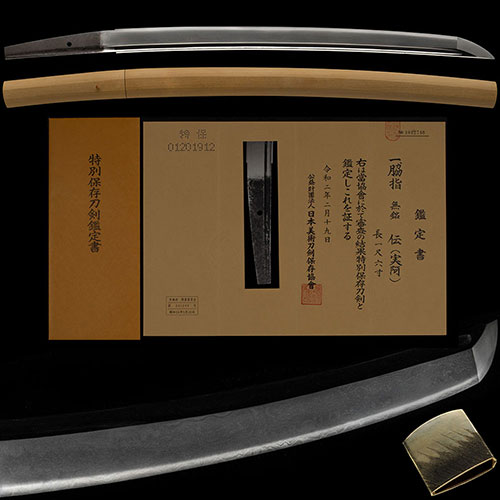
This is a wakizashi attributed to Jitsua, son of Nishiren Kuniyoshi and father of Samonji (Osa), a master of the Soshu tradition. It dates from the late Kamakura to early Nanbokucho period. The blade features a wide mihaba, a slightly elongated kissaki, and a beautiful jigane with small itamehada and mokume, displaying a bright and clear hamon with kinsuji and sunagashi.
 NihontoWatch
mumei · Nanbokucho · nagasa 48.5cm · sori 0.7cm

Chikuzen (Kyushu classical group; the Ryosai-Sairen line) · Chikuzen · around 1303-1335
Fujishiro Jo saku · Tōken Taikan top 10%
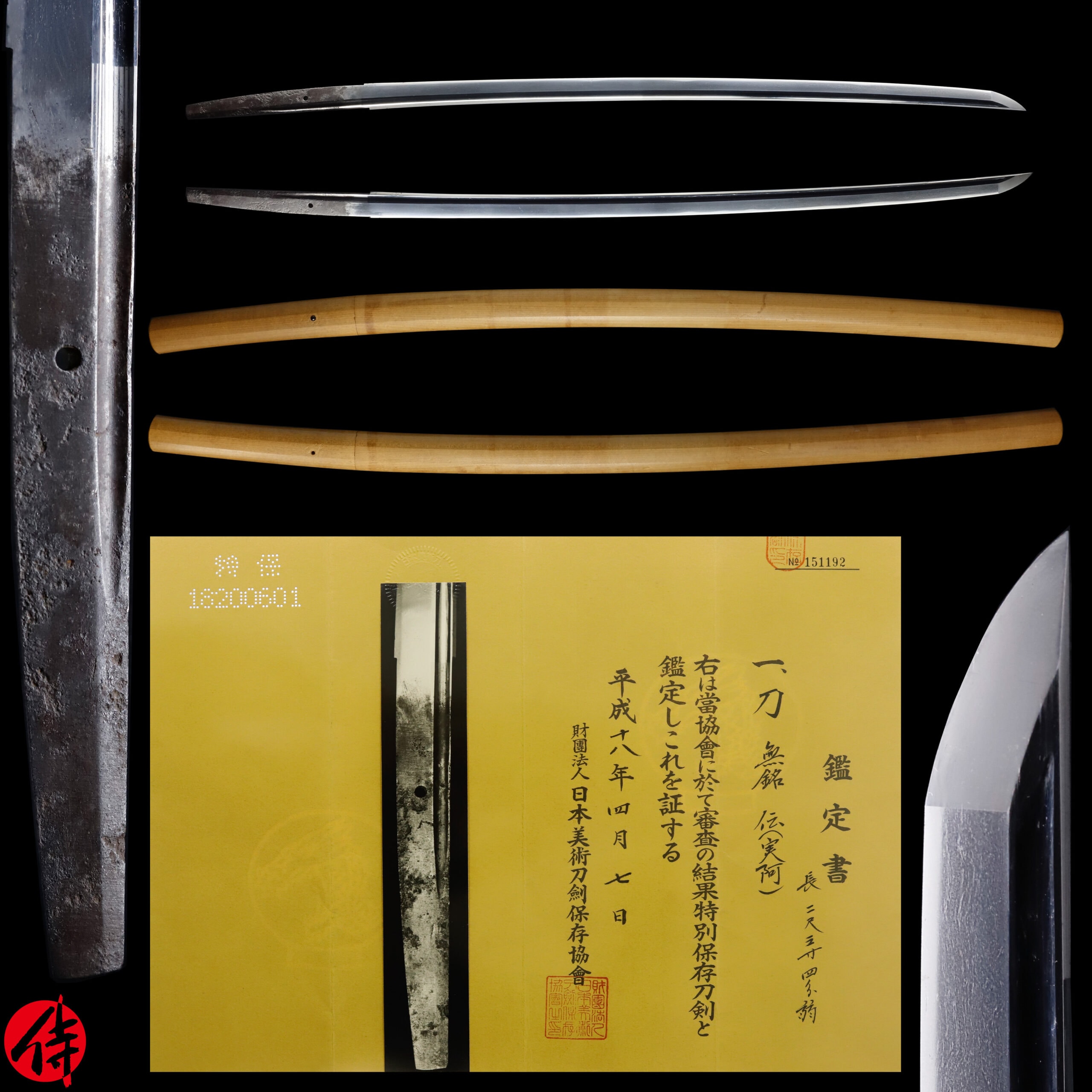
Jitsua of Chikuzen is dated by his own hand: tachi survive inscribed Genkō 3 (1333) and Kenmu 2 (1335), and a Kareki 2 (1327) sword drawing is recorded in the old swordbooks, so his period of activity is among the most securely fixed of his group. The published sources transmit him as the son of Sairen Kuniyoshi and the father of Ō-Sa, the prodigy Samonji, placing him at the hinge of the Kyūshū classical line just before it turned toward the bright Sōshū manner. He works within the tradition descending through Ryōsai, Nyūsai and Sairen, and the NBTHK reads his blades as adhering closely to that range, faithfully preserving, in their words, "the working domain of the Kyūshū classical group"[[c:1]].
His characteristic hand is that classical Kyūshū manner carried to its most vigorous. The forging is a large itame mixed with ō-itame and mokume that stands out and flows into nagare, turning toward masame near the edge and, in his most distinctive pieces, taking on an ayasugi-like grain. The published sources single him out within the lineage as the roughest and most unruly forger, the one with "the strongest tendency in the group toward a vigorous, rough character"[[c:2]]; they note further that this standing, flowing jigane at times recalls the Naminohira of the same province. Over it he tempers a low or fine suguha, the habuchi fraying into hotsure, the published record characterizing his temper as a straight one in which "the nioiguchi tends toward urumi"[[c:3]], with ko-nie adhering and sunagashi and kinsuji running through. The bōshi runs straight with hakikake to a ko-maru, at times finishing as yakitsume.
The jigane is the constant, and it is dark. Thick ji-nie scatters over the standing grain, chikei enter, and the steel takes on a blackish, iron tone over which a faint whitish shirake-utsuri rises along the shinogi. This is the Kyūshū jigane, distinct from the bright midare-utsuri of Bizen steel, and it stands together with the dark steel and the moist nioiguchi as the triad by which Jitsua is recognized. Where the forging tightens the utsuri grows clearer; where it loosens into the broad, flowing ō-itame the dark, rough character that the judges name as his comes forward. In both ji and ha the published commentary finds what one entry calls a "Kyūshū temperament"[[c:4]] of this period, distinct also from Yamato work, a regional coloration counted among the principal points of appreciation.
His record divides naturally into two registers. On one side stands the small body of signed work, extremely few in number and the documentary anchor for the whole line: tachi, several broader in body than the slender constructions of Irinishi and Sairen, with thick kasane, strong funbari and a high koshi-zori even where shortened, alongside two slender signed tantō in orthodox uchi-zori form. What sets the signed pieces apart is the signature itself, a two- or three-character mei cut unusually large and bold near the nakago-jiri, the strokes ordinary in form but the characters far larger than usual, so bold that one Tokubetsu Jūyō entry calls it "large to a degree without parallel among other examples"[[c:5]]. On the other side stands the broad body of his record, the ō-suriage mumei katana and naginata-naoshi affirmed to him from era and school, in which the same forging and the same subdued straight temper appear.
What separates Jitsua from his neighbours is exactly what the judges name. He is set apart from his quieter forebears Sairen and Nyūsai by his broader construction and his rougher, more flowing jigane; and he is held apart from his celebrated son by temper and steel alike, for where the published sources say "Ō-Sa perfected a Sōshū-den manner in which both ji and ha are bright and clear"[[c:6]], Jitsua's own suguha stays low and subdued, the nioiguchi moist over a dark, standing jigane. His is the classical Kyūshū root from which that brilliance grew, and the judges read his blades as the very foundation from which the prodigy of the next generation would emerge.
For the collector he is a rare early Kyūshū name. Fujishiro grades him Jō saku. He has no National Treasures; his record runs instead through one Important Cultural Property, the Tokubetsu Jūyō and Jūyō ranks, and the prewar Jūyō Bijutsuhin, with twenty-four blades in the Tokubetsu Jūyō and Jūyō tiers. Of recorded whereabouts his blades are preserved in long-held collections and institutions: the dignified signed tachi transmitted in the Uesugi family, others descending through the Shimazu and the Yanagawa Tachibana houses, a Jūyō Bijutsuhin held at the Sano Art Museum from the Ninomiya collection and another at the Kurokawa Institute, with further blades recorded at Kyoto National Museum and Atsuta Jingū. Signed work is the scarcer thing by far, the signed tantō scarcely to be found at all, so an in-mei Jitsua comes to light only seldom; even among the ō-suriage mumei attributions, most are held rather than traded, and a privately held example is a notable thing for a collector to encounter, a document of the Kyūshū hand from which Samonji was born.
Where Jitsua stands among comparable artisans: across all of nihontō, and within tradition, era, and period. The tiers (Foremost · Leading · Major · Notable) weigh official designations from the NBTHK and Japan's Agency for Cultural Affairs, together with historical honors of lasting repute such as the Sansaku and Meibutsu-chō.
Select a lens to see how it's measured.
Years he was demonstrably active, proven by signed-and-dated blades
Wakimono · Chikuzen
1 piece on the market now
The blades gathered here belong to the classical line of Chikuzen province seated at Hakata, whose smiths the NBTHK setsumei consistently place within what they call the Kyūshū classical group (Kyūshū koten-ha). The sampled works carry the signatures and attributions of three men of one descent: Ryōsai (良西), named in the setsumei as founder of the line; Sairen (西蓮), the tonsured name of Kuniyoshi, recorded as Ryōsai's son; and Jitsua (実阿), given as Sairen's son. The setsumei date the group to the late Kamakura period, with Jitsua's signed and dated pieces (Genkō 3, 1335 Kenmu 2) carrying the work into the early Nanbokuchō. "[[c:1]] The setsumei also gesture beyond the three: Nyūsai (Nyūsa), recorded as Ryōsai's younger brother or pupil, and Daisa, named as Jitsua's son who would carry the house toward Samonji and a matured Sōshū-den. Across the Chikuzen blades sampled, one forging idiom recurs. The kitae is itame on a large scale, the grain standing (hada-dachi) and flowing, tending to masame toward the edge, mixed in places with ō-itame and mokume; ji-nie adheres with fine chikei, and the steel carries a dark "kana-iron" cast, often with a faint whitish utsuri or shirake. The hamon is built on suguha, low in height, fraying into hotsure along the habuchi, with the nioiguchi drawn toward urumi, a moist and slightly blurred quality; ko-nie, uchi-noke, kinsuji, and sunagashi enter, sometimes with nijūba and sanjūba effects, and ko-gunome or ko-midare interspersed. Bōshi run straight into a ko-maru return, frequently with hakikake. Within this shared vocabulary the setsumei mark divisions.
Ryōsai is known from a single reliable tantō, a kanmuri-otoshi piece with conspicuous masame, a subdued (shizumi) nioiguchi, and a dropped temper at the machi (yaki-otoshi). Jitsua is read as the coarsest and most vigorous hand of the line, his forging the boldest in pattern and the one most apt to show an ayasugi-like texture, a trait the setsumei use to separate his work from Sairen's quieter suguha. For kantei the setsumei lean on this conjunction of dark, standing itame and a fraying suguha with urumi, treating the hotsure entwined with the forging as the signal that distinguishes the Chikuzen hand from other suguha traditions; the ayasugi hint and rough patterning push an attribution toward Jitsua specifically. The named works carry weight beyond style. A kinzogan-mei katana bears the gold-inlaid appraisal of Hon'ami Kōtoku, and other blades hold origami by Hon'ami Kōtsune valuing a Sairen at 150 kan. Provenance recorded in the setsumei reaches the highest houses: a Sairen katana transmitted in the Tokugawa shogunal house, another in the Shigetomi Shimazu family, and a Jitsua tachi of unusually bold mei kept in the Uesugi family. The Jūyō-Bijutsuhin entries add early-certified tachi and tantō signed Dangi-sho Kuniyoshi, Sairen, and Jitsua, with a Jitsua orikaeshi-mei dated Kenmu 2. Read together, the blades present Chikuzen not as a single voice but as a short, traceable descent whose archaic Kyūshū suguha, dark steel, and fraying edge form a recognizable register, and from whose later reach the Sōshū-den of Samonji is said to have grown. Learn more →
| Smith | Era | Designated |
|---|---|---|
| Sairen西蓮 | 1260-1261 | 43 |
| Jitsua實阿 | 1303-1335 | 27 |
| Nyusai入西 | 1293-1299 | 1 |
| Ryosai良西 | 1234-1235 | 1 |
| Sanea實阿 | 1293-1299 | 0 |
The Nanbokuchō period (1333 to 1392)
Two courts, sixty years of war, and the most dramatic silhouettes in the sword’s history: broad blades, extended points, true ōdachi later cut down into the majestic katana collectors prize. The Sōshū manner was the style of the age.
A Hozon-certified blade judged to show notably superior workmanship and a better state of preservation. The bar is higher: re-tempered blades and most unsigned Muromachi/Edo works are excluded.
The NBTHK (Nihon Bijutsu Tōken Hozon Kyōkai, the Society for the Preservation of Japanese Art Swords) is a public-interest incorporated foundation founded in 1948 and supervised by Japan’s Agency for Cultural Affairs (Bunkachō); it is based at the Japanese Sword Museum in Tokyo. Its expert panels physically examine each submitted work (shinsa) and issue a certificate (kanteishō) ranking it by artistic and historical merit. NBTHK papers are the most widely recognized standard of authentication for Japanese swords and fittings.
NBTHK official siteReturns/exchanges/cancellations not accepted after shipment except for significant defects; if defective, return/exchange possible within 3 days of arrival (return shipping paid by customer).
This is a wakizashi attributed to Jitsua, son of Nishiren Kuniyoshi and father of Samonji (Osa), a master of the Soshu tradition. It dates from the late Kamakura to early Nanbokucho period. The blade features a wide mihaba, a slightly elongated kissaki, and a beautiful jigane with small itamehada and mokume, displaying a bright and clear hamon with kinsuji and sunagashi.
NihontoWatchmumei · Nanbokucho · nagasa 48.5cm · sori 0.7cm
Chikuzen (Kyushu classical group; the Ryosai-Sairen line) · Chikuzen · around 1303-1335
Fujishiro Jo saku · Tōken Taikan top 10%
Jitsua of Chikuzen is dated by his own hand: tachi survive inscribed Genkō 3 (1333) and Kenmu 2 (1335), and a Kareki 2 (1327) sword drawing is recorded in the old swordbooks, so his period of activity is among the most securely fixed of his group. The published sources transmit him as the son of Sairen Kuniyoshi and the father of Ō-Sa, the prodigy Samonji, placing him at the hinge of the Kyūshū classical line just before it turned toward the bright Sōshū manner. He works within the tradition descending through Ryōsai, Nyūsai and Sairen, and the NBTHK reads his blades as adhering closely to that range, faithfully preserving, in their words, "the working domain of the Kyūshū classical group"[[c:1]].
His characteristic hand is that classical Kyūshū manner carried to its most vigorous. The forging is a large itame mixed with ō-itame and mokume that stands out and flows into nagare, turning toward masame near the edge and, in his most distinctive pieces, taking on an ayasugi-like grain. The published sources single him out within the lineage as the roughest and most unruly forger, the one with "the strongest tendency in the group toward a vigorous, rough character"[[c:2]]; they note further that this standing, flowing jigane at times recalls the Naminohira of the same province. Over it he tempers a low or fine suguha, the habuchi fraying into hotsure, the published record characterizing his temper as a straight one in which "the nioiguchi tends toward urumi"[[c:3]], with ko-nie adhering and sunagashi and kinsuji running through. The bōshi runs straight with hakikake to a ko-maru, at times finishing as yakitsume.
The jigane is the constant, and it is dark. Thick ji-nie scatters over the standing grain, chikei enter, and the steel takes on a blackish, iron tone over which a faint whitish shirake-utsuri rises along the shinogi. This is the Kyūshū jigane, distinct from the bright midare-utsuri of Bizen steel, and it stands together with the dark steel and the moist nioiguchi as the triad by which Jitsua is recognized. Where the forging tightens the utsuri grows clearer; where it loosens into the broad, flowing ō-itame the dark, rough character that the judges name as his comes forward. In both ji and ha the published commentary finds what one entry calls a "Kyūshū temperament"[[c:4]] of this period, distinct also from Yamato work, a regional coloration counted among the principal points of appreciation.
His record divides naturally into two registers. On one side stands the small body of signed work, extremely few in number and the documentary anchor for the whole line: tachi, several broader in body than the slender constructions of Irinishi and Sairen, with thick kasane, strong funbari and a high koshi-zori even where shortened, alongside two slender signed tantō in orthodox uchi-zori form. What sets the signed pieces apart is the signature itself, a two- or three-character mei cut unusually large and bold near the nakago-jiri, the strokes ordinary in form but the characters far larger than usual, so bold that one Tokubetsu Jūyō entry calls it "large to a degree without parallel among other examples"[[c:5]]. On the other side stands the broad body of his record, the ō-suriage mumei katana and naginata-naoshi affirmed to him from era and school, in which the same forging and the same subdued straight temper appear.
What separates Jitsua from his neighbours is exactly what the judges name. He is set apart from his quieter forebears Sairen and Nyūsai by his broader construction and his rougher, more flowing jigane; and he is held apart from his celebrated son by temper and steel alike, for where the published sources say "Ō-Sa perfected a Sōshū-den manner in which both ji and ha are bright and clear"[[c:6]], Jitsua's own suguha stays low and subdued, the nioiguchi moist over a dark, standing jigane. His is the classical Kyūshū root from which that brilliance grew, and the judges read his blades as the very foundation from which the prodigy of the next generation would emerge.
For the collector he is a rare early Kyūshū name. Fujishiro grades him Jō saku. He has no National Treasures; his record runs instead through one Important Cultural Property, the Tokubetsu Jūyō and Jūyō ranks, and the prewar Jūyō Bijutsuhin, with twenty-four blades in the Tokubetsu Jūyō and Jūyō tiers. Of recorded whereabouts his blades are preserved in long-held collections and institutions: the dignified signed tachi transmitted in the Uesugi family, others descending through the Shimazu and the Yanagawa Tachibana houses, a Jūyō Bijutsuhin held at the Sano Art Museum from the Ninomiya collection and another at the Kurokawa Institute, with further blades recorded at Kyoto National Museum and Atsuta Jingū. Signed work is the scarcer thing by far, the signed tantō scarcely to be found at all, so an in-mei Jitsua comes to light only seldom; even among the ō-suriage mumei attributions, most are held rather than traded, and a privately held example is a notable thing for a collector to encounter, a document of the Kyūshū hand from which Samonji was born.
Where Jitsua stands among comparable artisans: across all of nihontō, and within tradition, era, and period. The tiers (Foremost · Leading · Major · Notable) weigh official designations from the NBTHK and Japan's Agency for Cultural Affairs, together with historical honors of lasting repute such as the Sansaku and Meibutsu-chō.
Select a lens to see how it's measured.
Years he was demonstrably active, proven by signed-and-dated blades
Wakimono · Chikuzen
1 piece on the market now
The blades gathered here belong to the classical line of Chikuzen province seated at Hakata, whose smiths the NBTHK setsumei consistently place within what they call the Kyūshū classical group (Kyūshū koten-ha). The sampled works carry the signatures and attributions of three men of one descent: Ryōsai (良西), named in the setsumei as founder of the line; Sairen (西蓮), the tonsured name of Kuniyoshi, recorded as Ryōsai's son; and Jitsua (実阿), given as Sairen's son. The setsumei date the group to the late Kamakura period, with Jitsua's signed and dated pieces (Genkō 3, 1335 Kenmu 2) carrying the work into the early Nanbokuchō. "[[c:1]] The setsumei also gesture beyond the three: Nyūsai (Nyūsa), recorded as Ryōsai's younger brother or pupil, and Daisa, named as Jitsua's son who would carry the house toward Samonji and a matured Sōshū-den. Across the Chikuzen blades sampled, one forging idiom recurs. The kitae is itame on a large scale, the grain standing (hada-dachi) and flowing, tending to masame toward the edge, mixed in places with ō-itame and mokume; ji-nie adheres with fine chikei, and the steel carries a dark "kana-iron" cast, often with a faint whitish utsuri or shirake. The hamon is built on suguha, low in height, fraying into hotsure along the habuchi, with the nioiguchi drawn toward urumi, a moist and slightly blurred quality; ko-nie, uchi-noke, kinsuji, and sunagashi enter, sometimes with nijūba and sanjūba effects, and ko-gunome or ko-midare interspersed. Bōshi run straight into a ko-maru return, frequently with hakikake. Within this shared vocabulary the setsumei mark divisions.
Ryōsai is known from a single reliable tantō, a kanmuri-otoshi piece with conspicuous masame, a subdued (shizumi) nioiguchi, and a dropped temper at the machi (yaki-otoshi). Jitsua is read as the coarsest and most vigorous hand of the line, his forging the boldest in pattern and the one most apt to show an ayasugi-like texture, a trait the setsumei use to separate his work from Sairen's quieter suguha. For kantei the setsumei lean on this conjunction of dark, standing itame and a fraying suguha with urumi, treating the hotsure entwined with the forging as the signal that distinguishes the Chikuzen hand from other suguha traditions; the ayasugi hint and rough patterning push an attribution toward Jitsua specifically. The named works carry weight beyond style. A kinzogan-mei katana bears the gold-inlaid appraisal of Hon'ami Kōtoku, and other blades hold origami by Hon'ami Kōtsune valuing a Sairen at 150 kan. Provenance recorded in the setsumei reaches the highest houses: a Sairen katana transmitted in the Tokugawa shogunal house, another in the Shigetomi Shimazu family, and a Jitsua tachi of unusually bold mei kept in the Uesugi family. The Jūyō-Bijutsuhin entries add early-certified tachi and tantō signed Dangi-sho Kuniyoshi, Sairen, and Jitsua, with a Jitsua orikaeshi-mei dated Kenmu 2. Read together, the blades present Chikuzen not as a single voice but as a short, traceable descent whose archaic Kyūshū suguha, dark steel, and fraying edge form a recognizable register, and from whose later reach the Sōshū-den of Samonji is said to have grown. Learn more →
| Smith | Era | Designated |
|---|---|---|
| Sairen西蓮 | 1260-1261 | 43 |
| Jitsua實阿 | 1303-1335 | 27 |
| Nyusai入西 | 1293-1299 | 1 |
| Ryosai良西 | 1234-1235 | 1 |
| Sanea實阿 | 1293-1299 | 0 |
The Nanbokuchō period (1333 to 1392)
Two courts, sixty years of war, and the most dramatic silhouettes in the sword’s history: broad blades, extended points, true ōdachi later cut down into the majestic katana collectors prize. The Sōshū manner was the style of the age.
A Hozon-certified blade judged to show notably superior workmanship and a better state of preservation. The bar is higher: re-tempered blades and most unsigned Muromachi/Edo works are excluded.
The NBTHK (Nihon Bijutsu Tōken Hozon Kyōkai, the Society for the Preservation of Japanese Art Swords) is a public-interest incorporated foundation founded in 1948 and supervised by Japan’s Agency for Cultural Affairs (Bunkachō); it is based at the Japanese Sword Museum in Tokyo. Its expert panels physically examine each submitted work (shinsa) and issue a certificate (kanteishō) ranking it by artistic and historical merit. NBTHK papers are the most widely recognized standard of authentication for Japanese swords and fittings.
NBTHK official siteReturns/exchanges/cancellations not accepted after shipment except for significant defects; if defective, return/exchange possible within 3 days of arrival (return shipping paid by customer).