 NihontoWatchNihontoWatch
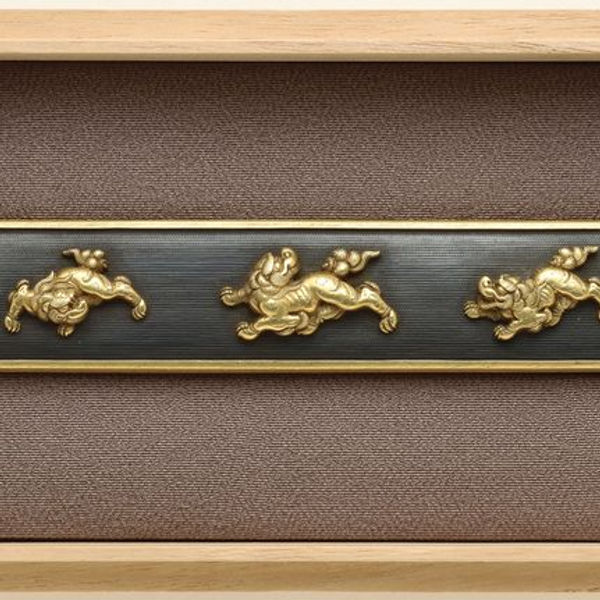
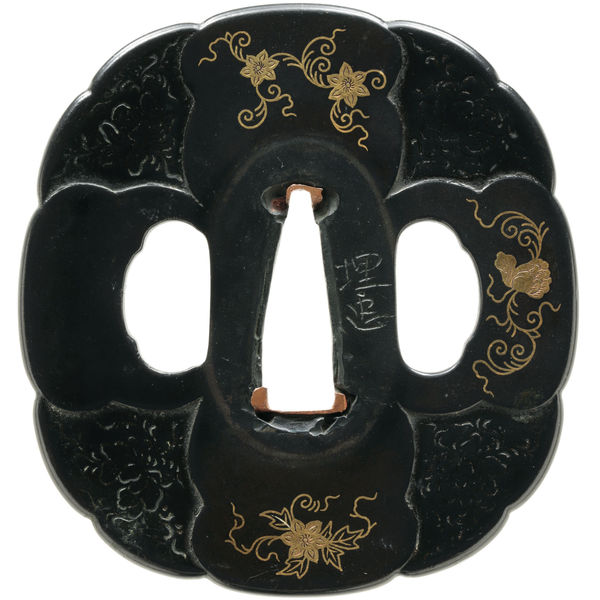
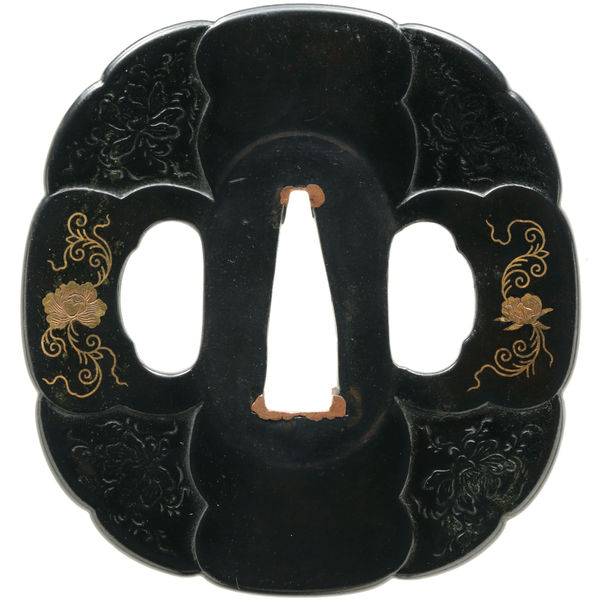
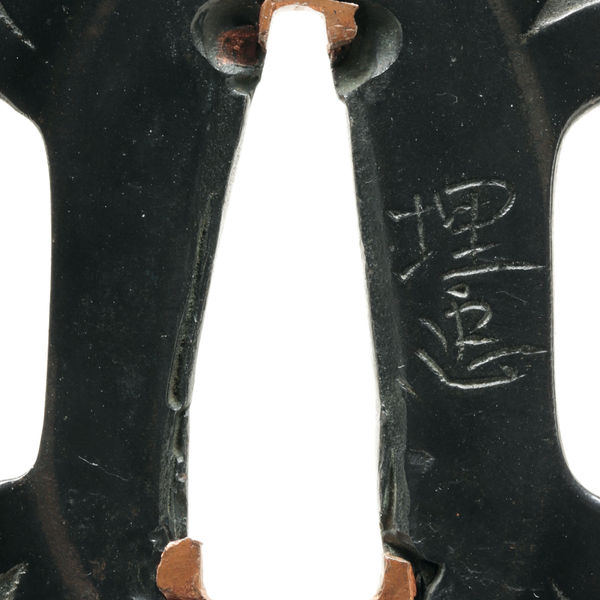
Ginza Choshuya 東京都中央区銀座3-10-4 月–土 9:30–17:30 牡丹唐草を題材に、造り込み、毛彫、平象嵌といった多彩な技法の駆使による、品の良さと文様文化の伝統とが示された、埋忠派の特質が鑑賞される鐔。桃山時代の埋(うめ)忠(ただ)明壽が生み出した表現の一つである平(ひら)象嵌(ぞうがん)は、絵画の文様表現という点で時代の最先端にあった。本作はこれを踏襲した明壽一門の作。花の開いた牡丹のように仕立てた赤銅地の表面に、繊細で鮮やかな金の平象嵌により牡丹と鉄線を描き、四方には石目地に煙り込むような毛彫で牡丹を彫り表している。
NihontoWatchOffered by Choshuya

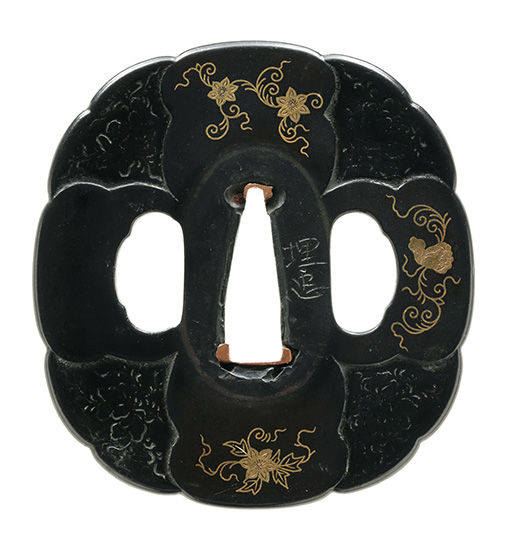
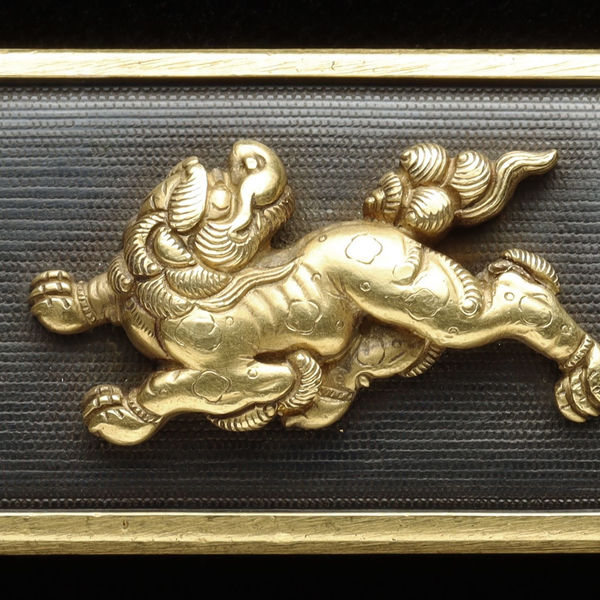
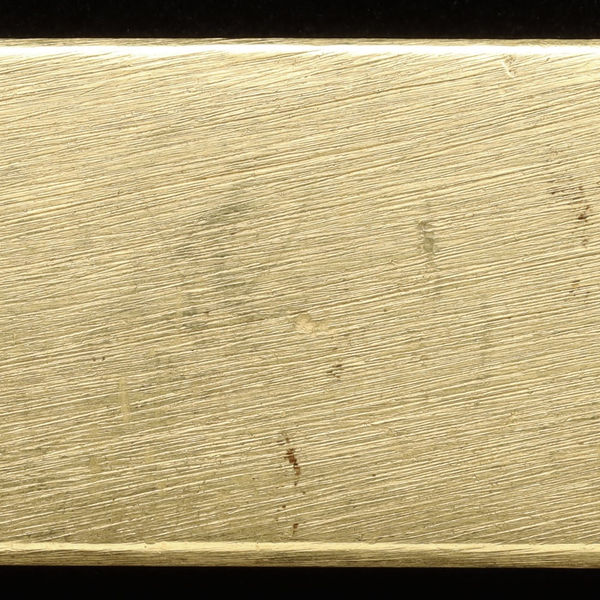
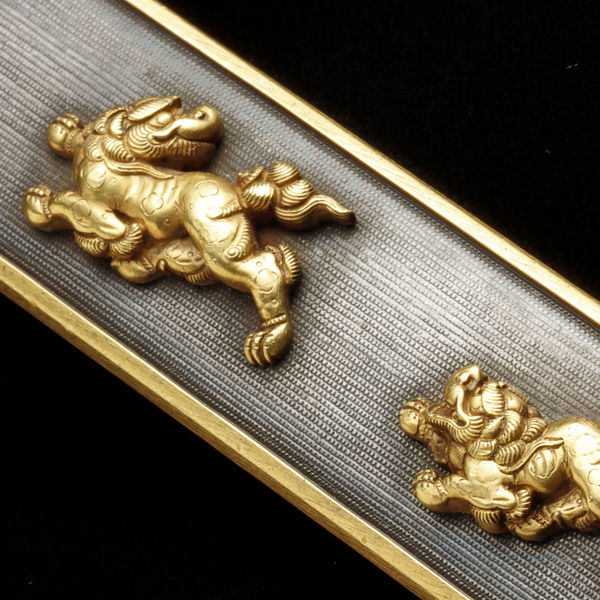
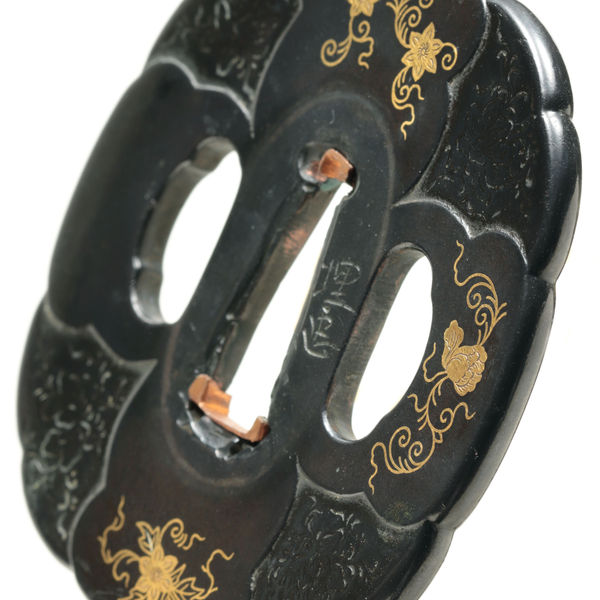
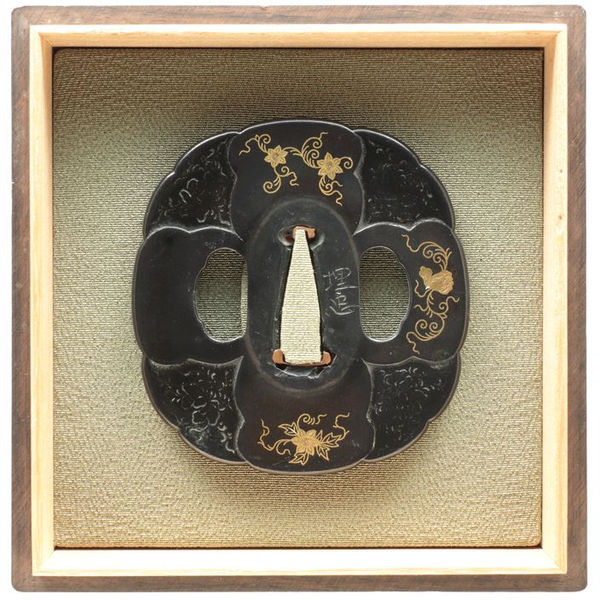
Shinto · around 1588-1591
The Umetada family constitutes one of the most distinguished metalworking lineages of the Momoyama period. Together with the Goto house, the Umetada are recognized as preeminent among sword-related artisans, yet in the making of tsuba they stand without rival. The lineage produced many celebrated masters, foremost among them Umetada Myoju, whose inventive originality and vigorous artistic spirit epitomize the era. Works bearing the two-character signature "Umetada" are encountered from time to time, clearly distinguishable from Myoju yet reflecting the same school tradition. The earliest productions, appraised as Ko-Umetada, date from the close of the Muromachi period into the Momoyama era and demonstrate that the group's technical foundations were already firmly established before Myoju's maturity.
Myoju's tsuba divide broadly into iron and irogane (soft-metal alloy) types, and in both form and design they display striking originality. Among the irogane works, materials such as shakudo, suaka, and brass are employed to bring out the underlying jigane texture, achieving varied surface effects of great subtlety. Myoju is credited with originating hira-zogan (flat inlay), thereby introducing a pictorial quality and opening an entirely new expressive dimension within the world of tsuba. The school's mastery of koke-yasuri (moss-file ground finish) is equally celebrated: executed upon solid-gold plates, this treatment yields an abundance of calm beauty through exquisitely controlled modeling of the flat planes. Further hallmarks include the uchikaeshi-mimi with hineri (twisted turned-back rim), bold stylization of motifs, and a subtle tapering of the seppa-dai contour from blade side to hilt side -- a careful provision characteristic of artisans who thoroughly understood koshirae and tosogu.
The Umetada are lauded for a virtuosity of filework that "defies adequate description," and their fittings are said to have enhanced innumerable celebrated swords with an elevated dignity. Solid-gold tsuba were frequently melted down during periods of upheaval, making surviving Momoyama-period examples extremely few; each is therefore of exceptional documentary and artistic value. In the broader context of Kyoto metalwork, the Umetada, along with the Goto, Hirata, and Shoami groups, mutually influenced one another after the beginning of the Edo period, and these interactions are reflected in evolving styles. The school's enduring significance lies in its fusion of technical mastery with the bold aesthetic sensibility of the Momoyama age, producing works that fully manifest the aesthetic core of the mainline tradition.
Where Umetada stands among comparable artisans: across all of nihontō, and within tradition, era, and period. The tiers (Foremost · Leading · Major · Notable) weigh official designations from the NBTHK and Japan's Agency for Cultural Affairs, together with historical honors of lasting repute such as the Sansaku and Meibutsu-chō.
Select a lens to see how it's measured.
Shinto · Kyoto
45 pieces on the market now
The Umetada school is one of the most distinguished metalworking lineages of the Momoyama period, rooted in Nishijin, Kyoto, and claiming descent from the legendary Sanjo Munechika. The house served the Ashikaga shogunal family over successive generations, establishing deep foundations in the full range of sword-related arts -- swordmaking, blade carving (toshin-bori), the production of steel and fittings, the shortening of blades, the insertion of inlaid signature attributions (zogan-mei), and the making of mountings. " Myoju taught both Hizen Tadayoshi and Higo no Kami Teruhiro, and accepted commissions from the Toyotomi and Tokugawa houses as well as many daimyo families. An earlier stratum of production, appraised as Ko-Umetada, dates from the close of the Muromachi period and demonstrates that the group's technical foundations were firmly established before Myoju's maturity. The near-contemporary Mitsutada, though absent from formal genealogies, is conjectured to have been of senior standing within the circle; his works, executed on brass with an archaic dekoboko-ji ground, display "an even more classically archaic elegance" than Myoju's. Shigeyoshi, active from the Kan'ei through Genroku eras, carried the tradition forward into the mid-Edo period. The Umetada school's collective technical identity divides into two principal modes: iron works and soft-metal (irogane) works. In the iron mode, Myoju expressed geometric patterns -- sayagata, raimon, kasumi-kaminari-mon, and rinzu-mon -- by means of gold nunome-zogan, complemented by celebrated openwork including wheel and double-tomoe sukashi tsuba.
The nejikaeshi-mimi (twisted turned-back rim) and gold rim inlay are techniques "at which he particularly excelled," while the iron itself is invariably "carefully selected" and displays excellent quality. In the irogane mode -- employing shakudo, suaka, brass, and other alloys as ground material -- the school developed a distinctive form of hira-zogan (flat inlay) that retains only slight relief, deploying colored metals in novel combinations. " Ground textures including hammered tsuchime-ji, polished migaki-ji, and file-finished surfaces are deployed with meticulous care to heighten the pictorial effect. Mitsutada's work on brass with its uneven, raised-and-recessed ground and enrichment through gold and silver nunome-zogan represents a more archaic variant of this aesthetic. Shigeyoshi synthesized the inherited hira-zogan tradition with textile-derived designs of linked shippo, karakusa arabesque, and sayagata patterns -- reflecting his Nishijin milieu, the heart of Kyoto's silk-weaving district -- while deploying suemon-zogan, sukidashi-bori, and kin-iroe across shakudo grounds in both polished and stone-textured finishes. The Umetada school's historical significance is singular: the pictorial manner of design, the hira-zogan technique, and the use of non-iron metals as the ground material "all find their earliest beginning with Myoju" -- he stands as the originator of an entire aesthetic vocabulary in kinko. The NBTHK consistently describes Myoju's work as possessing "the vitality that preserves the very momentum of brushwork," with a "strong connection with Hon'ami Koetsu and Tawaraya Sotatsu" that places him among the foremost artistic figures of the Momoyama age. " Solid-gold tsuba, frequently melted down during periods of upheaval, are recognized as extremely rare survivals of exceptional documentary and artistic value. Learn more →
| Smith | Era | Designated |
|---|---|---|
| Myoju明寿 | 1590-1631 | 45 |
| Muneyoshi宗吉 | 1596-1615 | 4 |
| Naritsugu就次 | — | 0 |
| Umetada Mitsushige光重 | 1700-1750 | 0 |
| Kaji’emon加治右衛門 | — | 0 |
Certifies a genuine fitting worth preserving: a correct signature, or, if unsigned, an identifiable era and school, with recognized artistic and craft value.
The NBTHK (Nihon Bijutsu Tōken Hozon Kyōkai, the Society for the Preservation of Japanese Art Swords) is a public-interest incorporated foundation founded in 1948 and supervised by Japan’s Agency for Cultural Affairs (Bunkachō); it is based at the Japanese Sword Museum in Tokyo. Its expert panels physically examine each submitted work (shinsa) and issue a certificate (kanteishō) ranking it by artistic and historical merit. NBTHK papers are the most widely recognized standard of authentication for Japanese swords and fittings.
NBTHK official siteIf, due to our fault, the item differs significantly from its proper condition, the item may be returned. Cooling-off is within one week of the item's arrival.