 NihontoWatchNihontoWatch
Echizen Sadayoshi (越前定吉) was a smith of the Chiyozuru school, active during the Nanbokuchô period in the mid-fourteenth century. He is a rare and somewhat elusive figure – his name does not appear in the standard Meikan sword reference books, and signed works attributed to him are unusual, some bearing simply the character “一” (Ichi) on the tang. What can be said is that the character of his work aligns with a northern tradition, and the Chiyozuru school connection places him within a lineage that produced bold, robustly constructed blades. The NBTHK’s attribution to Sadayoshi, confirmed at the 19th Jûyô session in June 1970 – one of the earlier sessions in the programme’s history – carries particular weight given how early such recognition was extended to a smith this lightly documented. This blade is a naginata-naoshi – a polearm blade reforged and remounted as a sword, a conversion that was common during and after the Nanbokuchô period as battlefield naginata were repurposed for personal wear. The naginata heritage is immediately apparent in the proportions: a wide mihaba with very little taper (3.1 cm at the base, 2.75 cm at the tip), and an ô-kissaki of extraordinary length at 10.25 cm – a figure that speaks directly to the sweeping, lethal geometry of the original polearm tip. The kitae is an ô-itame with nagare, hada-tachi throughout, and a shirake utsuri moving through the ji. The hamon is a ko-notare gunome midare with a relatively narrow yakihaba, hotsure along the habuchi, ko-ashi, sunagashi, kinsuji, deep nioi, and thick ko-nie. The bôshi is midare-komi with hakikake at the tip and yakizume – tight and decisive. Both sides of the blade retain traces of the original kanmuri-otoshi grooves from its naginata life, visible on the nakago. At the 19th Jûyô session, held in 1970, this was among a relatively small and selective body of blades to receive the designation in what remains one of the programme’s earlier and more tightly curated sessions. For a blade by a smith absent from the standard reference literature, Jûyô certification at this stage is a statement of exceptional quality. The combination of its unusual attribution, the dramatic naginata-naoshi sugata, and that commanding ô-kissaki make this a blade that is both historically significant and visually striking.
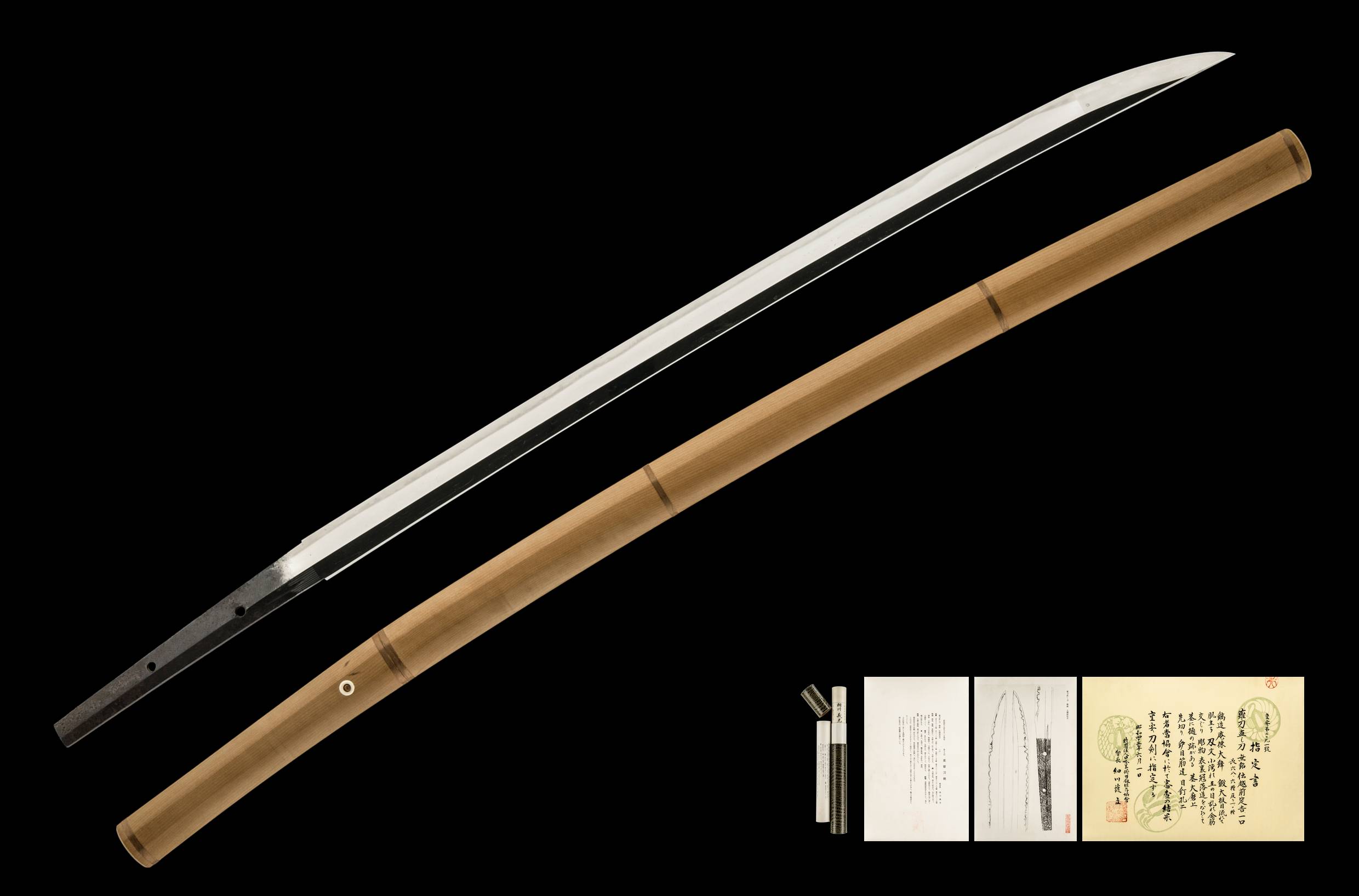
販売店の記載のまま
山城伝 · 越前
現在9点販売中
千代鶴派は越前を本拠とした一門である。説示によれば、その祖は来国安に求められる。来国安は生国を山城とし、一説に来国末の孫といい、のちに越前へ移住して千代鶴派の祖となったと伝え、銘鑑はその年代を貞治の頃とする。あわせて越前には来国安の弟子と伝える千代鶴国安なる工があり[[c:1]]、これを祖とする伝えもあって、時代を同じく貞治の頃という。いずれにせよ一門は山城の来派を源流に置き、これを越前の地に移したものとして説示は位置づけている。以後この派は室町期まで続き、国安系の守弘が現れる。守弘は同名に複数代があり、銘鑑は初代を応永、二代を嘉吉あるいは文安の頃とし、藤左衛門尉と称した者もあるという。さらに越前敦賀の光行のごとく[[c:2]]、一説に越前国行の門と伝える年紀作の工も説示に名を連ねる。 作風は、来派を承けた地刃に越前という地方色が加わる点に特徴がある。鍛えは板目に杢目や流れ肌を交え、総じて肌立ちごころとなり、地沸が厚くつき、地景がしきりに入り、白けごころを帯び、鉄色がやや黒みがかるものがある。刃文は来国安に擬せられる一類では中直刃を基調に小互の目を交え、足が入り、刃縁にほつれ・喰違刃・二重刃が現れ、沸がよくついて匂口が明るい。一方、守弘ら国安系の作では互の目調の乱れ刃となり、丁子ごころや尖りごころの刃を交え、飛焼が入り、棟焼がしきりにかかり、砂流し・金筋がかかって地刃ともによく沸づくものが目立つ。帽子は直ぐごころに小丸となるもの、乱れ込んで掃きかけるもの、焼き詰めるものなど作により変化する。見分けにあたっては、肌立ちと白けごころ、黒みがかる鉄色、帽子に見える野趣ある働きなどが手掛かりとなる。 鑑定では、一見すると山城本国の来国光あたりにも見えるが、注視すれば地刃の出来に一歩を譲り、肌立ちが強く帽子の働きが本国以上に野趣を示すところに、来国安の極めが首肯される、と説示はくり返し述べる。守弘の作は互の目調の乱れ刃で地刃ともによく沸え、来風とは趣を異にするとされ、有銘作が珍重される。代表的な遺例としては、無銘ながら身幅広く大鋒に結ぶ南北朝期の姿を示す来国安極めの刀、互の目調の乱れ刃を焼いた守弘の太刀や年紀ある脇指、越前敦賀の光行の年紀短刀などが説示に挙げられる。現存する作刀は少なく、来派の正系を越前に伝えた一門として位置づけられている。 詳しく見る →
特別保存刀剣の中から、特に出来が優れ、国認定の重要美術品に準ずると判断された名品です。年に一度の重要刀剣審査で選ばれます。
極めて選別的で、日本に登録された約250万口の刀剣のうち、重要刀剣に達したものは12,348口(約202口に1口)にすぎません。
日本美術刀剣保存協会(NBTHK)は、1948年に設立され、文化庁の監督を受ける公益財団法人で、東京・刀剣博物館に本部を置きます。専門の審査員が出品作を直接審査し、美術的・歴史的価値に応じた鑑定書を発行します。NBTHKの鑑定書は、日本刀および刀装具の真正性を示す最も広く認知された基準です。
NBTHK公式サイトAll swords come with a three-day inspection period beginning from the date of delivery. If not satisfied, the sword may be returned within this period for a full refund of the purchase price. Outside of this period, all sales are final. Swords purchased on a layaway payment plan are not eligible for the three-day inspection period.