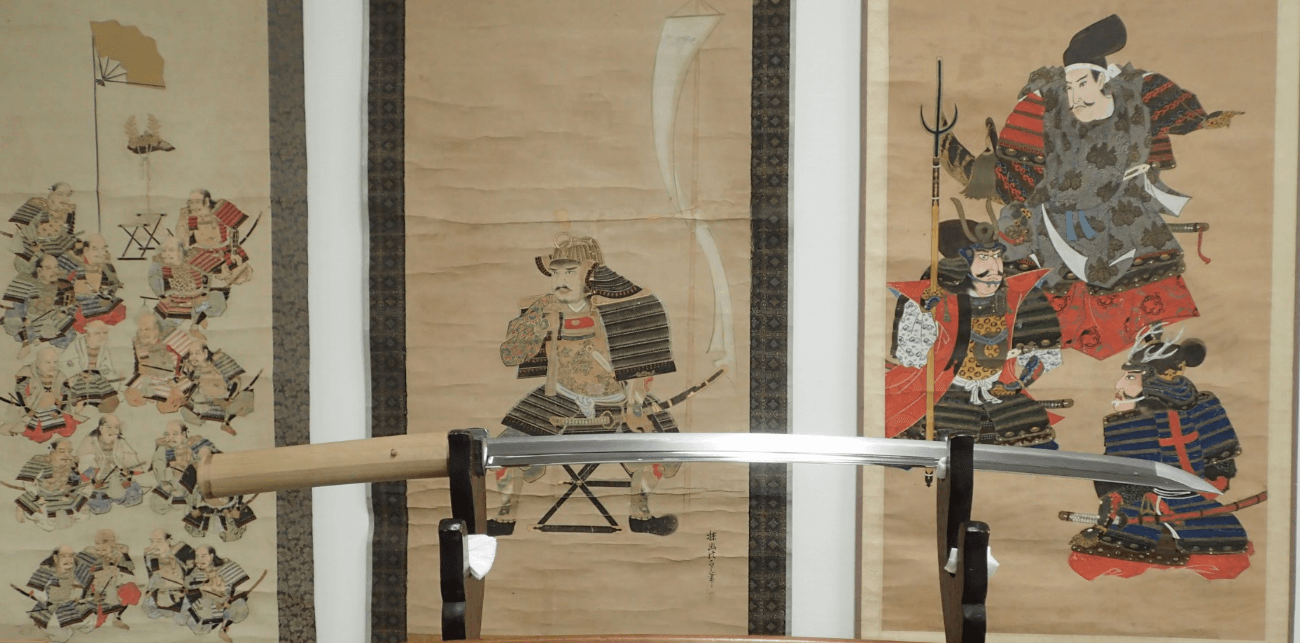
三人の天下人が戦国の世紀を終わらせ、刀は新しい秩序の道具となった。1588年の刀狩は刀を武士の標章とし、名刀は条約のごとく家々の間を行き交い、鑑定は以後この境で古刀と新刀を分かつ。
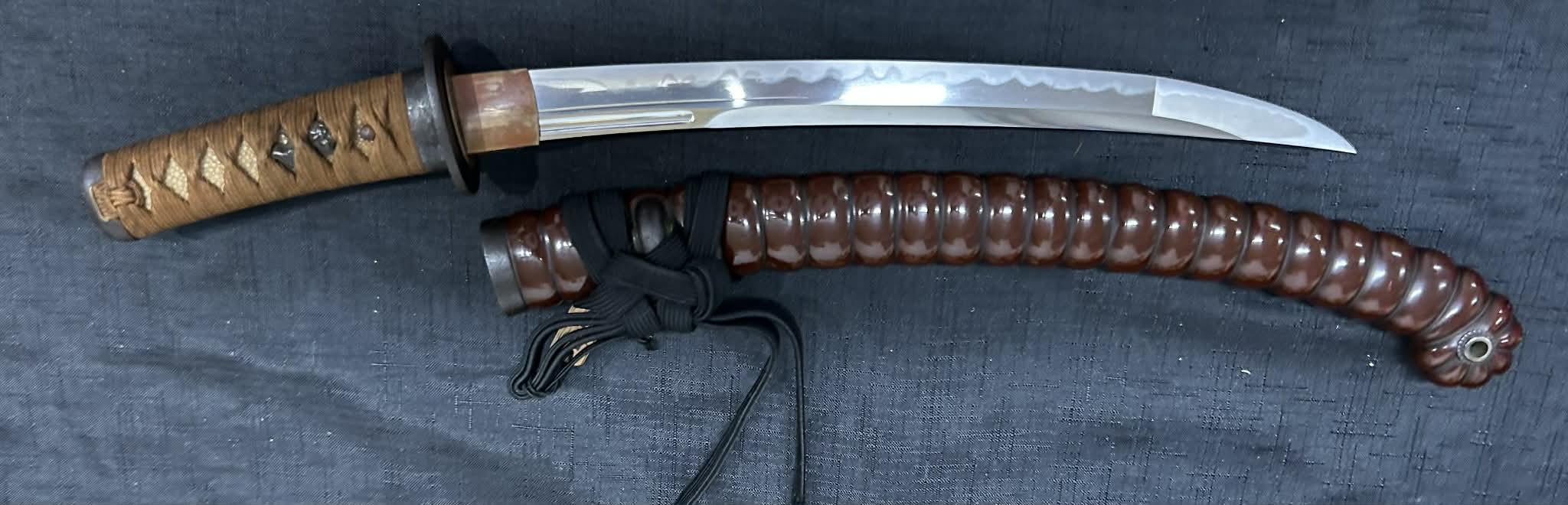
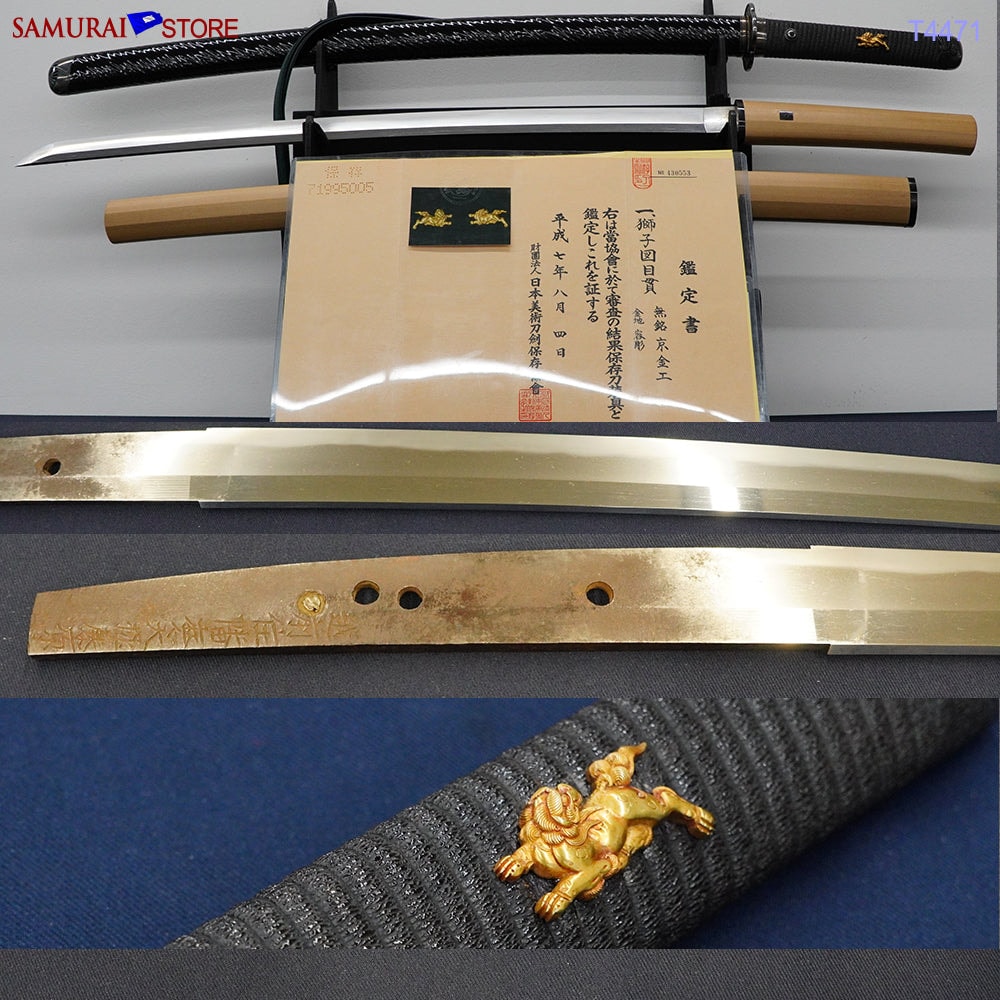
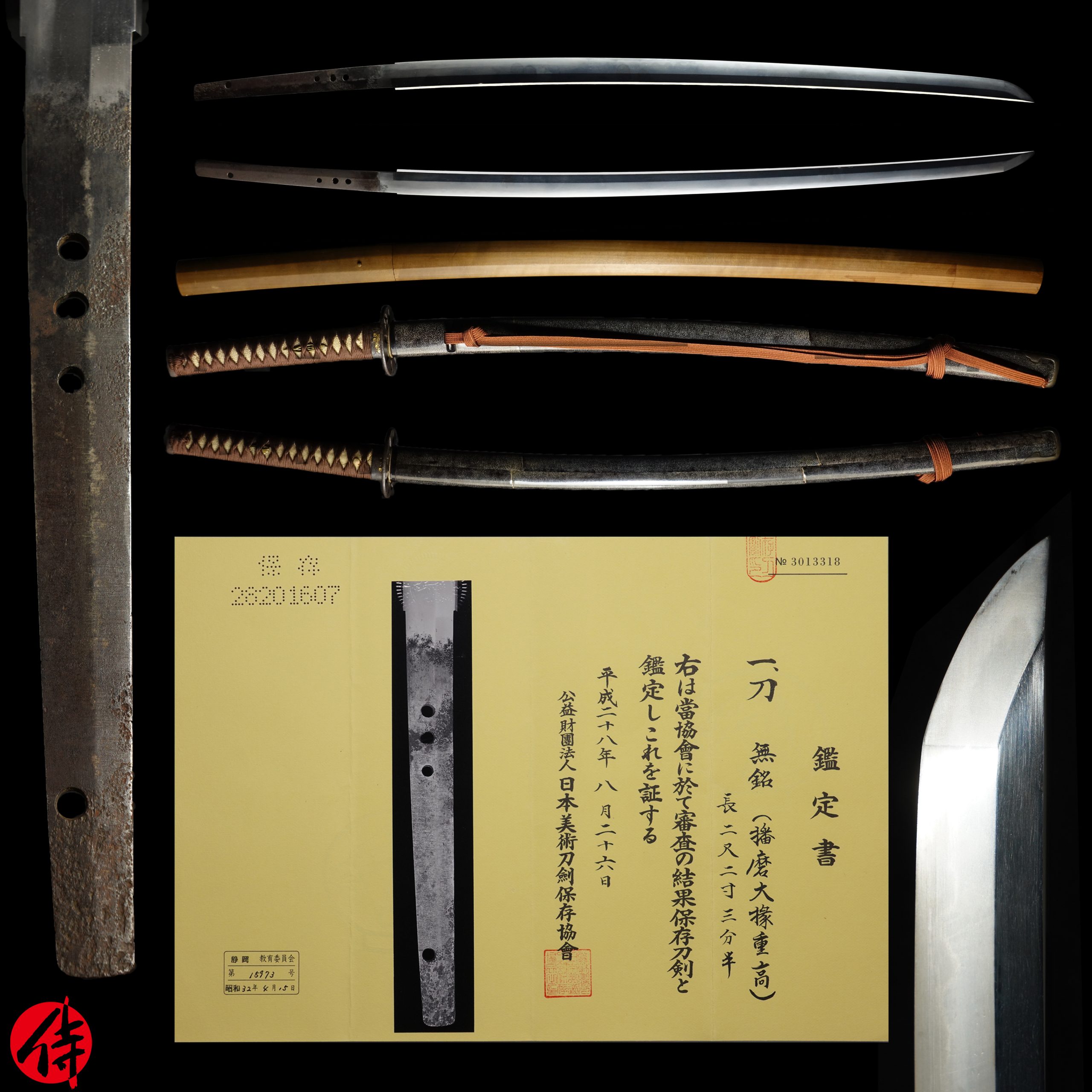
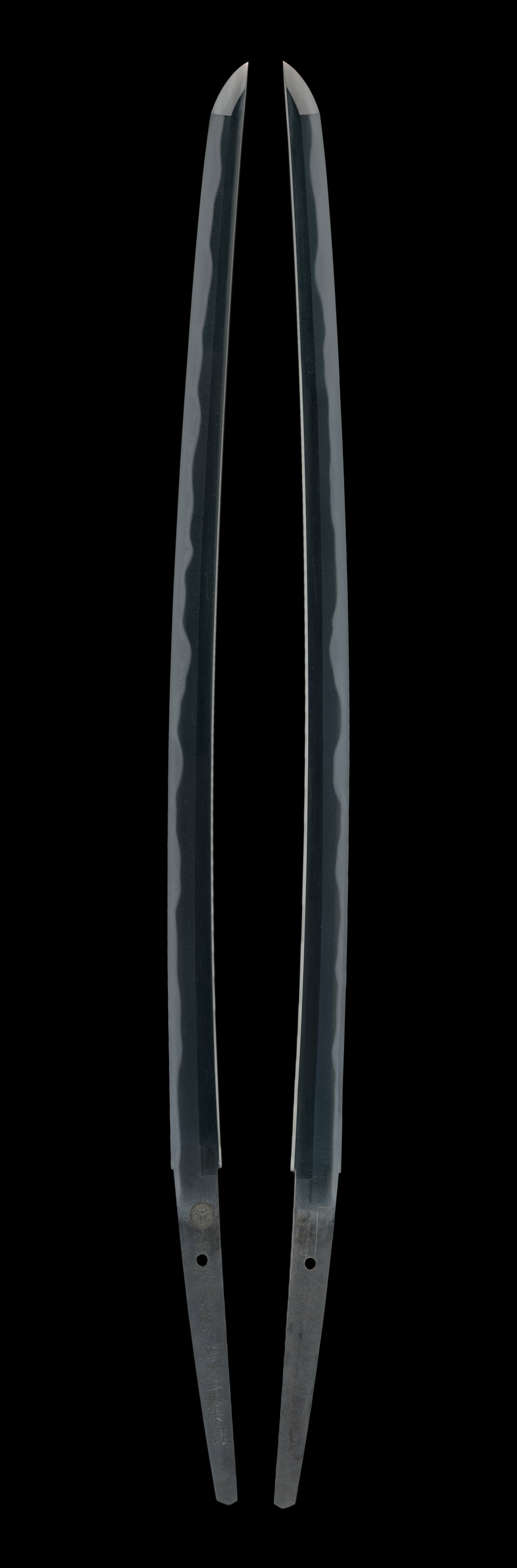
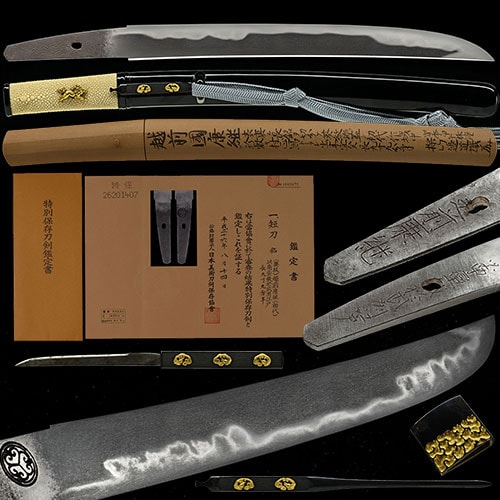
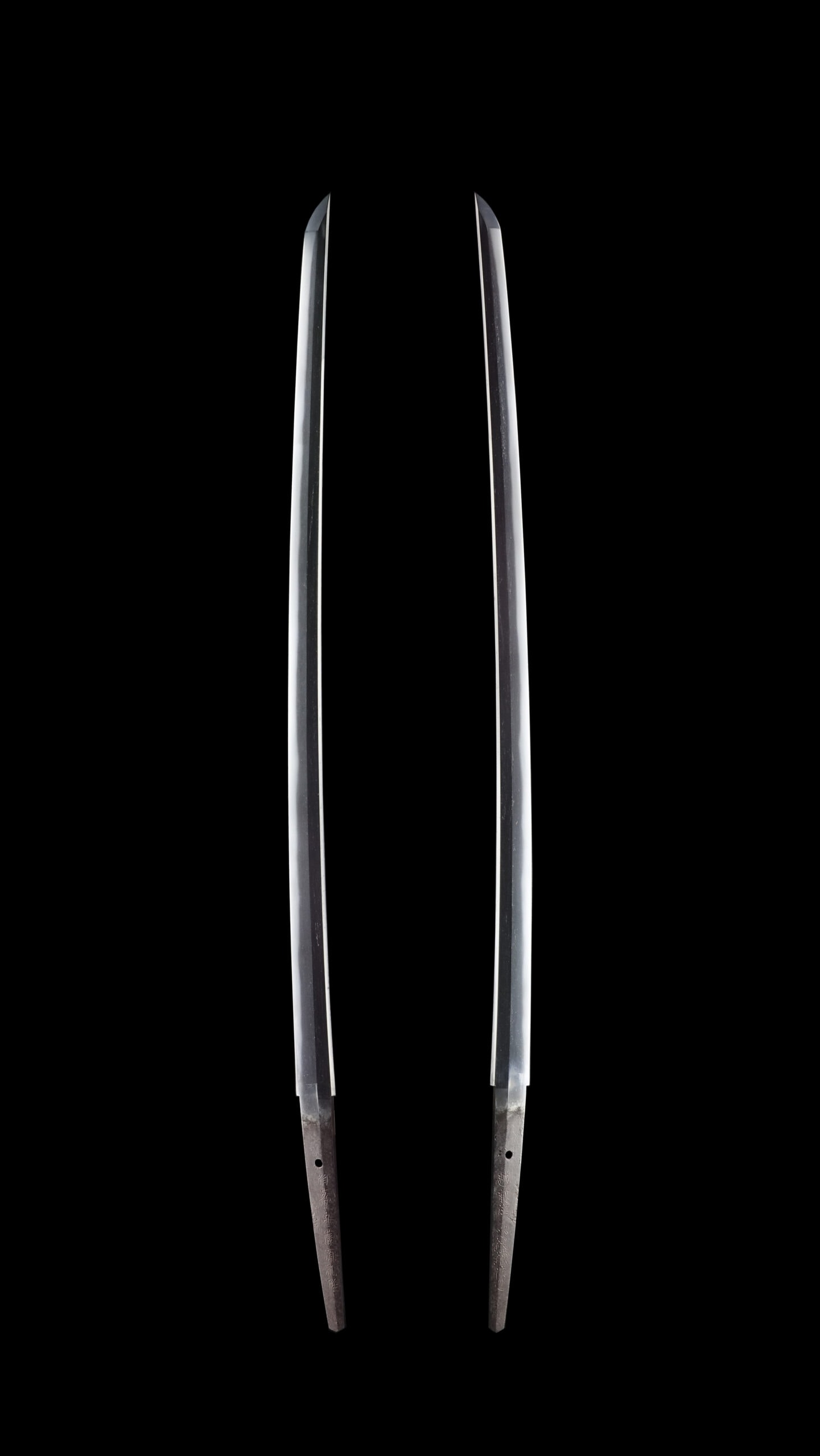
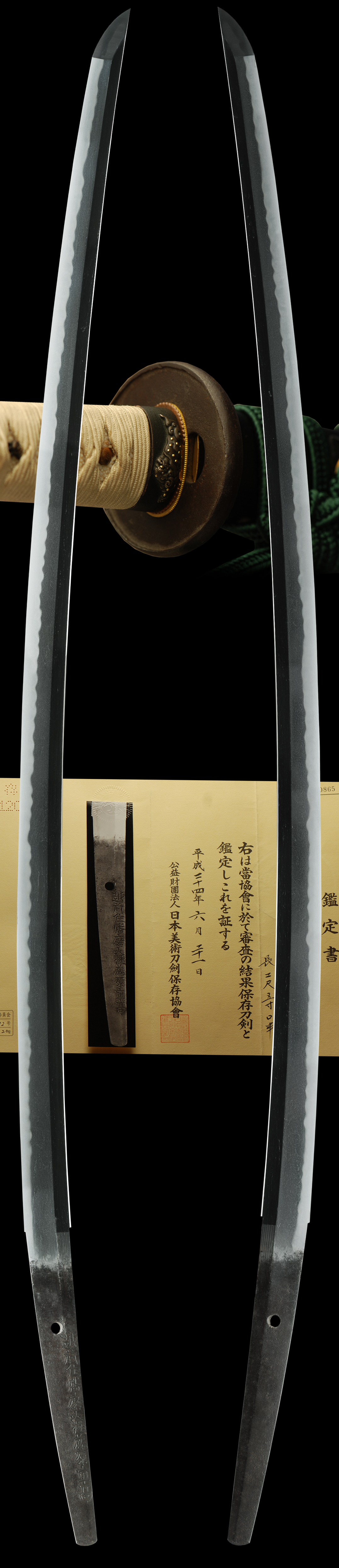
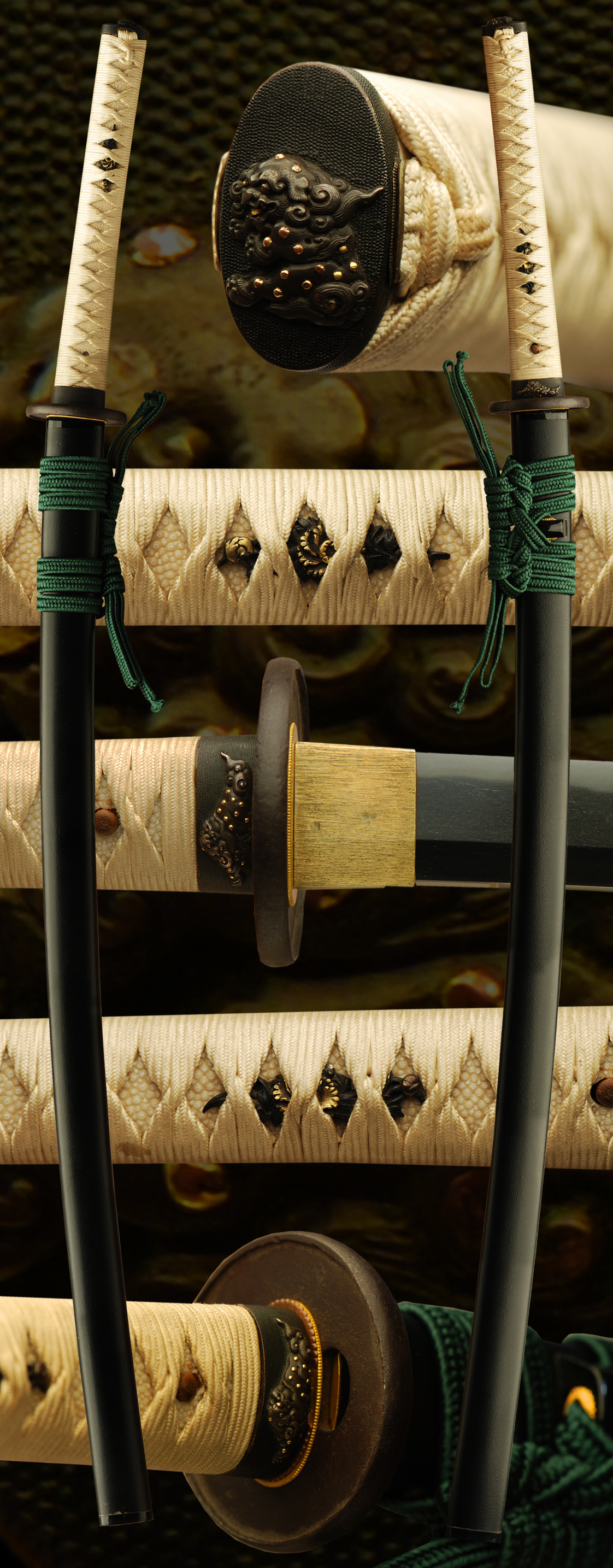
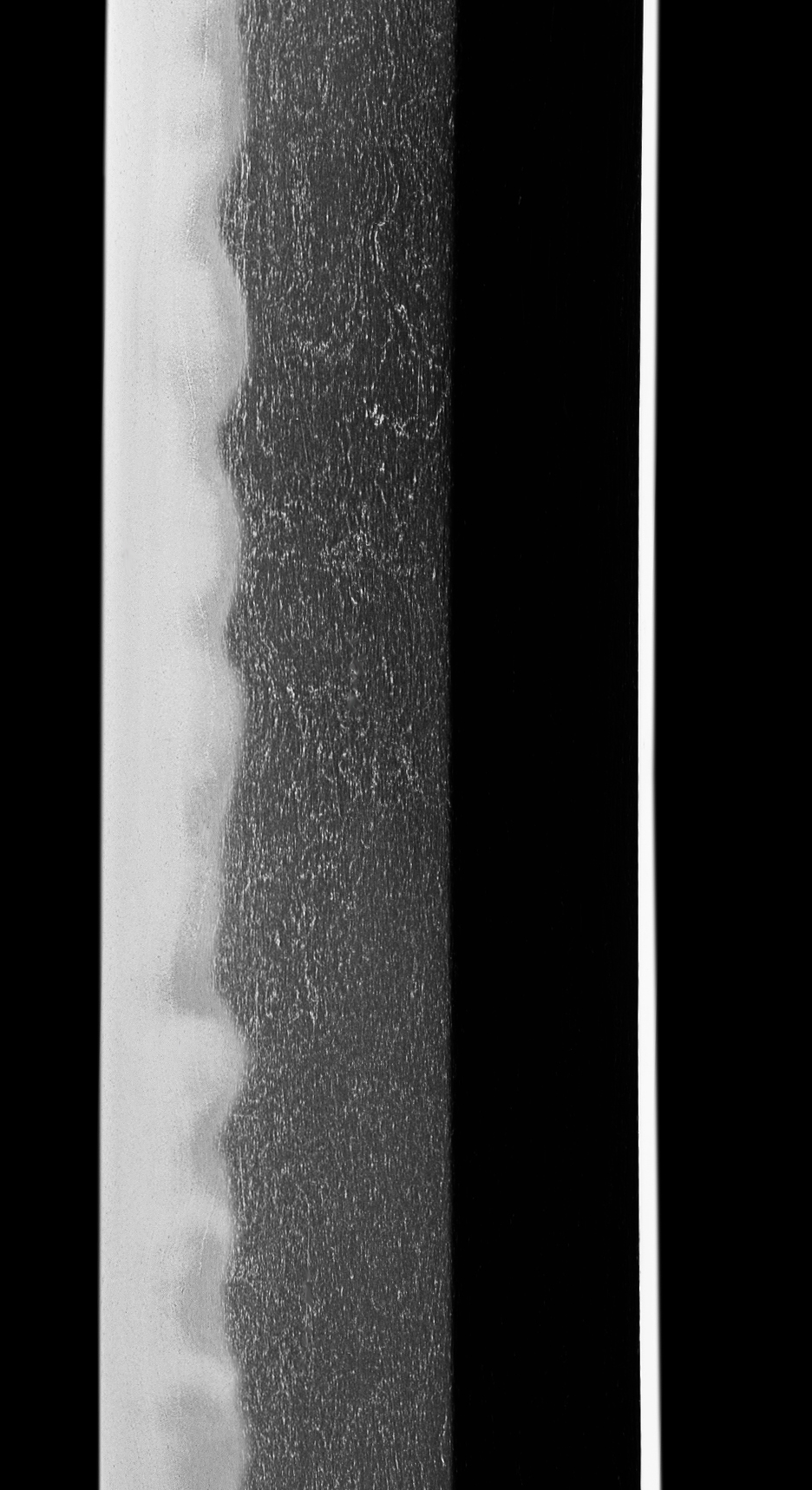
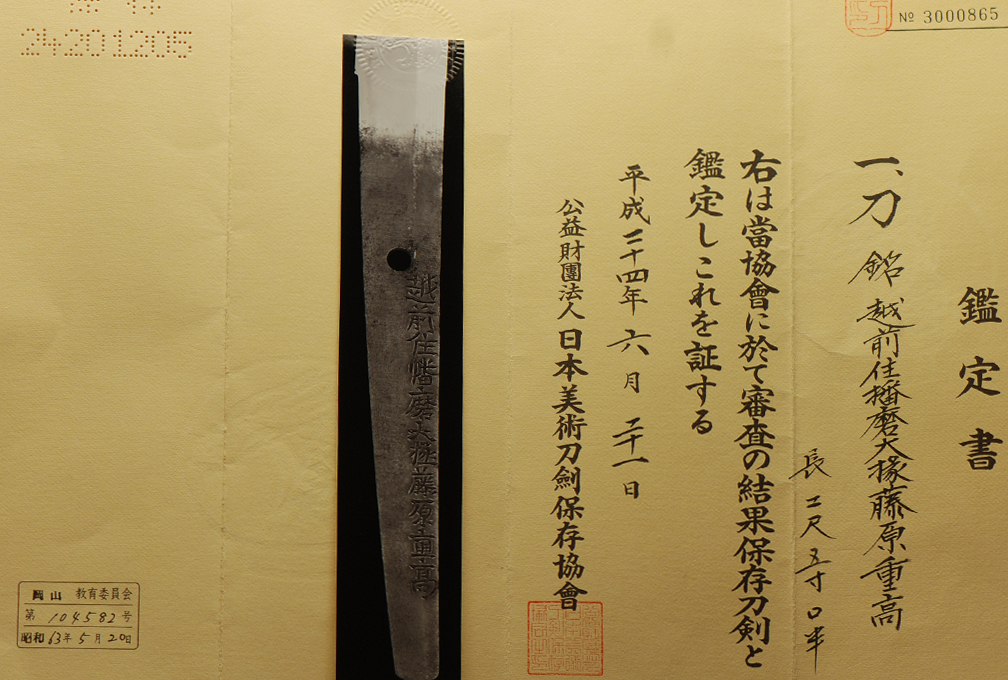
Harima no Daijō Shigetaka (fss-761) A SWORD SIGNED AND PAPERED TO: ” ECHIZEN JU HARIMA DAIJO FUJIWARA SHIGETAKA “At the beginning of the Shinto period Echizen province (now Fukui pref.), also known as the Azuchi-Momoyama period in the 1570s, Native sword smiths from Seki, Mino provence such as KANETANE 兼種, KANENORI 兼則 had moved and MASANORI 正則 were invited from the capital of Yamashiro to Fukui, Echizen provence.The AOI crest was bestowed on YASUTSUGU 康継 from the Lord Tokugawa and 16 petals KIKU crests were bestowed from the Imperial Court on KUNIKIYO 国淸 of Kunihiro school. They strived to attain the skill for performance, strength and beauty of the martial spirit with the increasing demand from the Samurai.The smith SHIGETAKA 重高 with the official title of Harima-daijo 播磨大掾, had come from Iida, Shinshu provence then moved to Seki, Mino to become a disciple of KANENORI 兼則.SHIGETAKA 重高 had moved to Ichijōdani, Echizen to accept an invitation to work for the Asakura clan along with his master KANENORI 兼則.From the later Muromachi period onwards, Mino province saw a steady outflow of swordsmiths, a trend that saw its peak in the Momoyama and early Edo period. Reason was for the most part the then significant demand for swords and thus local daimyô began to recruit famous masters to work for them on their lands. Mino bldes, or Seki blades in particular, were regarded as being durable and sharp and so a downright wave of migration of Mino/Seki swordsmiths can be seen, especially in the neighboring provinces of Owari and Echizen. As for Echizen, the province also gave a new home to many formerly Ômi-based Shimosaka smiths, thus we use classifications like “Echizen-Seki” (越前関) and “Echizen-Shimosaka” (越前下坂) to refer to these two different currents. The “trend-setters” of the Echizen-Seki group were first and foremost the Tenbun-era (天文, 1532-1555) Kanenori (兼法) and the two Keichô-era (慶長, 1596-1615) masters Kanenori (兼則) and Kanetsune (兼常).This sword was most likely made by 1st or 2nd generation SHIGETAKA 重高 who acquired the beautiful technique of the Shinto-era that emerged from the Koto period.During the early Edo period, it was the main focus of forging the tamahagane from theTATARAfurnace that had many different ratio’s of carbon content resulting in anItamestructure with superior construction and better cutting performance. These katana lived up to it’s reputation asWazamono orSupreme Sharp Cutting Performance.This was designed to present to the samurai, a sword full of the Samurai martial spirit. It’s Nagasa at katana length is both beautiful and impressive.Having a wide and thick Kasane much hiraniku can be found , this is the typical shape of the Kan’ei (1624-) period.This blade comese with a wonderful koshira. The saya is a black lacquer finish with green sageo. The ito is white with a floral themed menuki. The fuchi Kashira are of very high quality depicting ShiShi:Shishi (or Jishi) is translated as “lion” but it can also refer to a deer or dog with magical properties and the power to repel evil spirits. A pair of shishi traditionally stand guard outside the gates of Japanese Shinto shrines and Buddhist temples, although temples are more often guarded by two Nio protectors. The Shishi (like the Nio) are traditionally depicted in pairs, one with mouth open and one with mouth shut. The opened/closed mouth relates to Ah (open mouth) and Un (closed mouth). “Ah” is the first sound in the Japanese alphabet, while “N” (pronounced “un”) is the last. These two sounds symbolize beginning and end, birth and death, and all possible outcomes (from alpha to omega) in the cosmic dance of existence. The first letter in Sanskrit is “Ah” as well, but the last is “Ha.” Nonetheless, the first and last sounds produced by the mouth are “Ah” and “M.” The Sanskrit “m” and the Japanese “n” sound exactly the same when hummed with mouth closed. The spiritual Sanskrit terms AHAM and AUM thus encapsulate the first letter-sound (mouth open) and the final sound (mouth closed). Others say the open mouth is to scare off demons, and the closed mouth to shelter and keep in the good spirits. The circular object often shown beneath their feet is the Tama玉,or sacred Buddhist jewel, a symbol of Buddhist wisdom that brings light to darkness and holds the power to grant wishes.The Samegawa has a classic clean patina and the tsuba is a very nice ( Maru-gata ) rounded style with plain background and Mimi. (rim) Mei:Echizen-jū Harima no Daijō Fujiwara ShigetakaDate:Edo (1600’s-1700’s)Nagasa:29.88 inchesSori:15.0 mmWidth at the ha-machi:31.5 mmWidth at the yokote:21.7 mmThickness at the mune-machi:7.2 mmConstruction:Shinogi zukuriMune:IoriNakago:UbuKitae:Itame/mokumeHamon:Midare GunomeBoshi:MaruCondition:Good polish kantei-sho (鑑定書) No 300865 katana, mei: Echizen-jū Harima no Daijō Fujiwara Shigetaka (越前住播磨大掾藤原重高)nagasa 2 shaku 5 sun 0.5 bu Migi wa tô-kyôkai ni oite shinsa no kekka, hozon-tôken to kantei-shi kore o shô-suru.(右は當協會に於て審査の結果保存刀剣と鑑定
 NihontoWatch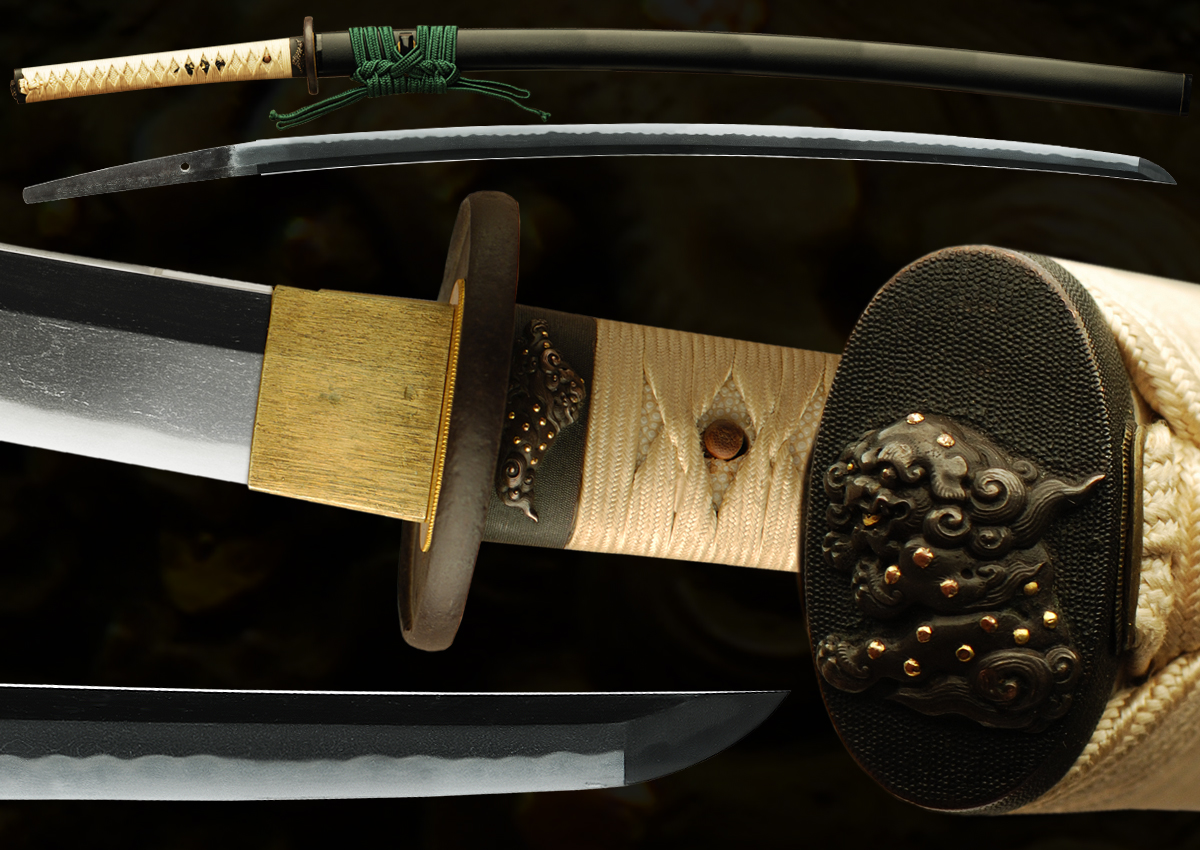
Shimosaka / Echizen (Echizen shinto) · 越前 · 1596-1615頃
藤代 Chu-jo saku · 刀剣大鑑 上位49%
現在5点販売中
重高は刀に「播磨大掾藤原重高」[[c:1]]と銘し、江戸初期の越前にあって活躍した。初代越前康継の門人で、現存する元和紀の脇指がその活躍期を慶長・元和頃に定める。説明書は本工を師に倣った上手とし、端的に「師に似て上手」と評する。重高の名はその後数代を経て幕末まで続くが、説明書は一貫して初代を最も技量高しとし、その上作は初代康継その人に迫る域に達するとする。本工は康継を中心に育った越前の下坂の一派に属し、その地刃は同派の相伝ごころを保つ。すなわち黒みをおびた鉄、深い沸、そして同時代の備前・美濃の華やかさではない静かに沈んだ刃である。
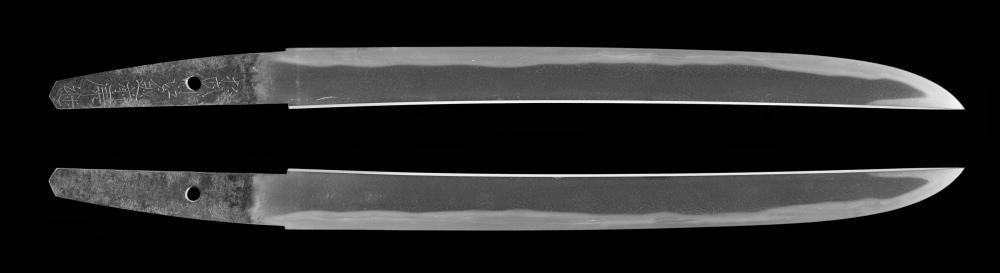
その手を最も確かに知らせるのは刃文ではなく茎にある。康継をはじめ越前刀工の多くが茎尻を剣形に切る中で、重高は各代を通して栗尻とし、説明書はこれを「重高は栗尻である点が特筆」[[c:2]]すべき特色として挙げる。初代の栗尻はやや浅い傾向にあり、長銘を竪詰りの太鏨で切り、二代・三代と思われるものは銘字がやや竪長となって角ばり細鏨のものが多い。いま一つの見どころは彫物である。上手の作には説明書が同工に直に名指す深く力強い記内彫が施され、倶利迦羅、不動明王と二童子の三体仏、長梵字と護摩箸を巧みに彫る。説明書はこの「巧みな記内彫」を称え、上作の短刀ではその彫物が刀身に劣らぬとする。
鍛えは板目に杢と流れ肌を交え処々やや肌立ち、地沸細かにつき地景細かに入り、かね黒みをおびる。これを説明書は越前物の地鉄の持ち味とする。刃文は直刃を基調に浅くのたれ、小互の目や尖りごころの刃を交え、足・葉入り、匂深く沸厚くつく。処々その沸が荒めとなって地沸となりむら立ち、刃縁ほつれ、総体に砂流しかかり細かに金筋が入り、匂口は冴えるよりむしろ沈みごころとなる。帽子は直ぐ、あるいは浅くのたれて小丸となり、しばしば突き上げ風に先尖りごころを見せ、掃きかけて深く返る。黒みをおびて肌立つ地鉄、深く厚い沸、沈んだ匂口を併せ見れば、説明書が康継に迫ると読む沈静で重厚な趣がそこにある。
現存する六口の指定作は、一つの手の二つの register に分かれる。身幅広い慶長新刀の脇指と刀には相伝ごころの本体が示され、身幅広く重ね厚め寸延びて反り浅く、直刃を浅くのたれて沸深く、彫も最も大らかに施される。説明書はこの刀を越前物のうち特に鍛えがつんで精美とし、穏やかな作とし、初代康継を髣髴とさせるとし、身幅広い脇指は「初代康継にせまる出来映え」[[c:3]]を示すとする。短刀にはより静かな古典の趣がある。冠落造・平造の短刀では造込みおよび地刃の出来が古作をねらったものとなり、説明書はその一口を「古作大和をねらった」[[c:4]]ものと判じ、細直刃を糸のように細め、小さく砂流し・金筋を交え、区際を焼込む古調を示す。これは別の作風ではなく同じ工が古典の手本に向かったもので、古い体配と目立つ彫物がその上作の短刀を身幅広い脇指と分かつ。
越前のうちでの本工の位置は、他工の特徴を挙げるよりその固有の見どころによって描かれる。相伝ごころの直刃のたれ、黒みをおびて肌立つ地鉄、そして何より栗尻の茎が本工を同派の下坂の工と分かち、説明書は繰り返し本工を後年の一派ではなく師康継に照らして測る。すなわち上作は初代康継に迫り、静かな一口は師を直に想わせるとする。本工は同名のうち最も技量高き工として記録に立ち、その域に迫ると目される唯一の代であり、後続の代は二代・三代の角ばった細鏨の銘によってその作と分かたれる。その作域は狭くとも一貫している。一つの越前相伝の手を二つの register、すなわち身幅広い慶長の脇指と古典に倣った短刀に通し、彫物と茎がこれを結ぶ。
重高は僅かながら一様に高い作、すなわち六口の重要刀剣によって知られ、うちに国宝も重要文化財もなく、指定の度合はそれに応じて控えめであり、参考書における評は中上作、上の中ほどの工とされる。最も名高い一口は名物骨喰藤四郎を写した脇指であり、説明書はこの「名物骨喰藤四郎写し」[[c:5]]の来歴を語り、本科に忠実で刀身も彫物も立派とし、これを「重高の最高傑作」の一口とする。これに冠落造の短刀二口、優れた記内彫を伴う平造の短刀、秋田本荘藩瀧沢家に伝来した身幅広い慶長新刀の脇指、そして精美な刀が続く。個人の蒐集家にとって本工は稀にしか出会えぬ名である。六口の指定作は商われるより伝えられ、現存するその作の多くは旧来の蔵に収まる。特別重要刀剣・重要刀剣の域の一口が市に現れるのは時折、辛抱を要してであり、現れれば一個の確かな越前新刀として、その背後の静かな康継に迫る手と等しく、栗尻の茎と記内彫という作者を名指す特徴ゆえに重んじられる。
重高の位置づけを、日本刀全体および伝統・時代・時期ごとに示します。各位(随一・屈指・有数・著名)は、NBTHK および文化庁による指定に加え、三作や名物帳などの歴史的栄誉を加味したものです。
各項目を選ぶと評価方法が表示されます。
新刀 · 越前
現在55点販売中
茎にきられた黒い鉄こそ、この一門の最も確かな標である。鍛えは板目に杢が目立って交じり、刃寄り棟寄りに流れて肌立ち、地沸厚く、地景細かに入って、かねが総じて黒みをおびる。説明書はこれを繰り返し「越前がねの特色」と名指し、初代康継から重高・貞国・貞次に至るまで終始変わらぬ見どころとする。この一団は近江国坂田郡下坂郷を本貫とし、新刀初頭の越前にあって「下坂」を商標として用いた幾人かの鍛冶の集まりであって、説明書は一人の刀工とみるよりは一団とみるのが妥当とし、初期は康継をその代表者とする。初代康継は下坂市左衛門と称して越前に移り結城秀康に仕え、初め肥後大掾下坂と銘した。慶長十年から十一年にかけて江戸に召され、家康・秀忠両将軍の御前で鍛刀した褒賞として「康」の一字と三つ葉葵紋を茎にきることを許されて康継と改名し、葵下坂・御紋康継の名はこれに発する。以後は将軍家の御抱工として越前と江戸を隔年に勤め、本国打には越前住、江戸打には於武州江戸と切り添え、南蛮鉄を以南蛮鉄と添えた。肥後大掾藤原下坂の康継前銘は貞国・兼法・国康らと鏨運びも筆意も酷似し、今日なお銘振りによってしか分かち得ぬほど近い。 この一門の手は静かで、同時代の備前・美濃の華やかな新刀の多くに対置される。刃文は浅いのたれ・中直刃を基調に小互の目を連れて交え、小足・葉入り、沸厚く、荒めの沸がむらにつき、本工らしいばさけを生じて、金筋・砂流しが長くかかり、棟焼・飛焼さかんに、時に皆焼風となり、匂口は沈みごころとなる。帽子は浅くのたれて先尖りごころに三品風を呈し、掃きかけて長く返る。姿は身幅広く元先の幅差少なく重ね厚め反り浅い慶長新刀体配で、平造脇指は幅広寸延びとなる。彫物がいま一つの恒常で、彫口深く力強い越前彫・記内彫が一門の手を示し、不動三体仏・倶利迦羅・梵字・護摩箸・素剣を巧みに彫る。記内ら越前の彫物師の手によるこの深い浮彫は、説明書が地方の特色と名指すものである。一門が最も称えられる作域は相州写しであって、初代・二代ともに大坂落城に焼失した名物の再刃を試み、中でも貞宗写しを最も得意とし、各写しに自らの作風を加えて徒らに模倣せぬところに特色がある。手は系統と目的とで分かれ、貞国は直刃を得意として地がつんで精美に、貞次は越前関の系譜を引いて丁子の目立つ明るい現れを示し、重高は茎尻を栗尻とする点で一門の剣形と分かたれる。 収集家がこの一門の作に向かうべき所以は、その見分けやすさにある。黒く肌立った越前がね、ばさけた刃縁、縞がかる砂流し、長く掃きかける小丸の返り、そして深い記内彫が併さって、写した古作によってではなく一門自らの語法によって読まれる。中心に立つのは初代康継で、駿府滞在中の駿州打や名物写しを残し、駿府御分物の一刀は紀州徳川家に、号風雷神の刀は越前松平家に伝来した。嫡子二代康継は父風を忠実に継ぎ、継の字形以外では殆ど区別し難く、晩年は初代に劣らぬ域に達した。二代の後、家は江戸三代を右馬助、越前家を四郎右衛門が継いで両系に分かれ、同名は幕末まで両地に栄えた。江戸三代は鍛えがつんで綺麗に、匂口は明るく、直ぐの焼出しを置いて法城寺一派など当時の江戸物に近づく。後援者本多飛騨守成重の立葵紋が貞次や康継一門の優品に多くきられ、截断銘がその伝来を彩る。藤代は上々作から上作に位し、一門は名だたる蔵伝よりも在銘の指定刀を通して出会われる。市に現れるのは葵紋を切った在銘の康継、あるいは下坂貞国・貞次・重高の在銘作であって、根気をもって待てば折にふれ世に現れ、現れれば家康の葵紋下賜に発する越前下坂の確かな一口となる。 詳しく見る →
桃山時代
三人の天下人が戦国の世紀を終わらせ、刀は新しい秩序の道具となった。1588年の刀狩は刀を武士の標章とし、名刀は条約のごとく家々の間を行き交い、鑑定は以後この境で古刀と新刀を分かつ。
銘が正しい、または無銘でも年代・国・系統を確実に指摘できる、保存に値する真正の作と鑑定されたものです。
日本美術刀剣保存協会(NBTHK)は、1948年に設立され、文化庁の監督を受ける公益財団法人で、東京・刀剣博物館に本部を置きます。専門の審査員が出品作を直接審査し、美術的・歴史的価値に応じた鑑定書を発行します。NBTHKの鑑定書は、日本刀および刀装具の真正性を示す最も広く認知された基準です。
NBTHK公式サイトWe offer a 48 hour inspection period for all Antique items shipped within the United States only. If the item is not to your satisfaction, we will gladly refund your money less any shipping and handling fees. All sales are final after the 48 hour inspection period. Please note that all discounted items are a final sale and not returnable.
Harima no Daijō Shigetaka (fss-761) A SWORD SIGNED AND PAPERED TO: ” ECHIZEN JU HARIMA DAIJO FUJIWARA SHIGETAKA “At the beginning of the Shinto period Echizen province (now Fukui pref.), also known as the Azuchi-Momoyama period in the 1570s, Native sword smiths from Seki, Mino provence such as KANETANE 兼種, KANENORI 兼則 had moved and MASANORI 正則 were invited from the capital of Yamashiro to Fukui, Echizen provence.The AOI crest was bestowed on YASUTSUGU 康継 from the Lord Tokugawa and 16 petals KIKU crests were bestowed from the Imperial Court on KUNIKIYO 国淸 of Kunihiro school. They strived to attain the skill for performance, strength and beauty of the martial spirit with the increasing demand from the Samurai.The smith SHIGETAKA 重高 with the official title of Harima-daijo 播磨大掾, had come from Iida, Shinshu provence then moved to Seki, Mino to become a disciple of KANENORI 兼則.SHIGETAKA 重高 had moved to Ichijōdani, Echizen to accept an invitation to work for the Asakura clan along with his master KANENORI 兼則.From the later Muromachi period onwards, Mino province saw a steady outflow of swordsmiths, a trend that saw its peak in the Momoyama and early Edo period. Reason was for the most part the then significant demand for swords and thus local daimyô began to recruit famous masters to work for them on their lands. Mino bldes, or Seki blades in particular, were regarded as being durable and sharp and so a downright wave of migration of Mino/Seki swordsmiths can be seen, especially in the neighboring provinces of Owari and Echizen. As for Echizen, the province also gave a new home to many formerly Ômi-based Shimosaka smiths, thus we use classifications like “Echizen-Seki” (越前関) and “Echizen-Shimosaka” (越前下坂) to refer to these two different currents. The “trend-setters” of the Echizen-Seki group were first and foremost the Tenbun-era (天文, 1532-1555) Kanenori (兼法) and the two Keichô-era (慶長, 1596-1615) masters Kanenori (兼則) and Kanetsune (兼常).This sword was most likely made by 1st or 2nd generation SHIGETAKA 重高 who acquired the beautiful technique of the Shinto-era that emerged from the Koto period.During the early Edo period, it was the main focus of forging the tamahagane from theTATARAfurnace that had many different ratio’s of carbon content resulting in anItamestructure with superior construction and better cutting performance. These katana lived up to it’s reputation asWazamono orSupreme Sharp Cutting Performance.This was designed to present to the samurai, a sword full of the Samurai martial spirit. It’s Nagasa at katana length is both beautiful and impressive.Having a wide and thick Kasane much hiraniku can be found , this is the typical shape of the Kan’ei (1624-) period.This blade comese with a wonderful koshira. The saya is a black lacquer finish with green sageo. The ito is white with a floral themed menuki. The fuchi Kashira are of very high quality depicting ShiShi:Shishi (or Jishi) is translated as “lion” but it can also refer to a deer or dog with magical properties and the power to repel evil spirits. A pair of shishi traditionally stand guard outside the gates of Japanese Shinto shrines and Buddhist temples, although temples are more often guarded by two Nio protectors. The Shishi (like the Nio) are traditionally depicted in pairs, one with mouth open and one with mouth shut. The opened/closed mouth relates to Ah (open mouth) and Un (closed mouth). “Ah” is the first sound in the Japanese alphabet, while “N” (pronounced “un”) is the last. These two sounds symbolize beginning and end, birth and death, and all possible outcomes (from alpha to omega) in the cosmic dance of existence. The first letter in Sanskrit is “Ah” as well, but the last is “Ha.” Nonetheless, the first and last sounds produced by the mouth are “Ah” and “M.” The Sanskrit “m” and the Japanese “n” sound exactly the same when hummed with mouth closed. The spiritual Sanskrit terms AHAM and AUM thus encapsulate the first letter-sound (mouth open) and the final sound (mouth closed). Others say the open mouth is to scare off demons, and the closed mouth to shelter and keep in the good spirits. The circular object often shown beneath their feet is the Tama玉,or sacred Buddhist jewel, a symbol of Buddhist wisdom that brings light to darkness and holds the power to grant wishes.The Samegawa has a classic clean patina and the tsuba is a very nice ( Maru-gata ) rounded style with plain background and Mimi. (rim) Mei:Echizen-jū Harima no Daijō Fujiwara ShigetakaDate:Edo (1600’s-1700’s)Nagasa:29.88 inchesSori:15.0 mmWidth at the ha-machi:31.5 mmWidth at the yokote:21.7 mmThickness at the mune-machi:7.2 mmConstruction:Shinogi zukuriMune:IoriNakago:UbuKitae:Itame/mokumeHamon:Midare GunomeBoshi:MaruCondition:Good polish kantei-sho (鑑定書) No 300865 katana, mei: Echizen-jū Harima no Daijō Fujiwara Shigetaka (越前住播磨大掾藤原重高)nagasa 2 shaku 5 sun 0.5 bu Migi wa tô-kyôkai ni oite shinsa no kekka, hozon-tôken to kantei-shi kore o shô-suru.(右は當協會に於て審査の結果保存刀剣と鑑定
NihontoWatchShimosaka / Echizen (Echizen shinto) · 越前 · 1596-1615頃
藤代 Chu-jo saku · 刀剣大鑑 上位49%
現在5点販売中
重高は刀に「播磨大掾藤原重高」[[c:1]]と銘し、江戸初期の越前にあって活躍した。初代越前康継の門人で、現存する元和紀の脇指がその活躍期を慶長・元和頃に定める。説明書は本工を師に倣った上手とし、端的に「師に似て上手」と評する。重高の名はその後数代を経て幕末まで続くが、説明書は一貫して初代を最も技量高しとし、その上作は初代康継その人に迫る域に達するとする。本工は康継を中心に育った越前の下坂の一派に属し、その地刃は同派の相伝ごころを保つ。すなわち黒みをおびた鉄、深い沸、そして同時代の備前・美濃の華やかさではない静かに沈んだ刃である。
その手を最も確かに知らせるのは刃文ではなく茎にある。康継をはじめ越前刀工の多くが茎尻を剣形に切る中で、重高は各代を通して栗尻とし、説明書はこれを「重高は栗尻である点が特筆」[[c:2]]すべき特色として挙げる。初代の栗尻はやや浅い傾向にあり、長銘を竪詰りの太鏨で切り、二代・三代と思われるものは銘字がやや竪長となって角ばり細鏨のものが多い。いま一つの見どころは彫物である。上手の作には説明書が同工に直に名指す深く力強い記内彫が施され、倶利迦羅、不動明王と二童子の三体仏、長梵字と護摩箸を巧みに彫る。説明書はこの「巧みな記内彫」を称え、上作の短刀ではその彫物が刀身に劣らぬとする。
鍛えは板目に杢と流れ肌を交え処々やや肌立ち、地沸細かにつき地景細かに入り、かね黒みをおびる。これを説明書は越前物の地鉄の持ち味とする。刃文は直刃を基調に浅くのたれ、小互の目や尖りごころの刃を交え、足・葉入り、匂深く沸厚くつく。処々その沸が荒めとなって地沸となりむら立ち、刃縁ほつれ、総体に砂流しかかり細かに金筋が入り、匂口は冴えるよりむしろ沈みごころとなる。帽子は直ぐ、あるいは浅くのたれて小丸となり、しばしば突き上げ風に先尖りごころを見せ、掃きかけて深く返る。黒みをおびて肌立つ地鉄、深く厚い沸、沈んだ匂口を併せ見れば、説明書が康継に迫ると読む沈静で重厚な趣がそこにある。
現存する六口の指定作は、一つの手の二つの register に分かれる。身幅広い慶長新刀の脇指と刀には相伝ごころの本体が示され、身幅広く重ね厚め寸延びて反り浅く、直刃を浅くのたれて沸深く、彫も最も大らかに施される。説明書はこの刀を越前物のうち特に鍛えがつんで精美とし、穏やかな作とし、初代康継を髣髴とさせるとし、身幅広い脇指は「初代康継にせまる出来映え」[[c:3]]を示すとする。短刀にはより静かな古典の趣がある。冠落造・平造の短刀では造込みおよび地刃の出来が古作をねらったものとなり、説明書はその一口を「古作大和をねらった」[[c:4]]ものと判じ、細直刃を糸のように細め、小さく砂流し・金筋を交え、区際を焼込む古調を示す。これは別の作風ではなく同じ工が古典の手本に向かったもので、古い体配と目立つ彫物がその上作の短刀を身幅広い脇指と分かつ。
越前のうちでの本工の位置は、他工の特徴を挙げるよりその固有の見どころによって描かれる。相伝ごころの直刃のたれ、黒みをおびて肌立つ地鉄、そして何より栗尻の茎が本工を同派の下坂の工と分かち、説明書は繰り返し本工を後年の一派ではなく師康継に照らして測る。すなわち上作は初代康継に迫り、静かな一口は師を直に想わせるとする。本工は同名のうち最も技量高き工として記録に立ち、その域に迫ると目される唯一の代であり、後続の代は二代・三代の角ばった細鏨の銘によってその作と分かたれる。その作域は狭くとも一貫している。一つの越前相伝の手を二つの register、すなわち身幅広い慶長の脇指と古典に倣った短刀に通し、彫物と茎がこれを結ぶ。
重高は僅かながら一様に高い作、すなわち六口の重要刀剣によって知られ、うちに国宝も重要文化財もなく、指定の度合はそれに応じて控えめであり、参考書における評は中上作、上の中ほどの工とされる。最も名高い一口は名物骨喰藤四郎を写した脇指であり、説明書はこの「名物骨喰藤四郎写し」[[c:5]]の来歴を語り、本科に忠実で刀身も彫物も立派とし、これを「重高の最高傑作」の一口とする。これに冠落造の短刀二口、優れた記内彫を伴う平造の短刀、秋田本荘藩瀧沢家に伝来した身幅広い慶長新刀の脇指、そして精美な刀が続く。個人の蒐集家にとって本工は稀にしか出会えぬ名である。六口の指定作は商われるより伝えられ、現存するその作の多くは旧来の蔵に収まる。特別重要刀剣・重要刀剣の域の一口が市に現れるのは時折、辛抱を要してであり、現れれば一個の確かな越前新刀として、その背後の静かな康継に迫る手と等しく、栗尻の茎と記内彫という作者を名指す特徴ゆえに重んじられる。
重高の位置づけを、日本刀全体および伝統・時代・時期ごとに示します。各位(随一・屈指・有数・著名)は、NBTHK および文化庁による指定に加え、三作や名物帳などの歴史的栄誉を加味したものです。
各項目を選ぶと評価方法が表示されます。
新刀 · 越前
現在55点販売中
茎にきられた黒い鉄こそ、この一門の最も確かな標である。鍛えは板目に杢が目立って交じり、刃寄り棟寄りに流れて肌立ち、地沸厚く、地景細かに入って、かねが総じて黒みをおびる。説明書はこれを繰り返し「越前がねの特色」と名指し、初代康継から重高・貞国・貞次に至るまで終始変わらぬ見どころとする。この一団は近江国坂田郡下坂郷を本貫とし、新刀初頭の越前にあって「下坂」を商標として用いた幾人かの鍛冶の集まりであって、説明書は一人の刀工とみるよりは一団とみるのが妥当とし、初期は康継をその代表者とする。初代康継は下坂市左衛門と称して越前に移り結城秀康に仕え、初め肥後大掾下坂と銘した。慶長十年から十一年にかけて江戸に召され、家康・秀忠両将軍の御前で鍛刀した褒賞として「康」の一字と三つ葉葵紋を茎にきることを許されて康継と改名し、葵下坂・御紋康継の名はこれに発する。以後は将軍家の御抱工として越前と江戸を隔年に勤め、本国打には越前住、江戸打には於武州江戸と切り添え、南蛮鉄を以南蛮鉄と添えた。肥後大掾藤原下坂の康継前銘は貞国・兼法・国康らと鏨運びも筆意も酷似し、今日なお銘振りによってしか分かち得ぬほど近い。 この一門の手は静かで、同時代の備前・美濃の華やかな新刀の多くに対置される。刃文は浅いのたれ・中直刃を基調に小互の目を連れて交え、小足・葉入り、沸厚く、荒めの沸がむらにつき、本工らしいばさけを生じて、金筋・砂流しが長くかかり、棟焼・飛焼さかんに、時に皆焼風となり、匂口は沈みごころとなる。帽子は浅くのたれて先尖りごころに三品風を呈し、掃きかけて長く返る。姿は身幅広く元先の幅差少なく重ね厚め反り浅い慶長新刀体配で、平造脇指は幅広寸延びとなる。彫物がいま一つの恒常で、彫口深く力強い越前彫・記内彫が一門の手を示し、不動三体仏・倶利迦羅・梵字・護摩箸・素剣を巧みに彫る。記内ら越前の彫物師の手によるこの深い浮彫は、説明書が地方の特色と名指すものである。一門が最も称えられる作域は相州写しであって、初代・二代ともに大坂落城に焼失した名物の再刃を試み、中でも貞宗写しを最も得意とし、各写しに自らの作風を加えて徒らに模倣せぬところに特色がある。手は系統と目的とで分かれ、貞国は直刃を得意として地がつんで精美に、貞次は越前関の系譜を引いて丁子の目立つ明るい現れを示し、重高は茎尻を栗尻とする点で一門の剣形と分かたれる。 収集家がこの一門の作に向かうべき所以は、その見分けやすさにある。黒く肌立った越前がね、ばさけた刃縁、縞がかる砂流し、長く掃きかける小丸の返り、そして深い記内彫が併さって、写した古作によってではなく一門自らの語法によって読まれる。中心に立つのは初代康継で、駿府滞在中の駿州打や名物写しを残し、駿府御分物の一刀は紀州徳川家に、号風雷神の刀は越前松平家に伝来した。嫡子二代康継は父風を忠実に継ぎ、継の字形以外では殆ど区別し難く、晩年は初代に劣らぬ域に達した。二代の後、家は江戸三代を右馬助、越前家を四郎右衛門が継いで両系に分かれ、同名は幕末まで両地に栄えた。江戸三代は鍛えがつんで綺麗に、匂口は明るく、直ぐの焼出しを置いて法城寺一派など当時の江戸物に近づく。後援者本多飛騨守成重の立葵紋が貞次や康継一門の優品に多くきられ、截断銘がその伝来を彩る。藤代は上々作から上作に位し、一門は名だたる蔵伝よりも在銘の指定刀を通して出会われる。市に現れるのは葵紋を切った在銘の康継、あるいは下坂貞国・貞次・重高の在銘作であって、根気をもって待てば折にふれ世に現れ、現れれば家康の葵紋下賜に発する越前下坂の確かな一口となる。 詳しく見る →
桃山時代
三人の天下人が戦国の世紀を終わらせ、刀は新しい秩序の道具となった。1588年の刀狩は刀を武士の標章とし、名刀は条約のごとく家々の間を行き交い、鑑定は以後この境で古刀と新刀を分かつ。
銘が正しい、または無銘でも年代・国・系統を確実に指摘できる、保存に値する真正の作と鑑定されたものです。
日本美術刀剣保存協会(NBTHK)は、1948年に設立され、文化庁の監督を受ける公益財団法人で、東京・刀剣博物館に本部を置きます。専門の審査員が出品作を直接審査し、美術的・歴史的価値に応じた鑑定書を発行します。NBTHKの鑑定書は、日本刀および刀装具の真正性を示す最も広く認知された基準です。
NBTHK公式サイトWe offer a 48 hour inspection period for all Antique items shipped within the United States only. If the item is not to your satisfaction, we will gladly refund your money less any shipping and handling fees. All sales are final after the 48 hour inspection period. Please note that all discounted items are a final sale and not returnable.