売切れ
Tokuho売切れ
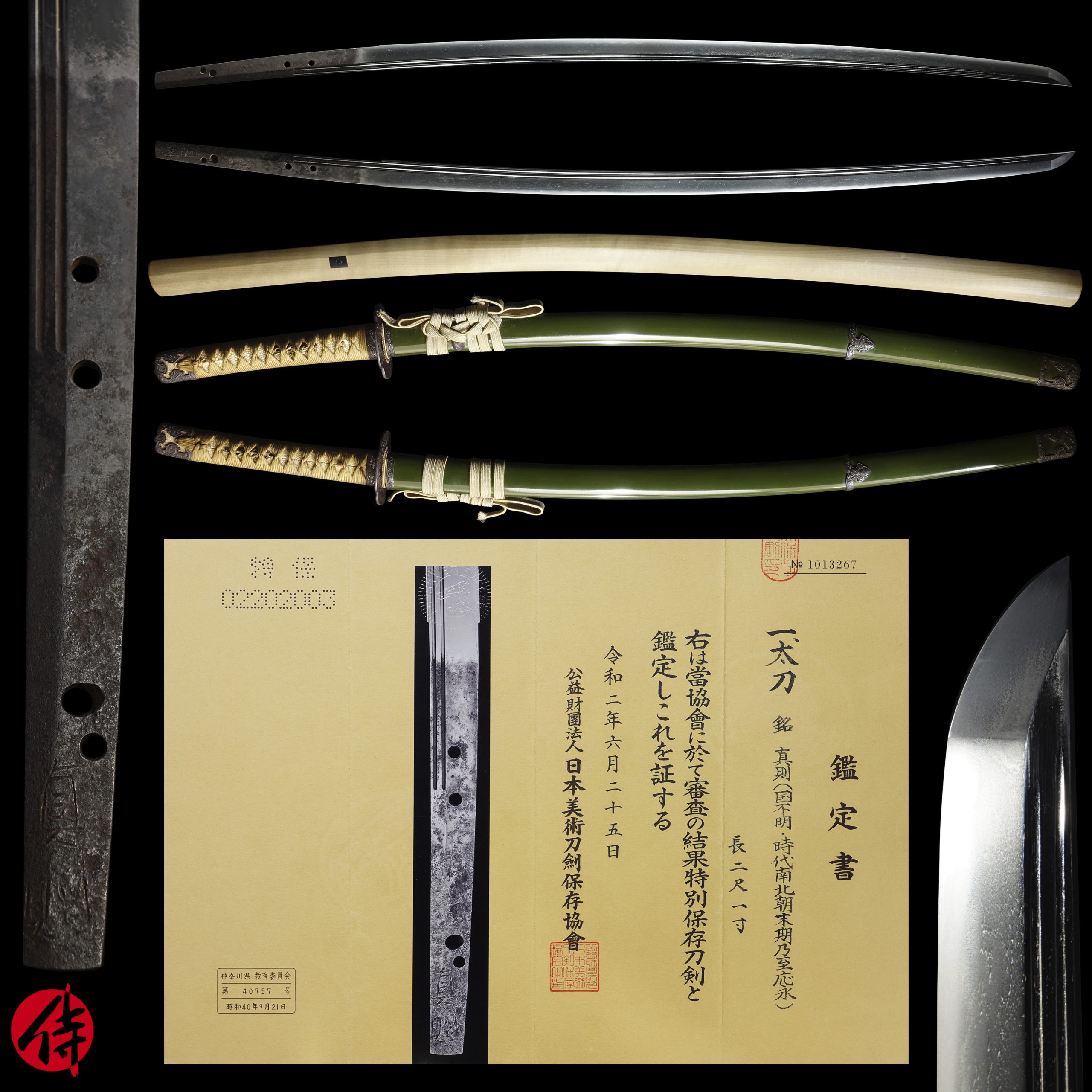
Antique Japanese Sword Signed by Sanenori NBTHK Tokubetsu Hozon Certificate
売却済
世界81社の刀剣商を横断追跡 · 価格履歴 · 売却アーカイブ
時代
Nanbokucho
仕様
長さ
63.5 cm
反り
1.4 cm
Antique Japanese Sword Katana Signed by Sanenori with Tokubetsu Hozon Certificate 【Description】 According to the NBTHK’s appraisal, this blade was forged by Sanemori during the late Nabokucho-Oei era(1370s-1428). A few swordsmiths signed as Sanemori during this time, and NBTHK couldn’t find conclusive evidence regarding which Sanemori created this blade after a thorough examination. Hence, their appraisal says the country is unknown. However, based on the characteristic of the blade, such as Jigane(Surface Pattern on the steel), Hamon(tempering line), and the shape of Nakago(tang), they appraised it as the one forged during the 1370s-1428. This blade is categorized as Koto(古刀). The Japanese swords made between the Early Heian Period towards the end of the Warring States (794-1595 A.D.) are called KOTO (古刀: Old-Sword). This blade is considered Tachi(太刀). It was mainly used by armored Samurai with one hand on horseback from the Heian period (794-1185 A.D.) until the beginning of the Muromachi period. TACHI was suspended loosely on the left waist with its edge facing the ground so that you could draw it faster to cut down soldiers on the ground. Based on the Nakago shape and the number of holes, this blade was shortened a few times in the past. We assume this blade used to be quite long but got shortened due to the regulations back then or its owner’s preferences. While NBTHK doesn’t mention which Sanenori forged this blade, it is still a piece of beautiful Samurai history. And it is accompanied by gorgeous sword mountings. This blade is appraised as a Tokubetsu Hozon certificate issued by NBTHK. This authentication paper was only given to Japanese swords, especially worth preserving by Nihon Bijutsu Touken Hozon Kyokai(the Society for the Preservation of the Japan Art Sword). 【 Blade】 Cutting Edge Length(Nagasa) : 63.5 cm( 25.0 inches) Curvature(Sori) : 1.4 cm( 0.55 inches) For more detailed measurement of the blade/sword mounting Hamon : The crystalline structure which forms along the cutting edge of a blade as a result of the hardening process Jimon(Jihada) : visible steel surface pattern created by folding and hammering during forging process Nakago : Nakago is the tang of the Japanese sword. Japanese swordsmiths left the black rust on the tang because it prevents red rust while the tang is in its handle. And the discoloration of the tang was created over time, and it is a great indicator for a Japanese sword specialist to estimate when the sword was forged. Koshirae: Koshirae is the mounting of the Japanese sword. There are several parts that consist of Koshirae such as Saya(Scabbard), Tsuka( Handle), Tsuba(Handguard). Fuchi-Kashira : A pair of matching sword fittings that cover the upper and bottom parts of its sword hilt. The wave pattern is designed on this Fuchi Kashira. The rough movements of the water surface with splashes of water are beautifully sculpted. Small golden dots express waterdrops. As waves’ movements continue endlessly, the wave pattern represents eternity, immortality, longevity, and birth, etcetera. Also, since tides change the shape and terrain of rocks repeatedly, some people hoped for a strong will by using this motif. People used this pattern wishing for an indomitable spirit without giving up. Thanks to its dynamic design, this motif has been appreciated, especially for men’s Kimono (traditional Japanese costume). Tsuka and Menuki : Tsuka is the handle of the Japanese sword and Menuki is its decoration. The dragon is the motif of this Menuki. The golden metal is applied to its entire body and gives it a shiny look. Initially, the dragon is an imaginary creature found in ancient traditions or myths. Furthermore, it is a symbolic beast of encouraging signs. Its body is likened to nine animals: antlers are deer, the head is a camel, eyes are demons, the neck is a snake, belly is Mizuchi (蛟, mythical animal in Japan which looks like a snake and have a horn and four legs), scales are fish, claws are fal
 NihontoWatchBETA
売却済
世界81社の刀剣商を横断追跡 · 価格履歴 · 売却アーカイブ
Nanbokucho
63.5 cm
1.4 cm
Antique Japanese Sword Katana Signed by Sanenori with Tokubetsu Hozon Certificate 【Description】 According to the NBTHK’s appraisal, this blade was forged by Sanemori during the late Nabokucho-Oei era(1370s-1428). A few swordsmiths signed as Sanemori during this time, and NBTHK couldn’t find conclusive evidence regarding which Sanemori created this blade after a thorough examination. Hence, their appraisal says the country is unknown. However, based on the characteristic of the blade, such as Jigane(Surface Pattern on the steel), Hamon(tempering line), and the shape of Nakago(tang), they appraised it as the one forged during the 1370s-1428. This blade is categorized as Koto(古刀). The Japanese swords made between the Early Heian Period towards the end of the Warring States (794-1595 A.D.) are called KOTO (古刀: Old-Sword). This blade is considered Tachi(太刀). It was mainly used by armored Samurai with one hand on horseback from the Heian period (794-1185 A.D.) until the beginning of the Muromachi period. TACHI was suspended loosely on the left waist with its edge facing the ground so that you could draw it faster to cut down soldiers on the ground. Based on the Nakago shape and the number of holes, this blade was shortened a few times in the past. We assume this blade used to be quite long but got shortened due to the regulations back then or its owner’s preferences. While NBTHK doesn’t mention which Sanenori forged this blade, it is still a piece of beautiful Samurai history. And it is accompanied by gorgeous sword mountings. This blade is appraised as a Tokubetsu Hozon certificate issued by NBTHK. This authentication paper was only given to Japanese swords, especially worth preserving by Nihon Bijutsu Touken Hozon Kyokai(the Society for the Preservation of the Japan Art Sword). 【 Blade】 Cutting Edge Length(Nagasa) : 63.5 cm( 25.0 inches) Curvature(Sori) : 1.4 cm( 0.55 inches) For more detailed measurement of the blade/sword mounting Hamon : The crystalline structure which forms along the cutting edge of a blade as a result of the hardening process Jimon(Jihada) : visible steel surface pattern created by folding and hammering during forging process Nakago : Nakago is the tang of the Japanese sword. Japanese swordsmiths left the black rust on the tang because it prevents red rust while the tang is in its handle. And the discoloration of the tang was created over time, and it is a great indicator for a Japanese sword specialist to estimate when the sword was forged. Koshirae: Koshirae is the mounting of the Japanese sword. There are several parts that consist of Koshirae such as Saya(Scabbard), Tsuka( Handle), Tsuba(Handguard). Fuchi-Kashira : A pair of matching sword fittings that cover the upper and bottom parts of its sword hilt. The wave pattern is designed on this Fuchi Kashira. The rough movements of the water surface with splashes of water are beautifully sculpted. Small golden dots express waterdrops. As waves’ movements continue endlessly, the wave pattern represents eternity, immortality, longevity, and birth, etcetera. Also, since tides change the shape and terrain of rocks repeatedly, some people hoped for a strong will by using this motif. People used this pattern wishing for an indomitable spirit without giving up. Thanks to its dynamic design, this motif has been appreciated, especially for men’s Kimono (traditional Japanese costume). Tsuka and Menuki : Tsuka is the handle of the Japanese sword and Menuki is its decoration. The dragon is the motif of this Menuki. The golden metal is applied to its entire body and gives it a shiny look. Initially, the dragon is an imaginary creature found in ancient traditions or myths. Furthermore, it is a symbolic beast of encouraging signs. Its body is likened to nine animals: antlers are deer, the head is a camel, eyes are demons, the neck is a snake, belly is Mizuchi (蛟, mythical animal in Japan which looks like a snake and have a horn and four legs), scales are fish, claws are fal
NihontoWatchBETA売却済
世界81社の刀剣商を横断追跡 · 価格履歴 · 売却アーカイブ
Nanbokucho
63.5 cm
1.4 cm