説明

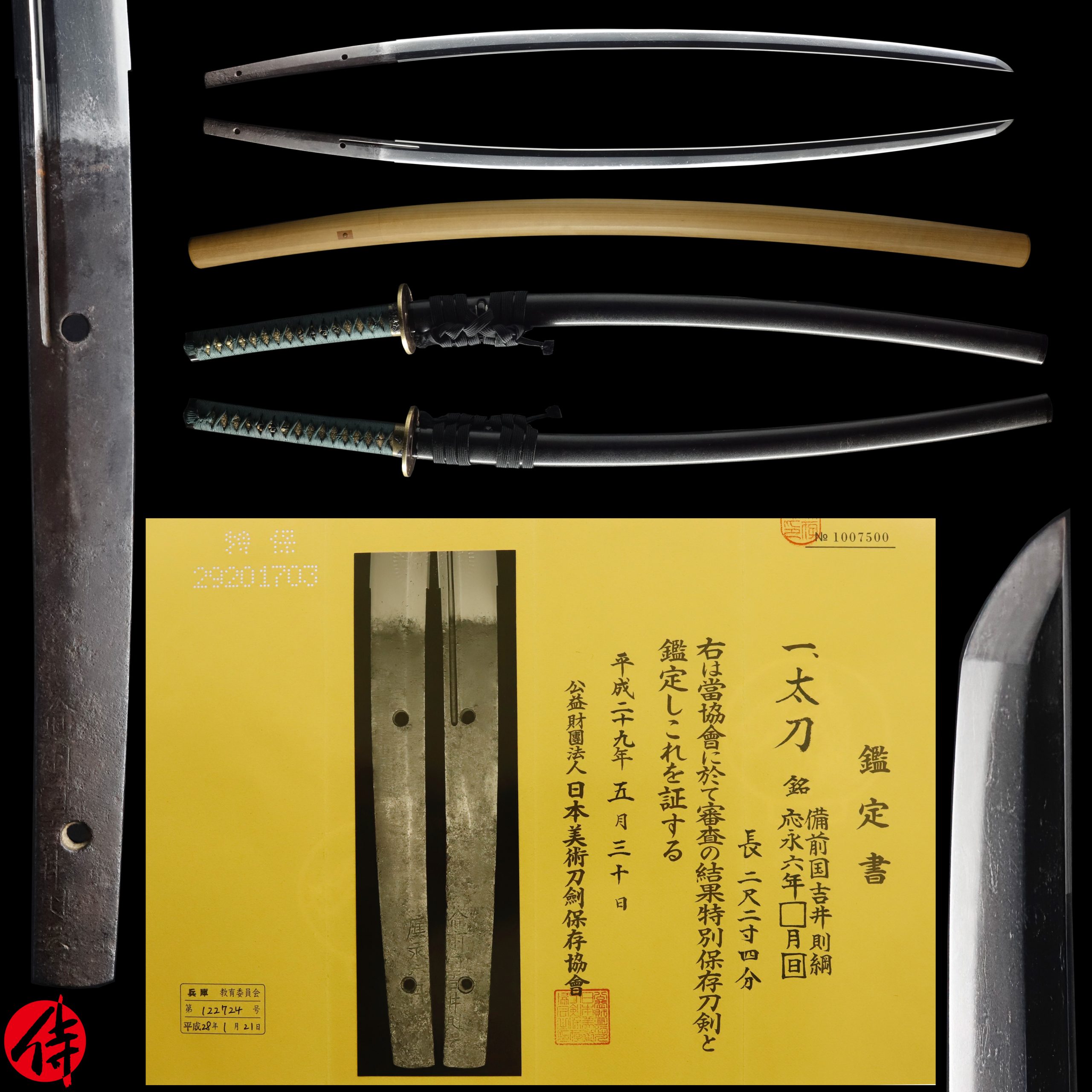
Antique Japanese Sword Tachi Signed by Bizen Noritsuna with Tokubetsu Hozon Certificate 【Description】 This blade was signed by Bizen Koku Yoshii Noritsuna (備前国吉井則綱) in the 6th year of the O-Ei era ( 1399 : early Muromachi period). Bizen Koku is the domain name in today’s Okayama prefecture. Bizen Koku was one of the most prominent sword-forging sites during the late Kamakura-Muromachi period (Late 13th-mid 16th century). Noritsuna was especially active during Meitoku~O-Ei era (1390-1399). Yoshii is the name of the village Noritsuna resided in and the name of the school he belonged to. This blade was made right after the Nanbokucho period ended when the imperial court was split into two sides (south and north), and so many conflicts arose. It is said that Yoshii school was founded by Tamenori (為則) in Yoshii village during the late Kamakura period (Late 13th century). The school flourished during the late Kamakura- Muromachi period. Many famous swordsmiths who belonged to this school had 則(Nori) in their maker’s names, such as Noritsuna, Kiyonori, Kagenori, and Yoshinori. BIZEN is located near the Chugoku Mountains, where iron sands, one of the essential materials for making Japanese swords, were abundant. Furthermore, BIZEN swordsmiths had close access to Yoshi River, where they could find water and charcoal. This geological location contributed to the swordsmiths forging high-quality refined blades. We presume BIZEN was quite active in sword-forging from ancient times. It is said that BIZEN DEN, one of the five most prominent Japanese sword traditions, was created by groups of swordsmiths there during the late Heian era (Late 12th century ). These ancient swordsmiths in Bizen province are called Ko-Bizen (Old Bizen) swordsmiths. By inheriting the sword forging techniques from Ko-Bizen swordsmiths, the Bizen domain, including Yoshii school, flourished. Based on which side the signature is located and the authentication paper, this blade was categorized as a Tachi sword. Tachi was mainly used by an armored Samurai with one hand on horseback from the Heian period (794-1185 A.D.) until the early Muromachi period. TACHI was suspended loosely on the left waist with its edge facing the ground so that you could draw it faster to cut down soldiers on the ground. It is stored in a Katana style Koshirae now. It is appraised as a Tokubetsu Hozon Token (特別保存刀剣) issued by NBTHK(Nihon Bijutsu Touken Hozon Kyokai:日本美術刀剣保存協会). This authentication paper was only given to authentic Japanese swords, especially well preserved and high quality with artistic value. *Please keep in mind that there are a couple of visible Kitae-Kizu on this blade. If you like to see the detailed condition, please feel free to contact us. 【 Blade】 Cutting Edge Length(Nagasa) : 67.8 cm (26.7 inches) Curvature(Sori) : 2.1 cm ( 0.82 inches) Hamon : The crystalline structure which forms along the cutting edge of a blade as a result of the hardening process Jimon(Jihada) : visible steel surface pattern created by folding and hammering during forging process Nakago : Nakago is the tang of the Japanese sword. Japanese swordsmiths left the black rust on the tang because it prevents red rust while the tang is in its handle. And the discoloration of the tang was created over time, and it is a great indicator for a Japanese sword specialist to estimate when the sword was forged. Koshirae: Koshirae is the mounting of the Japanese sword. There are several parts that consist of Koshirae such as Saya(Scabbard), Tsuka(Handle), Tsuba(Handguard). Fuchi-Kashira : A pair of matching sword fittings that cover the upper and bottom parts of its sword hilt. The Kashira part has a simple look. It seems to be coated with black lacquer. On the other hand, the Fuchi part is decorated with several motifs. You would find that a large flower and a butterfly are engraved. This flower is a Botan (牡丹, peony). Peony represents happiness, wealth, nobleness, and gorgeousness. This plant pattern has been

Antique Japanese Sword Tachi Signed by Bizen Noritsuna NBTHK Tokubetsu Hozon Certificate
売切れ
Tokuho売切れ

Antique Japanese Sword Tachi Signed by Bizen Noritsuna NBTHK Tokubetsu Hozon Certificate

太刀

売却済

世界81社の刀剣商を横断追跡 · 価格履歴 · 売却アーカイブ

仕様

長さ

67.8 cm

反り

2.1 cm

作者について

Yoshii Noritsuna則綱

3 重要刀剣

Noritsuna worked within the Yoshii group of Bizen Province, a branch whose origins remain the subject of ongoing study. Sword reference works identify the earliest generation as beginning with dated examples from the Joji era (1362-1368), with subsequent generations active around the Meitoku and Kansho eras; however, as the NBTHK has observed, "there remains room for further study regarding how these generations should be distinguished." Signed and dated tachi by Noritsuna are exceedingly rare, lending his extant *nenki-saku* particular importance as documentary material. The works attributed to Noritsuna divide broadly into two modes: those presenting a linked *ko-gunome* temper and those in *suguha*. In the former style, a small-patterned continuous *gunome* constitutes, in the NBTHK's assessment, "a hallmark unique to this group." Yet Noritsuna's earlier productions are distinguished from later Yoshii-school work by conspicuously stronger *nie* and vigorous internal activities -- *sunagashi* and *kinsuji* working clearly within the tempered area -- characteristics that mark what the examiners term an "old Yoshii" work free of later-period mannerisms. The *kitae* is consistently *itame-hada* mixed with *mokume* or *masame*, tending toward *hada-dachi*, with *ji-nie* and, on certain pieces, *utsuri*. In the *suguha* mode, the *nioiguchi* is tight with *ko-nie* and occasional *hotsure*, yielding a quieter but no less accomplished expression. Noritsuna's surviving corpus spans both tachi and *kodachi* forms from the late Nanbokucho into the early Muromachi period, with dated inscriptions from Joji 3 (1364) and the Meitoku era (1391-1392). These pieces preserve clearly legible signatures cut in bold strokes toward the *mune* side, and as the NBTHK has noted, they "constitute valuable documentary material" for the Yoshii school during a transitional era in Bizen sword-making.
刀剣商

サムライミュージアム

samuraimuseum.jp

売切れ