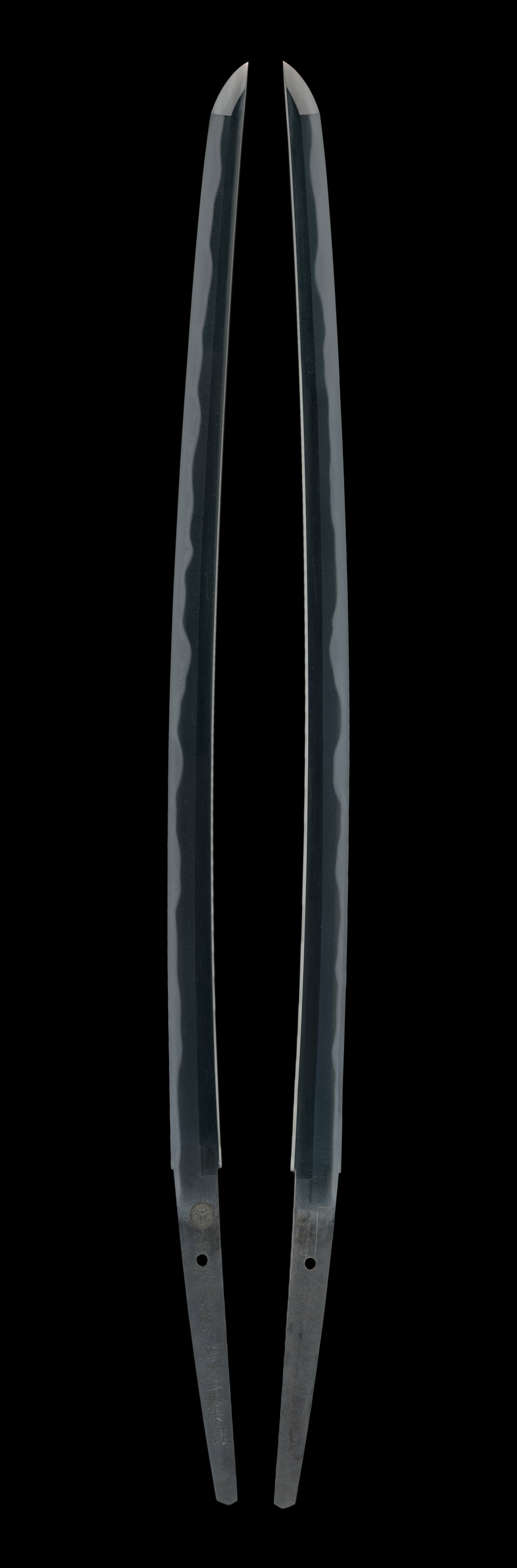
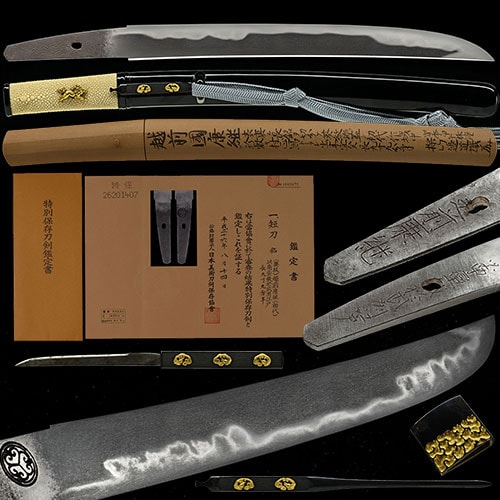
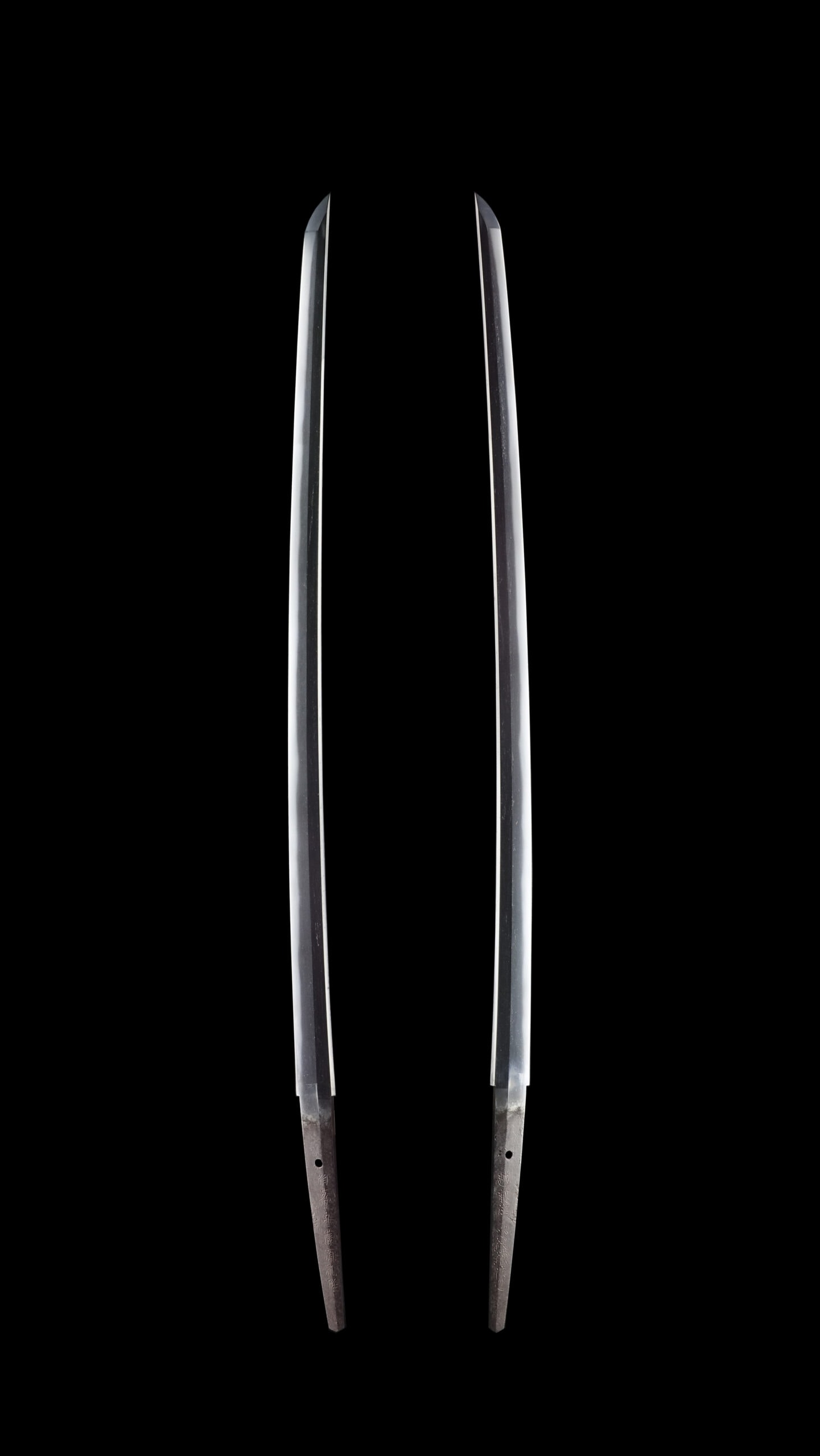
Shigetaka signed his blades Harima Daijo Fujiwara Shigetaka and worked in in the first decades of the period, a pupil of the first-generation Yasutsugu whose activity a surviving dated in the Genna era fixes to the Keicho and Genna years. The published sources describe him as a man who took after his master and was a fine hand in his own right, calling him simply skilled in the manner of his teacher. The name Shigetaka then ran on through several generations to the close of the period, but the published record is consistent that the stood highest among them in skill, and that his best work reached an order that approaches the first Yasutsugu himself. He belongs to the Shimosaka group of , the new-sword tradition that grew up around Yasutsugu, and his and keep that group's -leaning character: a darkish steel, deep , and a quiet, subdued temper rather than the bright flamboyance of the contemporary and makers.
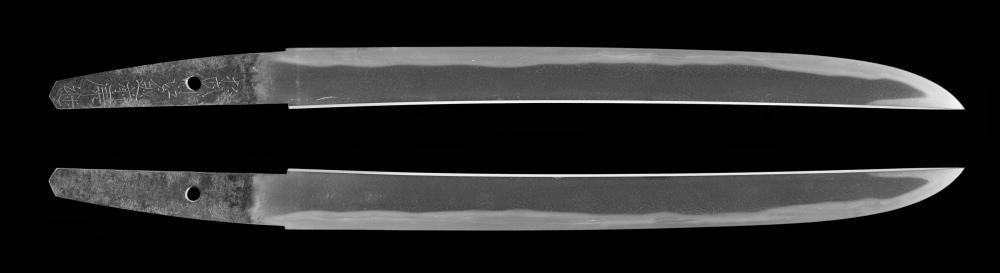
The surest way his hand is known sits in the rather than the temper. Where Yasutsugu and the great majority of smiths finish the tang to a sword-shaped point, Shigetaka cuts a chestnut-shaped tip across every generation of the name, and the published sources single this out as the feature most worth noting in him. On the 's own blades that chestnut tail tends to run a little shallow, paired with a long signature cut in a squat, thick-chiseled hand, while the second and third generations sign in slightly elongated, squared characters with a thinner chisel. The other mark of his best work is the carving. On his finest blades he sets the deep, powerful Kinai-school relief the published sources name in him directly, a dragon, a Fudo Myo-o flanked by the two attendant child-deities, long and paired , cut so cleanly that on his masterwork the carving is judged to stand level with the blade itself.
His forging is an mixed with and a flowing grain, in places standing a little, over which the gathers finely and the runs delicately, the steel taking on a blackish cast that the published sources count as the character of the . The temper is built on a base that grows shallowly undulating, and pointed elements mixed into it, with and entering, the deep, and the laid on thickly. Here and there those turn coarse and cluster, standing up into the and making the waver, while runs across the whole and fine enter through it, the tending to sink rather than to glitter. The resolves either straight or with a shallow undulation into a small round, often rising in a thrusting motion to a pointed tip before it brushes into and turns back deeply. Read together, the darkish standing , the deep thick , and the sinking give his work the muted, weighty quality the published sources read as Yasutsugu-approaching.
The six designated blades that survive divide cleanly into two registers of the one hand. On the broad Keicho- and the he works the prime -leaning manner: wide in the , thick in the , with a shallow curvature, the shallowly with deep , the carving worked at its boldest. The published sources call the close-grained and refined beyond the run of work, judge it a calm piece, and say plainly that it brings the first Yasutsugu to mind, holding that the broad shows a workmanship that closes on the master. The carry a second, quieter idea. On the and the construction and the workmanship of the and are read as aimed at old work; of one the published sources judge that it was made looking to the older Yamato makers, an archaic character carried in a fine narrowed to a thread, with ko-, , and the burned in hard at the . This is not a separate manner but the smith turning to a classical model, where the older bearing and the conspicuous carving set his best apart from the broad .
Within his distinction is best drawn through his own grounded traits rather than by contrast. His -leaning -, his blackish standing , and above all his chestnut-tailed mark him off from his fellow Shimosaka smiths, and the published sources repeatedly measure him against his teacher rather than against any later school: his finest blades, they say, approach the first Yasutsugu, and one calm is held to call the master directly to mind. He stands in the record as the most skilled bearer of his name, the only generation reckoned to reach near that level, and the line that followed him is distinguished from his work chiefly by the slighter, squared signatures of the second and third hands. His range is narrow but coherent: one manner worked through two registers, the broad Keicho and the classically aimed , bound together by the carving and the tang.
Shigetaka is known through a small but uniformly high body of work, six blades all raised to the rank, with no National Treasures or Important Cultural Properties among them and his designation factor accordingly modest; his rating in the reference texts is a chu-jo , an upper-middle master. The single most celebrated piece is the that copies the Hossho Fujishiro , the bone-gnawing Yoshimitsu whose long history the published sources recount, and which they hold faithful to its model in both blade and carving and rate his finest surviving work. To it stand the two , the with its superb Kinai carving, the broad Keicho- that descended in the Takizawa family of the Akita Honjo domain, and the refined . For a private collector this is a name encountered rarely. The six designated blades are held, not traded, and most of his work that survives is fixed in long-held collections; one in the Tokuju or range comes to market only from time to time and with patience, a substantial piece when it does, valued as much for the chestnut-tail tang and the Kinai carving that name the maker as for the quiet Yasutsugu-approaching hand behind them.