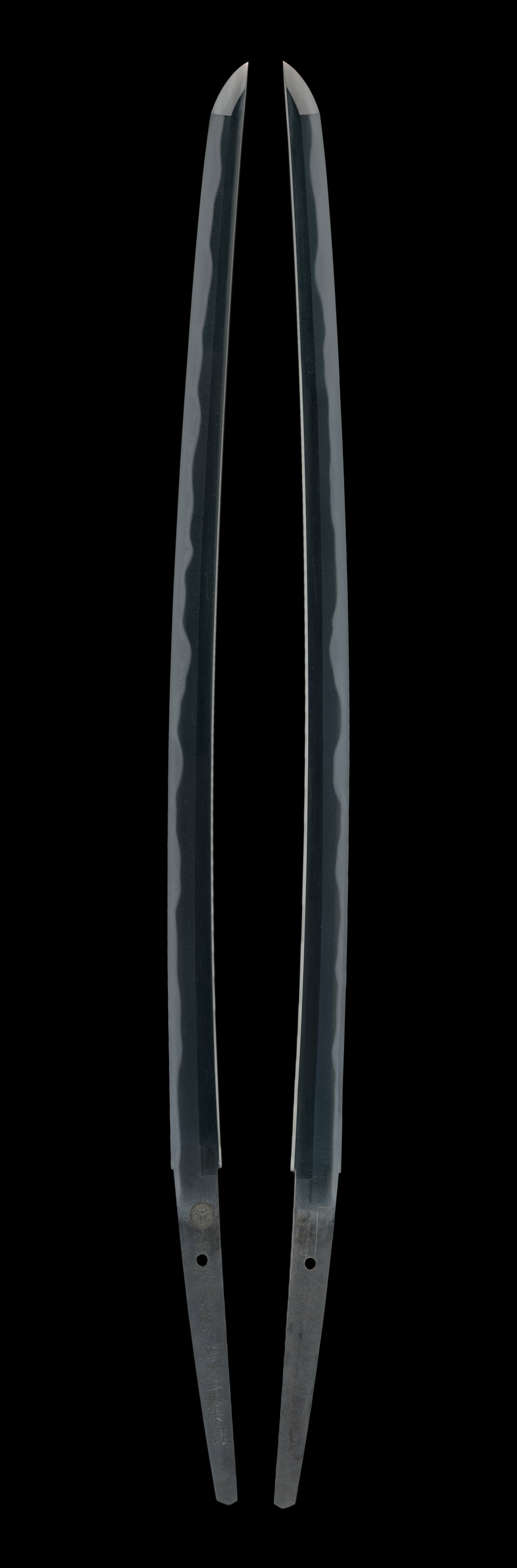
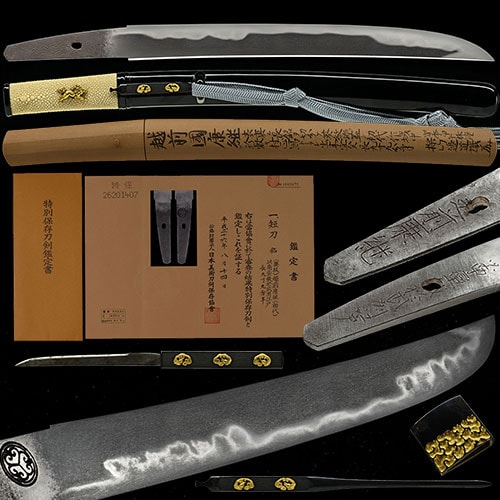
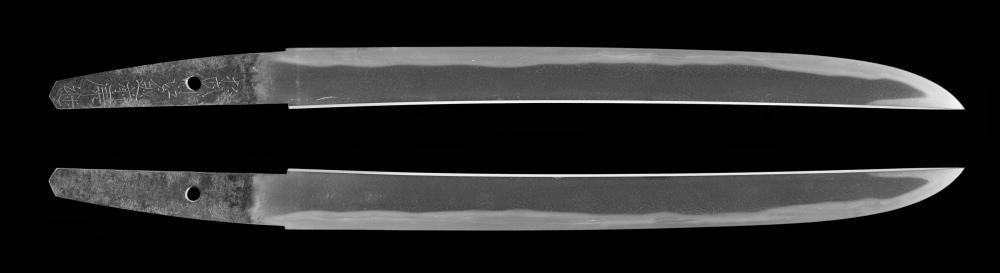
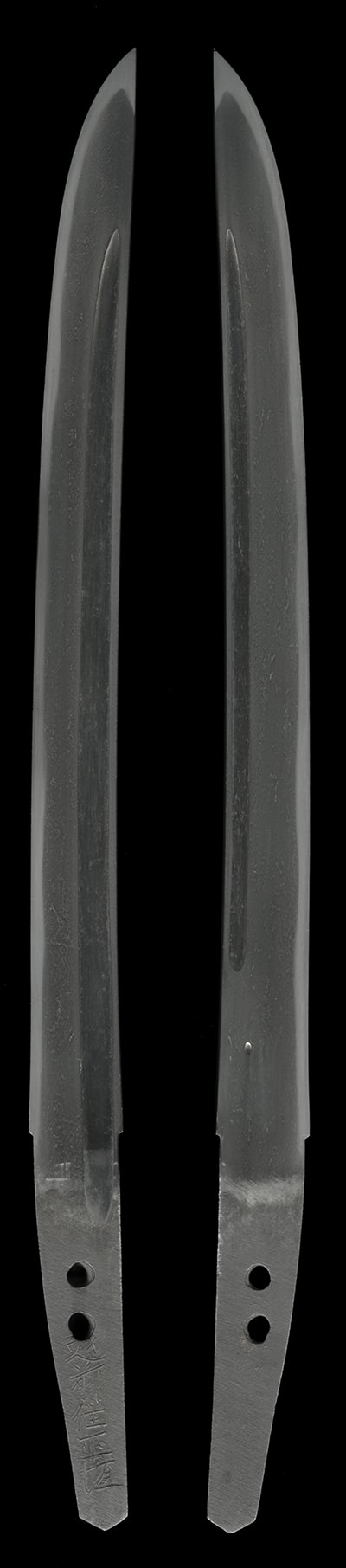
The first-generation Harima Daijo Shigetaka was a disciple of the first-generation Yasutsugu, and among the smiths of the group he is regarded as possessing the highest level of skill. An extant bearing a date of Genna 2 (1616) establishes his period of activity in the early period. The line continued through several generations into the Bakumatsu, yet it is the whose work most closely approaches the range of his master. While many smiths characteristically finish their tangs in form, Shigetaka is distinctive in employing , with the first generation tending toward a particularly shallow contour.
Shigetaka's forging presents tightly packed mixed with , with adhering well and fine entering; the steel frequently bears a darkened, "-colored" tone that the note as especially noteworthy in comparison with typical work. His characteristically favors with shallow , mixed with and somewhat pointed elements; enter well, the is deep with thick , and and appear throughout. The typically forms with a rather deep , showing at the tip. His manner of signing is compact and vertically tightened, executed with a thick chisel. The modeled after the celebrated "Honebami Toshiro" is praised as one of his greatest masterpieces, demonstrating faithful technique and splendid in the kinai-bori manner.
Surviving works by the are not commonly encountered, and among them are particularly few; are comparatively numerous, while include both and forms. The examples display an archaic manner suggesting an intention to evoke old Yamato precedents. Across his oeuvre, the refinement and compactness of the forging stands apart from ordinary production.