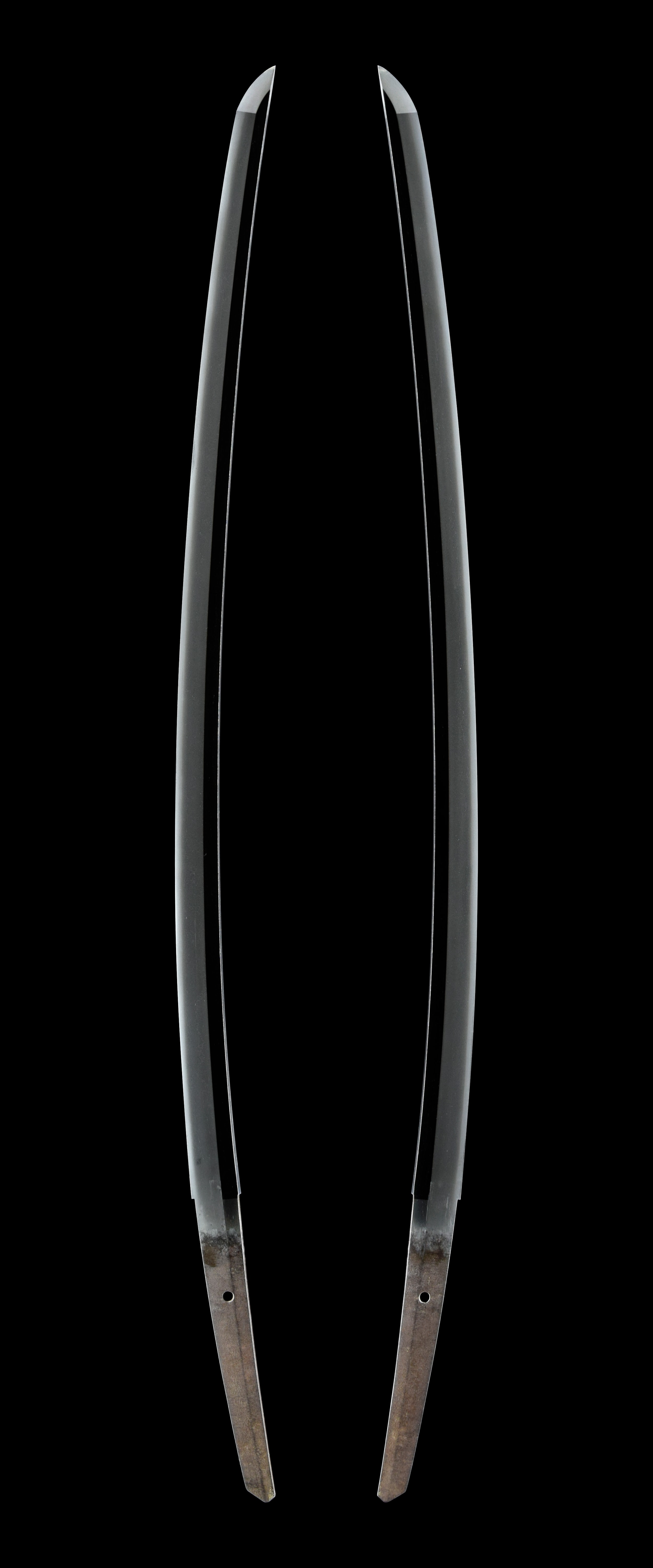
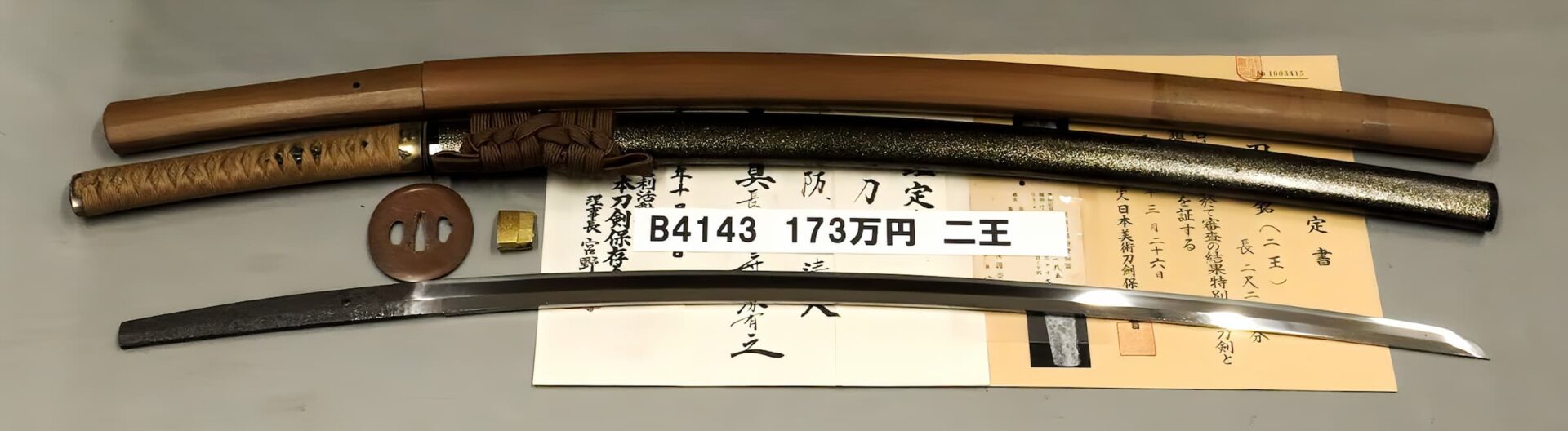
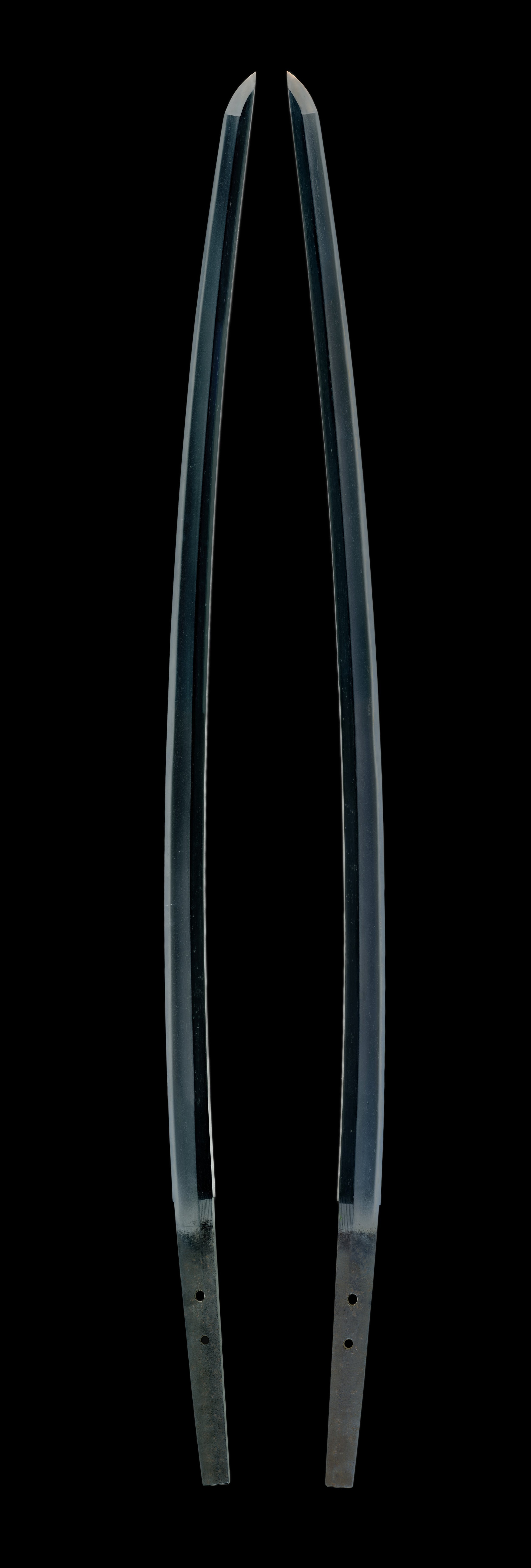
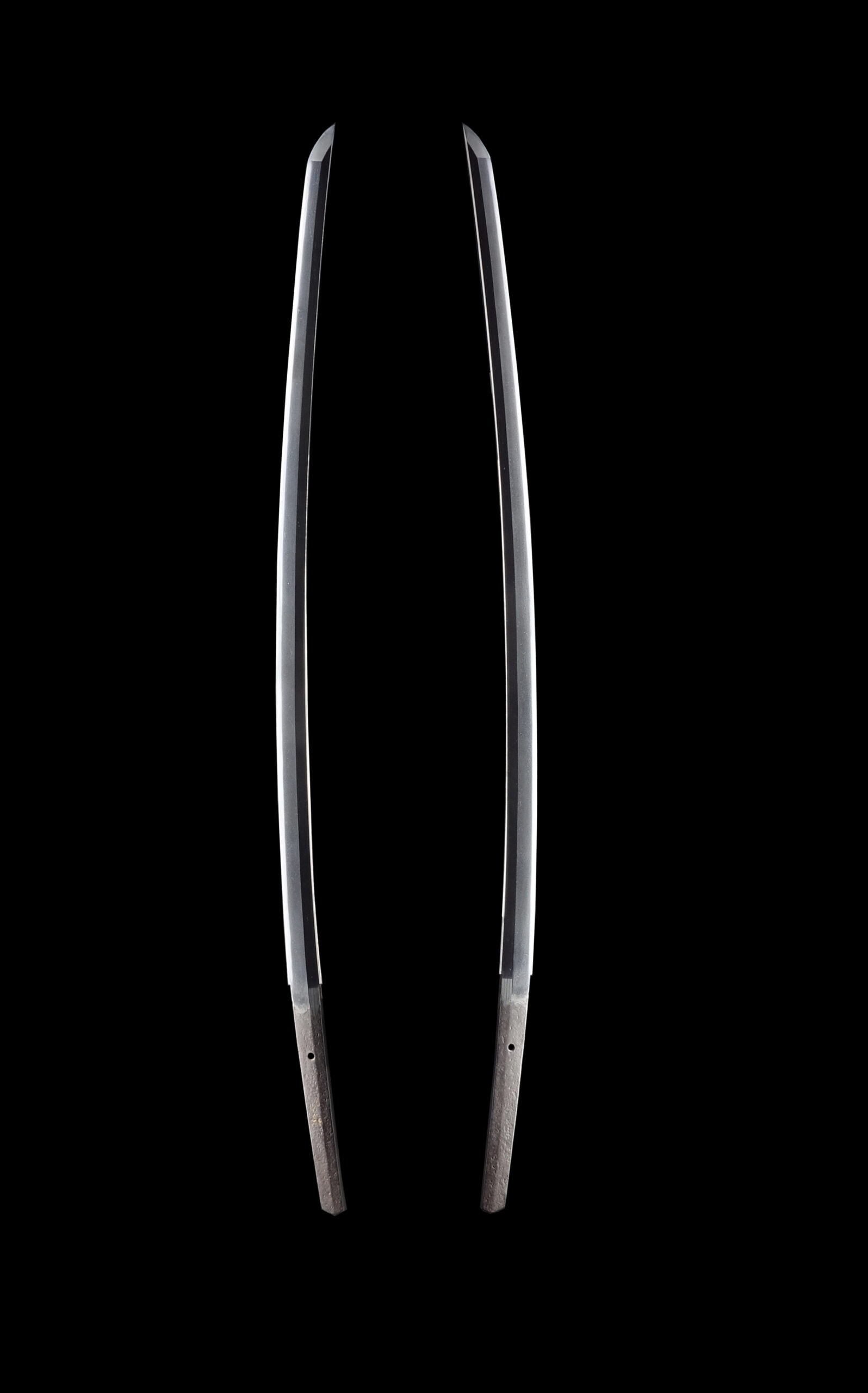
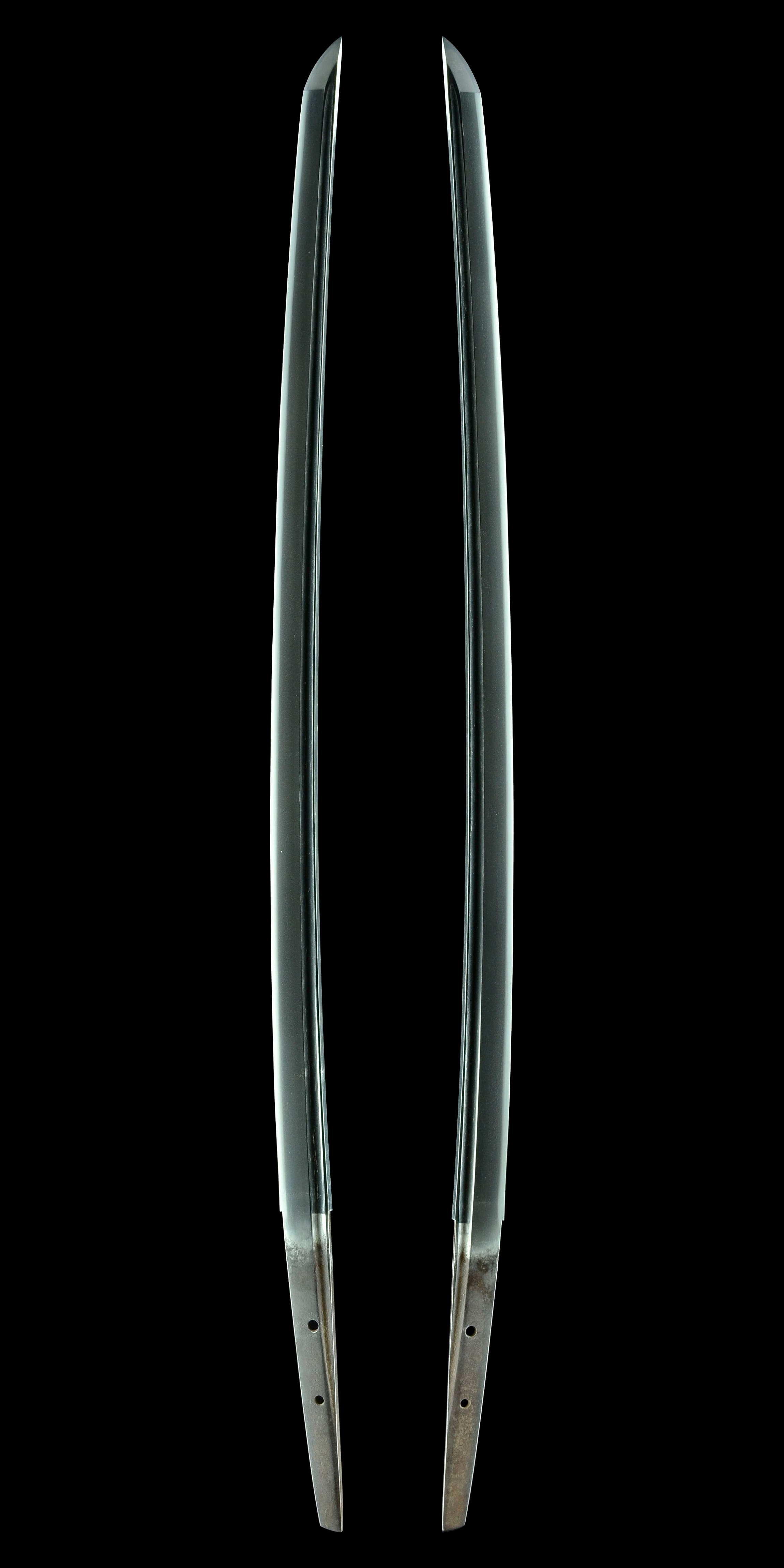
The Niō school of Suō Province is traditionally said to have begun around the Hōen era (1135–1141) with Kiyozane or Kiyohira as its founder, but the published sources record that no securely attributable work by either survives, so Kiyotsuna is now regarded "in effect as the school's founder". His oldest dated work, and the touchstone against which the first generation is read, is a signed in a written-out inscription, "Bun'ei 2, third month, Kiyotsuna" (文永二年三月 清綱, 1265), preserved at Itsukushima Shrine; after it the signature continues without interruption through the period and into the era, the name borne by generation after generation. The Niō name is most persuasively held to derive from the school's residence in Niho-shō within the province, though one tradition has the first Kiyotsuna cut a chain with a sword of his own making to free the Niō Guardian Kings from a temple fire, a pun the name itself carries. He works late in the period, the well-documented main generation of the line, and his hand sits between the Yamashiro of and the Yamato heartland.
His is a Yamato-leaning provincial make, and the published sources are explicit about why: Suō Province held a heavy concentration of temple estates, including lands of Tōdai-ji, so that the "strong Yamato color" of the Niō manner is understood as the fruit of exchange with the Yamato heartland. The is slender and high in the , the somewhat thick, the curvature marked at the hips with the of a late- blade; the is with a slight . Over a forging of with a little mixed in, the grain flows overall and in places flows strongly toward , the standing finely. The temper is a narrow carrying small and small in a continuous run, with attached; , and at times , move along it. The whole reads as quiet and controlled rather than flamboyant.
What the judges single out as the school's own individuality, the features that separate Niō from the Yamashiro and Yamato work it otherwise resembles, the published sources state outright: "the stands and the turns , and in these the individuality of the school is recognized". The whitish rises in the , faint and unlike a bright reflection, and it is paired with an , a softly clouded : the base of the temper tightens while the upper half clouds, the bright of the and giving way here to something moister and more subdued. The runs straight and turns back in a small . These are not bright effects but quiet ones, and it is precisely their quietness, named in the steel and in the line, that fixes the attribution.
The school is read in two registers off one coherent manner. The signed and carry a finely-chiseled two-character toward the and the original taka-no- file marks; the published sources call the characters "the typical old hand of Kiyotsuna" and assign the signed pieces to the first generation, taking care to note when both file marks and signature are preserved distinctly. Against these stand the unsigned blades, attributed to the school by the evidence read in reverse, the flowing-to- standing , the and the of the temper. Of one such the sources write that these points conspicuously express the traits of "the Niō school, and Kiyotsuna in particular". One of the earliest, fully signed type is judged to retain so little fatigue that it "clearly expresses not only this smith's manner but also the characteristic traits of the school"; a rare signed survives to anchor the form. The records distinguish this late- hand from the and Kiyotsuna who carried the name forward, the Kenmu 2 (1335) signed Bōshū Kuga-shō Kiyotsuna marking the line's continuation.
His place in the wider record is that of a western provincial founder whose manner is legible precisely because it is mixed. The flowing, -leaning is the Yamato inheritance the texts tie to Suō's temple lands; the narrow base looks toward the Yamashiro of ; and it is the and the together, not either alone, that the judges set against both to place the school. Kiyotsuna's standing, flowing clouds into in the and in the , a quieter, moister effect than the clear bright of or the tight Yamato grain of , and that pairing is the tell the published commentary returns to again and again. He stands, in the school's own telling, as its first knowable hand, the generation by which the rest are measured.
The weight of designation behind his name is real but slight in number, as befits a provincial line whose securely attributable corpus is small: a single of the early signed type, several blades signed and , two Important Cultural Properties, and three prewar Important Art Objects (Jūyō-Bijutsuhin) among the touchstones. The provenance recorded against the blades is distinguished where it survives: the Important Art Object now in the Sano Art Museum was held at the time of its prewar recognition by Tokugawa Iesato, head of the Tokugawa house, while another signed descends to the Seikadō from the Osaka collection of Kajima Isao, recognized in 1939. The dated touchstone remains at Itsukushima Shrine. Most of what survives is held, not traded: the Important Cultural Properties are patrimony, kept in shrine and institutional hands, and even the and blades of recorded whereabouts come to the market only rarely. A signed Kiyotsuna with its taka-no- file marks and old two-character intact is among the rarer things a collector of provincial work could hope to encounter, appearing from time to time and with patience, a landmark when it does.