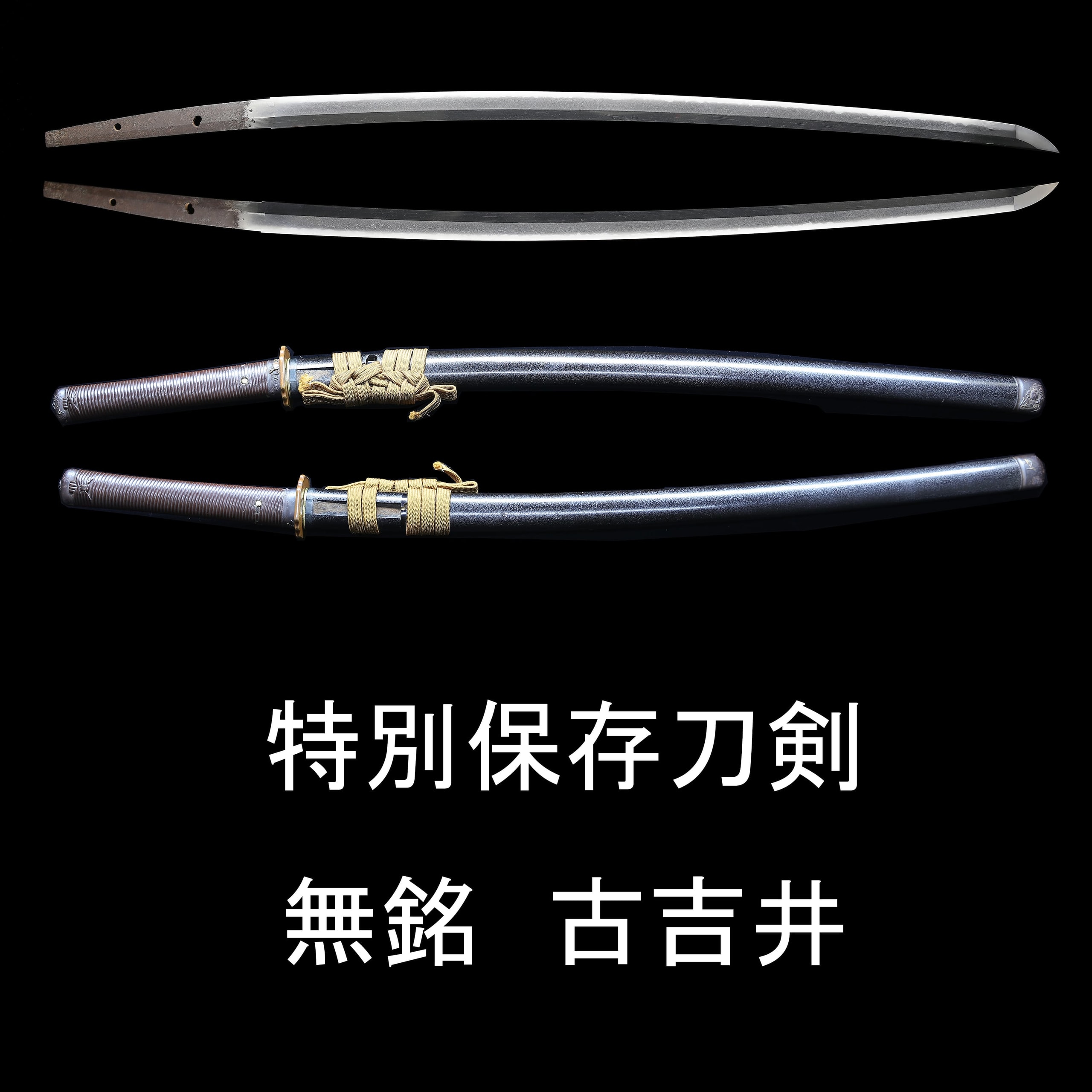
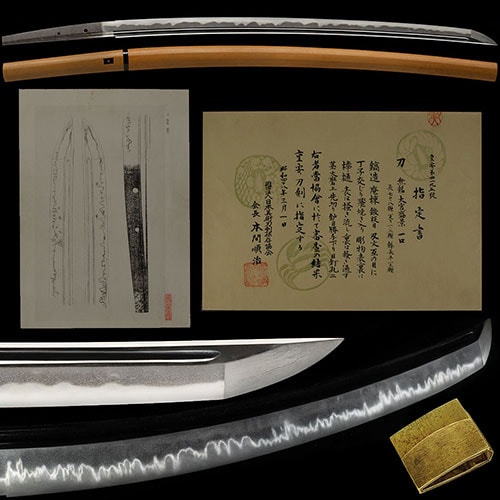
A by Kiyonori dated Hotoku 1, the tenth month of 1449, carries the full signature Province Yoshii Fujiwara Kiyonori, naming at once the man, his family and his school. Kiyonori is a smith of the Yoshii group working through the middle period, his dated blades running from Eikyo 3 in 1431 across the Kakitsu, Bun'an, Hotoku and Kyotoku years into the later 1450s. The signature compendia record him as the second to bear the name, a son of Yoshinori of the Yoshii line, and note that he later moved to Izumo. His work is the textbook face of a lineage that holds an unusual place in late history. The Yoshii group is traditionally said to have begun with Tamenori in the late period, though works that far back are exceedingly rare; pieces no later than the are classed as , and the production simply as Yoshii. While the other branches were drawn into , the Yoshii alone kept apart with a manner of their own, and Kiyonori is among the named, dated hands by which that manner is read.
The feature that fixes him is a small linked in a regular, continuous run. The published sources put it plainly, that this lineage's style lies above all in a temper of connecting in an orderly sequence, 「小互の目が規則的に連れる」, and Kiyonori's blades carry it as their spine. Over a standing he tempers the row in , mixing pointed and angular elements that give it a character, the temper running slightly near the base, with entering and a soft, bright . On his finest dated the temper takes on and a -like patch in the upper half, the row of small running the length of the blade in the even, repeating cadence the school made its signature. It is this orderly linking, not flamboyance or scale, that distinguishes a Yoshii blade, and Kiyonori's hand renders it cleanly. His are cut with a habit the sources count among the school tells, many strokes driven in reverse against the chisel, so that even the signature carries a Yoshii mark.
The beneath the temper is a tight mixed with , standing somewhat in the grain, with fine densely applied and entering. Across it Kiyonori raises the that is the school's other great hallmark, a reflection so particular that the published sources describe it as if the very form of the hardened edge were projected straight into the , 「その刃文の形をそのまま地に映し出したような、一派特有の映り」. On the typical blades this stands prominently, echoing the shape of the temper above it rather than drifting as an ordinary reflection would. The shape carrying this and is a with , standard in width with a clear taper toward the point, the somewhat thick, the rather deep with added and a , a carved on both faces and stopped at the base. The enters in and turns in , at times with a slightly pointed tendency or a Jizo-like return, following the irregularity of the temper into the point rather than resolving it.
Kiyonori is not confined to one register. The published sources name a second face within the Yoshii record, a narrow carrying only a slight admixture of small , and he works it cleanly. A Kyotoku is built in with , the a tight with and a distinct , the temper a narrow with a little and . A Bun'an is , wide and slightly extended with almost no curvature, the a well-forged of whitish tone, the temper again a narrow mixed with slight , with small and and a , carved on the front within the with a relief . The published sources read this not as a departure but as the other documented facet of the school style, the calm half of a hand whose louder half is the linked . His blades are also closely datable, the inscriptions spanning more than two decades, which the sources value as fine documentary material for studying the smith.
Within this body of work one blade stands apart, a Bun'an the published sources single out as his high point. Its forging is fine, a tight mixed with and interwoven with and , raising a standing , and the temper a with that becomes somewhat reverse-slanting, with . The sources judge it well forged and, for a Yoshii work of the period, unusually well covered in , holding that but for its proportions its workmanship approaches the range of itself, 「脇指姿の点を除けば古吉井の作域にせまる出来ばえで見事である」. Most of his record is the plainer, repeating production that makes the school recognizable, but in his best moments his hand reaches back toward the older, finer Yoshii standard. The conspicuous representative works, with their thick , soft and reverse-chisel , the sources call the typical Yoshii blade in which the school's character shows most clearly, 「銘字には逆鏨を多用しているなど、吉井派の特色が顕著に表れた典型作」, while this one shows how far that character could be pushed. His bright , linked and reverse-chisel signature set his work apart within , holding a distinct line where the surrounding lineages were absorbed into .
Kiyonori's standing is that of a documented master rather than a famed name, his record sitting entirely at the Important Sword rank, with Fujishiro grading his work chu-. Eight of his blades are designated , papered across sessions from the fifteenth in 1967 to the sixty-seventh in 2021, a span showing his work recognized steadily over half a century of ; none stand above that tier, with no National Treasure or Important Cultural Property among them. They are and both, all signed and most dated, so a buyer encounters a smith who can be placed to the year, which for a hand is part of the appeal. Of recorded whereabouts one of his is held by Yasukuni Shrine, the rest in private and collectors' hands. A signed, dated Yoshii Kiyonori is not beyond reach in the way a great blade is; examples come to market from time to time, and for a collector drawn to the linked and reflected of late , one of his dated is among the more attainable ways to hold the Yoshii manner in its clearest form.