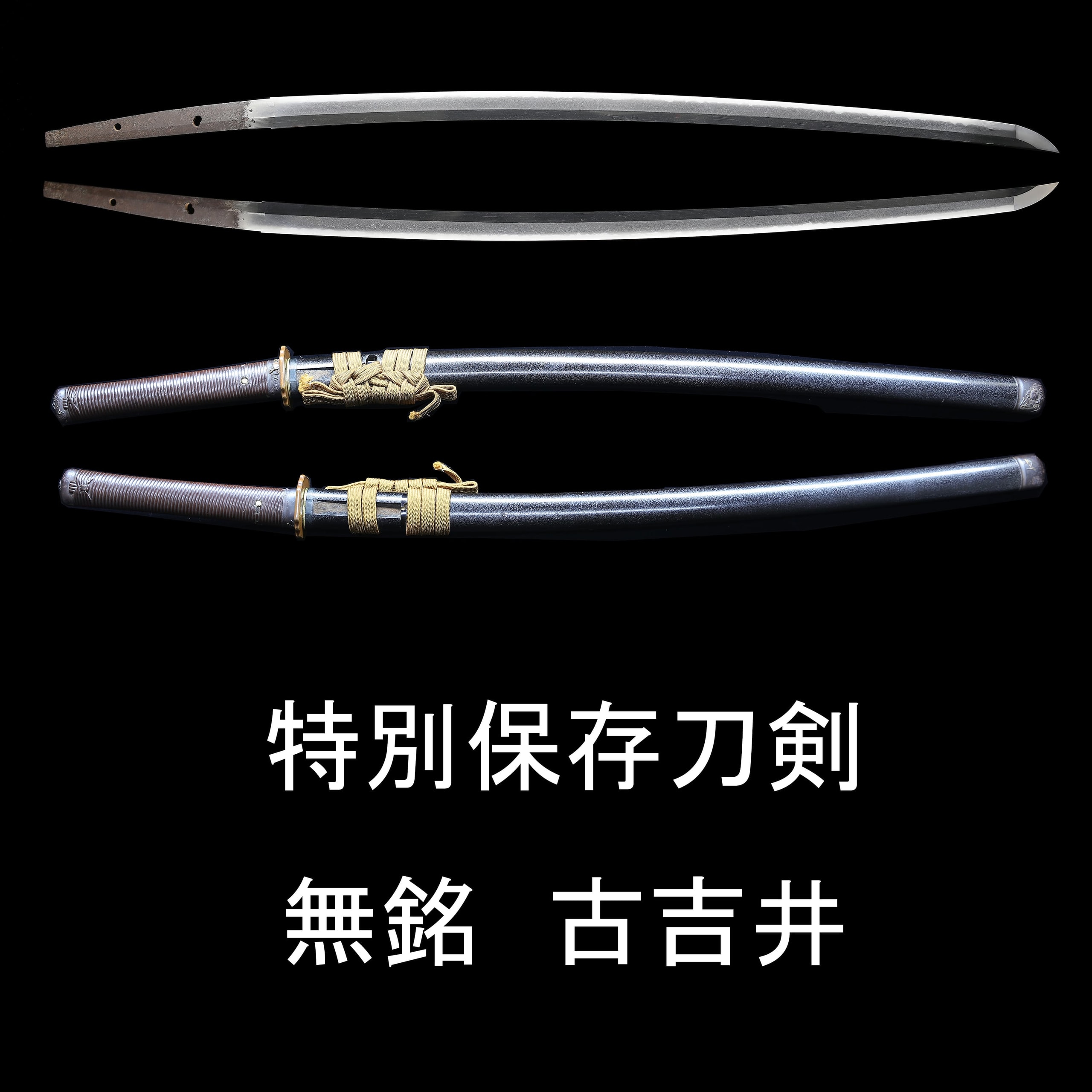
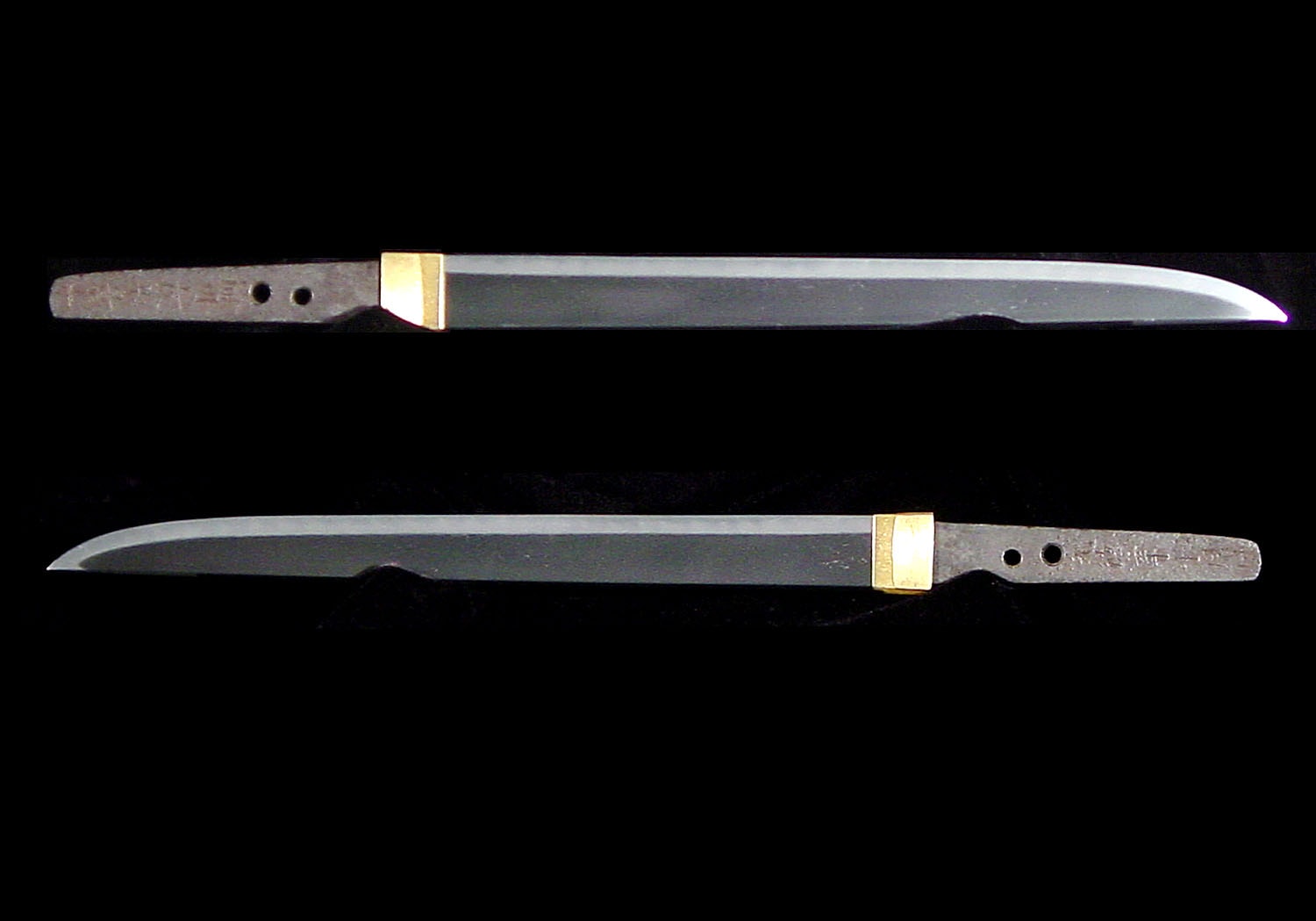
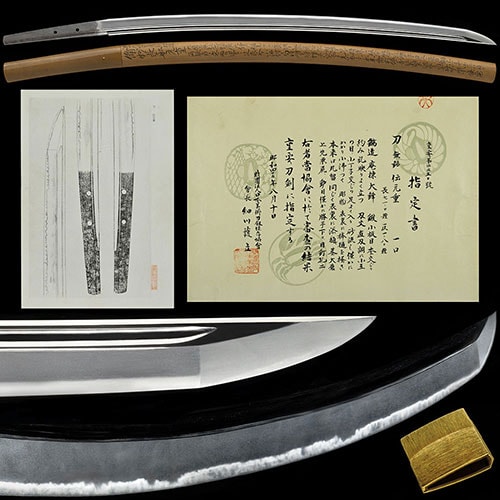
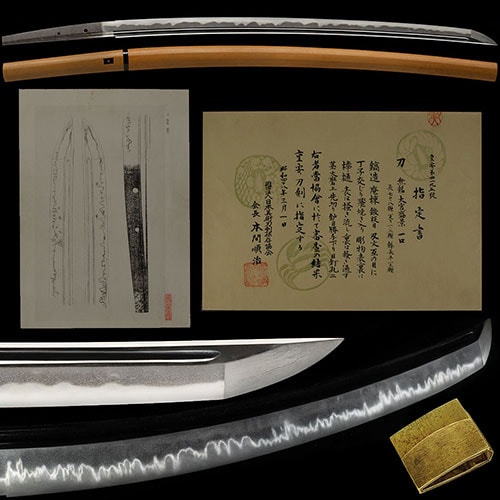
A by Kagenori dated Joji 5, the second month of 1366, carries the full signature no Yoshii ju Kagenori, the two characters of the name cut left and right of the second with a fine chisel and the date set to the reverse. Kagenori is a smith of the Yoshii group, the lineage that worked at Yoshii, the locality facing across the Yoshii River, and his signed and dated blades run from the late period through the across the Kareki, Joji, Kanno, Eitoku and later years. Among the craftsmen of the group his is the name that endured the longest, the published sources noting that within the Yoshii smiths it is Kagenori whose lineage-name 「名跡が最も長く続いている」, with one account even holding him 「一説に吉井の嫡流」, the main line of the school. The group is traditionally said to have begun with Tamenori in the late period, though works that far back are exceedingly rare, and so pieces no later than the are classed as and the production simply as Yoshii. While the other branches were drawn into , the Yoshii kept apart with a manner of their own, and Kagenori is the named, dated hand by whom that manner is most clearly read.
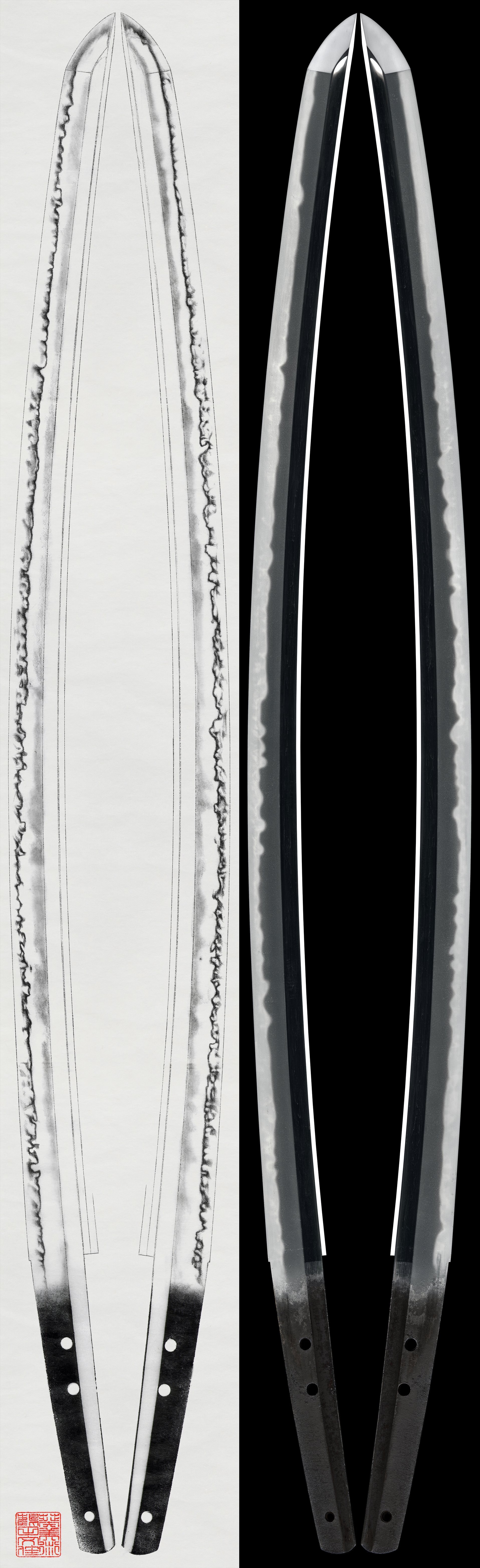
The feature that fixes him is a linked in regular, continuous groupings over a standing . The published sources put the school's tell plainly, that its workmanship lies above all in a arranged in an orderly, repeating sequence, and Kagenori's blades carry it as their spine, mixing in pointed elements that give the row a character and, on the late , a and a slight reverse tendency. Over the row the work is judged rather than the -based manner of , taking , , and within the . This is no incidental feature. On one wide, deeply curved with the sources read, through its bold two-character signature and the strong within the edge, an aspect of the oldest , 「刃中の沸が強い出来に古備前の面影を見」, recording that a boldly chiselled Kagenori once in the Date family had even been appraised as . It is this orderly linking and -laden edge that distinguishes a Yoshii blade, and the sources warn that the strength of the manner led later generations to be mistaken for work.
The beneath the temper is an standing somewhat in the grain, at times mixed with , with and on the a tightly forged carrying minute and a conspicuous mottled . Across several blades Kagenori raises the that is the school's other great hallmark, a reflection so particular that the published sources describe it as one in which 「刃文の形がそのまま影になったように見える」, the shape of the temper appearing cast as a shadow into the . On the this stands clearly, echoing the row of the temper above it rather than drifting as an ordinary reflection would. The shapes carrying this and range across his record: wide in body with deep , and a ; a compact ; and, on the dated pieces, a wide, thin and elongated in proportion to the width. The follows the temper into the point, entering in and turning in on the , rounding on the , and on the rising to a pointed return.
Kagenori is not confined to one register. Alongside the linked the published sources find a quieter, -based face on the and the dated Joji , a temper built on with a shallow into which and are mixed, linking in the regular manner so the Yoshii character still shows through. On the the row becomes generally connected, with and a little , adhering well, the growing uneven and spilling into the , the whole running with fine and , a vigorous construction the sources call atypical for the school yet unmistakably of it. His blades are closely datable, the Joji 3 and Joji 5 among them, which the published sources value as precious material for studying both the lineage and the smith. The long signature no Yoshii ju Kagenori is recorded as continuing through the Joji, Kanno, Eitoku, Oei and Shocho eras, so that the name spans from the late into the mid- as the through-line of the school, while two earlier with carved inscriptions dated Koan raise a question the sources hold open as to whether they are Yoshii at all.
The study of Kagenori is, more than for most smiths, a study of the name itself, for it was carried by more than one hand. On one early whose lower inscription is cut away the published sources affirm there is no dispute it is a -period Yoshii work, yet caution that 「景則でなければならぬと云う極め手はない」, there being no decisive factor requiring it to be this Kagenori, and present it instead as a representative and typical example of the tradition. On the the judges read further, appraising it from the in both and and its rich and as the work of a Kagenori 「初・二代を下らない」, no later than the first or second generation. His bright , his linked and his -laden edge set his work apart within , holding a distinct line where the surrounding lineages were absorbed into , and tying his name back through the strong to the oldest rather than to the mainstream of his own day.
Kagenori's standing is that of a documented hand rather than a famed name, his record sitting entirely at the Important Sword rank, with six of his blades designated across sessions from the twelfth in 1964 to the fiftieth in 2004, recognized steadily over four decades of . None stand above that tier; there is no National Treasure or Important Cultural Property among them. They are , , and , all signed and several dated, so a collector encounters a smith placed to the year, which for a hand is part of the appeal. Of recorded whereabouts the of the twelfth session, once held by Sano Takashi, is now in the Sano Art Museum, while the others have passed through private hands. A signed, dated Yoshii Kagenori is not beyond reach in the way a great blade is; an example comes to market from time to time, and for a collector drawn to the linked , -laden edge and reflected of early Yoshii, one of his dated blades is among the more attainable ways to hold the school's manner in its most exactly knowable form.