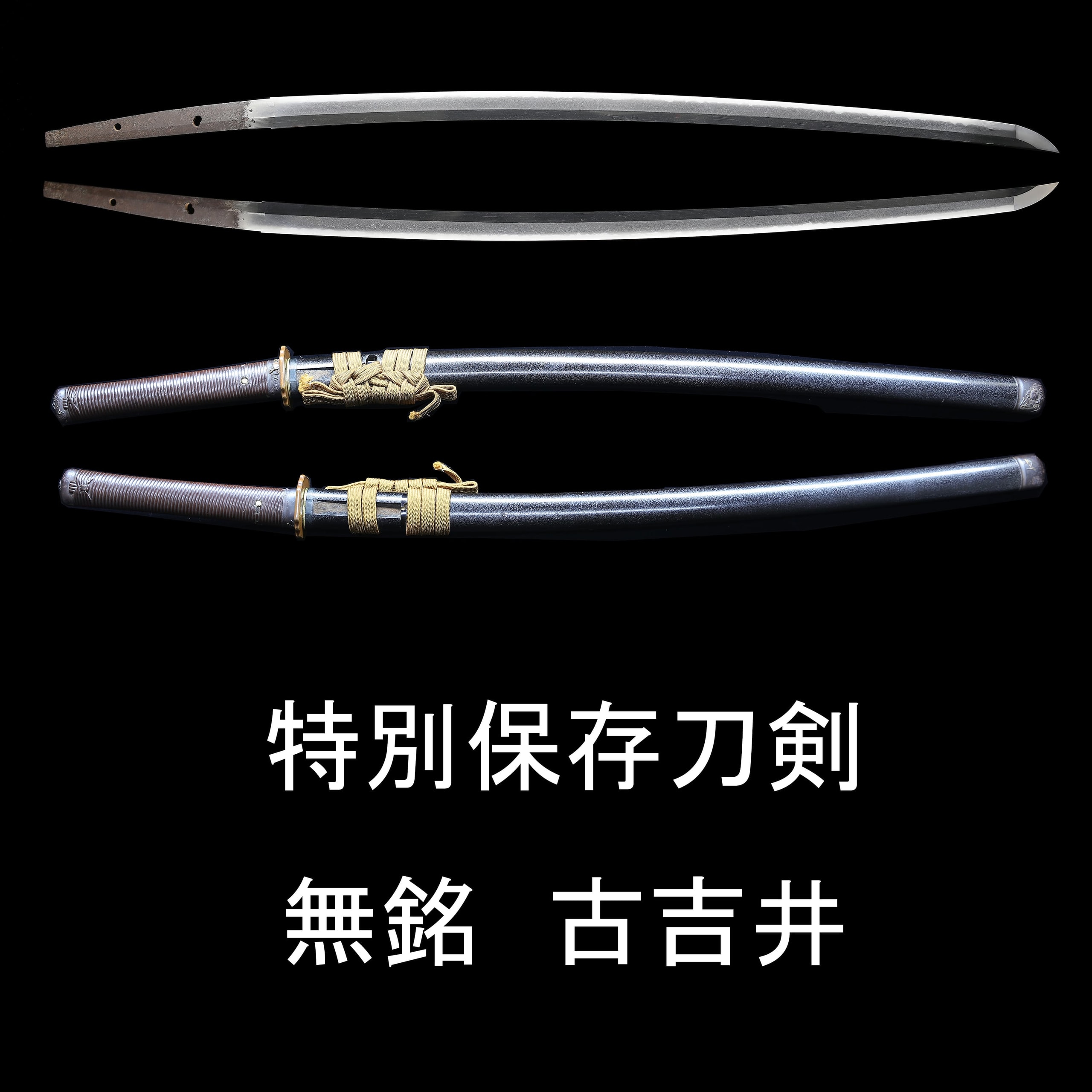
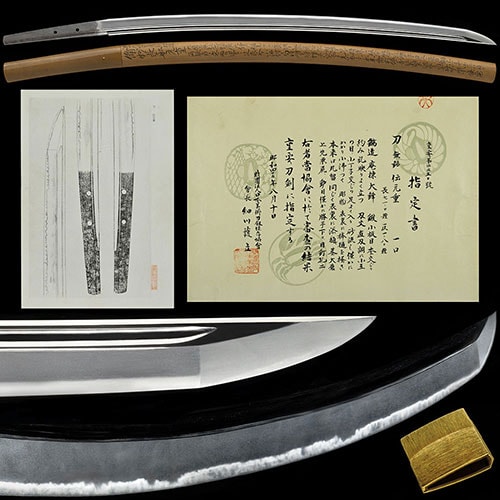
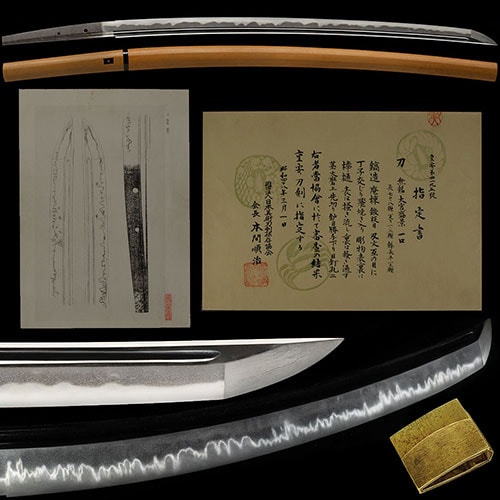
Naganori was a swordsmith of the Yoshii group, and the published sources place him in the Eikyo era of 1429 to 1441 and the Choroku era of 1457 to 1460, recording him as the son of Kiyonori and adding a tradition that he later moved to Izumo. The Yoshii group is traditionally said to have begun with Tamenori in the late period, though works that far back are exceedingly rare, and it flourished from the through the period as the one branch that was never drawn into the consolidated mainstream. His four designated blades are all signed with a bare two-character , Naganori, on a form with or and a , the tang with a on his earliest piece and shortened to a on the latest. They are the work that fixes the early-to-mid face of the school, and on one of them the published sources note that the well-ordered and the standing make it look, at first sight, like "a blade going back to an earlier age", a deception that only the of its shape betrays.
The recognized Yoshii hand divides into two manners, and Naganori works in both. The published sources name the chief hallmark of the school as a temper in which small run in a regular, continuous sequence, writing that "a major hallmark of Yoshii workmanship is a temper in which small run in a regular linked sequence". His fullest example of this manner, the fortieth-session , carries that in an orderly , the row mixing in angular , pointed and with opened bases, primarily in with and, here and there, strongly shining coarse , with and running through the temper. The enters in and turns back in a small , the standing strongly and sweeping into at the tip. His second manner is a narrow , ordinary in itself and of a kind the published sources say is seen in smiths such as Norimitsu, into which only a slight admixture of small enters. Of that admixture they write that "the places where small are mixed in may be regarded as a characteristic of the Yoshii group", so that even his quietest temper is read as Yoshii by the folded into it.
Beneath the temper the is a , densely and tightly forged, with applied and entering, and on one of the it takes on a tendency near the edge and stands somewhat open across the whole. Over it the school raises an that the published sources call distinctive among all works, one in which, as they put it, "the reflection is of a unique kind, as though the very outline of the hardened pattern were cast as a shadow and reflected into the ". The reflection therefore seems to repeat the shape of the temper rather than to drift as the soft, cloud-like of the mainstream. On the pieces the reads faintly over a closely forged with fine , the tending tight or showing , with small entering and slight ; on the linked- it stands more boldly, paired with the coarse and the running that the quieter register does not show. He carves a on both faces, on his earliest run through with a companion alongside the tang, and signs at the toward the .
These two registers are best held apart in the , since the smith covers a flamboyant linked and a restrained , and the published sources draw the line themselves when they observe that Yoshii workmanship can be divided broadly into the linked- out and the out. His earlier , signed and bearing the , sits between the two: the run there in a slightly irregular with small and mixed and a tight , the densely forged and the standing distinctly, which is the very combination that makes it read like an older piece. Oei-and-later Yoshii works, by Naganori and by his fellows alike, are few among extant examples, and it is in part for that scarcity that the published sources value his surviving as the representative pieces of their period. The directory carries several later Naganori in Izumo, consistent with the transmitted move, while in the name continues into the later Yoshii line beside Kiyonori and the other dated hands of the school.
What sets Naganori apart from the wider run of mid- is not force or display but the particular Yoshii combination his own blades carry, the orderly over the reflected , present even where the temper quiets to . The published sources find in his work the characteristics of the whole group fully manifested, and where the alone might pass for the ordinary straight temper of a Norimitsu, the small mixed through it and the shadow-cast standing behind it return the attribution to Yoshii. He stands, with Kiyonori his father and Morinori among the older , as one of the signed and locatable hands by which the school's early-to-mid manner is told, a documentary anchor rather than a name carried on grand provenance.
Naganori's work survives in a small number of signed , four of them papered to the rank across the tenth, twenty-second, twenty-fourth and fortieth sessions, the earliest designated in 1963 and the latest in 1994. The Fujishiro appraisers rate him at the chu-jo level, a standing above the average run of the school's hands, and the published sources reserve their warmest phrasing for the fortieth-session , of which they write that both and are sound and "both and are excellent". None of his blades carries one of the higher cultural-property designations, and none carries a recorded provenance, so his pieces belong to the upper- tier rather than to the museum-held patrimony of the great names; among recorded holders his powerful is kept in the Tokugawa Art Museum, while the designated have passed through private hands in Okayama, Nagasaki, Aichi and Tokyo. For a private collector this means a signed Yoshii Naganori, when one of the few survives to come to market, is an attainable rather than an unreachable thing, though it appears only from time to time and rewards patience, valued less for the weight of its name than for being a signed witness to the Yoshii hand at its early-to-mid best.