Shoami Denbei, born Suzuki Denbei in Keian 4 (1651) in Shonai, Dewa Province, is regarded as the founding master and foremost representative of the Akita Shoami lineage. At the age of eighteen, in 8 (1668), he traveled to and entered the school of Shoami Yoshinaga. In Enpo 1 (1673) he relocated to Akita in the company of Funao, a retainer of the Satake family, and in Enpo 3 (1675) he was taken into official service by the domain lord Satake Yoshizumi as a retained craftsman. The following year, in Enpo 4 (1676), he was granted permission to assume the Shoami lineage name and thereafter styled himself Shoami Denbei. He flourished as Akita's preeminent metalworker until his death in Kyoho 12 (1727) at the age of seventy-seven. The Akita Shoami themselves are understood to have relocated from to Akita in the Keicho era, accompanying the Satake ; Denbei consolidated this regional tradition into a distinctive artistic identity with national standing.
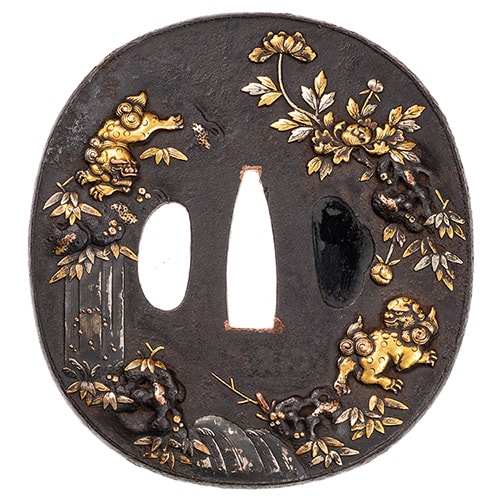
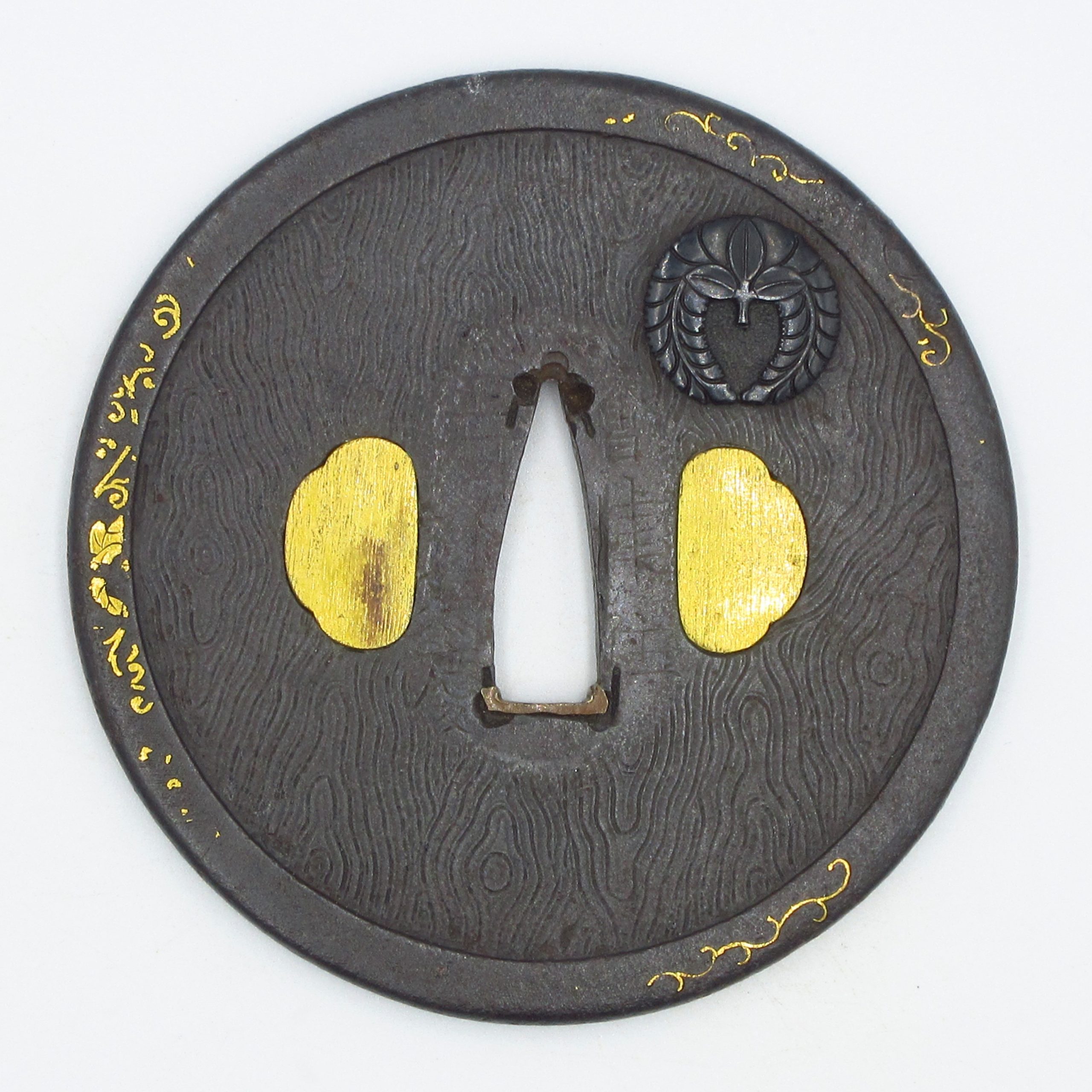
The range of Denbei's production is remarkably broad. His oeuvre encompasses pieces depicting subjects closely associated with Akita — most notably butterbur (fuki) motifs and cloud-and-dragon (unryu) themes — rendered through nikubori relief carving combined with openwork ground () and inlay. He also produced works employing guri-bori carving in laminated and copper that achieves effects reminiscent of lacquer tsuishu, a technique in which he particularly excelled. In every case, his compositions are innovative, and his advanced inlay methods — particularly sen- (line inlay) and (textile-pattern inlay) — are consistently striking. His gold ornament is highly individual, wholly different from the arabesques of , Kyoto, or Awa, and constitutes a distinctive Denbei idiom. The butterbur subject held special significance within the school, both for its association with Akita's celebrated giant fuki and for its auspicious homophony with fuki meaning "wealth and rank." Additionally, his shippo (gold cloisonne inlay) has been identified as entirely identical to the cloisonne methods of the main Hirata lineage, providing valuable evidence of technical exchange between the two houses.
Denbei's consistently project an assertive, powerfully individual artistic character regardless of subject or format. Whether working in otafuku forms with bold butterbur leaves, true-round iron plates with - and all-over gold , or hexagonal guards with bamboo openwork, his works convey both mastery and authority. His approach to spatial organization is distinctive: he combines realistic depiction with devised, original compositional ideas, and places importance on effects of coloration. Even with an intentionally simple motif, he projects a forceful, individual world and conveys the capacity of a master craftsman. Denbei's work reveals a sophisticated hand grounded in traditions inherited from the Shoami forebears, elevated by originality and technical virtuosity into a manner that is uniquely his own.