The twentieth century nearly killed the craft twice: wartime distortion, then the occupation ban. The NBTHK’s founding in 1948 and licensed forging from 1953 rebuilt the sword as an art, crowned by Living National Treasures and the mukansa rank.
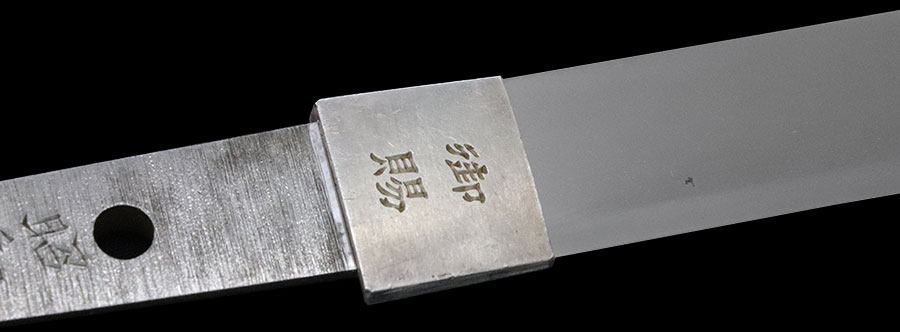
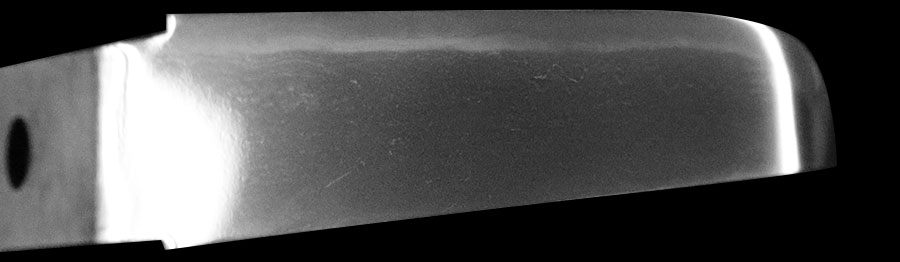
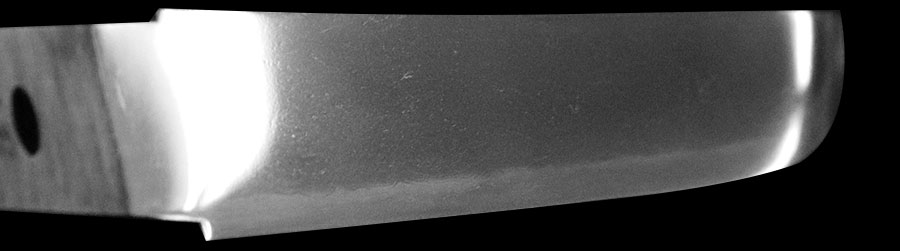
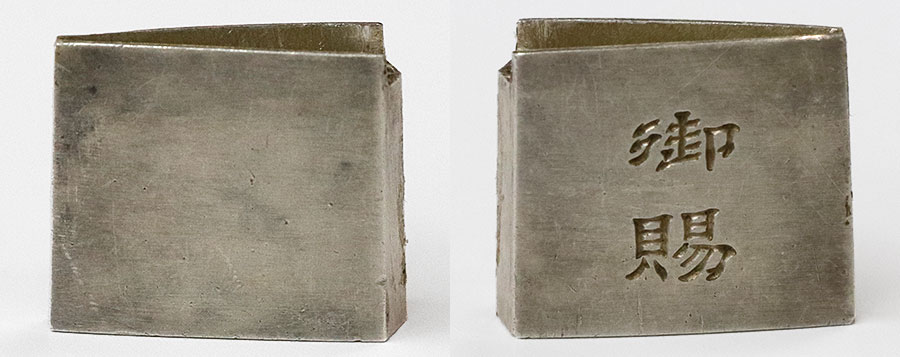
Who was the person who graduated with excellent and top results among the 160 members of the 64th class of the Naval Academy in Showa 12 and was awarded this imperial gift dagger; the appearance of this imperial gift dagger makes future research very exciting. The maker, swordsmith Kajiyama Yasutoku, whose real name was Kajiyama Tokutaro, was born in Nigata-cho, Hiroshima Prefecture on February 16, Meiji 14, and joined the Yasukuni Nihonto Tanrenkai on July 8, Showa 8. He was given the swordsmith mei "Yasutoku" and thereafter became a head swordsmith, and on December 9, Showa 9, he received the honor of producing a Japanese Army gunto for the Showa Emperor. The swordsmith Kajiyama Yasutoku won numerous awards such as the Monbu Daijin Saiko Eiyo Sho Tokusen at the Nihonto Tenrankai, and along with the swordsmith Miyaguchi Yasuhiro and the swordsmith Ikeda Yasumitsu, he is a leading figure among the "Yasukuni Tosho" and is one of the master smiths representing the Showa era. This tanto is a precious imperial gift Navy dagger of a kind one never sees, and it was produced using a tanto by Bizen Osafune Kagemitsu from the Kamakura period as a model. The sugata shows the form of a Kamakura period tanto without sori, the jigane is a well-tightened ko-itame hada, and the hamon is a skillfully tempered suguha. Please by all means enjoy this extremely precious Navy dagger by the swordsmith Yasutoku, an imperial gift that would not be awarded unless one graduated from the Naval Academy with excellent results.
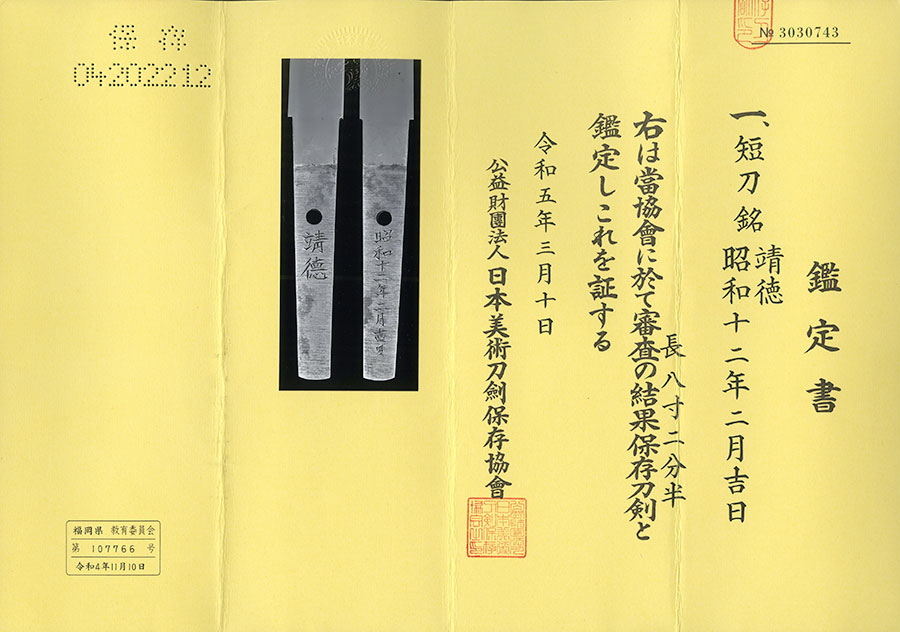
Certificate reading — 銘 靖徳 昭和十二年二月吉日
Yasutoku靖徳
Offered by Nipponto
2 on the market


As written by the shop
Machine translation from the shop's Japanese · may contain errors ·
Tokyo · around 1926-1989
Tōken Taikan top 95%
2 pieces on the market now
Shōwa to the present: destruction and revival
The twentieth century nearly killed the craft twice: wartime distortion, then the occupation ban. The NBTHK’s founding in 1948 and licensed forging from 1953 rebuilt the sword as an art, crowned by Living National Treasures and the mukansa rank.
Certifies a genuine blade worth preserving: a signature confirmed correct, or, if unsigned, an era, province, and school that the NBTHK can reliably identify.
The NBTHK (Nihon Bijutsu Tōken Hozon Kyōkai, the Society for the Preservation of Japanese Art Swords) is a public-interest incorporated foundation founded in 1948 and supervised by Japan’s Agency for Cultural Affairs (Bunkachō); it is based at the Japanese Sword Museum in Tokyo. Its expert panels physically examine each submitted work (shinsa) and issue a certificate (kanteishō) ranking it by artistic and historical merit. NBTHK papers are the most widely recognized standard of authentication for Japanese swords and fittings.
NBTHK official siteFor returns due to customer circumstances, the cost is the customer's responsibility. For returns due to our mis-shipment or a defective item, we bear the cost.
¥850,000