Tokuho
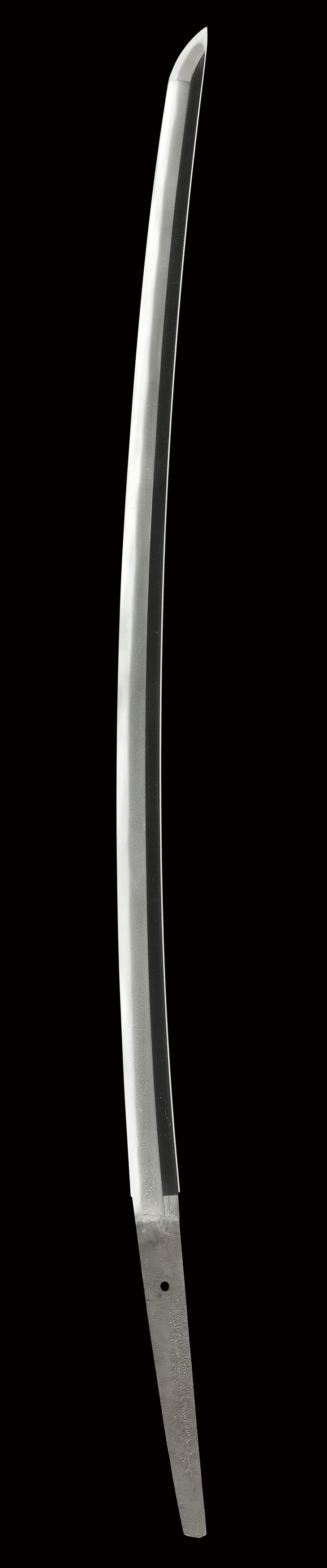
近江守法城寺橘正弘 元禄十二年二月日 飯田右衛門尉源英往 Ominokami Hojoji Tachibana Masahiro
Price on request
Specifications
Nagasa
75.1 cm
Sori
1.7 cm
Motohaba
3.44 cm
Sakihaba
2.3 cm
Weight (toushin only): 1001g It has arrived, it has arrived—a special-order masterpiece from an era when swords with owner inscriptions (shojisha-mei) were rare. This is a precious sword featuring a specific owner's name. The home province of Omi no Kami Hojoji Tachibana Masahiro was Tajima, and his distant ancestor was Hojoji Kunimitsu, who was praised as one of the "Sadamune Santetsu" (Three Disciples of Sadamune). The first generation Omi no Kami Hojoji Tachibana Masahiro, real name Takigawa, moved to Edo around the Manji era (1658, 366 years ago). Both the first and second generations used the name Omi no Kami Hojoji Tachibana Masahiro. As the leader of the Hojoji school, they flourished greatly in Edo by creating swords that rivaled those of Kotetsu. This sword is a precious work by the second generation Omi no Kami Hojoji Tachibana Masahiro, featuring a nenkii (date) from Genroku 12 (1699, 325 years ago)—during the reign of the fifth Shogun Tokugawa Tsunayoshi, just two years before the Ako Roshi incident—along with the shojisha-mei of "Iida Uemon-no-jo Minamoto Hideyuki." The sugata of this sword shows a thick moto-kasane and wide moto-mihaba, with a distinct difference between the moto and saki-mihaba, resulting in a grand and magnificent appearance. The jigane is a well-forged itame-hada with thick ji-nie, presenting a bright and clear steel. The hamon is nioi-deki with ko-nie in a notare style with continuous gunome, beautifully exhibiting Kotetsu’s signature juzuba. The boshi also returns in a ko-maru style similar to Kotetsu; it is a wazamono that looks as though it could cut through anything. Since ancient times, it has been said that Hojoji swords often had their mei erased to be disguised as works by Nagasone Kotetsu Nyudo Okisato, and this sword is indeed a masterpiece that surpasses the superior works of Kotetsu. The Edo-period koshirae further adds elegance to this masterpiece by Masahiro, which exceeds even the real Kotetsu. Iida Uemon-no-jo Minamoto Hideyuki was likely a high-ranking official of the Bakufu; future research will be something to look forward to. Having recently emerged from a private collector, we are offering this at a special bargain price. Please enjoy this exceptional piece.
 NihontoWatchBETA
Price on request
75.1 cm
1.7 cm
3.44 cm
2.3 cm
Weight (toushin only): 1001g It has arrived, it has arrived—a special-order masterpiece from an era when swords with owner inscriptions (shojisha-mei) were rare. This is a precious sword featuring a specific owner's name. The home province of Omi no Kami Hojoji Tachibana Masahiro was Tajima, and his distant ancestor was Hojoji Kunimitsu, who was praised as one of the "Sadamune Santetsu" (Three Disciples of Sadamune). The first generation Omi no Kami Hojoji Tachibana Masahiro, real name Takigawa, moved to Edo around the Manji era (1658, 366 years ago). Both the first and second generations used the name Omi no Kami Hojoji Tachibana Masahiro. As the leader of the Hojoji school, they flourished greatly in Edo by creating swords that rivaled those of Kotetsu. This sword is a precious work by the second generation Omi no Kami Hojoji Tachibana Masahiro, featuring a nenkii (date) from Genroku 12 (1699, 325 years ago)—during the reign of the fifth Shogun Tokugawa Tsunayoshi, just two years before the Ako Roshi incident—along with the shojisha-mei of "Iida Uemon-no-jo Minamoto Hideyuki." The sugata of this sword shows a thick moto-kasane and wide moto-mihaba, with a distinct difference between the moto and saki-mihaba, resulting in a grand and magnificent appearance. The jigane is a well-forged itame-hada with thick ji-nie, presenting a bright and clear steel. The hamon is nioi-deki with ko-nie in a notare style with continuous gunome, beautifully exhibiting Kotetsu’s signature juzuba. The boshi also returns in a ko-maru style similar to Kotetsu; it is a wazamono that looks as though it could cut through anything. Since ancient times, it has been said that Hojoji swords often had their mei erased to be disguised as works by Nagasone Kotetsu Nyudo Okisato, and this sword is indeed a masterpiece that surpasses the superior works of Kotetsu. The Edo-period koshirae further adds elegance to this masterpiece by Masahiro, which exceeds even the real Kotetsu. Iida Uemon-no-jo Minamoto Hideyuki was likely a high-ranking official of the Bakufu; future research will be something to look forward to. Having recently emerged from a private collector, we are offering this at a special bargain price. Please enjoy this exceptional piece.
NihontoWatchBETAPrice on request
75.1 cm
1.7 cm
3.44 cm
2.3 cm