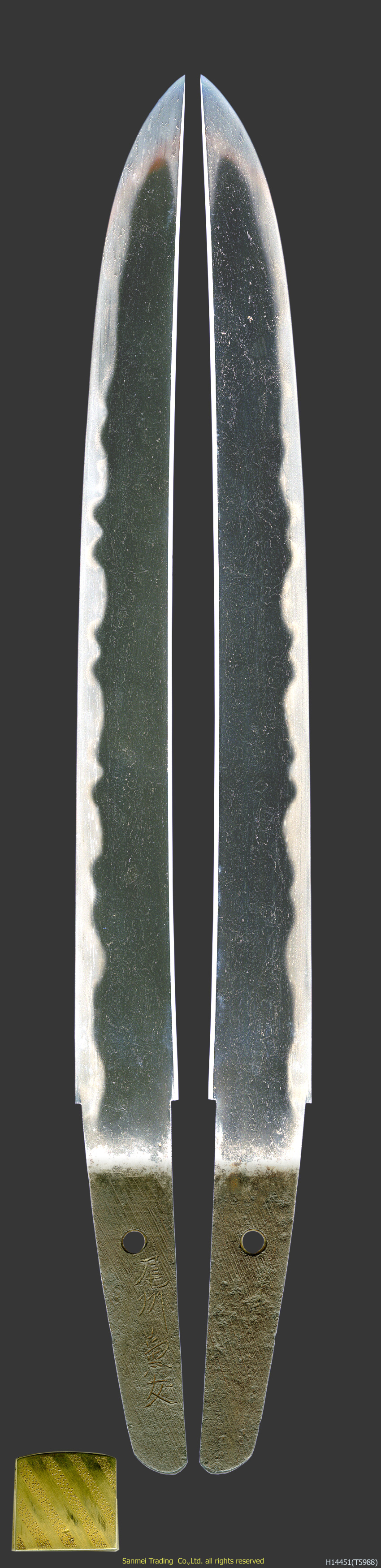
Blade construction: Hira-zukuri with an Iori-mune. Elongated proportions, wide in Mihaba and thick in Kasane. Less degree of tapering from base to the tip, giving the blade a powerful, heroic presence. The blade weight including the Habaki is 284 grams giving a solid, substantial feel in hand.
Forging pattern: Itame mixed with large Mokume, Sparkling Ji-nie presents with thick Chikei appearing, forming a strong and resilient forging texture.
Hamon: A complex mixture of double-gunome, box-like Hakoba and pointed Togari-ha elements. Along the boundary area of Yaki-gashira, a bit on coarse Nie densely gathers, intertwined with Kinsuji and Sunagashi streams, producing a bright and sharp appearance.
Bōshi: The temper continues strongly into the point with vigorous Midare, swept forcefully and forming a Chū-maru, with a bit on deeper side return.
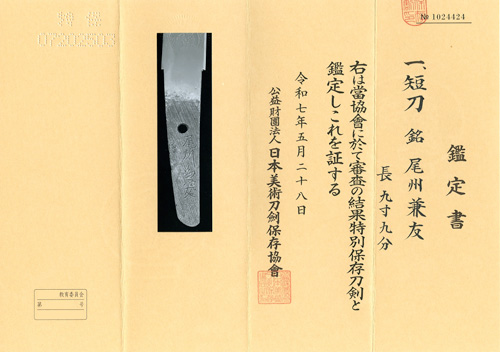
Tang: Ubu original. The cutting edge-side is slightly beveled in a ship-bottom style, finishing in a Ha-agari kurijiri heel. File marks is steep ō-sujikai mixed slightly with Higaki-style of crossing Yasurime. One Mekugi-ana. On the Omote side, near the mune, the large chisel work bears the four-character signature “Bishū KANETOMO”尾州兼友.
“KANETOMO”兼友 bore the personal name Jūzaemon 十左衛門 and the common name Tōshirō 藤四郎. He initially signed his work as “KANETOMO”兼伴 in different charactar. Born in Seki, Mino Province, he moved through Inuyama in Owari, then to Gifu in Mino and Kiyosu in Owari, where he served for Fukushima Masanori 福島正則. He became a disciple of Umetada Myōju 梅忠明寿 and was appointed to the title “Higo-no-Kami”肥後守 and changed his smith name to “TERUHIRO”輝広. Following Fukushima Masanori’s transfer, he relocated to Hiroshima in Aki Province, accompanied by his son“Harima-no-Kami TERUHIRO”播磨守輝広.
The subject tanto bears with its wide base, strongly tensioned upper Monouchi and thick Kasane, the blade presents a healthy sound and robust physique. The Hamon features reminiscent of Shizu work of the Nanbokuchō period, exudes the dignity and authority of a true Wazamono cutting performance. This is an article listed and reported in the "Owari To-ko-fu"
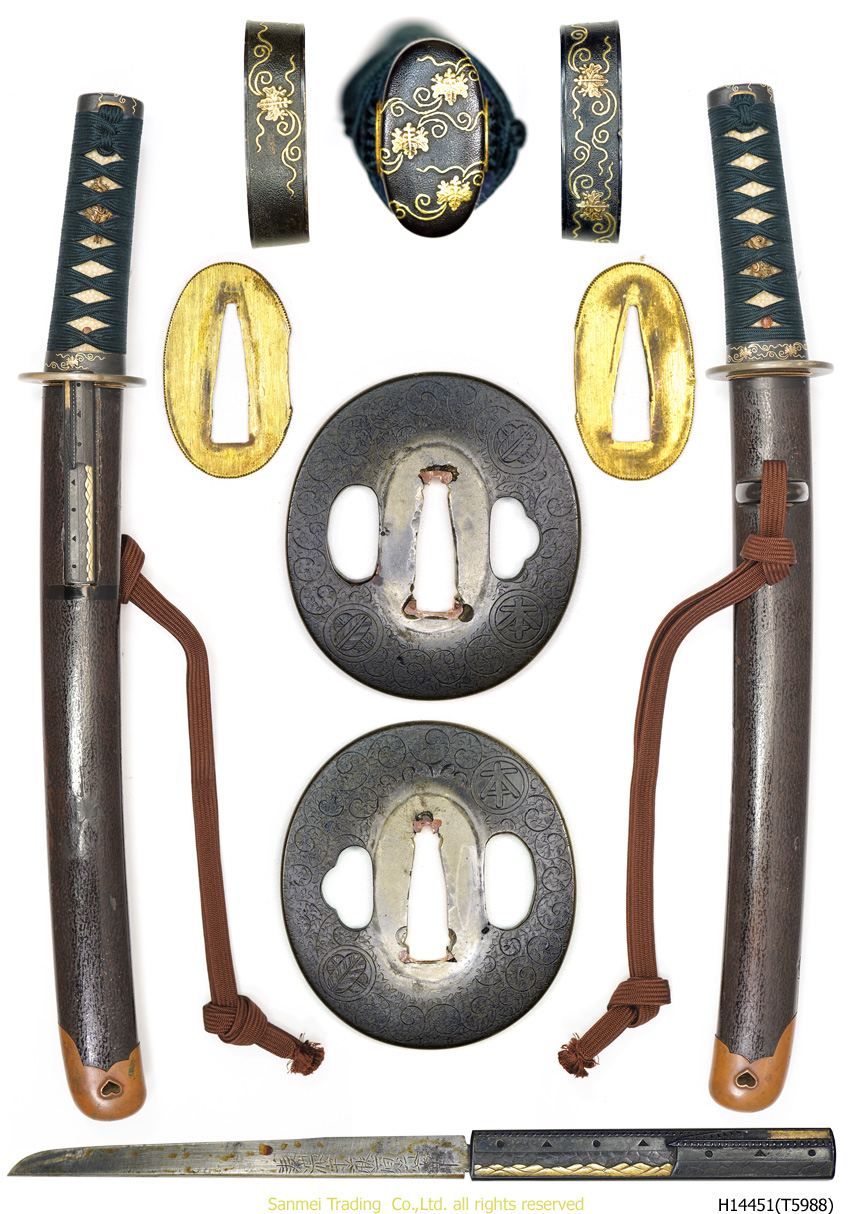
with) Brown wrinkled-leather–lacquered scabbard Koshirae
Fuchi/kashira: KIRI-mon crest Karakusa arabesque design, Shakudō Nanako-ji ground with gold Iroe unsigned
Menuki: Dragon motif, Takabori carving with gold Iroe
Tsuba: “Bukan” family crests motif with arabesque Karakusa design silver ground, Kebori-style carving, unsigned
Kozuka: Castle-wall motif Shakudō ground, Takabori relief, gold Iroe, unsigned
Tsuka: White ray skin Nando-iro Tsunegumi silk cord, Morotsumami-style lozenge wrap
Single-layer gold-foiled Habaki, preserved in plain wood mounting of Shirasaya
reference: Iwata Atou, Owari Toko-fu, Nagoya board of education, 1984

 NihontoWatch