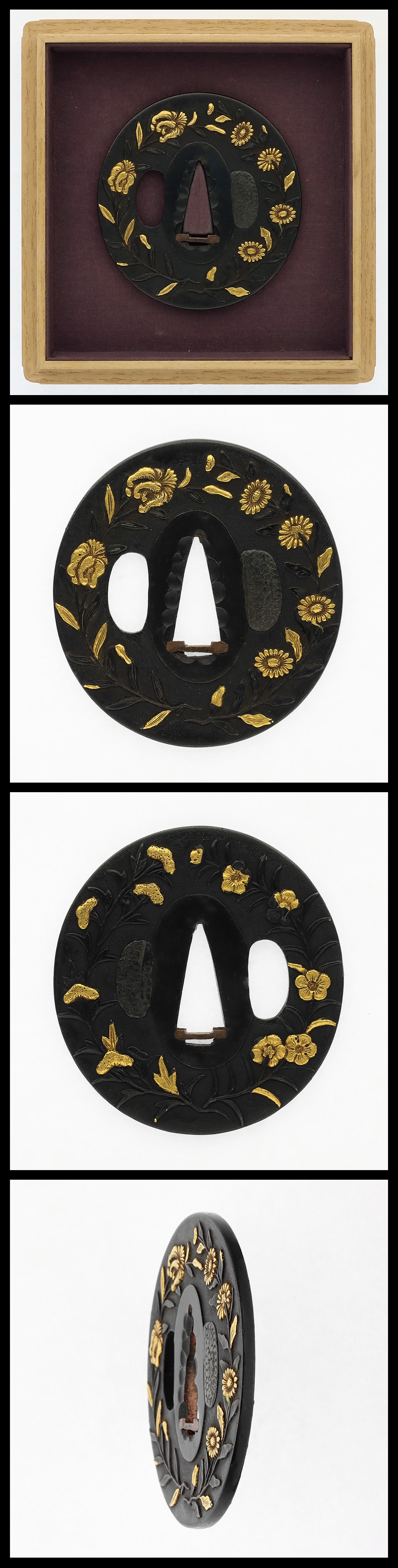
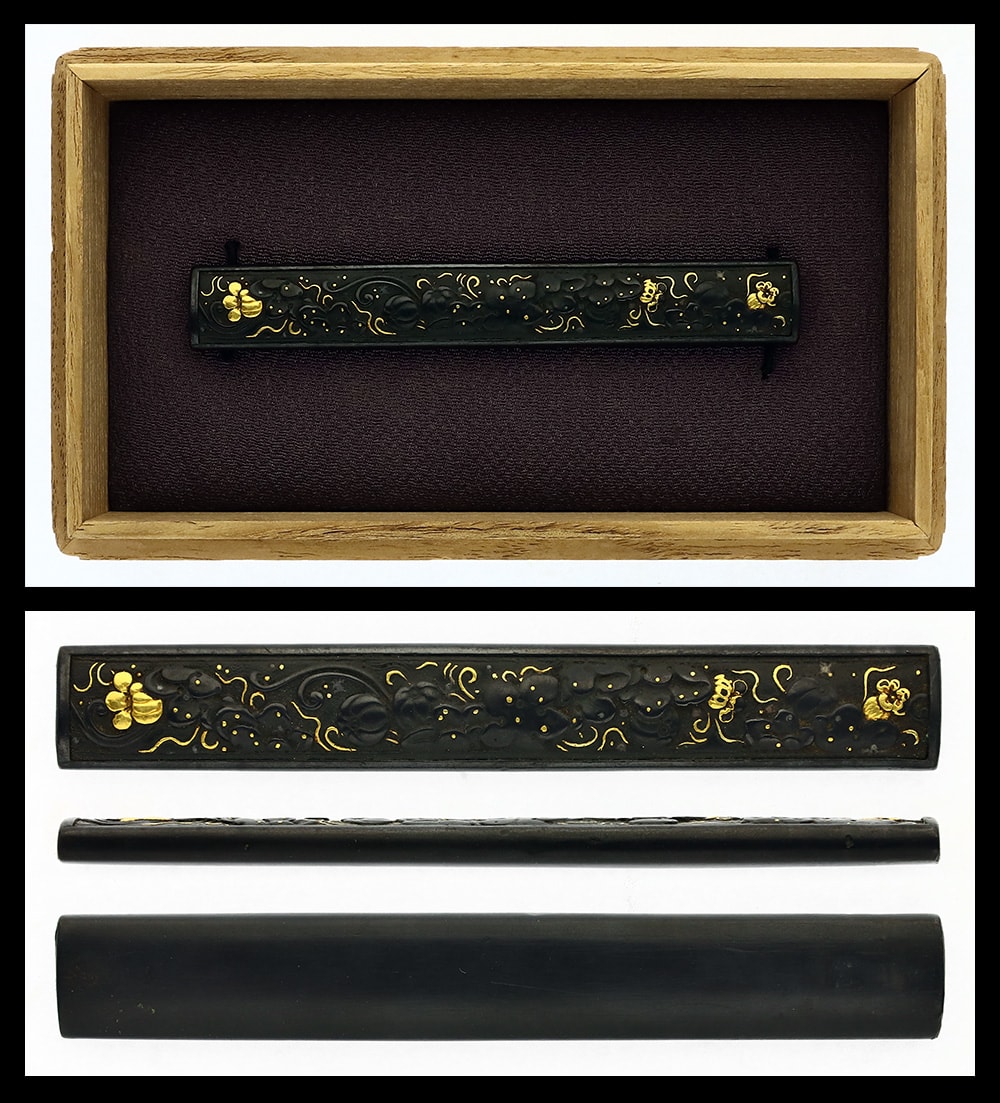
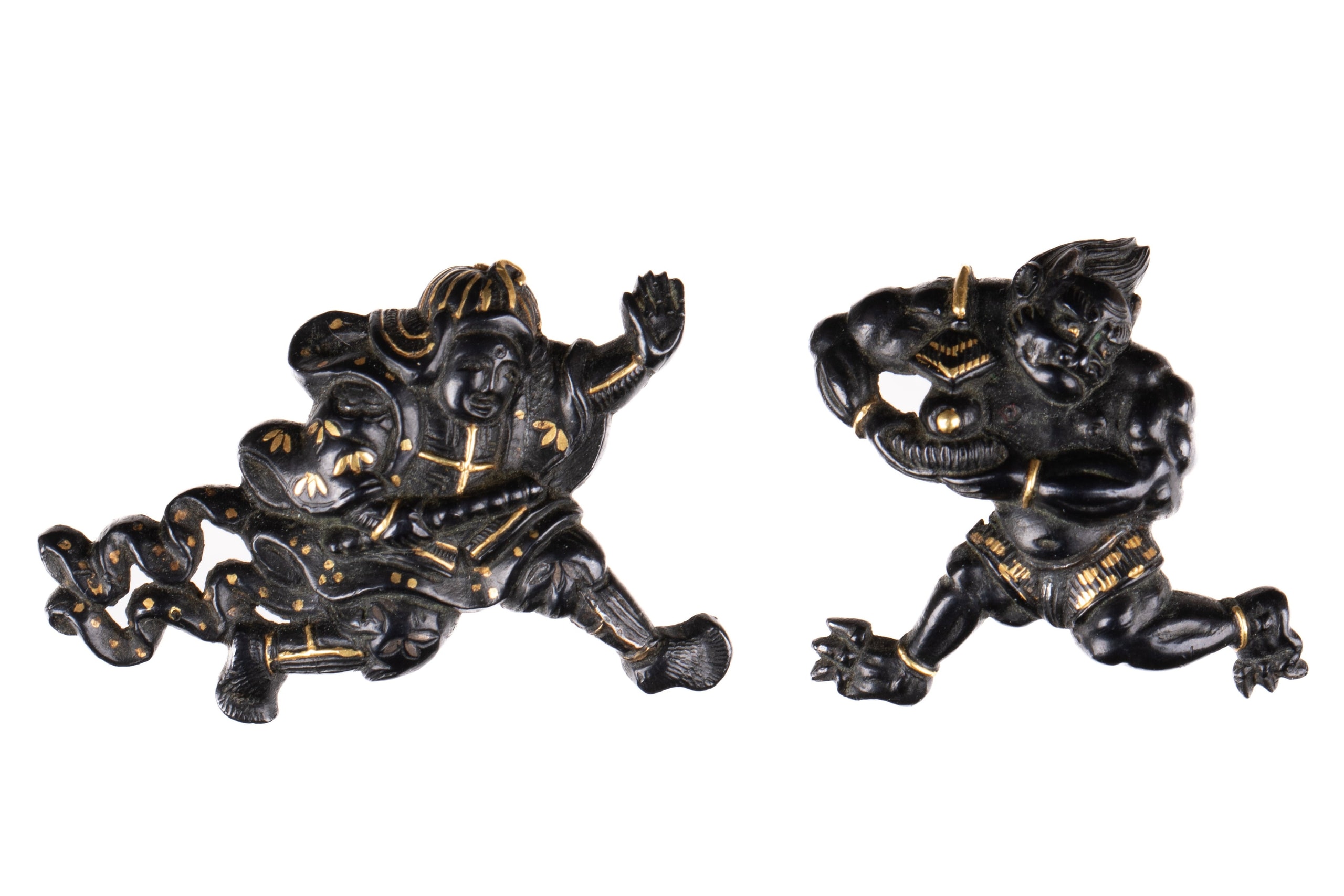
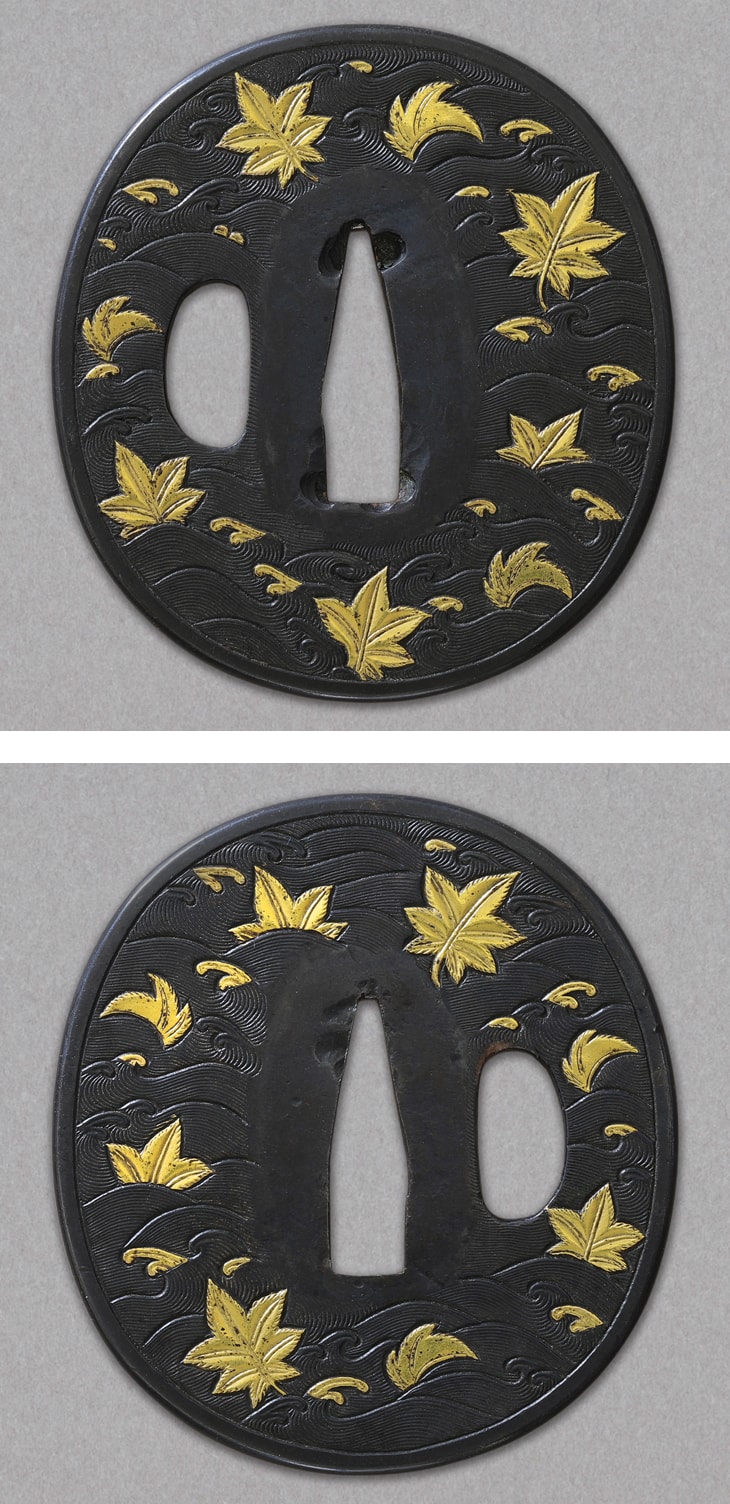
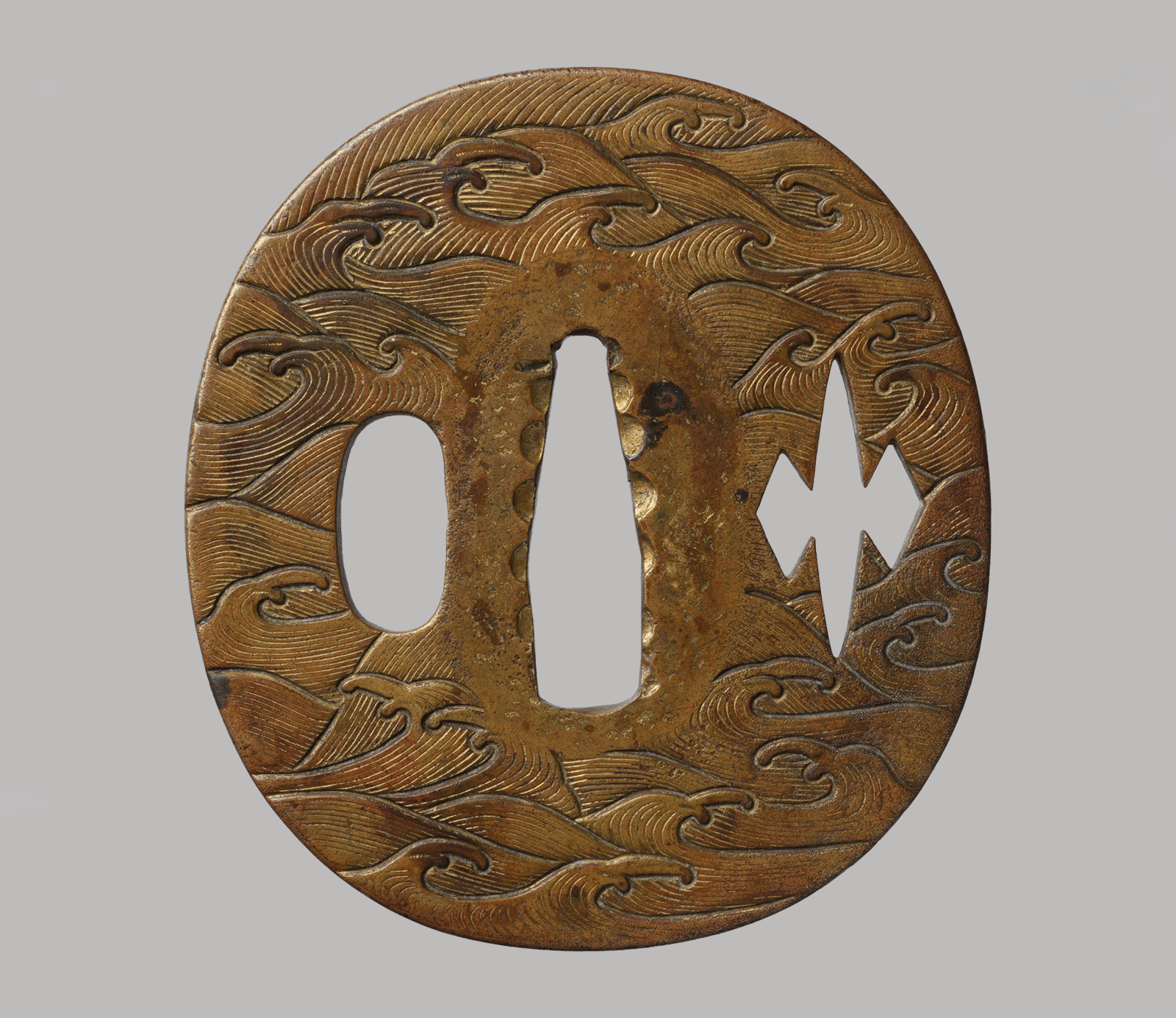
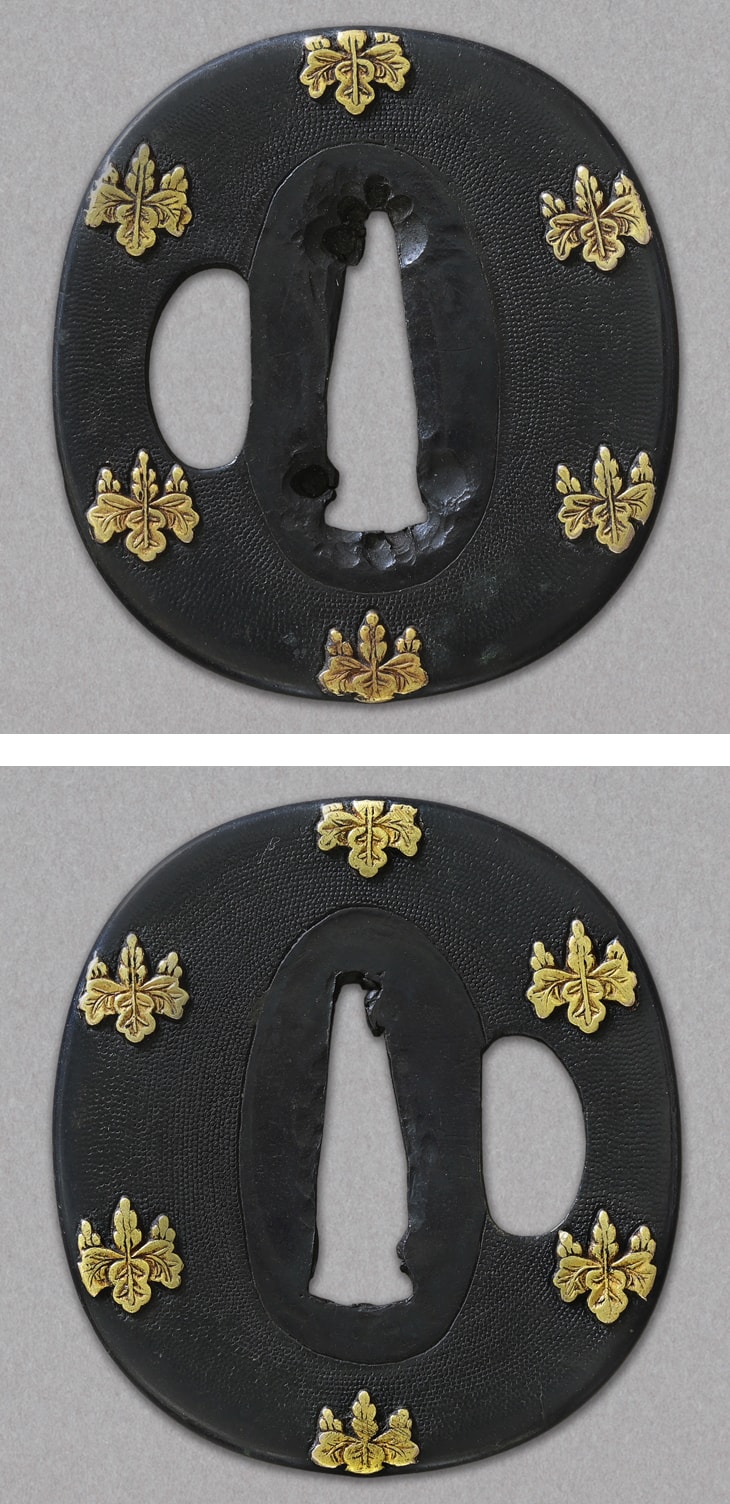
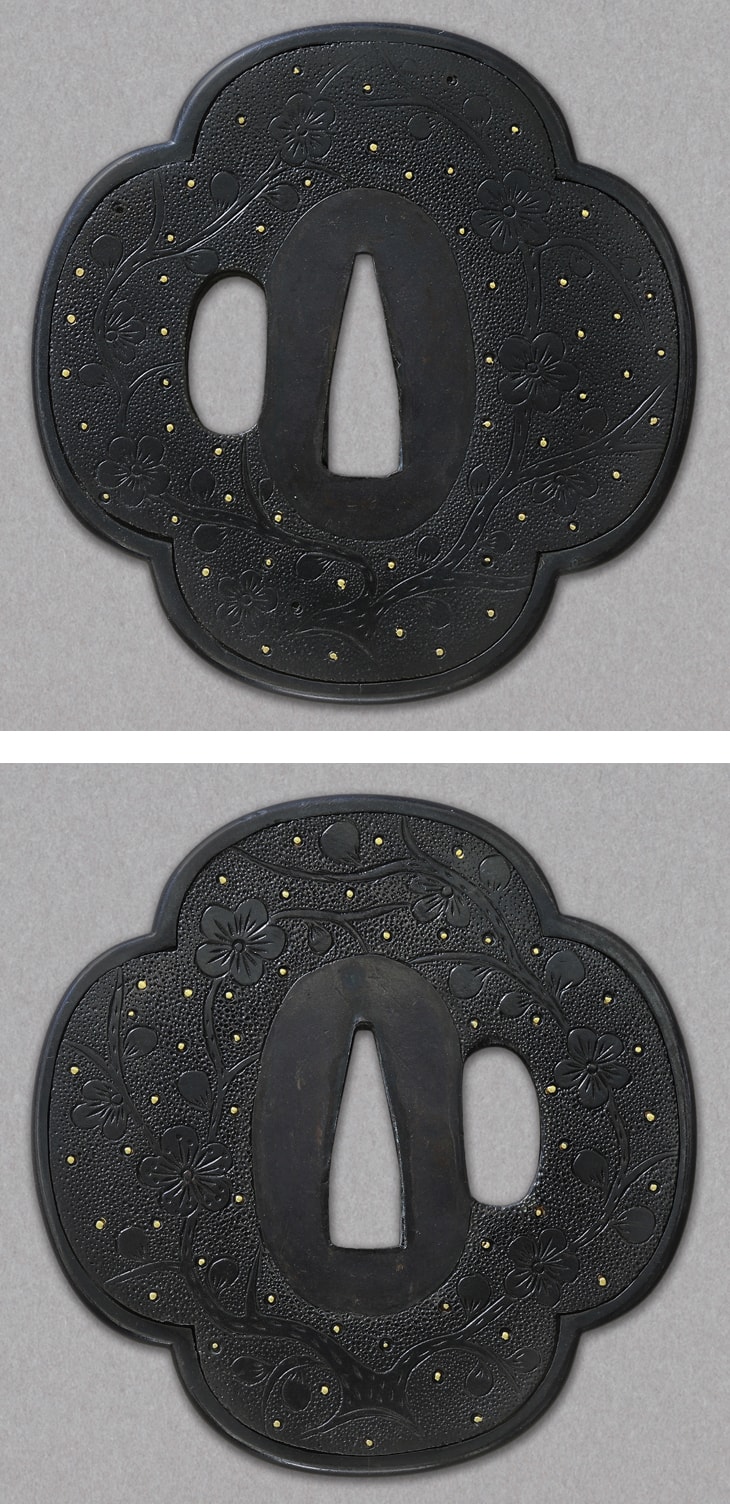
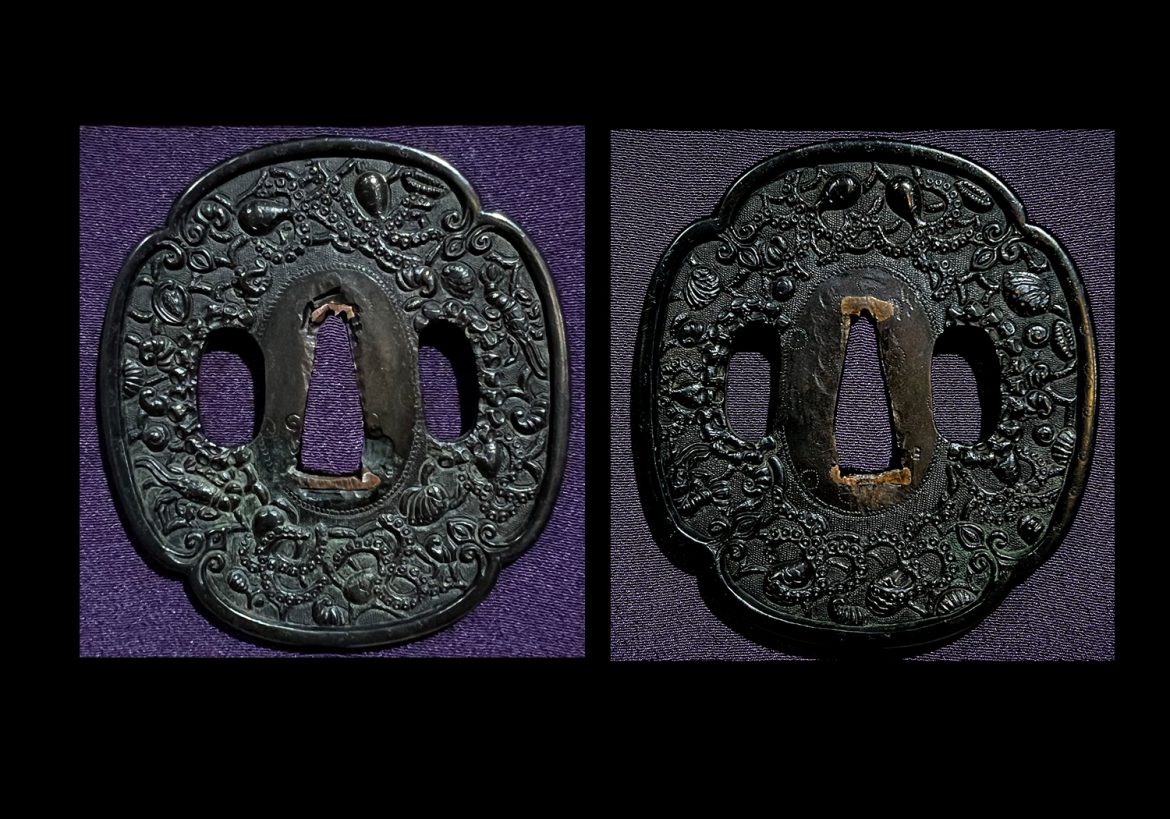
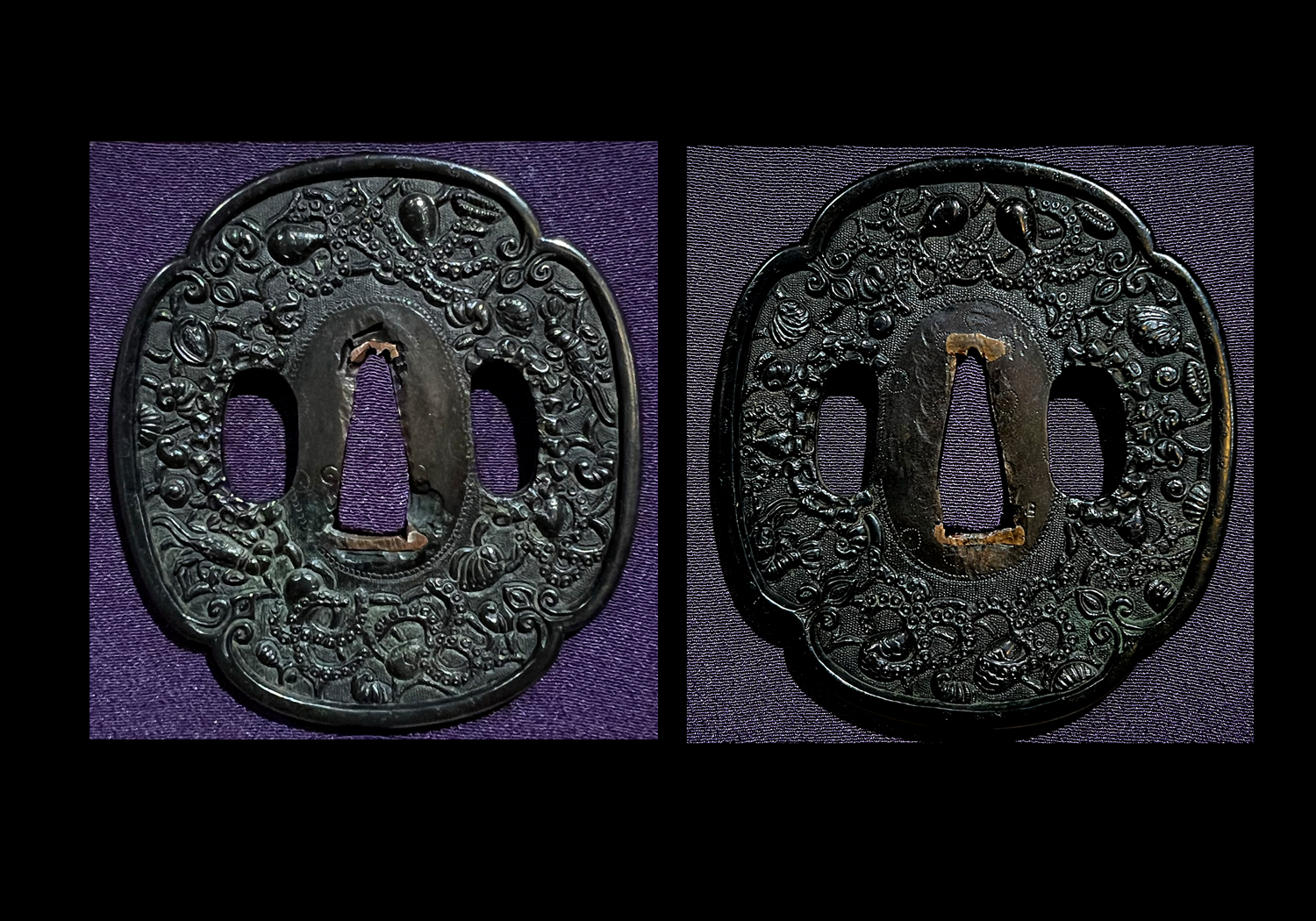
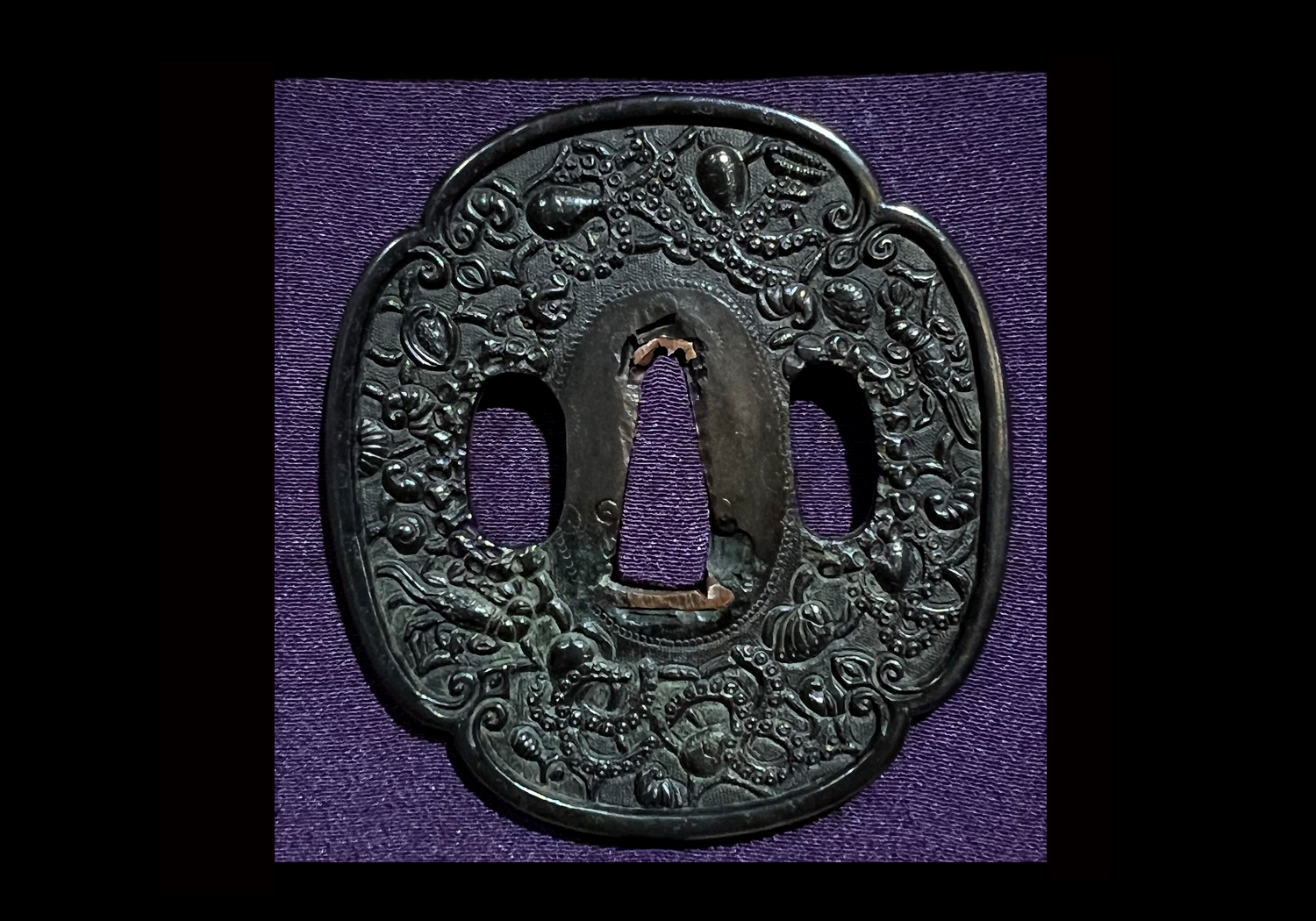
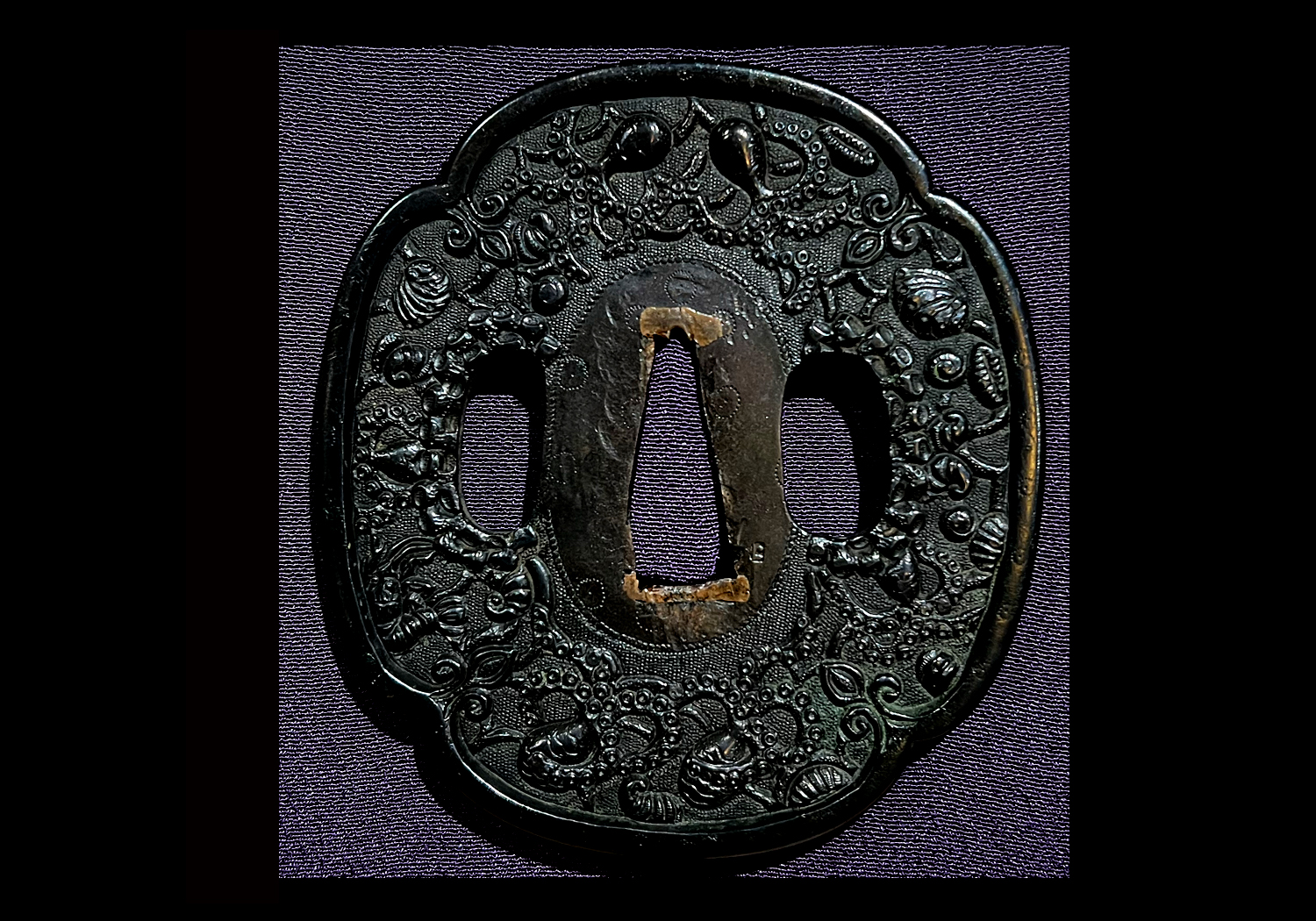
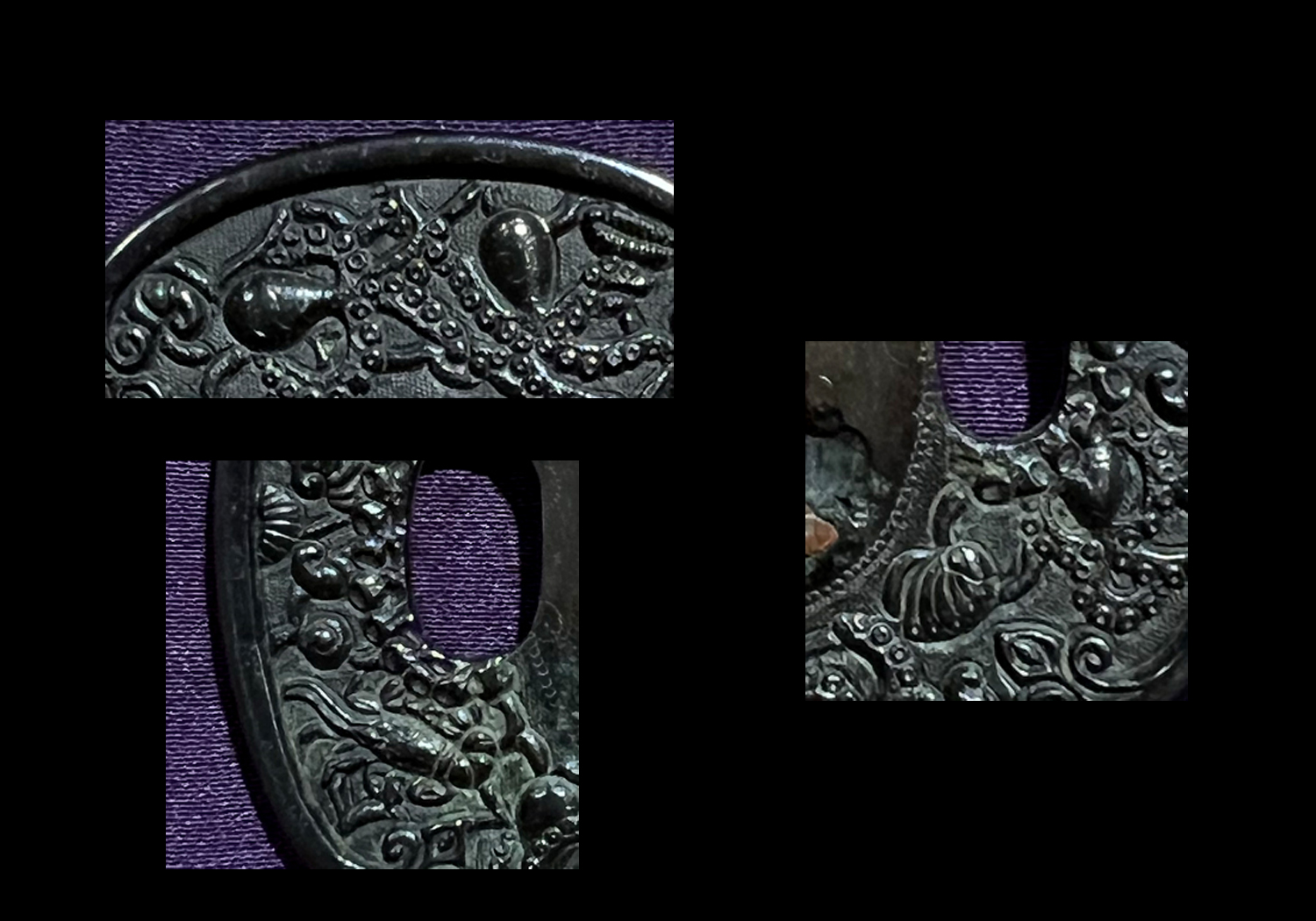
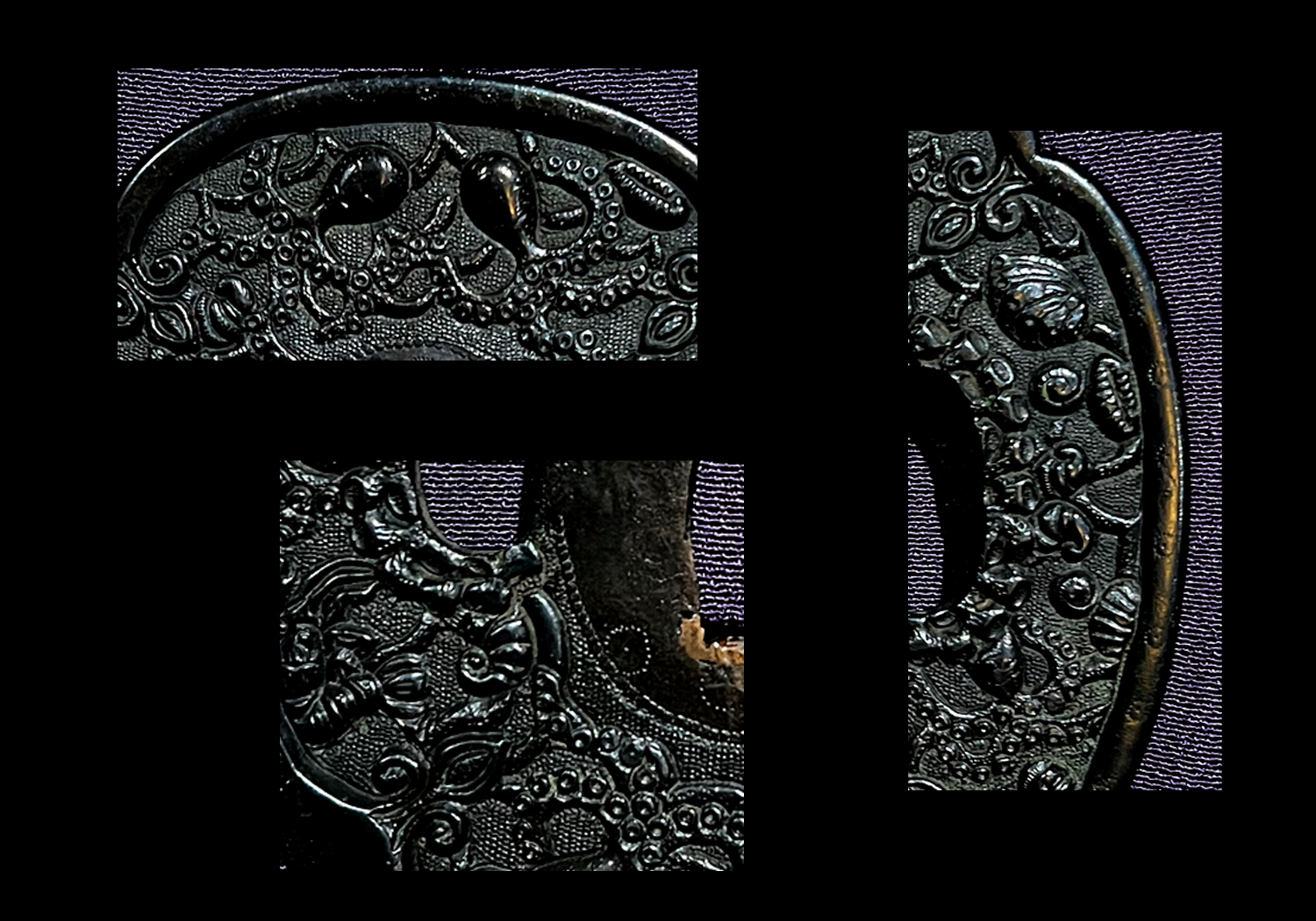
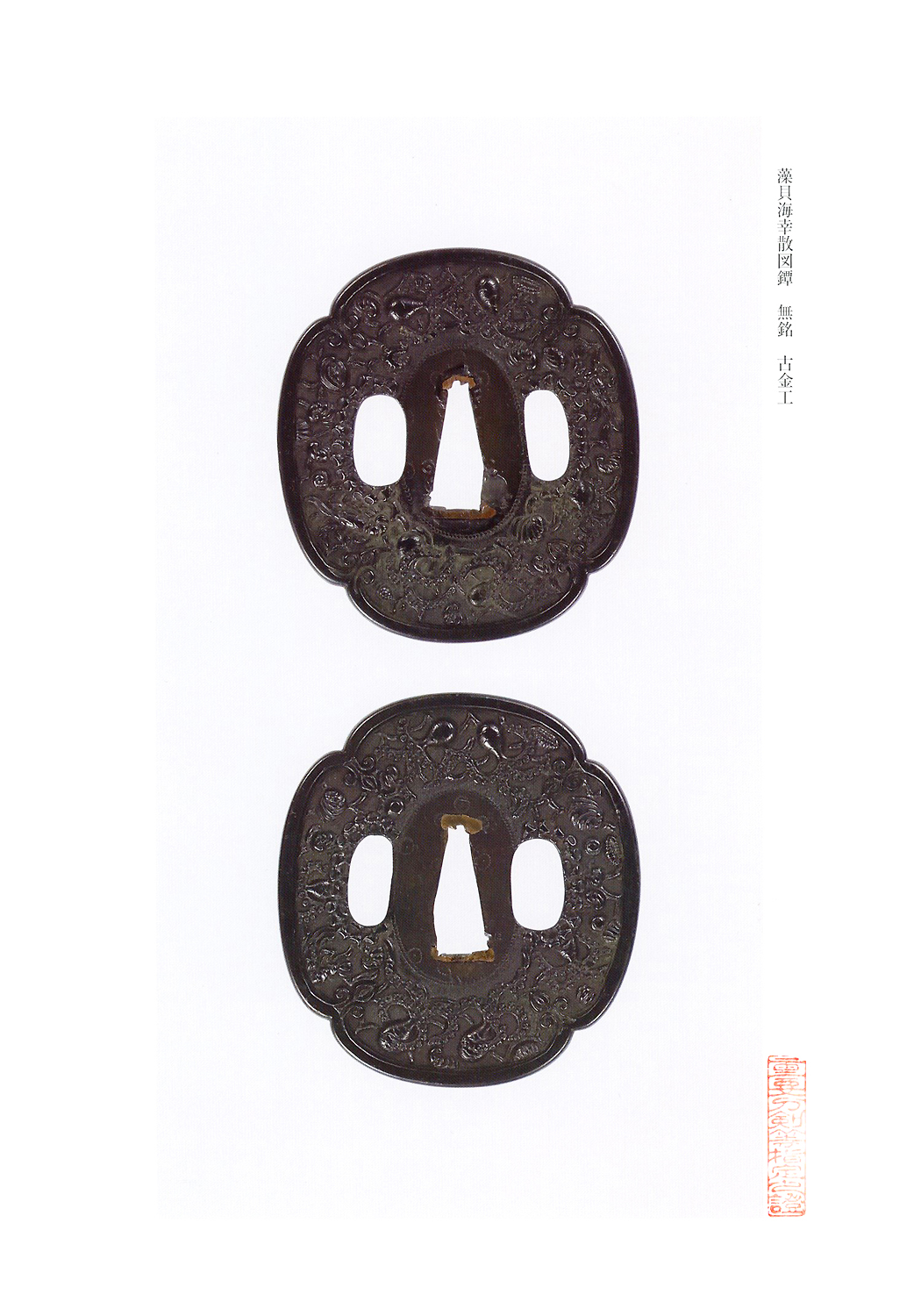
This is an outstanding Ko-Kinkô tsuba depicting an arrangement of arc clams and other marine life, primarily octopuses. Dating to the late Muromachi period, it features a mokkōgata shape, shakudō with a nanako ground, and elaborate takabori relief. The tsuba is certified Jûyô by the NBTHK, highlighting its exceptional quality and condition.
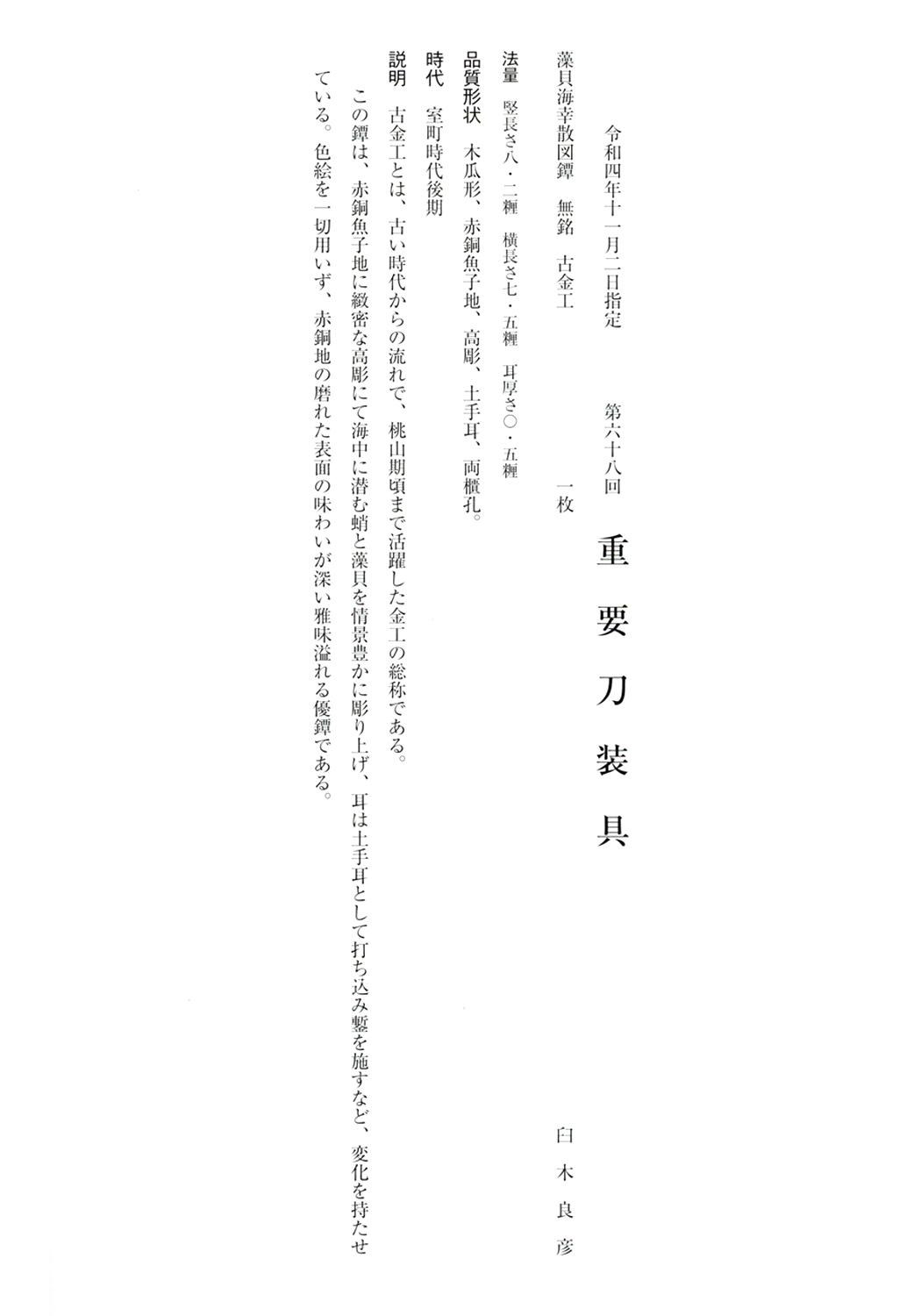
古金工とは、古い時代からの流れで、桃山期頃まで活躍した金工の総称である。 この鐔は、赤銅魚子地に緻密な高彫にて海中に潜む蛸と藻貝を情景豊かに彫り上げ、耳は土手耳として打ち込み鏨を施すなど、変化を持たせ ている。色絵を一切用いず、赤銅地の磨れた表面の味わいが深い雅味溢れる優鐔である。
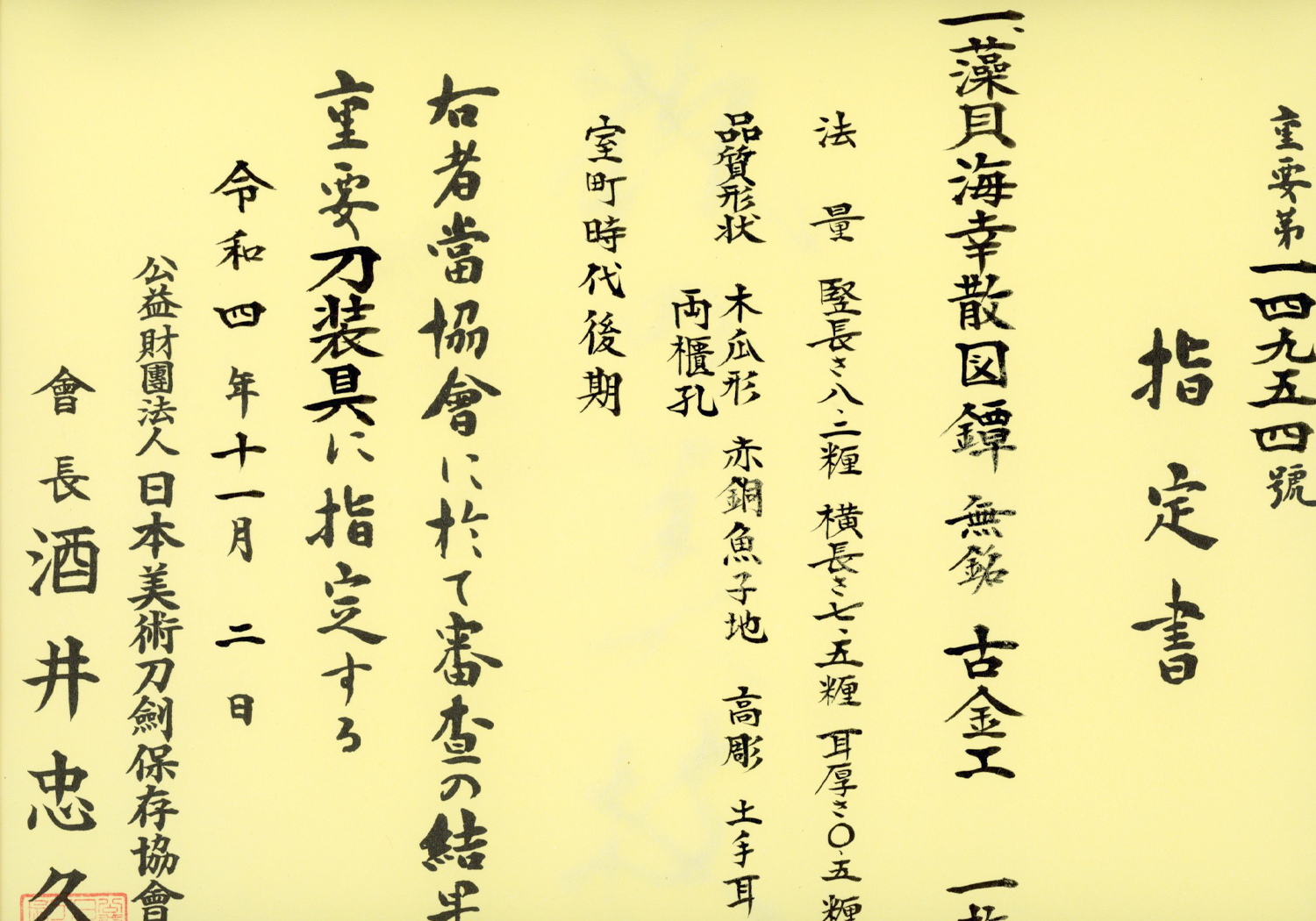
Certificate reading — 無銘(古金工)
 NihontoWatch
mumei · Ko-Kinkô · Koto
Ko-kinko School
Kotō
Unsigned
Jūyō #68 (NBTHK)
Kinko
The term Ko-kinkō (古金工) denotes a collective category of metalworkers whose lineages extend from archaic times and continue through the Momoyama period, representing traditions that predate the formalized schools of the Edo period. Rather than constituting a single unified workshop, this attribution encompasses multiple regional traditions that shared certain technical and aesthetic principles while maintaining distinct local characteristics. Works attributed to Ko-kinkō span from the Kamakura period through the late Muromachi era, with individual pieces appraised across this broad chronological range. The designation serves as an umbrella term for unsigned or anonymously crafted fittings that exhibit the technical hallmarks and aesthetic sensibilities of early Japanese metalwork, distinct from the later systematized iebori traditions exemplified by the Gotō school. The collective technical vocabulary of Ko-kinkō work demonstrates a preference for robust, unpretentious execution that prioritizes material honesty and directness of expression over virtuosic display. Characteristic features include shakudō or yamagane grounds worked with irregular nanako-ji punching, where the grains vary in size and the ridges stand proud, contributing an organic, rustic quality rather than the mechanical uniformity of later periods. High-relief carving (takabori) is employed with generous nikuoki (volumetric modeling), often enhanced with gilding (kin-tokin) or gold fukurokise applied in thick, pouch-like layers. Decorative programs favor auspicious motifs drawn from nature—peonies with shishi lions, weeping cherry blossoms, autumn grasses with dew, scattered shells amid waves, bamboo with tigers—rendered with straightforward sincerity.
The construction details of early works reveal period-specific features such as gyaku-mimi ear-scrapers on kōgai, in'yō-ne (male-and-female posts) on menuki, and dote-mimi rims on tsuba, while the chisel work (kebori) demonstrates forceful, unpretentious linework in mayu-gata (eyebrow-shaped) and warabite (bracken-scroll) motifs. Where polychrome iroe appears, it employs gold and silver inlay with restraint, allowing the naturally aged patina of the base metal—verdigris on yamagane, the lacquer-black sheen of shakudō—to contribute profound tonal depth. The legacy of Ko-kinkō traditions resides not in documented lineages or transmitted technical secrets, but in the corpus of surviving works that embody the aesthetic principles of medieval Japanese metalwork before the consolidation of the great Edo-period schools. These fittings convey what the written appraisals consistently characterize as kotan (古淡)—an archaic, quiet elegance arising from the passage of centuries—where wear and patina deepen rather than diminish the object's refinement. The technical influence of Ko-kinkō work is evident in the formative years of both the Gotō school and regional traditions such as Ko-Mino, yet Ko-kinkō pieces maintain a distinct artistic domain characterized by greater volumetric boldness, less systematic composition, and a preference for rustic directness over courtly sophistication. High-quality examples from this collective tradition, particularly early-period gyaku-mimi kōgai and pictorial tsuba with strong Fuji mandara or e-fū (pictorial-style) compositions, are recognized as exceedingly rare, serving as invaluable reference material for understanding the technical and aesthetic foundations upon which later formalized schools would build their practices. The designation Ko-kinkō thus preserves recognition of an entire stratum of medieval craftsmanship whose individual makers remain anonymous but whose collective achievement established the fundamental vocabulary of Japanese sword-fitting decoration. Learn more →
Exceptional craft of very high artistic value, judged to rank with a nationally recognized Important Art Object (Jūyō Bijutsuhin).
The NBTHK (Nihon Bijutsu Tōken Hozon Kyōkai, the Society for the Preservation of Japanese Art Swords) is a public-interest incorporated foundation founded in 1948 and supervised by Japan’s Agency for Cultural Affairs (Bunkachō); it is based at the Japanese Sword Museum in Tokyo. Its expert panels physically examine each submitted work (shinsa) and issue a certificate (kanteishō) ranking it by artistic and historical merit. NBTHK papers are the most widely recognized standard of authentication for Japanese swords and fittings.
NBTHK official siteThree-day inspection period and seven-day return period; buyer notifies by email within three days of receipt, no reason needed; full refund once item returned undamaged and unaltered.
$29,500
This is an outstanding Ko-Kinkô tsuba depicting an arrangement of arc clams and other marine life, primarily octopuses. Dating to the late Muromachi period, it features a mokkōgata shape, shakudō with a nanako ground, and elaborate takabori relief. The tsuba is certified Jûyô by the NBTHK, highlighting its exceptional quality and condition.
古金工とは、古い時代からの流れで、桃山期頃まで活躍した金工の総称である。 この鐔は、赤銅魚子地に緻密な高彫にて海中に潜む蛸と藻貝を情景豊かに彫り上げ、耳は土手耳として打ち込み鏨を施すなど、変化を持たせ ている。色絵を一切用いず、赤銅地の磨れた表面の味わいが深い雅味溢れる優鐔である。
Certificate reading — 無銘(古金工)
NihontoWatchmumei · Ko-Kinkô · Koto
Ko-kinko School
Kotō
Unsigned
Jūyō #68 (NBTHK)
Kinko
The term Ko-kinkō (古金工) denotes a collective category of metalworkers whose lineages extend from archaic times and continue through the Momoyama period, representing traditions that predate the formalized schools of the Edo period. Rather than constituting a single unified workshop, this attribution encompasses multiple regional traditions that shared certain technical and aesthetic principles while maintaining distinct local characteristics. Works attributed to Ko-kinkō span from the Kamakura period through the late Muromachi era, with individual pieces appraised across this broad chronological range. The designation serves as an umbrella term for unsigned or anonymously crafted fittings that exhibit the technical hallmarks and aesthetic sensibilities of early Japanese metalwork, distinct from the later systematized iebori traditions exemplified by the Gotō school. The collective technical vocabulary of Ko-kinkō work demonstrates a preference for robust, unpretentious execution that prioritizes material honesty and directness of expression over virtuosic display. Characteristic features include shakudō or yamagane grounds worked with irregular nanako-ji punching, where the grains vary in size and the ridges stand proud, contributing an organic, rustic quality rather than the mechanical uniformity of later periods. High-relief carving (takabori) is employed with generous nikuoki (volumetric modeling), often enhanced with gilding (kin-tokin) or gold fukurokise applied in thick, pouch-like layers. Decorative programs favor auspicious motifs drawn from nature—peonies with shishi lions, weeping cherry blossoms, autumn grasses with dew, scattered shells amid waves, bamboo with tigers—rendered with straightforward sincerity.
The construction details of early works reveal period-specific features such as gyaku-mimi ear-scrapers on kōgai, in'yō-ne (male-and-female posts) on menuki, and dote-mimi rims on tsuba, while the chisel work (kebori) demonstrates forceful, unpretentious linework in mayu-gata (eyebrow-shaped) and warabite (bracken-scroll) motifs. Where polychrome iroe appears, it employs gold and silver inlay with restraint, allowing the naturally aged patina of the base metal—verdigris on yamagane, the lacquer-black sheen of shakudō—to contribute profound tonal depth. The legacy of Ko-kinkō traditions resides not in documented lineages or transmitted technical secrets, but in the corpus of surviving works that embody the aesthetic principles of medieval Japanese metalwork before the consolidation of the great Edo-period schools. These fittings convey what the written appraisals consistently characterize as kotan (古淡)—an archaic, quiet elegance arising from the passage of centuries—where wear and patina deepen rather than diminish the object's refinement. The technical influence of Ko-kinkō work is evident in the formative years of both the Gotō school and regional traditions such as Ko-Mino, yet Ko-kinkō pieces maintain a distinct artistic domain characterized by greater volumetric boldness, less systematic composition, and a preference for rustic directness over courtly sophistication. High-quality examples from this collective tradition, particularly early-period gyaku-mimi kōgai and pictorial tsuba with strong Fuji mandara or e-fū (pictorial-style) compositions, are recognized as exceedingly rare, serving as invaluable reference material for understanding the technical and aesthetic foundations upon which later formalized schools would build their practices. The designation Ko-kinkō thus preserves recognition of an entire stratum of medieval craftsmanship whose individual makers remain anonymous but whose collective achievement established the fundamental vocabulary of Japanese sword-fitting decoration. Learn more →
Exceptional craft of very high artistic value, judged to rank with a nationally recognized Important Art Object (Jūyō Bijutsuhin).
The NBTHK (Nihon Bijutsu Tōken Hozon Kyōkai, the Society for the Preservation of Japanese Art Swords) is a public-interest incorporated foundation founded in 1948 and supervised by Japan’s Agency for Cultural Affairs (Bunkachō); it is based at the Japanese Sword Museum in Tokyo. Its expert panels physically examine each submitted work (shinsa) and issue a certificate (kanteishō) ranking it by artistic and historical merit. NBTHK papers are the most widely recognized standard of authentication for Japanese swords and fittings.
NBTHK official siteThree-day inspection period and seven-day return period; buyer notifies by email within three days of receipt, no reason needed; full refund once item returned undamaged and unaltered.
$29,500