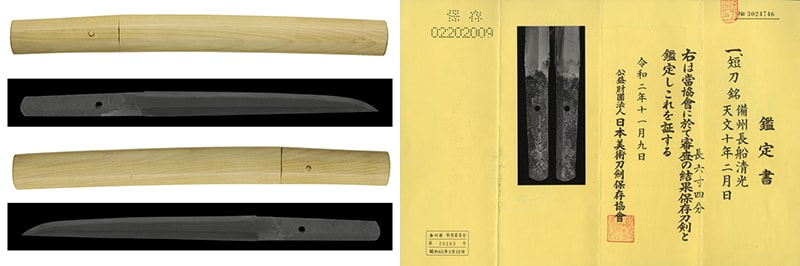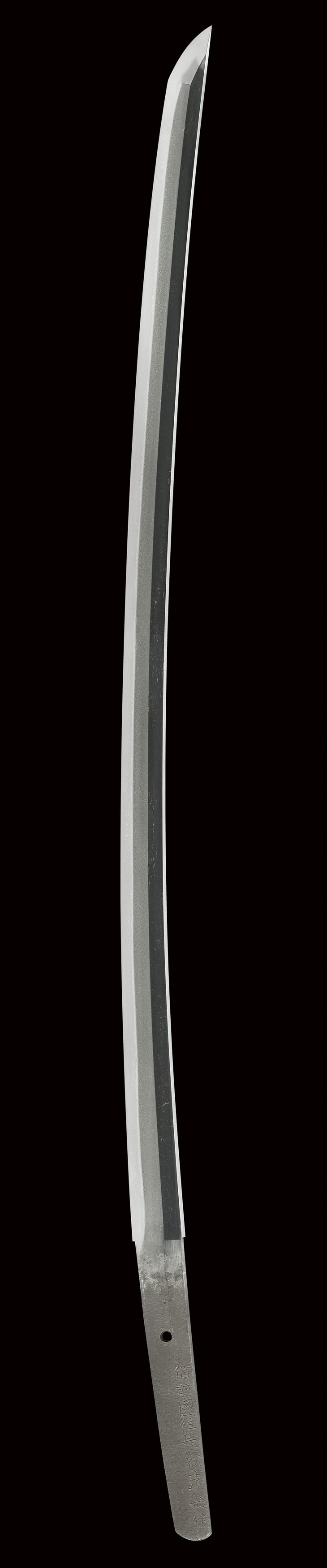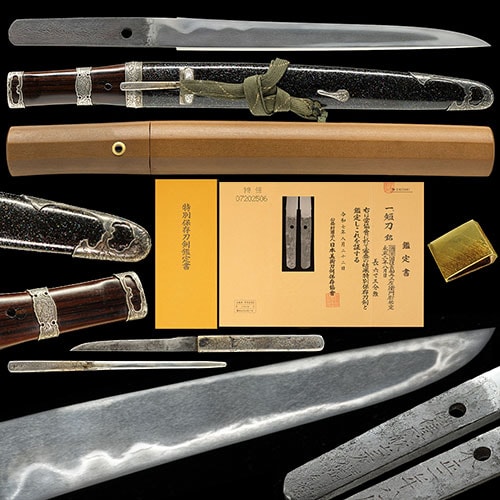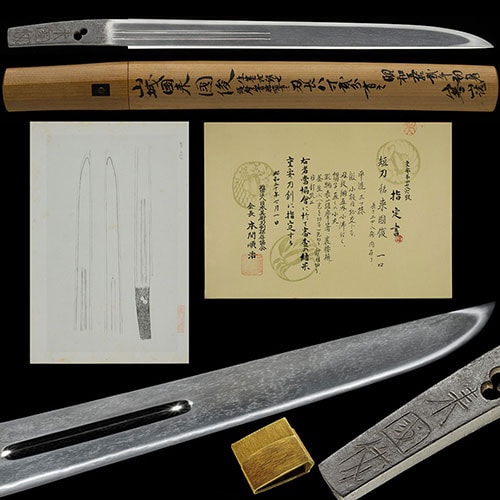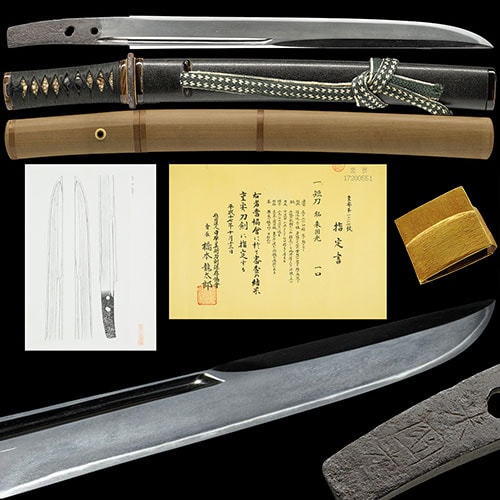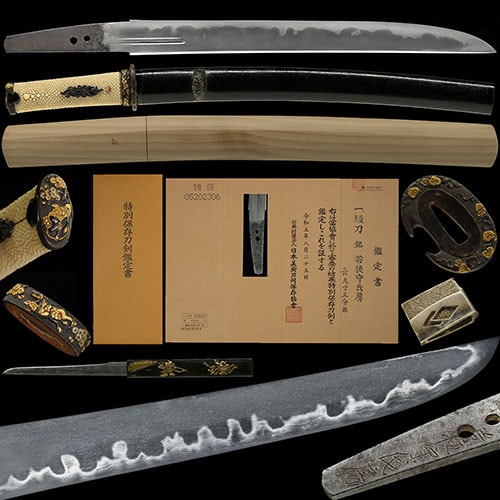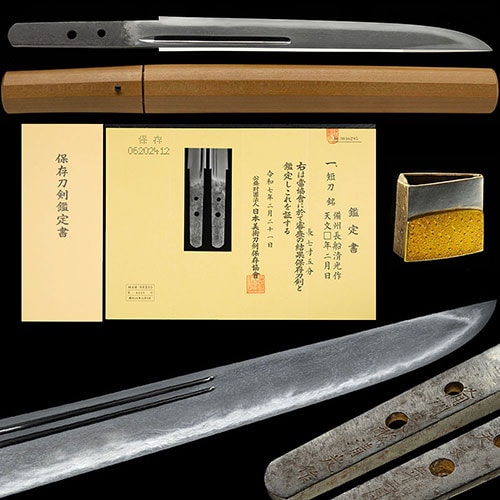
清光 短刀 保存刀剣
¥700,000
Tracked across 76 dealers worldwide · price history · sold archive
Specifications
22.7 cm
2.4 cm
About the school
Kiyomitsu School清光派
Within the Bizen Osafune workshops of the closing Muromachi period, the body of smiths and their output that scholars group under the heading *Sue-Bizen*, the name Kiyomitsu (清光) was carried by a large number of hands. The setsumei consistently note that the swords signed in the Tenbun, Kōji, and Eiroku eras issue from Osafune in Bizen Province, and that the Hayami reference work enumerates roughly ten craftsmen who used common names (*zokumyō*) such as Gorōzaemon-no-jō, Magōemon-no-jō, Yosazaemon-no-jō, Hikobei-no-jō, and Magobei-no-jō. Of these, the registers single out two as the superior masters (*jōkō*): Gorōzaemon-no-jō Kiyomitsu and Magōemon-no-jō Kiyomitsu, the latter appearing in a Genki 2 example appraised to the second generation of that name. A Jiemon-no-jō Kiyomitsu, dated Genki 3, is recorded as absent from the standard signature references (*meikan*), and one tang carries the fuller form Fujiwara Kiyomitsu. The blades place the line in the Sengoku world directly: one was forged while the smith stayed in the castle town of Tatsuno in Harima, and several bear commissioning inscriptions naming the Bizen *shugodai* Uragami (Urakami) Munekage. What recurs across the corpus is a *ko-itame* ground, often with *mokume* mixed in, that the setsumei describe as standing somewhat prominently (*hada-dachi*); *ji-nie* adheres thickly, fine *chikei* enter, and a faint *utsuri* appears. The hardening divides into two registers. The first, named again and again as the hallmark of the line, is a broad *suguha* into which *ko-gunome*, angular elements, and pointed (*togari*) forms are interwoven, with *ashi* and *yō* working vigorously, a *nioi*-based edge carrying *ko-nie*, and fine *kinsuji* and *sunagashi*; the *nioiguchi* runs bright and clear. The second is a *midareba* register: a *gunome-midare* whose waist opens broadly (*koshi-no-hiraita* / *koshi-biraki*), mixed with *ko-chōji* and crab-claw (*kani-no-tsume*) elements, taken high (*yakidaka*) with *muneyaki*, *tobiyaki*, and *yubashiri*, at times reaching full *hitatsura*. The setsumei stress that, against fellow *Sue-Bizen* makers Tadamitsu and Sukesada who also worked *suguha*, Kiyomitsu is told apart by that standing-grain *itame*-with-*mokume* texture; one register flatly compares his *gunome-midare* to Yosaemon-no-jō Sukesada. The form is the late-Muromachi *uchigatana sugata*: wide *mihaba* with little base-to-tip taper, thick *kasane*, deep *sakizori*, and an extended *chū-kissaki* (occasionally *ō-kissaki*), giving a weighty, dignified *taihai*. To separate the named master from bulk *Sue-Bizen*, the registers point to refined, tightly-knit grain free of irregular clustering (*seiryō*), abundant *nikuoki*, and a clear bright *nioiguchi*. For kantei the registers fix the discriminators: the standing *itame*/*mokume* texture, the *suguha* carrying *yō* with the bright edge, and, in the *midare* mode, the waist-opened compound (*fukushiki*) *gunome* with *kani-no-tsume*. One register observes that when *hitatsura* is tempered the *kasane* turns thinner than the usual thick *Sue-Bizen* build, and that *maru-mune* surfaces within the group. The setsumei tie the line to the cutting-oriented strength of *Sue-Bizen* blades and to the martial spirit of the Sengoku age, a *tantō* in *ryōba-zukuri* with ample *hiraniku* and a *gunome-midare* being read as overflowing with that vigor. Provenance recorded on the blades carries documentary weight: the Tatsuno residence inscription and the Uragami Munekage commission map Gorōzaemon-no-jō's movements, a Gorōzaemon-no-jō work descended in the Matsudaira family of Shinobu, and a Magōemon-no-jō katana entered the Imperial collection. Within the NBTHK register the line stands as the *Sue-Bizen suguha* master line whose finest signed and dated works, alongside the more numerous mass production, are judged the equal of the Sukesada and Tadamitsu workshops and valued as material for tracing the individual Kiyomitsu hands.