NihontoWatch Mon

NihontoWatch

Market
Encyclopedia
Kantei
NihontoWatch Mon

NihontoWatch

Market
Encyclopedia
Kantei

Description

This is a wakizashi attributed to Enju, certified as Tokubetsu Hozon by the NBTHK. It is a mumei (unsigned) blade from the Kamakura period. The listing indicates no photos are available for this item.

NihontoWatch MonNihontoWatch
MarketEncyclopediaKantei
Swords›Enju›Tokubetsu Hozon Enju (Wakizashi) - No Photo Available
wakizashiTokubetsu Hozon
Enju

Tokubetsu Hozon Enju (Wakizashi) - No Photo Available

mumei · Kamakura · nagasa 53.33cm

¥1,000,000
Visit seller website →
Measurements & details
Smith
Enju
Type
Wakizashi
Period
Around 987–1596(Koto)
Signature
Unsigned
Measurements
Nagasa 53.33cm
Description

This is a wakizashi attributed to Enju, certified as Tokubetsu Hozon by the NBTHK. It is a mumei (unsigned) blade from the Kamakura period. The listing indicates no photos are available for this item.

About the maker

Enju

延壽

Bungo · around 987-1596

2 pieces on the market now

›

The Enju school of Higo Province is said to have been founded by Taro Kunimura, traditionally regarded as the maternal grandson of Rai Kuniyuki of Yamashiro. From the late Kamakura period through the Nanbokucho period the school flourished greatly at Kumafu in Kikuchi District. Among its lineage were many highly skilled smiths, including Kuniyoshi, Kunitoki, Kunitai, Kunitomo, Kunisuke, Kuninobu, and Kunitsuna. As a school rooted in the Yamashiro Rai tradition yet active in the remote province of Higo, Enju represents one of the most important regional transmissions of the classical Yamashiro manner.

In general, the school's works "do not markedly differentiate into strongly individualized styles" and broadly resemble the Rai tradition. The forging frequently shows a conspicuous tendency toward masame, with areas of flowing itame-hada and nagare-hada; the steel characteristically takes on a somewhat whitish cast, and shirake-utsuri or nie-utsuri often appears. The hamon is typically a calm chu-suguha in ko-nie-deki, with ko-ashi entering; the nioiguchi shows a somewhat shizumi (subdued) tendency, and the activities within the tempered area are gentle and restrained. Along the habuchi, effects such as hotsure, uchi-noke, kuichigai-ba, and nijuba appear with quiet frequency. The boshi is a principal diagnostic feature: it runs straight before the roundness at the point becomes slightly larger -- tending toward o-maru -- while the kaeri is tempered comparatively shallow and short, sometimes ending in yakizume. Blades often retain a somewhat high shinogi and well-developed hiraniku, conveying a martial robustness beneath the serene surface.

The NBTHK consistently characterizes Enju work as possessing "a gentle, restrained charm" and "a serene calm" that distinguishes it from mainstream Rai production. The school's steel is praised for its "refined and polished" quality, and pieces displaying a bright nioiguchi are singled out as "especially fine" examples, precisely because brightness is not the school's default register. Works retaining deep wazori, thick kasane, and abundant nikuoki (blade flesh) are commended as "sturdily constructed so as to be thoroughly suited for martial use." The Enju manner occupies a distinctive position within the broader Yamashiro lineage -- quieter and more introspective than Rai, yet carrying a robust physicality that reflects its provincial, warrior-class patronage in Higo.

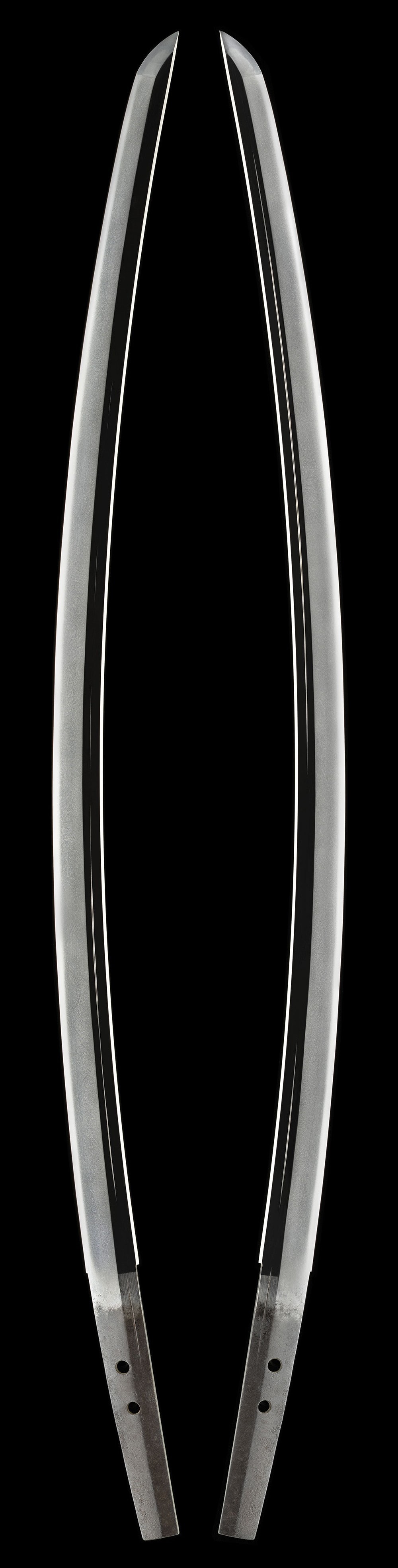
2 works by Enju on the market→
Enju — full profile

Historical context

Nearly every later authority calls Kamakura the golden age of the sword: the first warrior government as patron, the great traditions at full strength simultaneously, and, tradition holds, the finest smiths of the realm rotating through Go-Toba’s court.

The Kamakura period (1185 to 1333) →

NBTHK Certificate
Tokubetsu Hozon Tōken特別保存刀剣
Sword Especially Worthy of Preservation
›

A Hozon-certified blade judged to show notably superior workmanship and a better state of preservation. The bar is higher: re-tempered blades and most unsigned Muromachi/Edo works are excluded.

About the NBTHK›

The NBTHK (Nihon Bijutsu Tōken Hozon Kyōkai, the Society for the Preservation of Japanese Art Swords) is a public-interest incorporated foundation founded in 1948 and supervised by Japan’s Agency for Cultural Affairs (Bunkachō); it is based at the Japanese Sword Museum in Tokyo. Its expert panels physically examine each submitted work (shinsa) and issue a certificate (kanteishō) ranking it by artistic and historical merit. NBTHK papers are the most widely recognized standard of authentication for Japanese swords and fittings.

NBTHK official site→
Seller
Y
Yazawa Shokai
🇯🇵Ships from Japan
›
✓Verified dealerk.n-owner.jp
Settles in JPY
View all of Yazawa Shokai’s listings→View this item on the dealer’s site→

More works by Enju

View all →
Eirakudo
Hozon
Wakizashi - Hozon - by Enju - Enjyu Wakizashi Hozon TokenWakizashi - Hozon - by Enju - Enjyu Wakizashi Hozon Token

Wakizashi

ByEnju
¥700,000

Previously sold by Enju

Yazawa Shokai
Tokuho
Katana - Tokuho - by Enju - Late Kamakura Period ~ (Enju, flawless) Nagasa 66.2cm, Sori 1.5cm, in ShirasayaKatana - Tokuho - by Enju - Late Kamakura Period ~ (Enju, flawless) Nagasa 66.2cm, Sori 1.5cm, in Shirasaya
Sold

Katana

ByEnju
SOLD

Swords

  • Katana
  • Wakizashi
  • Tantō
  • Tachi
  • Naginata
  • Yari

Fittings

  • Tsuba
  • Fuchi-Kashira
  • Kozuka
  • Menuki

Armor

  • Kabuto
  • Samurai Armor

By Certification

  • Tokujū
  • Jūyō
  • Tokuho
  • Hozon

Resources

  • Dealer Directory
  • Artist Directory
  • The Daily Kantei
  • Glossary
  • Browse All
Nihontowatch© 2026
TermsPrivacyCookiesAbout

Description

This is a wakizashi attributed to Enju, certified as Tokubetsu Hozon by the NBTHK. It is a mumei (unsigned) blade from the Kamakura period. The listing indicates no photos are available for this item.

NihontoWatch MonNihontoWatch
MarketEncyclopediaKantei
Swords›Enju›Tokubetsu Hozon Enju (Wakizashi) - No Photo Available
wakizashiTokubetsu Hozon
Enju

Tokubetsu Hozon Enju (Wakizashi) - No Photo Available

mumei · Kamakura · nagasa 53.33cm

¥1,000,000
Visit seller website →
Measurements & details
Smith
Enju
Type
Wakizashi
Period
Around 987–1596(Koto)
Signature
Unsigned
Measurements
Nagasa 53.33cm
Description

This is a wakizashi attributed to Enju, certified as Tokubetsu Hozon by the NBTHK. It is a mumei (unsigned) blade from the Kamakura period. The listing indicates no photos are available for this item.

About the maker

Enju

延壽

Bungo · around 987-1596

2 pieces on the market now

›

The Enju school of Higo Province is said to have been founded by Taro Kunimura, traditionally regarded as the maternal grandson of Rai Kuniyuki of Yamashiro. From the late Kamakura period through the Nanbokucho period the school flourished greatly at Kumafu in Kikuchi District. Among its lineage were many highly skilled smiths, including Kuniyoshi, Kunitoki, Kunitai, Kunitomo, Kunisuke, Kuninobu, and Kunitsuna. As a school rooted in the Yamashiro Rai tradition yet active in the remote province of Higo, Enju represents one of the most important regional transmissions of the classical Yamashiro manner.

In general, the school's works "do not markedly differentiate into strongly individualized styles" and broadly resemble the Rai tradition. The forging frequently shows a conspicuous tendency toward masame, with areas of flowing itame-hada and nagare-hada; the steel characteristically takes on a somewhat whitish cast, and shirake-utsuri or nie-utsuri often appears. The hamon is typically a calm chu-suguha in ko-nie-deki, with ko-ashi entering; the nioiguchi shows a somewhat shizumi (subdued) tendency, and the activities within the tempered area are gentle and restrained. Along the habuchi, effects such as hotsure, uchi-noke, kuichigai-ba, and nijuba appear with quiet frequency. The boshi is a principal diagnostic feature: it runs straight before the roundness at the point becomes slightly larger -- tending toward o-maru -- while the kaeri is tempered comparatively shallow and short, sometimes ending in yakizume. Blades often retain a somewhat high shinogi and well-developed hiraniku, conveying a martial robustness beneath the serene surface.

The NBTHK consistently characterizes Enju work as possessing "a gentle, restrained charm" and "a serene calm" that distinguishes it from mainstream Rai production. The school's steel is praised for its "refined and polished" quality, and pieces displaying a bright nioiguchi are singled out as "especially fine" examples, precisely because brightness is not the school's default register. Works retaining deep wazori, thick kasane, and abundant nikuoki (blade flesh) are commended as "sturdily constructed so as to be thoroughly suited for martial use." The Enju manner occupies a distinctive position within the broader Yamashiro lineage -- quieter and more introspective than Rai, yet carrying a robust physicality that reflects its provincial, warrior-class patronage in Higo.

2 works by Enju on the market→
Enju — full profile

Historical context

Nearly every later authority calls Kamakura the golden age of the sword: the first warrior government as patron, the great traditions at full strength simultaneously, and, tradition holds, the finest smiths of the realm rotating through Go-Toba’s court.

The Kamakura period (1185 to 1333) →

NBTHK Certificate
Tokubetsu Hozon Tōken特別保存刀剣
Sword Especially Worthy of Preservation
›

A Hozon-certified blade judged to show notably superior workmanship and a better state of preservation. The bar is higher: re-tempered blades and most unsigned Muromachi/Edo works are excluded.

About the NBTHK›

The NBTHK (Nihon Bijutsu Tōken Hozon Kyōkai, the Society for the Preservation of Japanese Art Swords) is a public-interest incorporated foundation founded in 1948 and supervised by Japan’s Agency for Cultural Affairs (Bunkachō); it is based at the Japanese Sword Museum in Tokyo. Its expert panels physically examine each submitted work (shinsa) and issue a certificate (kanteishō) ranking it by artistic and historical merit. NBTHK papers are the most widely recognized standard of authentication for Japanese swords and fittings.

NBTHK official site→
Seller
Y
Yazawa Shokai
🇯🇵Ships from Japan
›
✓Verified dealerk.n-owner.jp
Settles in JPY
View all of Yazawa Shokai’s listings→View this item on the dealer’s site→

More works by Enju

View all →
Eirakudo
Hozon
Wakizashi - Hozon - by Enju - Enjyu Wakizashi Hozon TokenWakizashi - Hozon - by Enju - Enjyu Wakizashi Hozon Token

Wakizashi

ByEnju
¥700,000

Previously sold by Enju

Yazawa Shokai
Tokuho
Katana - Tokuho - by Enju - Late Kamakura Period ~ (Enju, flawless) Nagasa 66.2cm, Sori 1.5cm, in ShirasayaKatana - Tokuho - by Enju - Late Kamakura Period ~ (Enju, flawless) Nagasa 66.2cm, Sori 1.5cm, in Shirasaya
Sold

Katana

ByEnju
SOLD

Swords

  • Katana
  • Wakizashi
  • Tantō
  • Tachi
  • Naginata
  • Yari

Fittings

  • Tsuba
  • Fuchi-Kashira
  • Kozuka
  • Menuki

Armor

  • Kabuto
  • Samurai Armor

By Certification

  • Tokujū
  • Jūyō
  • Tokuho
  • Hozon

Resources

  • Dealer Directory
  • Artist Directory
  • The Daily Kantei
  • Glossary
  • Browse All
Nihontowatch© 2026
TermsPrivacyCookiesAbout
NihontoWatch Mon

NihontoWatch

Market
Encyclopedia
Kantei
NihontoWatch Mon

NihontoWatch

Market
Encyclopedia
Kantei